Best Earth Ground Resistance Tester for Ground Rods
As an Amazon Associate we earn from qualifying purchases. Details
An earth ground resistance tester helps you decide if a ground rod, array, or equipment ground will carry fault current as intended. You use it to check new rods after driving, to recheck older grounds, and to compare readings over time.
This guide explains the two main types — staked earth resistance meter units and clamp-on units — and helps you match the method, range, jaw size, and kit contents to your task. You will see six options drawn from product listings, with ranges, lead lengths, and limits stated as listed. Use the decision rules to pick a ground resistance tester that fits single rods, multi-ground loops, or general maintenance checks.
Quick answer
For a new ground rod resistance tester with stakes and long leads, start with a 3-wire earth resistance tester that lists a 0-2000Ω range and includes auxiliary rods and 5m, 10m, and 15m leads. For checking an existing multi-ground loop without disconnecting wires, choose a ground resistance tester clamp on model with a listed 0.010Ω-200Ω or 0.01Ω-500Ω range and a stated jaw opening for your conductor. If you need higher AC earth-voltage indication, compare 30V, 600V, and 750V listings carefully and follow the manual. Work on mains circuits can kill. The meter CAT rating must suit the circuit, and panel or service work belongs to a licensed electrician.
What matters for an earth ground resistance tester
An earth ground resistance meter is not like a standard multimeter continuity check. It must measure a low-ohm path through soil, rods, bonds, and leads. Your choice changes with soil access, whether you can drive stakes, whether the ground system has a loop, and what resistance and voltage ranges you need.
1. Test method: staked 3-wire or stakeless clamp
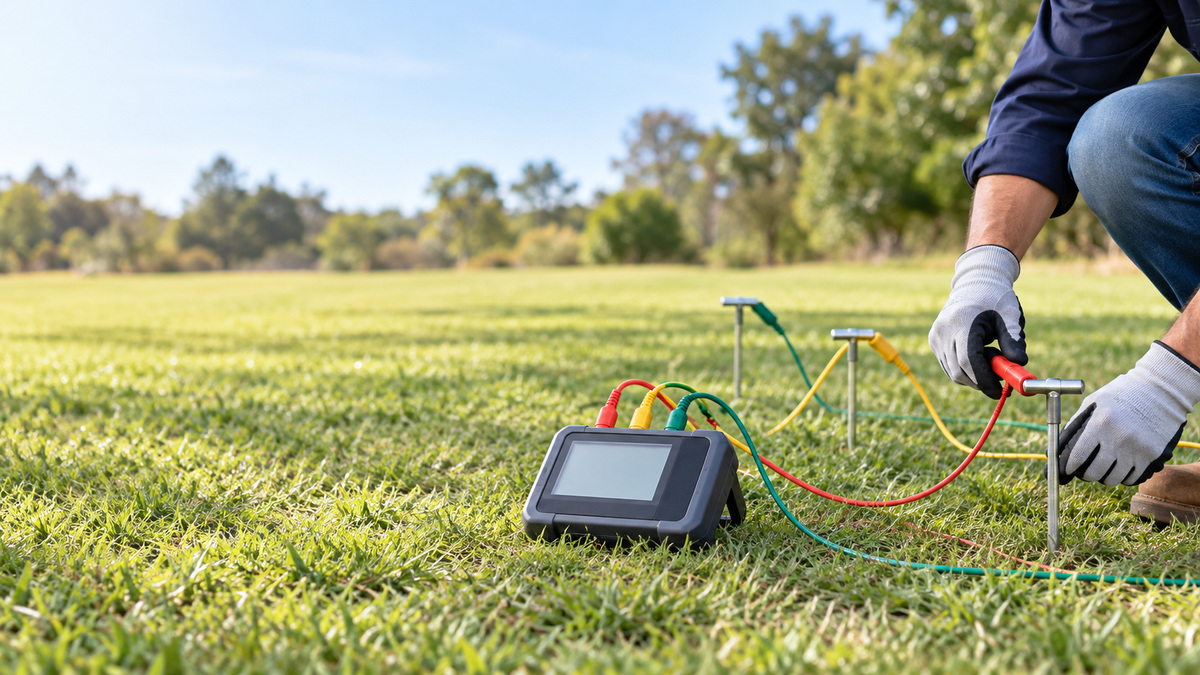
A staked earth resistance tester uses auxiliary rods and long test wires. You connect to the rod under test, drive two temporary stakes at a distance, take a reading, and often repeat at a second stake position. The listings here describe 3-wire measurements and simplified 2-wire measurements. Use staked testing when you install a new rod or when you need a direct rod-to-soil reading.
A clamp earth ground tester uses jaws that close around a ground conductor. It induces a signal and reads loop resistance without auxiliary stakes and without disconnecting the ground wire. The two clamp listings state loop-only measurement. That means you need a complete loop with more than one ground path. A single isolated rod with no return has no loop to measure.
Choose staked if you install rods, work in open soil, and can place leads. Choose clamp if you maintain multi-grounded systems, poles, towers, or buildings where disconnecting grounds is not practical. Many users need one of each over time, but buy the method that matches your first job.
2. Resistance range and resolution
Ground rods for homes and small buildings often read in the low tens of ohms, but dry, rocky, or frozen soil can push readings much higher. A wider range helps you see the actual value instead of an over-range indication.
The staked listings in this guide state up to 2000Ω, with one option stating three ranges at 20Ω, 200Ω, and 2000Ω and 0.01Ω precision on the low range. One staked listing states 0 Ohm – 4000 Ohm in its title. Check the listing for the exact switching and accuracy for each range before you buy, because low-range accuracy matters more than the top number.
The clamp options state 0.010Ω-200Ω with 0.001Ω resolution and 0.01Ω-500Ω with 0.001Ω resolution. Higher top values help on poor loops. Finer resolution helps when you compare bonds or track small changes. For a ground rod resistance tester used after rain versus drought, resolution and repeatability help you see trends.
3. Earth voltage indication and overload limits
Stray AC voltage on the ground can disturb a resistance reading and signal a wiring or system issue. Several staked units also list an earth-voltage function.
One listing states AC voltage test below 600V and DC voltage test below 1500V. Another states 0-30V AC earth voltage with overload protection stated as 300V AC for 1 minute on voltage and 200V AC for 10 seconds on resistance. A third states AC voltages up to 750V with 1V resolution. These are different capabilities. Do not assume they are interchangeable.
Read the manual for input limits, lead connections, and whether voltage must be checked before resistance. None of the listings in PRODUCT DATA state a CAT rating. The listing does not state a CAT rating for any pick in this guide, so do not call any of these meters safe for household mains based on this article. Confirm the rating in the listing or manual, match it to the circuit, and follow local rules.
4. Clamp jaw size and loop requirements for clamp models
A ground resistance tester clamp on tool must physically fit around the conductor or bus. One clamp listing states a Φ32mm jaw. The other states a 55mm x 32mm clamp jaw size, listed as 2.16” x 1.26”. Measure your ground rod, flat steel busbar, or stranded lead before ordering. A jaw that will not close fully will not give a valid reading.
Clamp models also depend on loop continuity. The listings state they measure loop resistance only, not single-point grounding. If you test poles with a continuous neutral, telecom sites with bonded grounds, or buildings with multiple electrodes tied together, a clamp check is fast. If you test one new rod before bonding, use a staked earth ground resistance meter instead.
Both clamp listings state 99 sets of data storage, automatic shifting, 0.5 second single measurement time, and measurement frequency above 1 kHz. One lists an alarm threshold setting range of 1Ω-199Ω with sound and light alarm. That alarm helps during repeat checks when you want a pass-or-fail cue.
5. Kit contents, leads, power, and field use
Staked kits live or die by leads and stakes. Two listings include 2 auxiliary ground rods, a 15M red test wire, a 10M yellow test wire, and a 5M green test wire. The third staked kit includes auxiliary earth bars, leads stated as 15m red, 10m yellow, 5m green for 3-wire plus 1.6m red and green leads for simple testing, batteries, a tool bag, and a manual. If you work alone, a bag, hold function, backlight, and clear E, P, C terminal markings reduce errors.
Power matters in the field. Listings state battery-powered operation with 6pcs 1.5V batteries, 4 PCS LR6 alkaline batteries at DC 6V, 6x AA 1.5V plus 1x 23A 12V, and 4 PCS 5 alkaline dry batteries. Carry spares. One listing states continuous working for 30 hours at ≤50mA power consumption. One states auto power off after 5 minutes without operation. Another states an LCD backlight that stays on for 30 seconds. Check the listing for battery type before you buy spares.
For related clamp work, see Best Clamp Meter and AC DC current clamp options. For outlet ground checks that do not replace rod testing, see open ground outlet tester guide and ground fault tester guide.
1. Earth Ground Resistance Tester 0.03-2000 ohm Meter,Upgraded Earth Resistance Tester Auto (Best overall)
Specs from the listing (checked 2026-10-10):
- Brand: DUOYI
- Power Source: Battery Powered
- Measurement Type: Ohmmeter, Voltmeter, Resistivity Meter
- Model: DY4100A
- Included Components: Earth Resistance Tester
Pros
- Lists 4 resistance ranges up to 2000Ω with voltage/resistance gear switching
- Includes 2 auxiliary rods plus 15M red, 10M yellow and 5M green wires and probes
- Lists one-button auto measurement plus data hold and LED backlight display
Cons
- Listing does not state a CAT rating, so mains suitability cannot be confirmed
- DC 1500V solar-voltage mention adds modes a ground-rod beginner may never use
Best for: New single-rod installs with open soil for full stake spacing
Skip if: You need a clamp loop check or cannot drive auxiliary stakes
View on Amazon (affiliate link)
2. ETCR2100A+ Digital Clamp Ground Earth Resistance Meter Tester 200Ω (Best clamp for tight loops)
Specs from the listing (checked 2026-10-10):
- Brand: ETCR
- Model: ETCR2100A+
- Resistance Range: 0.010Ω-200Ω
- Resolution: 0.001Ω
- Clamp Size: Φ32mm
Pros
- Lists 0.010Ω-200Ω range with 0.001Ω resolution and ±1%rdg ± 0.01Ω accuracy
- States Φ32mm clamp, 0.5 second measurement and automatic shift
- Lists 99 sets storage plus resistance alarm from 1Ω~199Ω
Cons
- Measures loop resistance only, not single-point grounding per listing
- 1160 g weight with case is heavier to hold overhead than smaller probes
Best for: Fast rechecks on bonded multi-ground loops without lifting leads
Skip if: You test a lone new rod with no return loop
View on Amazon (affiliate link)
3. Professional Digital Earth Ground Tester Kit – 2000Ω Resistance & 30V AC Voltage Meter | 3-Wire (Best kit for beginners)
Specs from the listing (checked 2026-10-10):
- Brand: VIVANTECH
- Model: VIDY4100
- Specification Met: Ul 61010-1, Iec 61010-2-030, Ce Marked, Rohs Compliant
- Item Weight: 3 pounds
- Item dimensions L x W x H: 5.8 x 3.9 x 2.4 inches
Pros
- Lists dual 0-2000Ω resistance and 0-30V AC earth-voltage functions
- Includes auxiliary bars, 3-wire and 1.6m simple leads, batteries and tool bag
- Lists IP54 equivalent casing, HOLD and E/P/C/V terminal markings
Cons
- 30V earth-voltage ceiling is lower than other staked picks in this guide
- 3 1/2 digit LCD shows less detail than 4-digit clamp displays here
Best for: First-time staked testing where leads, bag and markings matter
Skip if: You expect high stray earth voltage or need clamp testing
View on Amazon (affiliate link)
4. VC4105A Earth Resistance Tester Digital Grounding Resistance Meter 20/200/2000Ω Ground Resistance (Best for high voltage indication)
Specs from the listing (checked 2026-10-10):
- Brand: SKYCENX
- Model: VC4105A
- Measurement Type: Earth resistance tester
- Item Weight: 680 g
- Item Dimensions: 7.28 x 4.53 x 2.56 inches
Pros
- Lists 20/200/2000Ω ranges with 0.01Ω precision and 1999-count display
- States AC to 750V at 1V resolution plus NCV power detection
- Lists 7.28 x 4.53 x 2.56 inches, 680 g and dust/moisture resistant build
Cons
- Listing Specification Met shows [Basic] with no CAT rating to judge mains use
- Portable size still needs space to lay out long accessory leads
Best for: Sites where stray AC indication range matters alongside rod tests
Skip if: You need loop testing without stakes or a stated CAT rating
View on Amazon (affiliate link)
5. MS2302 Digital Earth Ground Resistance Tester with 2 Pole and 3 Pole Mode High Precision, 0 Ohm (Best for data logging)
Specs from the listing (checked 2026-10-10):
- Brand: Yachuang
- Model: MS2302
- Measurement Type: Ohmmeter
- Included Components: MS2302 earth ground resistance Tester
- Number of Items: 1
Pros
- Title states 0 Ohm – 4000 Ohm range with 2-pole and 3-pole modes
- Lists storage for up to 100 groups retained through power cuts
- Lists double insulation protection and REL relative measurement mode
Cons
- Listing does not state lead lengths, stake count or voltage function
- No clamp jaw, so bonded loops still need disconnects or another tool
Best for: Repeat maintenance rounds where stored readings matter
Skip if: You need a complete lead-and-stake kit stated up front
View on Amazon (affiliate link)
6. EITAI2000A-S Gen2 Clamp Ground Earth Resistance Meter Tester, 0.01Ω-500Ω, Manufacturer Direct Sales (Best extended clamp range)
Specs from the listing (checked 2026-10-10):
- Brand: EITAI
- Model: EITAI2000A-S
- Resistance Range: 0.01Ω-500Ω
- Resistance Resolution: 0.001Ω
- Clamp Jaw Size: 2.16” x 1.26” (55mm x 32mm)
Pros
- Lists extended 0.01Ω-500Ω range with 0.001Ω resolution for poor loops
- States 55mm x 32mm jaw for flat steel busbars and round rods
- Includes standard resistance ring, case and 99-group memory per listing
Cons
- Batteries not included due to import regulations per listing
- No earth-voltage function stated, unlike staked picks in this guide
Best for: Large busbars and high-reading loops needing wider clamp range
Skip if: You test single isolated rods or need staked verification
View on Amazon (affiliate link)
How to choose the right type for your job
Start with access. Can you drive two temporary stakes and run long leads in a straight line away from the rod? If yes, a staked earth resistance tester fits. If you face concrete, asphalt, frozen ground, buried utilities, or no space for stakes, the simplified 2-wire method or a clamp loop check may be the only practical option. Still confirm that the alternative method is valid for your grounding layout.
Next, define the system. A new single rod needs a staked test. A lightning conductor, agricultural distribution wire, or power-system ground listed in the DUOYI bullets also points to staked testing when you commission the electrode. An existing building, tower, or meter base with multiple bonded electrodes points to clamp rechecks. The ETCR listing states no need to break down grounding leads or use auxiliary electrodes for loop system measurements. The EITAI listing states no grounding lead breakage or auxiliary electrodes required. Both still require a loop.
Then compare ranges. For staked work on unknown soil, favor a unit that states 0-2000Ω or higher and clear low-range resolution. For clamp work on bonded systems, favor the 0.01Ω-500Ω extended range if your loops read high, or the 0.010Ω-200Ω range with 0.001Ω resolution if you track small changes. Do not compare a clamp loop reading directly with a staked rod reading. They measure different paths.
Check voltage functions last. If your site has mixed power, motors, or long signal grounds, earth voltage indication helps you spot stray voltage before you trust resistance. Match the stated voltage function and overload limits to the site. When in doubt, ask a licensed electrician and follow the instrument manual.
For stake-based Fluke-style workflows, see Best Ground Rod Tester Fluke. For wider earth meter comparisons, see Best Earth Tester Meter and Best Earth Ground Meter. For clamp-specific comparisons, see Best Earth Clamp Tester, Best AEMC clamp on ground resistance tester, and Best Fluke 1630 earth ground clamp.
Three buying scenarios
You drive a new rod for a shed, garage, or small outbuilding. You have open soil and can run leads. Choose a staked earth ground clamp tester alternative — meaning a staked tester, not a clamp — with 2 rods and 15m, 10m, and 5m leads, a hold function, and a backlight. Take readings at two stake spacings and keep notes.
You maintain several small commercial sites with bonded grounds and need fast rechecks without lifting leads. Choose a clamp earth ground tester with a jaw that fits your largest ground bar, 99 groups of memory, and an alarm band such as 1Ω-199Ω. Create an artificial loop near the electrode only as the manual directs if no natural loop exists.
You support farm, telecom, or lightning-protection grounds and need both resistance and earth voltage context. Choose a staked unit that lists both 0-2000Ω resistance and a stated AC earth-voltage range, plus IP54-style dust and moisture protection and clear terminal marks. Confirm battery types and carry a spare set.
Comparison table built only from listings
| Type and model hint | Resistance listing | Voltage listing | Jaw / leads listing | Power and display listing |
|---|---|---|---|---|
| DUOYI staked digital tester | 4 resistance ranges, up to 2000Ω | AC voltage test below 600V, DC voltage test below 1500V | 2 auxiliary rods, 15M red, 10M yellow, 5M green, 1 pair probes | 6pcs 1.5V batteries, LED backlight display, auto power off |
| ETCR clamp 200Ω | 0.010Ω-200Ω, 0.001Ω resolution | Measured current frequency 50/60Hz automatic | Φ32mm jaw | DC 6V from 4 PCS LR6, 4 digits LCD 47mm x 28.5mm, 99 sets storage |
| VIVANTECH staked kit | 0-2000Ω, ±2% rdg stated | 0-30V AC earth voltage | 15m red, 10m yellow, 5m green plus 1.6m red/green, auxiliary bars | 6x AA 1.5V plus 1x 23A 12V, 3 1/2 digit LCD, HOLD function |
| SKYCENX staked meter | 20Ω, 200Ω, 2000Ω ranges, 0.01Ω precision stated | AC voltages up to 750V, 1V resolution | Listing states meter and all accessories included | 7.28 x 4.53 x 2.56 inches, 680 g, backlight LCD to 1999, data hold |
| Yachuang staked tester | Title states 0 Ohm – 4000 Ohm | Listing does not state voltage range | Listing states MS2302 earth ground resistance Tester included | Large LCD display, stores up to 100 groups, REL mode |
| EITAI clamp 500Ω | 0.01Ω-500Ω, 0.001Ω resolution | Listing does not state earth-voltage function | 55mm x 32mm clamp jaw, 2.16” x 1.26” | 6V DC from 4 PCS 5 batteries, 4-digit LCD 47mm x 28.5mm, 99 groups |
The table uses only values that appear in the listings. Where a cell says the listing does not state a value, check the listing or manual before you assume the function exists.
Worked planning example with our planning estimate
This example helps you plan a staked test layout and battery spares. It does not change the resistance of your soil. It is our planning estimate, not a measurement result.
Suppose you test one rod behind a garage. You define: lead runs of 15m for the current stake, 10m for the potential stake, and 5m for the rod connection; two reposition checks; 0.5 second per clamp check if you add a clamp recheck later; and a crew of one person with one meter.
Step 1: Add total copper lead length laid out. 15m + 10m + 5m = 30m. Re-verify: 15 + 10 = 25, 25 + 5 = 30. Total is 30m.
Step 2: Convert 30m to feet for spacing sense. Use 1m = 3.28084 ft. 30 x 3.28084 = 98.4252 ft. Re-verify: 30 x 3 = 90, 30 x 0.28084 = 8.4252, 90 + 8.4252 = 98.4252. Total is about 98.43 ft.
Step 3: Estimate walking and setup time only, not electrical performance. Allow 4 minutes to drive two stakes, 3 minutes to run 30m of leads, and 2 minutes per reading for 3 readings. Setup is 4 + 3 = 7 minutes. Reading time is 3 x 2 = 6 minutes. Trip total is 7 + 6 = 13 minutes. Re-verify: 4 + 3 = 7, 3 x 2 = 6, 7 + 6 = 13.
Step 4: Check battery spares. If the meter uses 6pcs 1.5V batteries, total nominal voltage is 6 x 1.5V = 9V. Re-verify: 6 x 1 = 6, 6 x 0.5 = 3, 6 + 3 = 9. Carry one full spare set of 6 plus the 1.6m red/green simple-test leads if your kit includes them.
Use this layout to decide between kits. If you cannot run a 15m leg in a straight line clear of metal, pipes, and other grounds, do not force a staked test in a cramped trench. Switch to a valid clamp loop check or ask an electrician.
5 common mistakes with a ground resistance tester
1. Using a clamp meter on a single isolated rod
Clamp models in this guide measure loop resistance only. They cannot report single-point grounding by themselves. Testing a new rod before it is bonded to another ground gives a misleading open or over-range cue. Use a staked earth resistance tester for that first reading.
2. Assuming any meter is rated for mains contact
No pick in this guide states a CAT rating in the data given. The listing does not state a CAT rating. Do not touch live service conductors, busbars, or panel interiors with these testers unless the manual and listing confirm the rating and method. Panel and service work belongs to a licensed electrician. Follow the manual and local rules.
3. Placing stakes too close or in line with buried metal
Short spacing, loops of excess wire, or stakes driven next to pipes and fences distort staked readings. Use the full 15m, 10m, and 5m runs where possible, keep leads separated, and move the middle stake to confirm stability. If readings swing widely between positions, suspect interference or buried metal, not a meter fault.
4. Ignoring earth voltage before resistance
Measuring resistance while stray AC sits on the ground wastes time. Check the earth-voltage function first where provided, such as 0-30V, below 600V AC, or up to 750V AC depending on the model. If voltage is present and unexplained, stop and get qualified help. Do not exceed the stated overload limits such as 300V AC for 1 minute or 200V AC for 10 seconds where listed.
5. Comparing staked and clamp numbers as if equal
A 3-wire rod reading and a clamp loop reading cover different current paths. Soil moisture, bond quality, neutral continuity, and lead placement all shift results. Track staked readings against prior staked readings at the same spacing, and clamp readings against prior clamp readings on the same conductor. Note temperature, rain, lead lengths, and jaw position with each entry.
For insulation checks that are separate from grounding, see Best Insulation Resistance Tester. For AC load diagnostics that pair with grounding maintenance, see Best Fieldpiece SC680 Wireless Power Clamp Meter.
Care, storage, and safety notes
Follow the instrument manual and local electrical rules. This article is not a substitute for a licensed electrician. Never open panels, lift utility bonds, or drive stakes where utilities may be buried without proper locates and approval.
Keep leads straight, clean, and dry. Rinse mud from stakes, dry the kit before bagging, and store rods so tips stay sharp and straight. One listing notes an IP54 equivalent dustproof and wet-proof casing and a 0°C-40°C working range. Another notes a working environment of -20℃ to 55℃ at 20%rh to 80%rh. Another notes -10℃ to 55℃ at 10%RH to 90%RH. Store and use each meter only within its listed limits.
Check low-battery indicators before a trip. Listings describe LED and LCD battery warnings, a low-battery symbol below 5.3V on one clamp model, and auto-off to save power. Weak batteries cause unstable or low readings. Remove batteries for long storage if the manual directs, and confirm the exact cell types — AA 1.5V, LR6, 23A 12V, or size 5 alkaline — from your listing.
Measurement category comes from IEC classification of live circuits by available energy and impulse withstand. Category II covers circuits directly connected to the low-voltage installation, while Category IV covers measurements at the source of the high-voltage installation, with impulse withstand from 500V to 12,000V depending on category and voltage. Because none of these listings state a CAT rating, verify CAT and voltage in the manual and choose a different instrument or professional help when the circuit exceeds the rating. Sources: Measurement Category classification and IEC 61010-1 transient marking requirements.
FAQ
What does an earth ground resistance tester actually measure?
It measures resistance of the ground path, including the electrode, connections, and surrounding soil for staked tests, or the full loop for clamp tests. A lower, stable reading suggests a better path, but soil, moisture, and bonds change results. Compare like-for-like methods and record lead spacing and conditions.
Should I buy a staked earth resistance tester or a clamp model?
Buy staked if you install or verify single rods and can drive auxiliary stakes with 15m, 10m, and 5m leads. Buy a ground resistance tester clamp on unit if you recheck bonded multi-ground systems without disconnecting leads. Clamp models here measure loop resistance only and need more than one ground path.
Can a clamp earth ground tester test a new single ground rod?
No, not by itself. The clamp listings state loop-only measurement. For a lone rod with no return, there is no loop to read. Use a 3-wire staked test, or create an artificial loop only as the manual directs. When in doubt, use stakes or call an electrician.
What resistance value should I aim for?
Targets depend on your wiring rules, utility requirements, and equipment manual. This guide does not set a pass value because soil and system design vary. Ask the authority having jurisdiction or a licensed electrician, then track your own site over time with the same method and spacing.
Why do my readings change after rain?
Moisture lowers soil resistivity, while dry, frozen, or rocky soil raises it. Temperature, stake depth, lead placement, and nearby metal also shift results. Note weather, date, lead lengths, and jaw position each time so trends mean something.
Do I need true RMS or counts for ground testing?
True RMS and counts matter for multimeters measuring AC waveforms, but ground testers are judged by resistance range, resolution, earth-voltage function, and method. Compare 0.001Ω resolution, 0.01Ω precision, 99 or 100 groups of memory, and alarm bands instead. For general meter concepts, see Best Voltage Meter Tester.
How do I check the meter before a job?
Inspect jaws or terminals, leads, and stakes. Confirm battery type and charge, test the backlight and hold functions, and verify alarm and memory settings where listed. Confirm CAT rating, voltage limits, and fuse details in the manual. If anything is cracked, corroded, or unclear, do not use the meter on live circuits.
When should I call an electrician instead of testing myself?
Call when you see unexplained earth voltage, damaged conductors, loose bonds, or readings that swing widely. Panel interiors, service equipment, lightning damage, and any work that requires lifting utility or service bonds belong to a licensed electrician. Do not work on live panels as a beginner.
Bottom line
Choose by method first, then range. Pick a staked 0-2000Ω or wider earth ground resistance meter with full-length leads and rods if you install or prove single rods. Pick a Φ32mm or 55mm x 32mm clamp loop tester with 0.001Ω resolution and 99-group memory if you recheck bonded systems without breaking connections. If the listing does not state a CAT rating, do not use the meter on mains-level circuits, and leave panel or service work to a licensed electrician.
Sources
- Measurement category: CAT II vs CAT IV scope and impulse withstand voltages