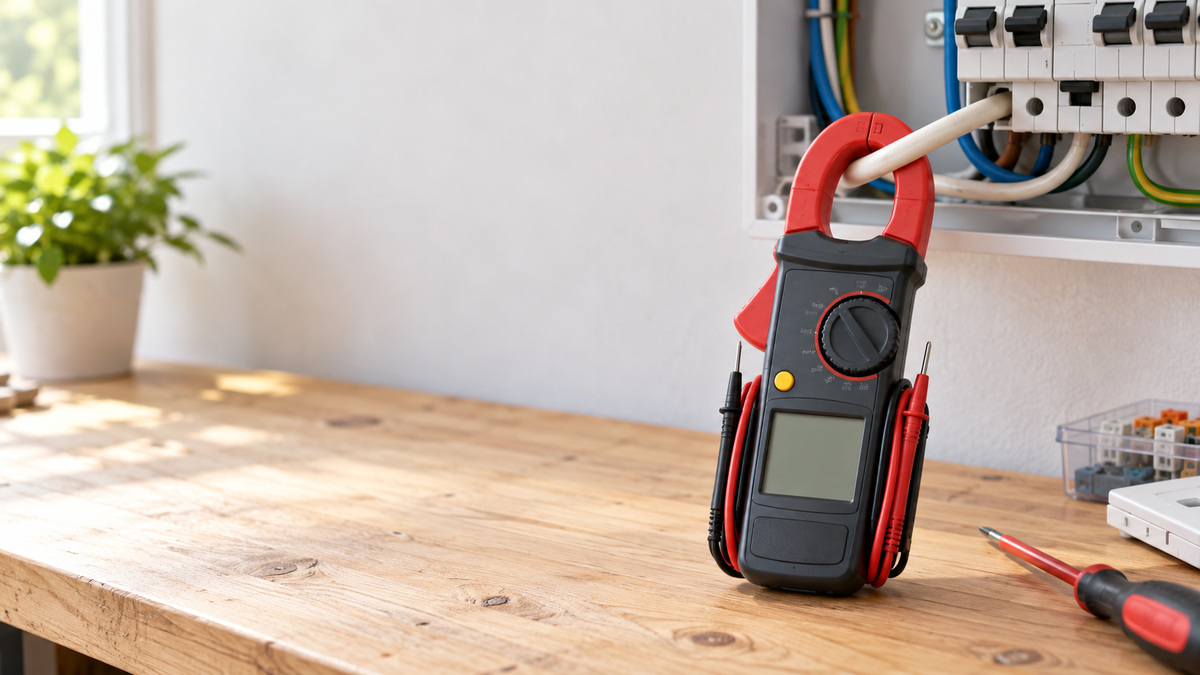
How Does a Current Clamp Work? Picks Explained
As an Amazon Associate we earn from qualifying purchases. Details
How does a current clamp work and which type should you buy for your task? This guide explains the sensing idea in plain terms, then helps you decide between a clamp meter with a display and a clamp probe that needs a separate meter or scope.
Work on mains circuits can kill. Use a meter with a CAT rating that suits the circuit, follow the instrument manual and local electrical rules, and leave panel or service work to a licensed electrician. This article is research help, not a substitute for a licensed electrician.
Quick answer
A current clamp measures current without breaking the circuit. You open the jaw, close it around one conductor, and read amps on the screen or on a connected meter. As a simplification, AC clamps sense the changing magnetic field around the wire, while DC-capable clamps add a sensor for steady fields. Choose a self-contained clamp meter for direct amp readings, and choose a clamp probe when you already own a compatible meter or oscilloscope. Check the listing for AC current, DC current, CAT rating, counts, and output type before you buy.
What matters when you ask how a clamp senses current
1. AC sensing vs DC sensing
An AC-only clamp responds to alternating current. A meter that lists AC/DC current can also read steady DC and battery-related loads. The distinction matters because many low-cost clamps cannot measure DC current.
The FNIRSI listing states AC/DC current up to 600A. The Klein listing states AC current and AC/DC voltage, with current through the clamp for AC. The AstroAI listing states it can not test DC Current and lists AC Current ranges of 2A/20A/200A/400A. The Hantek listing states an Effective Measurement Range of 20mA to 65A DC with frequency range up to 20 kHz. The ZIBOO listing describes an AC Current Clamp with 1 mV/A ac output. Match the listing to your load.
For more background, see How Do Clamp Meters Work and Can Clamp Meter Measure Dc Current.
2. Clamp meter vs clamp probe
A clamp meter has jaws, electronics, and a display in one tool. All three handheld meters here work that way. A clamp probe has jaws and an output cable but no amp display of its own.
The Hantek listing states Output: BNC connector and Compatible Devices: Multimeter, Oscilloscope. The ZIBOO listing states Compatible Devices: Multimeters, mV AC measurement tools and 1 mV/A ac output. If you want a direct amp number with no extra box, choose a clamp meter. If you want to view current on a scope or extend a meter you own, check probe compatibility in the listing. See What Does a Clamp on Ammeter Measure.
3. Range, counts, and resolution
Range tells you the largest current the clamp setting is meant to read. Counts describe display resolution on a digital meter. Neither tells you accuracy by itself.
The FNIRSI listing states 9999 Count and AC/DC current up to 600A. The Klein listing states Auto-Ranging 400 Amp AC. The AstroAI listing states 2000 Counts and AC Current ranges of 2A/20A/200A/400A. A higher maximum does not mean better low-current resolution. If you chase small DC drains or electronics loads, check the lowest range and the DC capability. The Hantek probe lists 20mA as the lower end of its effective range, which suits smaller currents better than a 600A-first design. Learn the measuring steps in How to Measure Current Using a Clamp Meter.
4. CAT rating and where you may use it
Measurement category classifies live circuits used in measurement and testing, usually in relation to a building. The categories take into account the total continuous energy available at the given point and impulse voltages. Measurement category II is for circuits directly connected to the low-voltage installation, while measurement category IV is for measurements at the source of the high-voltage installation. The required impulse withstand voltage varies from 500 V to 12,000 V depending on category and voltage.
Quote CAT and voltage only from the listing. The AstroAI specs state CAT.III 600V. The ZIBOO bullets state CAT III 600 V safety rating. The Klein package includes test leads with CAT III/CAT IV safety caps, but the listing excerpt does not state a separate meter CAT number, so check the listing and manual. The FNIRSI listing states Specification Met: Ul 61010-1, Ce Marked, Rohs Compliant without a CAT number in the excerpt, so the listing does not state a CAT rating. The Hantek excerpt does not state a CAT rating. Do not call a meter safe for household mains unless the listing states a suitable rating.
5. Jaw use, single conductor, and leads
The clamp jaw is for current only. Voltage, resistance, continuity, capacitance, and temperature need test leads or a separate probe. You must clamp around one conductor, not a whole two-wire cord, or the fields cancel and the reading will be wrong or near zero.
The FNIRSI note states voltage measurement must be performed with the test leads and the clamp jaws are for current measurement only. The AstroAI tips state to clamp around one of the wires and not the whole power cord, with the conductor in the center of the clamp head. The Klein bullets state it measures AC current and NCVT via clamp and AC/DC voltage, resistance, and continuity via test-leads. For step order, see How Do You Use a Clamp Meter and How to Use Clamp Meter to Measure Ac Current.
1. FNIRSI DMC-100 Clamp Meter 9999 Counts TRMS, 600A AC/DC Amp Meter (Best overall)
Specs from the listing (checked 2026-10-11):
- Brand: FNIRSI
- Unit Count: 9999 Count
- Item Weight: 6.72 ounces
- Item Dimensions: 7.7 x 2.91 x 1.14 inches
- Included Components: Clamp Meter*1, Multimeter Pen*2, Temperture Probe*1, Type-C Charging Cable*1
Pros
- States AC/DC current to 600A with TRMS and 9999 Count display
- 2-inch TFT with graphing plus 8 real-time and 30 historical records
- Includes test leads, temperature probe and Type-C cable with 1500mAh battery
Cons
- Excerpt does not state a CAT rating, so mains suitability is unproven
Best for: DIY and auto/RV users who want AC/DC amps plus graphing in one tool
Skip if: You need a stated CAT III/IV meter for mains or prefer AAA cells
View on Amazon (affiliate link)
2. Klein Tools CL120 Digital Clamp Meter, Auto-Ranging 400 Amp AC (Best for simple AC checks)
Specs from the listing (checked 2026-10-11):
- Brand: KLEIN TOOLS
- Model: CL120
- Item Weight: 9.76 ounces
- Item Dimensions: 8.45 x 3.51 x 1.51 inches
- Included Components: Digital Clamp Meter, AC Auto-Ranging 400 Amp
Pros
- Auto-ranging 400 Amp AC clamp with backlit LCD
- Measures AC/DC voltage and continuity via leads with NCVT in jaw
- Includes case, leads, instructions and 3 x AAA batteries
Cons
- Excerpt does not state DC current through the clamp
Best for: Homeowners wanting simple AC current plus lead-based voltage tests
Skip if: You need DC amps through the jaws
View on Amazon (affiliate link)
3. AstroAI Digital Clamp Meter Multimeter 2000 Counts Amp Voltage Tester Auto-ranging with AC/DC (Best stated CAT pick)
Specs from the listing (checked 2026-10-11):
- Brand: AstroAI
- Model: CM2K0R
- Unit Count: 1 Count
- Power: 1.5V AAA Batteries x 2 Included
- Dimensions: 195x68x29mm
Pros
- States CAT.III 600V with AC Current ranges 2A/20A/200A/400A
- Auto or manual range with 2000-count LCD, backlight and flashlight
- Includes leads, manual, bag and 1.5V AAA Batteries x 2
Cons
- Listing states it can not test DC Current
Best for: Beginners wanting a stated CAT III tool for basic AC work
Skip if: You need DC current measurement
View on Amazon (affiliate link)
4. Hantek CC-65 AC/DC Current Clamp Meter Transducer for Digital Multimeter Oscilloscope with BNC Type (Best scope probe)
Specs from the listing (checked 2026-10-11):
- Brand: Hantek
- Model: CC-65
- Weight:: 250 gram typical
- Dimensions:: 195 mm (H) x 70 mm (W) x 33 mm (D)
- Output:: 1m wire with a BNC connector
Pros
- Effective range from 20mA to 65A DC for small-current viewing
- BNC output on 1m wire for multimeter or oscilloscope
- 9mm max conductor with 9V battery power and LED warning
Cons
- Requires a separate meter or scope, no direct amp display
Best for: Scope owners who want current waveforms and small DC readings
Skip if: You want a standalone meter with built-in display
View on Amazon (affiliate link)
5. ZIBOO i600E 600Amp AC Current Clamp,4mm Banana Plug for Multimeters/mV AC Measurement Tools Perfect (Best mV-output probe)
Specs from the listing (checked 2026-10-11):
- Brand: ZIBOO
- Model: ZIBOO i600E
- Compatible Devices: Multimeters, mV AC measurement tools
- Specification Met: IEC 61010-1:2000-1
- Included Components: 1pcs AC Current Clamp
Pros
- Converts AC current to 1 mV/A for a compatible meter
- States CAT III 600 V and IEC 61010-1:2000-1 in excerpt
- Compact shape for tight spots without breaking the circuit
Cons
- AC-only accessory that needs an mV AC host meter
Best for: Meter owners who want to add AC amps without a new display
Skip if: You need DC amps or standalone readings
View on Amazon (affiliate link)
Clamp meters and clamp probes that show the differences
FNIRSI DMC-100 clamp meter with display and graphing
This is a handheld clamp meter with a 2-inch TFT display, 9999 Count display, and TRMS measurement. The listing states AC/DC current up to 600A plus voltage, resistance, capacitance, frequency, temperature, NCV detection, continuity, and diode checks.
Who it fits: a DIYer or auto/RV user who wants AC and DC current in one tool with on-screen graphing. The bullets state real-time data graphing, storage for 8 sets of real-time data plus 30 sets of historical records, and simultaneous voltage/current display. Included components are Clamp Meter1, Multimeter Pen2, Temperture Probe1, and Type-C Charging Cable1. Power comes from a built-in 1500mAh lithium battery with Type-C charging, and item weight is 6.72 ounces with item dimensions of 7.7 x 2.91 x 1.14 inches.
Limit: the excerpt does not state a CAT rating, only Ul 61010-1, Ce Marked, Rohs Compliant, so do not assume it suits household mains. Skip it if you need a stated CAT III or CAT IV meter for panel-adjacent work or if you want disposable AAA cells instead of recharging.
Klein Tools CL120 auto-ranging AC clamp meter
This is a battery-powered clamp meter focused on AC current through the jaw plus AC/DC voltage, resistance, and continuity through leads. The title states Auto-Ranging 400 Amp AC, and the bullets state auto-ranging selects the appropriate range.
Who it fits: a homeowner or apprentice who needs simple AC load checks with lead-based voltage tests. Details from the listing include a backlit LCD, Max and Data Hold, auto-power off after 10 minutes, test lead holder on the side, optional magnetic hanger support, NCVT integrated into the clamp jaw, and included carrying case, test leads, instructions, and 3 x AAA batteries. Item weight is 9.76 ounces and item dimensions are 8.45 x 3.51 x 1.51 inches.
Limit: the listing excerpt does not state DC current measurement through the clamp, so DC battery-drain users should look elsewhere. Skip it if you need DC amps through the jaws or a stated meter CAT number in the excerpt.
AstroAI CM2K0R 2000-count AC clamp meter
This is a compact auto-or-manual ranging clamp meter for AC current plus AC/DC voltage, capacitance, resistance, diode, continuity, and live-wire tests. The specs state CAT.III 600V, Pollution Level 2, and Altitude <2000m.
Who it fits: a beginner who wants a stated CAT.III 600V tool for basic AC current and voltage checks. Concrete details include AC Current ranges of 2A/20A/200A/400A, LCD Size of 35 x 25mm, Sampling Speed of 3 times per second, Data Hold, Max/Min, auto shut-off, low battery indicator, LCD backlit screen and flashlight, and Power from 1.5V AAA Batteries x 2 Included. Dimensions are 195x68x29mm and weight is Approx. 203g.
Limit: the listing states this model can not test DC Current. Skip it if you need DC amps, small DC parasitic-draw tests, or DC system analysis.
Hantek CC-65 BNC current probe for meters and scopes
This is not a standalone meter. It is a clamp transducer with a 1m wire and BNC connector for a digital multimeter or oscilloscope. The listing states Effective Measurement Range: 20mA to 65A DC and frequency range up to 20 kHz.
Who it fits: a hobbyist or student who already owns a compatible scope or meter and wants to view current waveforms or small DC currents. Details include captured conductor diameter of 9mm maximum, battery type of 9V DC, NEDA 1604, 6F22, 006P, red LED low-battery indicator, weight of 250 gram typical, dimensions of 195 mm (H) x 70 mm (W) x 33 mm (D), and storage temperature of -20℃~+70℃, 80% R.H.
Limit: it needs a separate display instrument, a 9V battery, and correct BNC input settings, and the excerpt does not state a CAT rating. Skip it if you want direct amp numbers with no extra gear or a stated mains CAT rating.
ZIBOO i600E AC probe with millivolt output
This is an AC-only clamp accessory that converts current to a small AC voltage for a meter to read. Bullets state 1 mV/A ac output, 600 mV ac range context, and a CAT III 600 V safety rating, with Specification Met: IEC 61010-1:2000-1.
Who it fits: someone who owns a compatible multimeter or mV AC tool and wants to add AC current without breaking the circuit. Details include Compatible Devices: Multimeters, mV AC measurement tools, compact shape for tight spots, and a design meant to take accurate current readings without breaking the circuit. The model is listed as ZIBOO i600E with 1pcs AC Current Clamp included.
Limit: it measures AC only and needs a host meter set to mV AC, so it is not a grab-and-read clamp meter. Skip it if you need DC current, a built-in display, or standalone use.
How to choose for this exact question
Start with the signal. For household AC loads, an AC clamp is enough. For car, RV, solar DC, or battery drain, you need a listing that explicitly states DC current. Do not assume DC support.
Then pick the form. Choose a clamp meter when you want jaws plus display in one hand. Choose a BNC or mV-output probe when you want waveforms on a scope or want to extend a meter you trust. Check connector type, output scaling, and host compatibility. The Hantek needs BNC. The ZIBOO needs mV AC input.
Check the current span. A 600A or 400 Amp top end suits appliance and feeder-style checks within its rating, but it will not resolve milliamps well. A 20mA lower bound suits small-current viewing. Compare the lowest range, not only the headline maximum.
Check safety markings. Look for CAT II, CAT III, or CAT IV plus volts in the listing and manual. If the listing does not state a CAT rating, treat the tool as unproven for mains and limit use to low-energy circuits described in the manual. Never open a panel to gain access.
Check leads and extras. Voltage always needs leads. NCV is a proximity alert, not a proof of absence. Data Hold, Max/Min, backlight, auto-off, and case affect ease more than sensing. Confirm battery type: built-in 1500mAh lithium with Type-C, 3 x AAA, 1.5V AAA Batteries x 2, or 9V DC.
For method refreshers, see How to Measure Amps with a Clamp Meter, How to Use a Clamp Ammeter, and How to Use a Amp Clamp.
Comparison table built only from the listings
| Model | Type | Current capability stated | Display / output | Safety marking in excerpt |
|---|---|---|---|---|
| FNIRSI DMC-100 | Clamp meter | AC/DC current up to 600A, 9999 Count, TRMS | 2-inch TFT, graphing, 1500mAh rechargeable | Ul 61010-1, Ce Marked, Rohs Compliant; no CAT stated |
| Klein CL120 | Clamp meter | Auto-Ranging 400 Amp AC | Backlit LCD, Max/Data Hold | Leads with CAT III/CAT IV safety caps; meter CAT not stated |
| AstroAI CM2K0R | Clamp meter | AC Current 2A/20A/200A/400A, 2000 Counts; cannot test DC Current | LCD 35 x 25mm, Data Hold, Max/Min | CAT.III 600V |
| Hantek CC-65 | Probe for meter/scope | 20mA to 65A DC, up to 20 kHz | 1m wire with BNC connector | No CAT stated |
| ZIBOO i600E | Probe for meter | AC Current Clamp, 1 mV/A ac output | Needs mV AC host meter | CAT III 600 V, IEC 61010-1:2000-1 |
Planning example: reading a millivolt-output AC probe
This worked case shows why output scaling matters. It is our planning estimate, not a meter specification.
Define the scenario once: you clamp a ZIBOO-style AC probe around one insulated 120 V branch conductor feeding a portable heater. The probe scaling is 1 mV/A ac output. Your host digital meter is set to mV AC and shows 11.8 mV AC.
Step 1: write the relation. Current equals meter voltage divided by scaling. Units: millivolts divided by millivolts per amp gives amps.
Step 2: insert values. 11.8 mV divided by 1 mV/A equals 11.8 A. Re-verify division: 11.8 / 1 = 11.8, unit becomes A.
Step 3: sanity check against range context. The probe description references a 600 mV ac range context, so 11.8 mV sits well below 600 mV. Re-verify subtraction for headroom: 600.0 − 11.8 = 588.2 mV remaining.
Step 4: check conductor fit and mode. Use one conductor centered in the jaw, clamp mode for current only, and leads only for voltage. Re-verify count of conductors inside jaw: 1, not 2.
Result: the planning estimate is about 11.8 A AC in this hypothetical. If your actual meter shows a different millivolt number, divide that number by 1 mV/A to get amps, then compare to the probe and host-meter limits in the manuals.
Three buying scenarios
You want one tool for home AC troubleshooting and basic voltage checks. Choose a self-contained AC clamp meter with a stated CAT rating that matches the circuit. The AstroAI lists CAT.III 600V and AC Current to 400A. Confirm lead ratings and manual limits. Leave breaker-panel interiors alone.
You want auto or RV DC work plus household AC. Choose a meter that explicitly lists DC current through the clamp. The FNIRSI lists AC/DC current up to 600A. Because its excerpt lacks a CAT statement, limit mains use until you verify the manual rating. Check whether rechargeable or AAA power suits you.
You own a scope or quality meter and want waveforms or small-current views. Choose a probe, not another display. The Hantek lists 20mA to 65A DC with BNC output for scope work. The ZIBOO offers AC-only 1 mV/A output for a mV AC host. Verify connector, scaling math, and host input range first.
Five common mistakes
Clamping the whole cord. A flat lamp cord or extension contains outgoing and return current together, so the net field cancels. Separate and clamp one conductor. The AstroAI tips warn to clamp one wire, not the whole power cord.
Using the jaw for voltage. Jaws sense current. For volts, ohms, continuity, or capacitance, connect the test leads as the FNIRSI note and Klein bullets describe. Check the manual diagram before touching probes to terminals.
Assuming every clamp reads DC. Many do not. The AstroAI cannot test DC Current, the Klein excerpt lists AC current via clamp, and the ZIBOO is AC only. Buy only when DC appears in the current spec.
Ignoring CAT and volts. A CAT number without volts is incomplete. AstroAI states CAT.III 600V and ZIBOO states CAT III 600 V. If a listing does not state a CAT rating, do not use that tool on household mains. Follow the manual and local rules.
Expecting NCV to prove a circuit dead. Non-contact detection is a first alert. It can miss shielded, deeply buried, or de-energized conductors and can trigger on nearby live parts. Confirm with proper lead-based tests per the manual and treat panel work as electrician work.
Care, limits, and safety notes
Store the tool dry within the stated limits. The Hantek lists storage at -20℃~+70℃, 80% R.H. The AstroAI lists working at 32°F~104°F and storage at 14°F~122°F with humidity limits. Follow those windows.
Keep jaws clean and closing fully. Dirt or a cracked jaw face can upset readings. Do not force the jaw around an oversized conductor. The Hantek caps conductor diameter at 9mm maximum. Check your meter’s jaw guidance in its manual.
Replace weak batteries promptly. Low supply can cause dim displays or odd readings. Types here differ: 1500mAh built-in lithium with Type-C, 3 x AAA, 1.5V AAA Batteries x 2 Included, and 9V DC for the probe. Use the specified type.
Respect category limits. IEC 61010-1 requires that transient withstand capability be made known to the user. If you cannot find CAT and volts for your exact circuit, stop and check the listing and manual or ask a licensed electrician. Never improvise high-energy measurements.
FAQ
How does a current clamp work without touching copper?
As a simplification, the closed jaw forms a magnetic path around one conductor. AC current creates a changing field that the clamp converts to a reading. DC-capable clamps add a steady-field sensor. You get an amp number without stripping insulation or breaking the circuit. Follow the manual for range, jaw position, and limits.
Why must I clamp only one wire?
Each current-carrying wire makes its own field. In a normal cord, the out-and-back fields oppose and cancel at the jaw, so the meter sees little or nothing. Separate the conductors and center one conductor in the jaw. See How to Use a Cen Tech Digital Clamp Meter.
Can a clamp meter measure DC current?
Some can, many cannot. Check the current spec line. The FNIRSI lists AC/DC current up to 600A and the Hantek lists 20mA to 65A DC, while the AstroAI states it cannot test DC Current. If DC is not listed, assume the clamp is AC only.
What is the difference between a clamp meter and a current probe?
A clamp meter displays amps itself. A probe sends a signal to another instrument. The Hantek uses a BNC connector to a scope or meter, and the ZIBOO gives 1 mV/A to an mV AC host. If you do not own a compatible host, buy the meter style.
What do counts and auto-ranging mean?
Counts describe display resolution steps on a digital meter, such as 9999 Count or 2000 Counts. Auto-ranging means the meter picks the range for you. Higher counts do not equal higher accuracy. Check the accuracy line, lowest range, and manual for your task.
What CAT rating do I need for home outlets?
Match or exceed what the manual requires for that circuit, and check both category and volts. The AstroAI states CAT.III 600V and the ZIBOO states CAT III 600 V. If the listing does not state a CAT rating, do not assume mains safety. Panel and service areas belong to a licensed electrician.
Why does my clamp read zero on a power cord?
You likely clamped both conductors of the cord at once. The opposing currents cancel. Clamp a single conductor, center it, close the jaw fully, and select the correct AC or DC current mode. If it still reads zero, check range, battery, and manual troubleshooting.
Bottom line
If you want to learn by doing with one tool, match the signal first, then the form. Need AC plus DC in one display? Shortlist only listings that state DC current through the clamp. Need scope waveforms or tiny DC views? Pick a compatible BNC or mV-output probe and confirm scaling. Need basic home AC checks? Pick a meter with a stated CAT III rating that covers the circuit. When the listing does not state a CAT rating, check the manual before any mains use.
Sources
- Measurement category: supports CAT definitions, II vs IV use, impulse voltages 500 V to 12,000 V, and IEC 61010-1 marking rule