Test an Electrical Outlet With a Multimeter Safely
As an Amazon Associate we earn from qualifying purchases. Details
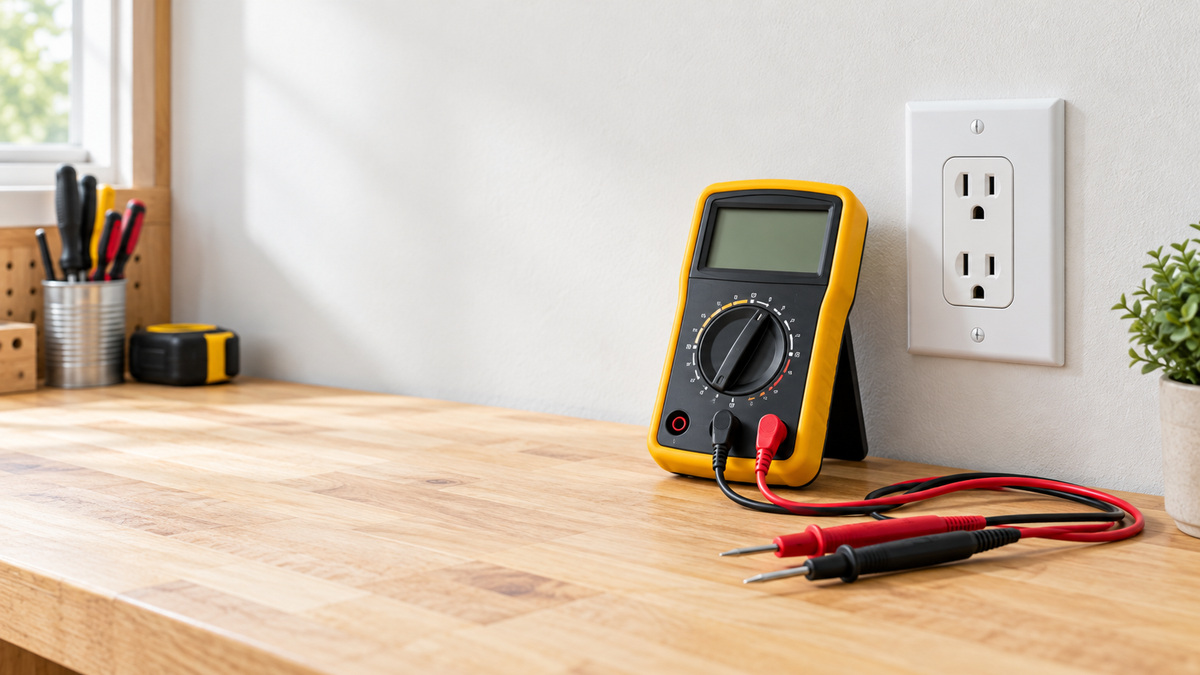
Testing an outlet with a multimeter means setting the meter to AC volts and measuring between the slots, then between each slot and the ground hole. Those readings show whether the receptacle is energized and wired as expected. Mains circuits can kill, so confirm the meter’s CAT rating suits the circuit before you insert a lead into any slot, and keep your fingers behind the probe guards.
The method below also explains what an unexpected reading can point to, including why a GFCI outlet or an odd pattern of readings calls for more care. When the problem seems to lie in the panel, the wiring, or a larger appliance circuit, pass the work to a licensed electrician.
Quick answer
If you want to use a multimeter to test an outlet, choose a kit with both a meter and a plug-in outlet tester for standard receptacles. The Klein 3-piece kit and the chelectnis 3-piece kit fit that need because each listing includes a multimeter, a non-contact tester, and an outlet tester. For meter-only measurements, choose by CAT rating and voltage range stated in the listing. The Fluke 17B+ states CAT III 600V and AC/DC voltage to 1000V, while the ZMIWNIED FS899L states Cat.III 1000V, Cat.IV 600V. Never open a panel to test a large-appliance outlet unless you are qualified; ask an electrician.
What matters when you test an outlet
A meter for outlet work must measure AC voltage in the range you will check. Listings here state up to 600V AC/DC voltage or up to 1000V. Check the listing for the exact AC voltage function before you buy, and follow the instrument manual and local electrical rules.
CAT rating must suit the circuit. Measurement category is a method of classification by the International Electrotechnical Commission of live electric circuits used in measurement and testing. Categories account for continuous energy and impulse voltages at the point of measurement. The required impulse withstand voltage varies from 500 V to 12,000 V across categories. If the listing does not state a CAT rating, do not call the meter safe for household mains. This article is not a substitute for a licensed electrician.
Display counts affect resolution. A 1999 counts display, a 4000 counts display, and a 6000 counts display show different levels of detail. Counts alone do not mean accuracy. For outlet voltage checks, a basic display can help distinguish a dead receptacle from a live one or identify a reading that needs an electrician.
Manual-ranging or auto-ranging changes ease of use. Auto-ranging selects the range for you. Manual-ranging requires you to turn the dial to the correct voltage range. If you are new, auto-ranging or smart auto mode reduces dial errors. If you want to How to Use Multimeter on Outlet, start with a meter that sets AC volts with one step.
A plug-in outlet tester speeds up wiring checks. A multimeter reads volts between contacts. A receptacle tester plugs in and lights a pattern for open ground, open neutral, or reversed wires. Kits that include both let you use multimeter to check outlet voltage and then confirm wiring without moving leads. For GFCI receptacles, a tester with a test button is useful.
1. Klein Tools 69149P Electrical Test Kit, 3 Piece (Best kit for first outlet check)
Specs from the listing (checked 2026-10-10):
- Brand: KLEIN TOOLS
- Model: 69149P
- Item Highlight: With Digital Multimeter, Non-Contact Voltage Tester and Electrical Outlet Tester, Leads and Batteries Included
- Compatible Devices: Klein Tools MM320, NCVT1XT, RT110
- Item Weight: 15.04 ounces
- Item Dimensions: 3.5 x 0.9 x 6 inches
Pros
- Includes MM320 meter plus NCV tester and RT110 receptacle tester in one box
- States up to 600V AC/DC voltage and 10A DC current for household checks
- NCV pen signals 50 to 1000 VAC with LED and tone before probe contact
Cons
- Manual-ranging meter requires you to set the range yourself
- Listing does not state a CAT rating for mains work
Best for: First-time homeowners who want voltage plus plug-in wiring indication
Skip if: You want auto-ranging or need a stated CAT rating for mains circuits
View on Amazon (affiliate link)
2. Electrical Test Kit -Multimeter,Non Contact Voltage Tester,Outlet Tester (Best auto-ranging kit)
Specs from the listing (checked 2026-10-10):
- Brand: chelectnis
- Item Highlight: Digital Auto-Ranging AC/DC Voltage,Current,Continuity,Resistance,Frequency,Breakpoint Finder,DIY Household Tools
- Compatible Devices: Digital Multimeter (SZ303), Non-Contact Voltage Tester (B15), Outlet Socket Tester (AC27)
- Specification Met: Ul 61010-1, Ce Marked
- Number of Items: 1
Pros
- Auto-ranging SZ303 lists AC/DC Voltage 600V and 1999 counts backlit display
- B15 pen lists 24V-250V AC detection with breakpoint finder and flashlight
- AC27 tester lists 6 wiring faults plus 6mA RCD test at 250V 50/60Hz
Cons
- Socket tester 250V rating does not extend to higher-voltage appliance circuits
- Listing does not state a CAT level in words
Best for: DIYers who want auto-ranging and a 6-fault socket tester
Skip if: You need to work on higher-voltage appliance circuits or need a stated CAT rating
View on Amazon (affiliate link)
3. Fluke 17B+ Digital Multimeter, for Electrical Applications, Measures AC/DC Voltage 1000V, Current (Best overall meter with stated CAT)
Specs from the listing (checked 2026-10-10):
- Brand: Fluke
- Model: Fluke-17B+
- Specification Met: Cat Iii 600v
- Item Weight: 470 g
- Item Dimensions: 8.46 x 2.76 x 5.91 inches
- Included Components: 17B+ Digital Multimeter with TL75 Test Leads and K-Type Thermocouple Assembly
Pros
- States CAT III 600V safety rating for residential and commercial settings
- States AC/DC voltage to 1000V and current to 10A with TL75 leads included
- Includes K-type thermocouple with temperature to 400C plus capacitance and frequency
Cons
- No plug-in outlet tester in the box for automatic wiring lights
- Larger body at 470 g and 8.46 x 2.76 x 5.91 inches for tight spaces
Best for: Buyers who want a stated CAT rating and wide voltage range
Skip if: You want a plug-in receptacle tester or NCV pen included
View on Amazon (affiliate link)
4. 2026 Upgraded FS899L Digital Multimeter, 6000 Counts True RMS Auto-Ranging AC/DC Voltage Tester (Best True RMS pick)
Specs from the listing (checked 2026-10-10):
- Brand: ZMIWNIED
- Specification Met: Cat.iii 1000v, Cat.iv 600v
- Measurement Type: Multimeter
- Style Name: modern
- Part Number: FS899L-1
Pros
- States Cat.III 1000V and Cat.IV 600V with dual ceramic fuses
- States 6000-count True RMS auto-ranging for AC/DC volts, current, resistance, capacitance
- Lists 4.8-inch color screen and USB-C 2-hour charge with alligator clips
Cons
- Feature-rich interface can overwhelm a first-time outlet checker
- Listing does not state lead voltage ratings in the provided fields
Best for: Users who want True RMS, high counts, and high stated CAT levels
Skip if: You want a simple meter or an included plug-in outlet tester
View on Amazon (affiliate link)
5. TM-510 Digital Multimeter, 4000 Counts, Smart Measurement, Auto-Ranging Voltmeter; Voltage Tester (Best simple smart meter)
Specs from the listing (checked 2026-10-10):
- Brand: TESMEN
- Model: TM-510
- Display: 4000 counts
- AC Voltage: 0.8V~600V; ±(1.2%+5)
- DC Voltage: 0.8V~600V; ±(1.0%+5)
- Included Components: 1*TM-510 Multimeter; 2*Test Leads; 2*AAA Batteries; 1*Storage Bag; 1*User Manual
Pros
- Smart Auto Mode switches AC/DC voltage, resistance, and continuity without manual ranging
- Lists 4000 counts display with 0.8V~600V AC and DC ranges
- Includes test leads, 2 AAA batteries, storage bag, and manual at 0.1 kg
Cons
- Note states CAN'T MEASURE CURRENT, so no current troubleshooting
- CAT II 600V is lower than CAT III/IV and not for panels or service gear
Best for: Beginners who want simple AC voltage and continuity checks
Skip if: You need current measurement or higher-category mains protection
View on Amazon (affiliate link)
6. Circuit Breaker Finder Kit, Electrical Circuit Tracer with Digital Multimeter, GFCI Outlet Tester (Best for breaker finding)
Specs from the listing (checked 2026-10-10):
- Brand: KUYTN
- Style: Industry
- Included Components: adapter
- Power Source: Battery Powered
- Part Number: V100X
Pros
- Combines breaker finder, GFCI outlet tester, and multimeter in one carrying case
- States up to 600V detection with AC/DC voltage, continuity, capacitance, and NCV
- Model 2027 notes max 300V detection supported for GFCI tester functions
Cons
- Listing does not state CAT rating, counts, or fuse ratings for mains judgment
- Title and spec model wording differ, so confirm contents on the listing
Best for: Users who also need to locate the breaker feeding an outlet
Skip if: You need a stated CAT rating or a meter-only workflow
View on Amazon (affiliate link)
Picks for testing outlets
Klein 3-piece kit with multimeter and receptacle tester
This is a 3-piece test kit for homeowners who want one box for receptacle work. The listing names the set as Klein Tools 69149P Electrical Test Kit, 3 Piece and lists Compatible Devices as Klein Tools MM320, NCVT1XT, RT110. The Item Highlight states With Digital Multimeter, Non-Contact Voltage Tester and Electrical Outlet Tester, Leads and Batteries Included. That combination fits someone who wants to measure voltage and then plug in a tester to confirm wiring faults.
Three specifics come from its listing. It Measures up to 600V AC/DC voltage, 10A DC current, and 2MOhms resistance. It includes NCVT1P with bright red LED and audible tone for detecting voltage in the range of 50 to 1000 VAC. It includes Cat. No. RT110 that detects wiring configurations, indicates correct wiring, and identifies common wiring faults. Item Weight is listed as 15.04 ounces, and Item Dimensions are listed as 3.5 x 0.9 x 6 inches.
The limit is ranging. Included Components lists Manual-Ranging Multimeter, so you must set the range yourself. The listing does not state a CAT rating in the fields provided, so do not assume mains suitability from the brand alone. Skip this kit if you want auto-ranging or if you need a stated CAT rating for mains work. Check the listing and manual before you measure.
chelectnis 3-piece kit with auto-ranging meter
This kit fits renters and DIYers who want auto-ranging plus a socket tester. The title states Electrical Test Kit -Multimeter,Non Contact Voltage Tester,Outlet Tester. The Item Highlight states Digital Auto-Ranging AC/DC Voltage,Current,Continuity,Resistance,Frequency,Breakpoint Finder,DIY Household Tools. Compatible Devices lists Digital Multimeter (SZ303), Non-Contact Voltage Tester (B15), Outlet Socket Tester (AC27).
Three specifics come from its listing. The SZ303 measures AC/DC Voltage (600V), AC/DC Current (10A), Resistance (20MΩ), Frequency (2MHz), and Diode with 1999 counts high resolution backlit display. The B15 non-contact tester detects 24V-250V AC voltage without touching wires. The AC27 socket detector identifies 6 wiring faults with 250V 50/60Hz rating and 6mA RCD leakage test button. Specification Met lists Ul 61010-1, Ce Marked.
The limit is outlet voltage scope. The socket tester rating is 250V 50/60Hz, so it does not cover a higher-voltage appliance receptacle by itself. Skip this kit if you need to test appliance-circuit receptacles at the panel or need a stated CAT level; the listing does not state a CAT rating in words. Check the product listing for lead ratings and manual steps.
Fluke 17B+ digital multimeter
This meter fits a buyer who wants a single meter with a stated CAT rating and temperature. The title states Fluke 17B+ Digital Multimeter, for Electrical Applications, Measures AC/DC Voltage 1000V, Current Measurements to 10A. Included Components lists 17B+ Digital Multimeter with TL75 Test Leads and K-Type Thermocouple Assembly. Item Weight is listed as 470 g, and Item Dimensions are listed as 8.46 x 2.76 x 5.91 inches.
Three specifics come from its listing. Specification Met is Cat Iii 600v. The bullets state AC/DC Voltage and Current Measurements up to 1000V and 10A. Temperature measurement is listed with included type K thermocouple up to 400C. Resistance, continuity, capacitance, diode test, and frequency are also listed functions.
The limit is no plug-in tester. You get voltage readings but no automatic wiring-fault lights. You must place probes correctly and read the display. Skip this meter if you want a one-plug wiring indication or a non-contact pen in the same box; the listing does not list those parts. Pair it with guidance from How to Test an Outlet with a Multimeter and follow the manual.
ZMIWNIED FS899L True RMS meter
This meter fits someone who wants True RMS, high counts, and a stated high CAT level. The title states 2026 Upgraded FS899L Digital Multimeter, 6000 Counts True RMS Auto-Ranging AC/DC Voltage Tester. Specification Met states Cat.iii 1000v, Cat.iv 600v. The bullets state dual ceramic fuses and full-range overload protection.
Three specifics come from its listing. True RMS technology and a 6000-count resolution are stated for AC/DC voltage, current, resistance, and capacitance. The display is described as 4.8-inch high-definition color screen. Power is described as USB-C rechargeable design with fast 2-hour charge for a full day of continuous field use. NCV detection, continuity, frequency, and live wire functions are also listed.
The limit is complexity for first-time users. A color screen and many modes do not replace safe probe practice. The listing does not state lead voltage ratings in the fields provided, so check the listing. Skip this meter if you want a simple two-lead voltage check or a plug-in outlet tester included. It suits a careful beginner who will read the manual first.
TESMEN TM-510 smart meter
This meter fits car owners and homeowners who want simple AC voltage checks without dial errors. The title states TM-510 Digital Multimeter, 4000 Counts, Smart Measurement, Auto-Ranging Voltmeter. The Function field states Measure AC/DC Voltage, Risistent, Continuity. Display is listed as 4000 counts. Sampling is listed as approx. 3 times / second.
Three specifics come from its listing. AC Voltage is listed as 0.8V~600V; ±(1.2%+5). DC Voltage is listed as 0.8V~600V; ±(1.0%+5). Safety Guarantee in bullets states CAT II 600V, CE, and RoHS certified. Included Components lists 1TM-510 Multimeter; 2Test Leads; 2AAA Batteries; 1Storage Bag; 1*User Manual. Item Weight is listed as 0.1 kg.
The limit is current. The Note field states CAN’T MEASURE CURRENT. That is fine for outlet voltage but not for current troubleshooting. CAT II 600V is a lower measurement category than CAT III or CAT IV, so check whether it suits your circuit and do not use it on panels or service equipment. Skip this meter if you need 10A current or higher-category protection. Learn the basics at Best Testing Ac Voltage with a Multimeter.
KUYTN 3-piece diagnostic set
This set fits someone who wants breaker finding plus outlet verification in one case. The title states Circuit Breaker Finder Kit, Electrical Circuit Tracer with Digital Multimeter, GFCI Outlet Tester, 3-Piece Electrical Diagnostic Tool Set with LCD Display, NCV. Included Components lists adapter. The bullets state Supports up to 600V Detection and Supports a wide range of measurements, including AC/DC voltage, DC, resistance, capacitance, diodes, transistors, continuity, battery voltage, and NCV detection.
Three specifics come from its listing. The upgraded Model 2027 is described with max 300V detection supported for GFCI testing functions. The kit combines a circuit breaker finder, a GFCI outlet tester, and a digital multimeter into a single portable carrying case. Power Source is listed as Battery Powered, and Style is listed as Industry.
The limit is unclear ratings. The listing does not state a CAT rating, counts, or fuse ratings in the fields provided, so you cannot judge mains suitability from the listing alone. The title and specs use different model wording, so confirm what you receive. Skip this set if you need a stated CAT rating or a simple meter-only workflow. Check the product listing and manual for voltage limits before you measure.
How to choose for this task
Start with the receptacle type. A standard duplex receptacle needs AC voltage and a wiring check. A GFCI receptacle needs a tester that can trip and reset it. A dryer or range receptacle may need a check at the receptacle face, not inside the panel. If you are not trained for higher-voltage circuits, do not proceed; ask a licensed electrician. You can review tester-only steps at How to Test an Outlet with a Voltage Tester.
Decide between meter-only and kit. Meter-only gives numbers. Kit gives numbers plus plug-in fault lights and non-contact detection. If you want to use a multimeter to test an outlet for the first time, a kit reduces probe handling. If you already own a receptacle tester, a meter-only pick with a stated CAT rating may be enough. See also Best Digital Multimeter for Home Use for household context.
Match CAT and voltage to the job. The listing must state the CAT rating and voltage rating. Do not borrow a meter rated only for electronics for a receptacle. If the listing does not state a CAT rating, write that down as unknown and choose another meter for mains work. IEC 61010-1 requires that the transient withstand capability is made known to the user, so the manual should state it.
Check counts, ranging, and leads. For outlet work, 1999 counts to 6000 counts all work; higher counts do not make an unsafe meter safe. Auto-ranging helps beginners. Confirm that leads and batteries are included. The Klein listing states Leads and Batteries Included, the TESMEN listing lists 2*AAA Batteries, and the LJPXHHU-style basic meters may list different parts, so verify each listing.
Plan safe access. You need clear light, dry hands, intact probe insulation, and space to stand to the side. Do not touch metal probe shafts. Do not measure with cracked leads. If the receptacle is damaged, hot, or scorched, stop and call an electrician. For background on live conductors, read How to Test a Live Wire with a Multimeter and Best Multimeter Check Live Wire.
| Pick | What is in the box per listing | Voltage / current stated | Display / ranging stated | Safety / rating stated |
|---|---|---|---|---|
| Klein 69149P kit | Digital multimeter, non-contact tester, outlet tester, leads and batteries included | Up to 600V AC/DC voltage, 10A DC current, 2MOhms resistance | Manual-ranging multimeter | Listing does not state a CAT rating |
| chelectnis MT01 kit | SZ303 multimeter, B15 NCV pen, AC27 outlet tester, AAA batteries, manual, bag | AC/DC Voltage 600V, AC/DC Current 10A, Resistance 20MΩ, Frequency 2MHz | 1999 counts, Digital Auto-Ranging | Ul 61010-1, Ce Marked; socket 250V 50/60Hz, 6mA RCD test |
| Fluke 17B+ | 17B+ meter with TL75 leads and K-type thermocouple | AC/DC voltage 1000V, current to 10A | Digital multimeter, 8.46 x 2.76 x 5.91 inches | Cat Iii 600v |
| ZMIWNIED FS899L | Meter, manual, alligator clips per bullets; USB-C rechargeable | AC/DC voltage, current, resistance, capacitance | 6000 Counts True RMS Auto-Ranging, 4.8-inch color screen | Cat.iii 1000v, Cat.iv 600v, dual ceramic fuses |
| TESMEN TM-510 | Meter, 2 test leads, 2 AAA batteries, storage bag, manual | AC Voltage 0.8V~600V, DC Voltage 0.8V~600V | 4000 counts, Smart Auto Mode | CAT II 600V, CE, RoHS; can’t measure current |
| KUYTN V100X set | Breaker finder, GFCI outlet tester, digital multimeter, adapter, case | Supports up to 600V detection; Model 2027 max 300V detection supported | LCD display, NCV | Listing does not state a CAT rating |
It does not change safety.
Suppose you expect about 118.0V AC at a standard receptacle and your meter shows 117.8V. Suppose the same receptacle later reads 112.5V under load from a space heater on the same branch. Define drop as first reading minus second reading.
Step 1: first reading = 117.8 V. Step 2: second reading = 112.5 V. Step 3: drop = 117.8 V − 112.5 V = 5.3 V. Step 4: percent drop = 5.3 V ÷ 117.8 V = 0.04499. Step 5: convert to percent: 0.04499 × 100 = 4.499%, about 4.5%.
A 4000 counts display can show 117.8, while a 1999 counts display may show 118 or 117 depending on range. If you see 0V, repeated low volts, or volts between ground and neutral that look wrong, stop and call an electrician. Do not open the panel to chase the drop yourself.
5 common mistakes
Measuring with the wrong dial setting causes confusion or damage. Set the meter to AC voltage, not DC volts, resistance, or current, before touching a receptacle. If the meter is manual-ranging, select a range above the expected volts, such as a 600V AC range for a standard outlet. Check the listing for the exact dial labels.
Pushing probes too shallow gives 0V on a live outlet. Insert probes straight until the tips contact the metal inside the slots. Do not wiggle sideways or touch both tips together. If you use a non-contact pen first, remember it only signals presence of voltage in its stated range, such as 50 to 1000 VAC or 24V-250V AC depending on model.
Testing a GFCI or large-appliance receptacle like a standard duplex leads to errors. A GFCI needs a wiring check plus a trip test. A dryer receptacle has different slots and higher energy. Beginners should not remove covers or touch panel breakers to reach those contacts. For related checks, see Best Test Circuit Breaker with Multimeter.
Ignoring the CAT rating puts you at risk during a surge. A meter without a stated CAT rating is not proven for mains use. A CAT II 600V meter is not the same as CAT III 600V or CAT IV 600V. Measurement category IV is for measurements at the source of the high-voltage installation, while category II is for circuits directly connected to the low-voltage installation. Choose the category your manual allows.
Using damaged leads or skipping the manual wastes the meter’s protection. Check probe insulation, fuse ratings, and input jacks before each use. Keep one hand clear where possible and wear eye protection in line with the manual. If anything smells hot or looks burned, stop and call a licensed electrician. General circuit background is at Best Testing Electrical Circuits with Multimeter.
FAQ
Can I use a multimeter to test an outlet without turning off power?
Yes for a voltage check, because the meter needs the circuit live to read volts. Keep the meter on AC voltage, hold probes by the insulated handles, and do not touch metal. If you feel unsure, use a plug-in tester first or ask an electrician. Follow the manual.
How do I use multimeter to check outlet voltage on a standard receptacle?
Set the dial to AC voltage with a range above expected volts. Put one probe in the left slot and one in the right slot to read hot to neutral. Then check hot to ground and neutral to ground. A missing or odd reading points to a wiring fault. Stop if the device is damaged.
What should the reading be?
The manual and your utility nominal voltage decide what is normal. Look for a steady reading close to nominal, not an exact number from this article. A 0V reading, a very low reading, or a reading that jumps around means the receptacle or circuit needs attention. Call an electrician if you see damage or heat.
Can I test a large-appliance outlet with multimeter as a beginner?
You can read about it, but do not open panels or remove covers as a beginner. A large-appliance receptacle carries more energy and has different slot layouts than a standard duplex. If the dryer or range receptacle is dead or shows burn marks, leave breakers alone and call a licensed electrician. Extra context is at Test 220 Outlet.
Is test 220V outlet with multimeter the same as testing a large-appliance outlet?
The terms often refer to the same type of large-appliance circuit, with nominal voltage varying by system. The safe approach is the same: measure only at the receptacle face if you are qualified to do so, with a meter rated for that circuit. Never work inside the panel. Ask an electrician for panel or service checks.
Do I need True RMS for outlet checks?
Not for a basic live or dead check. True RMS matters more when loads distort the waveform, such as dimmers or some electronics. The ZMIWNIED listing states True RMS with 6000 counts, while basic meters do not. Choose True RMS if you will also diagnose electronics or HVAC controls.
Why does my non-contact tester beep but the meter reads 0V?
The pen may sense voltage in nearby wires or through a high-impedance path, while the meter probes may not be contacting metal. Re-seat probes fully in the slots. The Klein pen lists 50 to 1000 VAC detection, and the chelectnis pen lists 24V-250V AC, so each pen has its own range. If doubt remains, stop and get help.
When should I stop and call an electrician?
Stop if you see sparks, heat, smoke, buzzing, scorched slots, loose receptacles, or repeated breaker trips. Stop if the CAT rating does not suit the circuit or the listing does not state one. Panel, service, and damaged-receptacle work belongs to a licensed electrician.
Bottom line
Choose a kit if this is your first receptacle check: plug-in fault lights plus a meter reduce guesswork. Choose a meter with a stated CAT III or higher rating if you will check household mains voltage and the manual allows that use. If the listing does not state a CAT rating, do not treat the meter as mains-safe. When the job involves a large-appliance receptacle, a damaged device, or any panel access, close it up and call a licensed electrician.
Sources
- Measurement category: CAT definitions, II/IV scope, impulse withstand 500V to 12,000V, IEC 61010-1 disclosure rule