Hioki RM3548 Resistance Meter: Specs and Buying Checks
Hioki RM3548 Resistance Meter: Specs and Buying Checks
As an Amazon Associate we earn from qualifying purchases.
The Hioki RM3548 is a portable resistance meter for measuring very low and very high resistance, from a few milliohms up to 3 megohms. It uses a four-terminal method rather than the two-lead method of a typical handheld multimeter, so it suits readings where lead and contact resistance would distort the result. Hioki’s manuals describe it for indoor use. The manuals we opened do not state a CAT rating, so this article does not treat it as a meter for mains voltage work.
Quick answer
- The manual states a measurable range of 3 mΩ to 3 MΩ full scale across 10 ranges.
- It uses a DC four-terminal method with a constant measurement current, with separate SOURCE and SENSE terminals.
- The manual states an operating environment of indoors, pollution degree 2, 0 to 40 °C, and 80% RH or less without condensation.
- The manual we opened does not state a CAT rating or a mains voltage rating.
- Check the model suffix first. The November 2025 manual covers the RM3548-50, and the 2023 manuals cover the RM3548.
What a resistance meter does, in plain terms
Resistance is how strongly a material or component opposes current. A resistance meter sends a small, known current through the item and measures the voltage across it. Dividing voltage by current gives resistance. This is a simplification, but it explains why the meter needs to control the current carefully: the reading is only as good as the current and the voltage measurement behind it.
Most handheld multimeters use two test leads for resistance. The two leads both carry current and sense voltage, so the resistance of the leads and of the contacts at the probe tips is added to the reading. For a 100 Ω part this error is small. For a joint, a fuse, a switch contact or a short length of heavy cable, the lead and contact resistance can be a large share of the value you want to know.
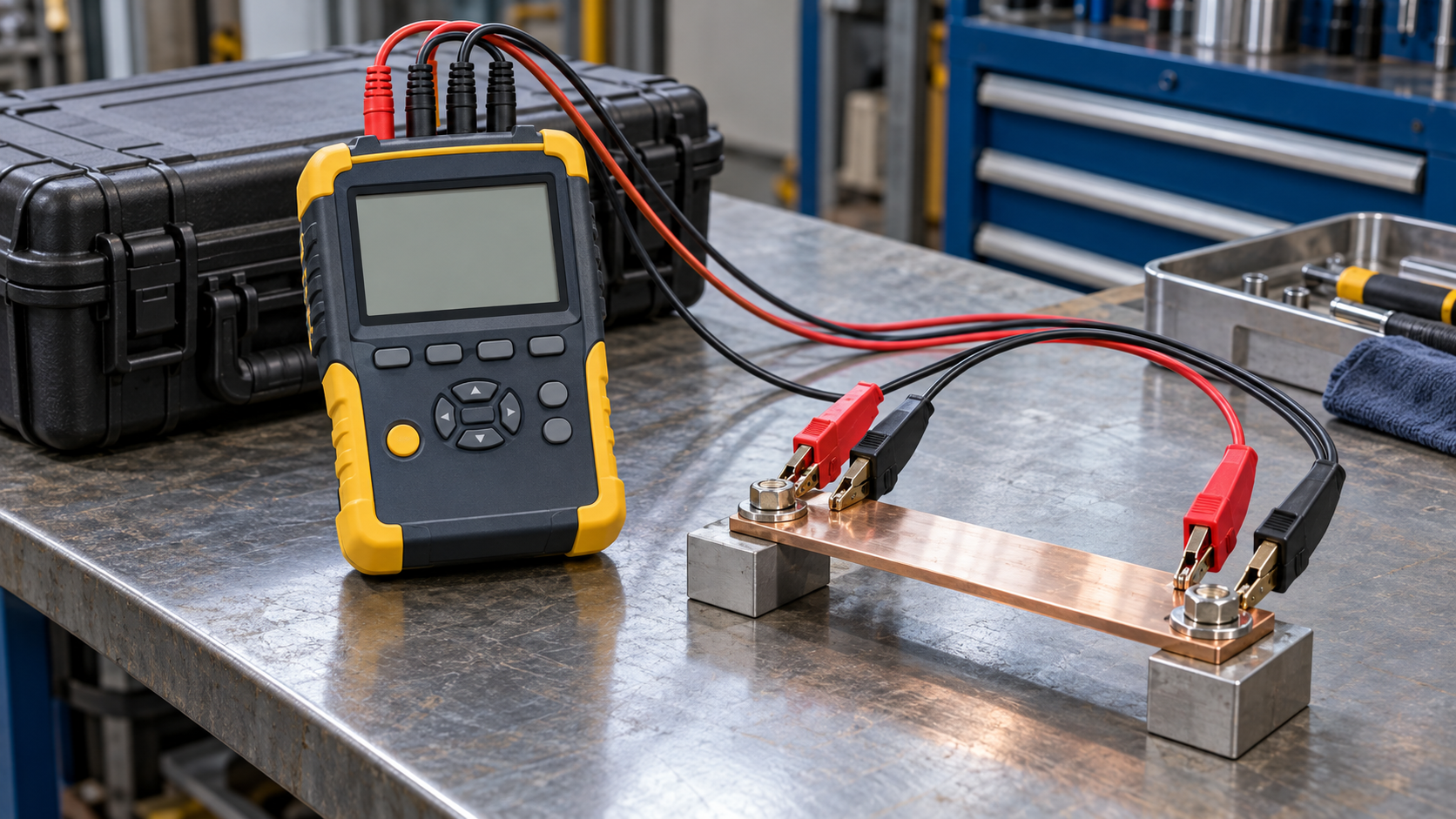
The RM3548 separates the two jobs. Two terminals, SOURCE A and SOURCE B, carry the measurement current. Two other terminals, SENSE A and SENSE B, measure the voltage at the item under test. The manual calls this the DC four-terminal method. Many engineers call the same idea a Kelvin connection. Because the voltage is sensed at the item itself, the current path resistance does not enter the reading.
Specifications the manual states
The table below lists figures from the November 2025 RM3548-50 edition, which is the most recent English manual we opened. The 2023 RM3548 edition is a separate document for the base model, and we did not check its specification section line by line against this table. Check that section before relying on a figure for the base model.
| Item | What the manual states |
|---|---|
| Measurable range | 3 mΩ range to 3 MΩ range, 10 ranges (3 mΩ, 30 mΩ, 300 mΩ, 3 Ω, 30 Ω, 300 Ω, 3 kΩ, 30 kΩ, 300 kΩ, 3 MΩ full scale) |
| Measurement method | DC four-terminal method, constant current |
| Terminals | Banana terminals: SOURCE A, SOURCE B, SENSE A, SENSE B |
| Accuracy, 3 Ω range (offset compensation off) | ±(0.020% of reading + 0.007% of full scale) |
| Accuracy, 3 MΩ range (offset compensation off) | ±(0.200% of reading + 0.007% of full scale) |
| Open-circuit voltage | 5.5 V maximum, as shown in the range table |
| Accuracy guarantee conditions | 23 °C ±5 °C, 80% RH maximum |
| Temperature coefficient | One tenth of the measurement accuracy per °C is added in the ranges 0 to 18 °C and 28 to 40 °C |
| Accuracy warranty period | One year |
| Operating environment | Indoors, pollution degree 2, altitude up to 2000 m, 0 to 40 °C, 80% RH or less |
| Power | Eight LR6 alkaline cells or eight HR6 nickel-metal hydride cells, 1.5 V DC each |
| Continuous operating time | About 10 hours, under the manual’s reference test pattern at 23 °C |
| Fuse | F2AH/250 V, built in |
| Dimensions and mass | About 199 W × 132 H × 60.6 D mm; about 890 g including the protector |
| Safety and EMC standards | EN 61010 (safety); EN 61326 (EMC) |
| Product warranty period | 3 years |
| CAT rating or mains voltage rating | Not stated in the manuals we opened |
Two of these lines need a closer reading. The accuracy figure has two parts: the first is a percentage of the reading you see, and the second is a percentage of the full-scale value of the range. On a low range, the second part can matter more than the first. The temperature line means that outside about 18 to 28 °C the stated accuracy is worsened by a fraction for each degree. Use the manual’s accuracy table for the exact figure on the range you choose.
How we chose and what this article covers
This article covers one product, the Hioki RM3548 family, and nothing else. We chose it because it matches a specific question: how to read a resistance meter that is built for low-resistance measurement. Our criteria were simple. The figures must come from a manufacturer document that we opened and could read as text. Each figure must have a stated edition, model and date. We did not use any retail listing, marketplace page, forum or encyclopedia entry as a source for a specification.
The three sources are all Hioki documents. Two are English instruction manuals and one is a Spanish instruction manual. The copies were downloaded from the manufacturer’s own download pages. We did not use a third-party copy for this article.
What we could not verify
- The sources we opened do not state a CAT rating or a mains voltage rating for the instrument.
- The sources we opened do not give independent measurements of the instrument’s accuracy in a real workshop or lab.
- We did not confirm all differences between the RM3548 and the RM3548-50. The newer manual covers the -50 version, and the older manual covers the base model.
- We could not confirm current pricing, availability, or which accessories are included with each version. Check the seller’s package list.
Safe use: what the manual asks you to check
The manual’s safety notes include a caution about measuring a point that is connected to power, and a warning that electrical sparks may occur when a power cable is connected or disconnected from the measurement target. The safe reading of these notes is that the item under test should be isolated and de-energized before you connect the leads. Resistance measurement is a job for a circuit that is switched off and proven dead. Do not use this meter as a voltage check on a live circuit.
The manual also warns that electrical sparks may occur when a power cable is connected to or disconnected from the measurement target, and says not to use the instrument where combustible gases may be generated. Keep the instrument in the indoor conditions listed above, and keep it within the 0 to 40 °C range.
Work on mains panels, service entrances and any circuit you cannot isolate belongs to a licensed electrician. A resistance meter does not change that rule.
Power and batteries
The RM3548 runs on eight LR6 alkaline cells or eight HR6 nickel-metal hydride cells. The manual states that a unit powered by nickel-metal hydride cells will show an inaccurate remaining-battery level, but it can still be used normally. This is a display issue, not a measurement issue, but it can be confusing. Check the battery indicator against a fresh set of alkaline cells when the reading seems strange.
The manual says to turn the power off after use. The instrument also has an automatic power-off feature, called auto power save, which is described in the manual’s section on power off. Switch the unit off by hand at the end of a session if you are unsure whether it has shut down.
Measurement habits that matter
Four-terminal measurement only works if the SENSE leads sit on the two points whose resistance you want. A common mistake is to place the SENSE leads on a wider section of the circuit than intended, which measures more than the item you meant to test.
In the calibration appendix of the November 2025 manual, Hioki warns that alligator clips on the voltage detection terminal can give inaccurate readings because of thermal EMF, a small voltage that appears where two different metals meet at a temperature difference. The appendix is written for calibration work, but the same caution about clean, firm contacts is a reasonable habit for low-resistance readings.
For the basics of resistance and continuity on a standard meter, see how to test continuity with a multimeter without sound. For a general look at meters with true RMS and auto ranging, see best true RMS multimeter and best auto-ranging multimeter. The RM3548 is a different class of instrument, so read those guides with that difference in mind.
Buying checklist
- Confirm the model. The RM3548 and RM3548-50 have separate manuals, and the newer manual covers the -50 version.
- Confirm the range you need. The manual lists 10 ranges from 3 mΩ to 3 MΩ full scale.
- Confirm the power source you plan to use: alkaline or nickel-metal hydride cells.
- Confirm which leads and sensors come with your unit. The sources we opened do not list the accessory set for each version.
- If you need a CAT rating for mains work, look for a meter that states one. The RM3548 manuals do not.
- Read the safety notes in the manual before the first use.
Mistakes to avoid
- Using it as a mains voltage meter. The manuals we opened do not state a CAT rating or a mains voltage rating, so it is not a substitute for a meter rated for live work.
- Buying the wrong suffix. The RM3548-50 manual and the RM3548 manual are separate documents. Match the manual to the unit in your hand.
- Trusting the battery indicator on nickel-metal hydride cells. The manual says this indicator can be inaccurate with those cells.
- Ignoring the temperature coefficient. Outside about 18 to 28 °C, the manual adds a fraction of the accuracy for each degree.
- Using the SENSE leads on the wrong points. Four-terminal readings only help when the voltage sense points are on the item under test.
FAQ
What does the Hioki RM3548 measure?
The manuals we opened describe resistance measurement from 3 mΩ to 3 MΩ full scale, across 10 ranges, using a DC four-terminal method with constant current.
Is the RM3548 a multimeter?
No. The manuals describe it as a resistance meter, and the specification section we opened covers only resistance measurement.
Does the RM3548 have a CAT rating?
The manuals we opened do not state a CAT rating or a mains voltage rating. Do not use it as a mains safety meter.
Which battery should I use?
The manual allows eight LR6 alkaline cells or eight HR6 nickel-metal hydride cells. It notes that the battery indicator can be inaccurate with nickel-metal hydride cells.
What is the difference between the RM3548 and the RM3548-50?
Both are covered by Hioki instruction manuals, but the manuals are separate and have different editions. The November 2025 manual covers the RM3548-50. Read the model label on the instrument and match it to the manual before you rely on any figure.
Where did the specifications in this article come from?
From the Hioki instruction manuals listed under Sources. We did not use retail listings or third-party summaries for the figures.
Bottom line
The Hioki RM3548 is a four-terminal resistance meter for low and high resistance readings. Use the figures in the manual, match the manual to your model, and do not use the instrument as a mains voltage meter, because the manuals we opened do not state a CAT rating for it.
As an Amazon Associate we earn from qualifying purchases.
Sources
- Hioki RM3548 Instruction Manual, Dec. 2023, Revised edition 5, document RM3548A981-05, English. https://www.hioki.com/download/30553 (opened 2026-10-27)
- Hioki RM3548-50 Instruction Manual, Nov. 2025, Revised edition 2, document RM3548B981-02, English. https://www.hioki.com/download/41701 (opened 2026-10-27)
- Hioki RM3548 Manual de Instrucciones, Dec. 2023, Revised edition 4, document RM3548A983-04, Spanish. https://www.hioki.com/download/30575 (opened 2026-10-27)