Fluke 8588A Explained: Reference Multimeter Specs and Uses
As an Amazon Associate we earn from qualifying purchases.
The Fluke 8588A is an 8.5-digit reference multimeter from Fluke Calibration, built for calibration laboratories. This explainer covers its published accuracy, its digitizing function, its interfaces and what the sources do not say, including a CAT rating. It draws on the Fluke Calibration product page, a Fluke blog article and the technical data sheet.
Quick answer
- The Fluke 8588A is an 8.5-digit reference multimeter from Fluke Calibration. It is designed for calibration laboratories, standards labs and high-end test environments.
- Fluke publishes 3.5 ppm one-year DC voltage relative accuracy, with 8.5-digit resolution in one second.
- The instrument can digitize signals. Fluke’s blog says it samples as fast as every 200 nanoseconds in digitizing mode.
- Fluke says it sustains at least 100,000 readings per second at 4.5 digits over GPIB, USB or Ethernet.
- It is a laboratory instrument, not a field meter. None of the three sources we opened states a CAT rating for it. Check the manual before using it on any mains circuit.
What “reference multimeter” means
A reference multimeter is a high-precision instrument used to check other instruments and to set up calibration. A common handheld or bench meter is built to be useful across many jobs. A reference meter is built to hold a very small error over a long time, so its readings can be trusted to correct other equipment.
The 8588A is a long-scale instrument. Fluke Calibration says it builds on the established 8508A long-scale DMM and extends the platform with digitizing and data analysis. In its blog, Fluke describes the 8588A as a reference multimeter for calibration, standards laboratories and high-end manufacturing and test environments.
Resolution and accuracy are different. The “8.5 digit” name describes the display. The accuracy figure describes how close a reading is to the true value, and it depends on the range, the period since calibration and the environment.
The published accuracy figures
The Fluke Calibration product page gives the headline figure: 3.5 ppm one-year DC voltage relative accuracy, with 8.5-digit resolution in one second. The page says the meter does not need daily internal self-calibration or autozeroing.
The technical data sheet gives the same figure with a confidence level attached. It lists 3.5 µV/V at 99 % confidence for one-year DC voltage relative accuracy. It also gives 2.7 µV/V at 95 % confidence for the same quantity. The two numbers are not interchangeable. A 99 % figure is a wider bound than a 95 % figure, so read the confidence level before you compare this meter with another.
The data sheet gives a DC voltage range of 100 mV to 1000 V, with a maximum of 1050 V. It also describes a 0 to 10 second reading aperture for the DC voltage function. Read the full accuracy table for the range and function you plan to use.
Digitizing: what it adds
The 8588A can digitize signals, which means it captures a waveform as a series of samples instead of giving a single averaged reading. Fluke’s blog says that in normal measurement mode the meter measures frequencies up to 10 MHz. In digitizing mode, the bandwidth extends to 20 MHz, and sampling can be as fast as every 200 nanoseconds.
This is useful when a lab needs to look at signal behavior, not just a steady value. The data sheet lists a memory of 15 million readings. It also lists a time stamp feature for stored readings and a line trigger.
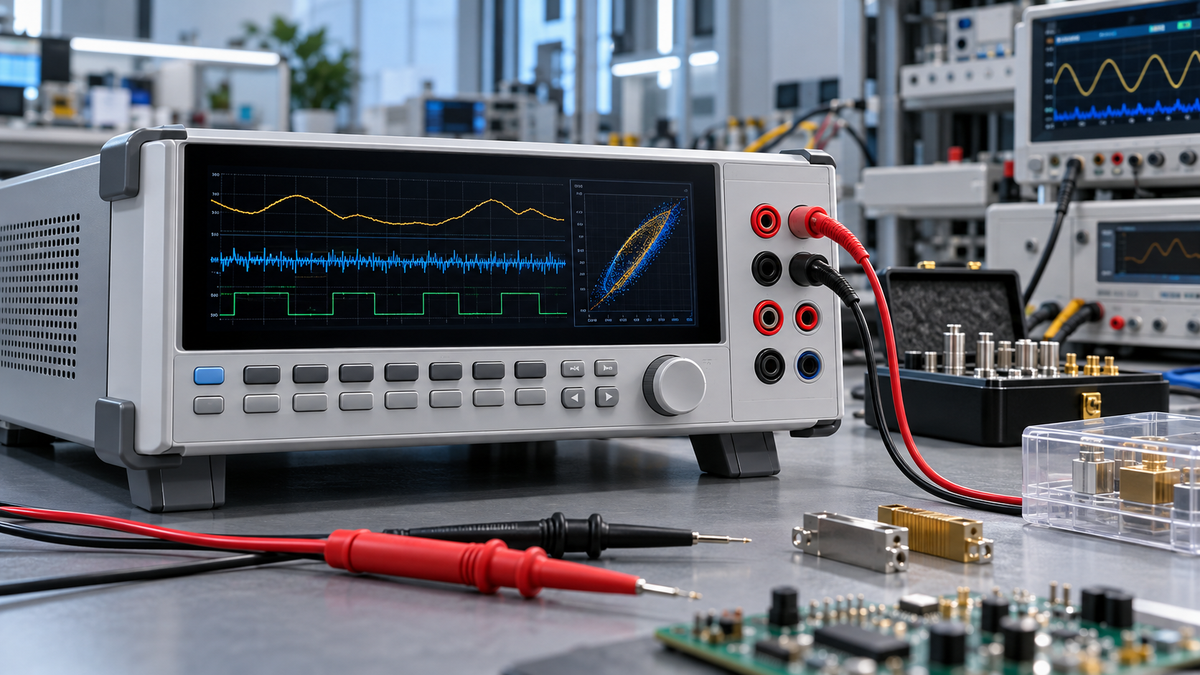
The Fluke Calibration page describes trend plots, histograms, FFT and statistics on the color display, so the captured data can be examined on the instrument without a computer. Those functions are useful in a lab that needs to analyze results, but they add to the setup you need to learn before the meter is productive.
Throughput and interfaces
Fluke says the 8588A sustains at least 100,000 readings per second at 4.5 digits over GPIB, USB or Ethernet. That is a throughput figure for lower-resolution readings, not a measure of the full 8.5-digit output. The data sheet lists the same rate.
The interfaces are Ethernet, GPIB and USBTMC for system control. The Fluke Calibration page also lists USB host ports on the front and rear for exporting data as CSV files and for firmware updates. A USB thumb drive can be used for the same purpose.
The page states that the 8588A has full emulation of the Fluke 8508A and SCPI command compatibility with the Keysight 3458A. If your lab has automated test code written for either instrument, check the compatibility details in the manual against that code before you rely on it.
The 8558A and the model choice
The data sheet covers two models in the same platform: the 8588A and the 8558A. Both share a common user interface. The sources we opened do not give a full side-by-side of the two models’ functions and accuracy, so check the data sheet for the functions each model supports before choosing between them.
If you do not need digitizing or the highest accuracy, the second model may suit your lab. If you do need reference-grade digitizing, the 8588A is the model Fluke describes for that role.
Safety and environment
None of the three sources we opened states a CAT rating for the 8588A. The product page lists interfaces, accuracy and functions, but we did not find a measurement category in the sections we read. Do not use this meter on a mains circuit based on its laboratory role. Check the safety section of the manual for the exact model before you connect it to any live circuit.
The Fluke Calibration page says the meter is part of a calibration and metrology system that Fluke supports with service and calibration. If your lab depends on documented traceability, confirm the calibration documentation and the service terms with Fluke or an authorized distributor before you buy.
Who this meter suits
The 8588A suits calibration labs, standards laboratories, semiconductor test and automated production test where the measurement uncertainty of the reference instrument matters. It suits a team that will use digitizing and data analysis regularly, and that has the software and interface work to connect it to its systems.
It is not a meter for an electrician, a technician working on car batteries or a hobbyist checking a circuit. A handheld meter with a clear CAT rating, fused leads and a simple display is a better fit for those tasks.
Checks before you buy
- Confirm the accuracy figure and its confidence level. A 3.5 µV/V figure at 99 % and a 2.7 µV/V figure at 95 % are not the same claim.
- Confirm the functions you need: digitizing, capacitance, RF power or the current ranges. Check whether the 8558A covers your work.
- Check the interface needs. Ethernet, GPIB and USBTMC are listed. Confirm that your system uses one of them.
- Confirm the emulation and SCPI compatibility you need, against your existing code.
- Check the calibration and service terms with Fluke or an authorized distributor.
- Read the safety section of the manual before any use on a live circuit.
Mistakes to avoid
Do not compare the 8588A with a bench meter on resolution alone. The 8.5-digit display shows more digits than a 6.5-digit meter, but the accuracy at each range decides whether those digits mean anything.
Do not assume a high accuracy figure applies to every function. The accuracy tables differ by function and range.
Do not use the 8588A as a safety instrument on mains wiring. It is a laboratory reference, and the sources we opened do not give a CAT rating for field use.
FAQ
What is the 8588A’s DC voltage accuracy?
Fluke publishes 3.5 ppm one-year DC voltage relative accuracy. The data sheet gives 3.5 µV/V at 99 % confidence, and 2.7 µV/V at 95 % confidence.
Is the 8588A a long-scale multimeter?
Yes. Fluke describes it as a long-scale reference multimeter that builds on the 8508A.
How fast can it digitize?
Fluke’s blog says sampling can be as fast as every 200 nanoseconds in digitizing mode, with a bandwidth of up to 20 MHz.
How many readings can it store?
The memory figure in the data sheet is 15 million readings.
Does it have a CAT rating?
None of the three sources we opened states one. Check the manual for the model you buy.
Bottom line
The Fluke 8588A is a reference multimeter for calibration and metrology work. Buy it only if your lab needs its accuracy, digitizing and data analysis, and you have confirmed the accuracy figure, interfaces and service terms for your system. For field and mains work, choose an instrument whose manual gives a clear CAT rating for that use.
How we chose
This article covers one model in one post, because a reader who searches for the model needs its published figures and its buying checks together. We read the manufacturer’s own documents first. Where the original was not reachable to us, we opened a copy hosted elsewhere and say so in the source list. We did not use reseller listings, forums or used-equipment pages as a source for any figure. Every number quoted is one printed in a document we opened, with its revision or date where the document gives one.
What we could not verify
None of the three sources states a CAT rating or a mains safety rating for the 8588A.
The sources we read do not give physical size or weight. The 8558A is covered only in outline here.
The technical data sheet we opened is a third-party copy of a Fluke document, not Fluke’s own host.
Sources
- Fluke Calibration, “8588A Reference Multimeter,” product page. Opened and read, https://fluke.com.au/en/product/calibration-tools/electrical-calibration/bench-multimeters/8588a
- Fluke, “Fluke 8588A: An 8.5-digit multimeter built for modern calibration and digitising,” blog post. Opened and read, https://fluke.com/en-gb/learn/blog/electrical-calibration/modern-digitising-reference-multimeter
- Fluke Calibration, “8588A/8558A Technical Data Sheet.” Opened and read, hosted at https://xdevs.com/doc/Fluke/8588A_8558A/8588A.pdf (a third-party copy of a Fluke document)
Related guides: Best Digital Multimeters, How to Read Multimeter Symbols and Dial Positions, Best Digital Multimeters for Electrical Work: Specs Compared.