Brymen BM869s Multimeter: Specs, Uses and Safe Use
As an Amazon Associate we earn from qualifying purchases.
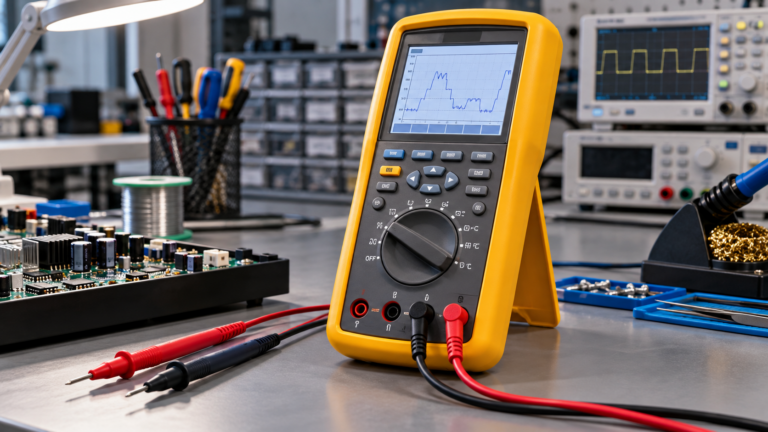
The Brymen BM869s is a handheld digital multimeter with True RMS AC and AC+DC sensing, a dual display, and a CAT IV 1000V rating for AC and DC. Brymen’s manual and product pages state these points. This guide explains what the meter measures, how to use it safely around mains circuits, which figures the sources publish, and what to check before you buy. It is a single-model explainer, not a ranking, and it covers only what the sources we opened actually state.
Quick answer
- The manual states CAT IV 1000V AC and DC. CAT IV is the category for work at the source of a building’s low-voltage mains supply, so the rating is higher than the CAT II category used for outlets.
- Display: 50,000 counts in fast mode. The manual limits 500,000 counts to a stable mode for DC voltage. Brymen’s product pages describe the display as 500,000 counts, so check the manual figure against the product page figure.
- Fuses: 0.44 A at 1000 V for the milliamp input, and 11 A at 1000 V for the amp input, both listed as fast fuses in the manual.
- Power: one 9V battery. The manual says the low-battery warning appears below about 7V.
- Safety first: test leads and probes must match the meter rating, and panel or service work belongs to a licensed electrician.
What the BM869s measures
The manual describes a meter that measures AC voltage and current, DC voltage and current, resistance, continuity, diodes, frequency and capacitance. It also lists dBm readings and %4-20mA loop current readings among its special features. The manual states that sensing is AC and AC+DC True RMS, which means the meter is designed to report the heating value of the signal, not just its average. The manual describes True RMS in plain terms, and that section is the best place to read the explanation before relying on it for non-sinusoidal waveforms.
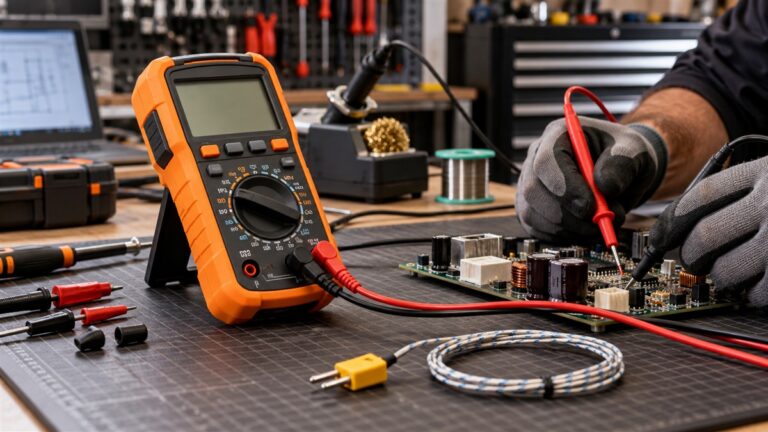
Three features are marked as Model 869s only in the manual: the T1-T2 differential temperature readings, the VFD V and Hz readings, and the K-type thermocouple supplied with the meter. The manual that covers this model also covers the BM867s, so check which features you need before you choose between the two.
The manual also describes an audible and visible input warning, which is useful when a test lead is left in the wrong jack. A warning is a reminder, not a substitute for checking the lead position before each measurement.
What CAT IV 1000V means for your work
Measurement categories describe where a meter can be connected in a building’s electrical system. The manual gives these definitions in its safety section. CAT IV applies to circuits connected at the source of the low-voltage mains installation, and the manual’s example is measurements on devices installed before the main fuse or circuit breaker. CAT III applies to the distribution part of the installation, including distribution boards, circuit breakers, wiring and fixed socket outlets. CAT II applies to points where household appliances and portable tools plug in.
Two points follow from the manual. First, a meter’s category rating is not enough on its own, because the test probe assembly must meet the same rating or better. The manual states that the supplied probe assembly meets the 61010-031 standard for the same meter ratings, and that the probe tips must be 4 mm or less for CAT III and CAT IV use. Second, the manual warns that accessories such as detachable caps or alligator clips can change the applicable rating, so their own category markings must be checked.
Choose the category that matches the work, then check the probes and accessories against it. A higher rating on the meter does not change the category of the circuit you are measuring.
How to use it safely
The manual’s safety section starts with a clear line: observe proper precautions when working with voltages above 30 Vrms, 42.4 Vpeak or 60 VDC, because these levels pose a potential shock hazard. Mains voltage is well above that threshold. Work on mains circuits can kill, so treat each step below as a minimum.
- Read the category and probe ratings first. Confirm that the meter’s CAT rating and the probe ratings meet or exceed the category of the circuit you will touch.
- Inspect the leads. The manual says to inspect lead wires, connectors and probes for damaged insulation or exposed metal, and to replace any that show defects. Replace the probe tips when a white inner insulation layer shows, if you have the premium probe with wear indicators.
- Keep your fingers behind the barriers. The manual says to keep hands and fingers behind the barriers on the meter and the probe assembly.
- Disconnect the leads before changing functions. The manual gives this instruction directly. Changing the function while the leads are on a live point is a common mistake.
- Check the function and range before you connect. The meter supports manual ranging. Press the RANGE button to select manual ranging; the manual notes that manual ranging is not available in the Hz function.
- Stop at the panel. Opening a panel, working on a service entrance, or changing wiring belongs to a licensed electrician. A meter is not a reason to open live equipment.
Fuses and batteries
The manual lists two current-input fuses. FS1 protects the milliamp and mA input and is rated 0.44A at 1000V AC and DC, with an interrupt rating of 10 kA or better. FS2 protects the amp input and is rated 11A at 1000V AC and DC, with an interrupt rating of 20 kA or better. Both are F-type fuses. The manual says to install only the same type of fuse or an equivalent. The fuse dimensions are 10 x 35 mm for FS1 and 10 x 38 mm for FS2.
The manual states that the meter uses one 9V battery, with the approved types NEDA1604A, JIS6AM6 or IEC6LF22 listed in the battery section. The manual also says that the automatic power-off timing is 17 minutes of inactivity. Replacement is done through the battery access door on the case bottom, with the two screws removed and refitted afterwards.
The manual includes a note on voltage ratings for the protection fuses. It says to consider the phase-to-phase voltage as the working voltage for the protection fuses, to avoid exceeding the fuse voltage rating by accident.
Published specifications
The table below uses the manual’s figures unless a row says otherwise. The product pages were used to check the display and rating wording. Where the sources differ, both figures are shown.
| Item | Figure stated | Where stated |
|---|---|---|
| Display | Four and four-fifths digits, 50,000 counts (fast mode); five and four-fifths digits, 500,000 counts for DC voltage (stable mode) | Manual, General Specification |
| Product page display wording | 500,000 counts (five and four-fifths digits) | brymen.eu and brymen.co.th product pages |
| Sensing | AC and AC+DC True RMS | Manual |
| Safety rating | CAT IV 1000V AC and DC | Manual; product pages state CAT IV 1000V |
| Overload protection | A and mA: 0.44A/1000V; A: 11A/1000V; V: 1100V; mV and other ranges: 1000V | Manual |
| Transient protection | 12 kV transient surge protection | Manual |
| Pollution degree | 2 | Manual |
| Operating temperature | 0C to 45C | Manual |
| Operating altitude | Below 2000 m | Manual |
| Power | Single 9V alkaline battery; low battery below about 7V | Manual |
| Auto power-off | Idle for 17 minutes | Manual |
| Size and weight | 208 x 103 x 64.5 mm with holster; 635 g with holster | Manual |
| Included items | Test leads (pair), holster, battery installed, user’s manual, and on the 869s a K-type thermocouple | Manual |
The manual states that the meter is certified to IEC, EN, UL and CSA safety standards at CAT IV 1000V AC and DC. The manual also says that accuracy is specified for one year after calibration, and that annual calibration is recommended to maintain accuracy. The manual’s limited warranty section gives a period of one year from the date of purchase. These are the manufacturer’s figures; this article does not restate the accuracy tables.
How we chose
The criteria here are simple. The article covers one model. It uses only figures printed in the manufacturer’s manual or on Brymen’s own product pages, and it cites each figure. Retail prices, customer ratings and marketplace listings were not used. The sources were opened on 27 October 2026. Three sources were used: the manual PDF on the Brymen domain, and two regional Brymen product pages. No third-party manual copy could be opened as readable text, so none is cited.
What we could not verify
- The sources we opened do not state a separate CAT III rating for the BM869s. They state CAT IV 1000V AC and DC.
- The accuracy tables are in the manual, but they are not reproduced here, and this article makes no claim about real-world accuracy.
- The manual and the product pages describe the display differently. The manual limits 500,000 counts to DC voltage in stable mode. The product pages give 500,000 counts without that limit. Use the manual figure for the limit.
Buying checklist
- Match the CAT rating to the work. CAT IV 1000V is the rating the sources state for this meter.
- Check whether you need the 869s-only features: T1-T2 temperature readings, VFD readings and the K-type thermocouple.
- Check the probes. The meter rating is only as good as the probe rating, and accessory caps or clips can change it.
- Keep a spare 9V battery and the fuse types listed above, since the manual asks for the same fuse type or an equivalent.
Mistakes to avoid
- Changing functions with the leads connected. The manual tells you to disconnect the leads first.
- Replacing a current fuse with a different type. The manual asks for the same type or an equivalent.
- Assuming 500,000 counts everywhere. The manual limits that mode to DC voltage in stable mode.
- Trusting an accessory’s rating without checking it. The manual warns that caps or clips can change the rating.
FAQ
Is the BM869s a True RMS meter?
Yes. The manual states AC and AC+DC True RMS sensing. The manual’s True RMS section explains how the function differs from average-responding readings.
What CAT rating does the BM869s have?
The manual states CAT IV 1000V for AC and DC. The probes must meet the same rating or better, and the manual warns that accessories can change the applicable rating.
Can I use it on household outlets?
The category descriptions in the manual place outlets in CAT II, and CAT IV is the higher rating. Outlets still carry shock risk. Follow the safety steps above and do not work inside an energized outlet or panel.
How many counts does the display show?
The manual gives 50,000 counts in fast mode, and 500,000 counts for DC voltage in stable mode. Brymen’s product pages describe 500,000 counts in general, so the manual limit is the one to use.
What battery does it use?
One 9V battery. The manual lists approved types and says the low-battery warning appears below about 7V.
Which features are only on the 869s?
The manual marks the T1-T2 differential temperature readings, the VFD V and Hz readings and the K-type thermocouple as 869s-only features.
Related reading
If the category terms are new, read what a CAT rating means on a multimeter before you compare any meter’s ratings. For the basic dial and symbol set, see how to read multimeter symbols. Readers who want the step-by-step basics can start with how to use a multimeter step by step. For a broader choice of meters, see the beginner multimeter guide.
Bottom line
Choose the BM869s only if its stated CAT IV 1000V rating, True RMS sensing and 869s-only features match your work. Confirm the probe and accessory ratings before any mains measurement, and leave panel and service work to a licensed electrician.
Sources
- Brymen, “USER’S MANUAL BM867s BM869s”, PDF file BM860s-manual-2-033Ed2, https://www.brymen.com/images/ProductsList/BM860s_List/BM860s-manual-2-033Ed2-ES636-Print1.pdf (manufacturer copy, opened 2026-10-27; the manual covers the BM867s and BM869s)
- Brymen EU, product page for BM869s, https://brymen.eu/product/bm869s/ (manufacturer regional site, opened 2026-10-27; specification wording only, no prices used)
- Brymen Thailand, product page for BM869s, https://brymen.co.th/product/bm869s/ (regional Brymen site, opened 2026-10-27; specification wording only, no prices used)