Keithley 2001 Digital Multimeter: Specs and Status
As an Amazon Associate we earn from qualifying purchases.
Keithley 2001 Digital Multimeter: Specs and Status
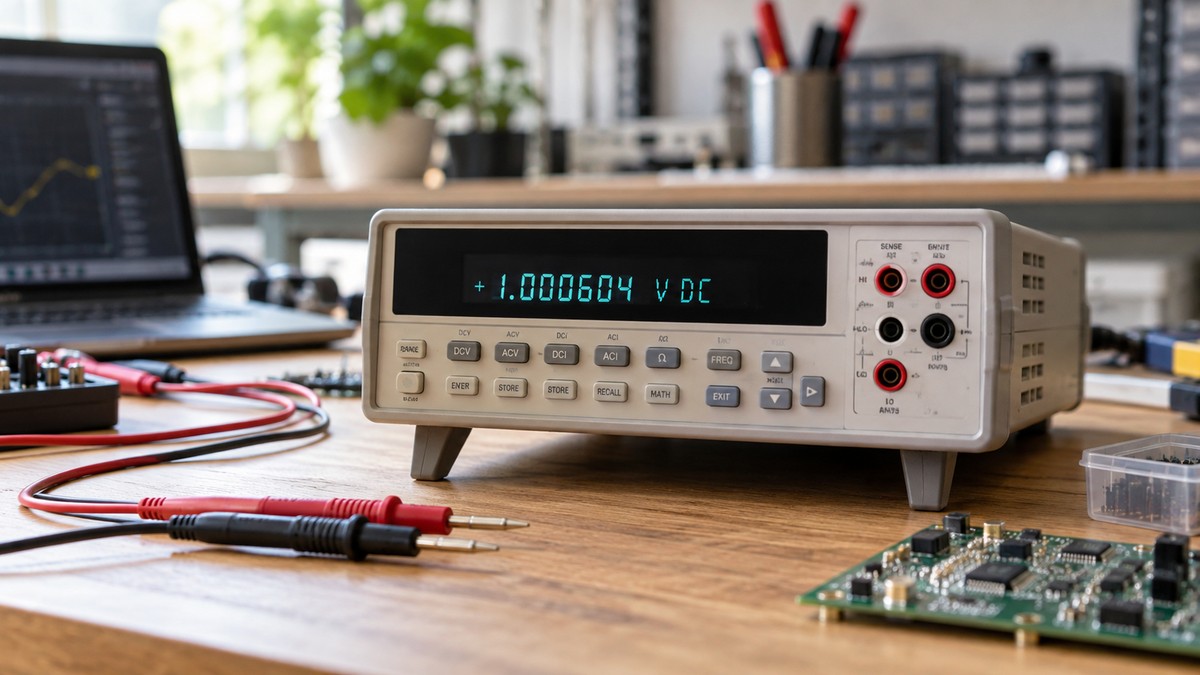
The Keithley 2001 is a 7½-digit bench digital multimeter with scanning options, made by Keithley, which is now part of Tektronix. Tektronix’s product page says the 2001 has been discontinued and points to the DMM7510 as its alternative. The specifications Tektronix published for the 2001 include a 28-bit A/D converter, true 7½-digit resolution and a basic DC voltage accuracy of 0.0018%. If you already own one, or you are weighing a used unit, those figures tell you what it was designed to do. They do not tell you what support is available, so check that first.
Quick answer
- Resolution: true 7½ digits from a 28-bit A/D converter, per the Tektronix product page.
- Basic DC voltage accuracy: 0.0018%, per the Tektronix product page.
- Status: discontinued, per the Tektronix product page, which names the DMM7510 as the alternative.
- Maximum input: 1100 V peak, per the specification PDF.
- Scanning: a rear-panel card slot accepts scanner cards such as the 2000-SCAN, per the product page.
What the 2001 was built to do
A 7½-digit meter is a precision instrument. The extra digits matter when a reading has to be resolved to a few parts per million, such as a reference voltage check, a calibration bench or a long-term measurement where drift is the question. The 2001 was also built for multi-point work. Its rear-panel slot takes a scanner card, so one meter can read several channels in turn. Tektronix’s product page lists the 2000-SCAN scanner board and the 2001-TCSCAN thermocouple scan card among the options.
The product page also describes the AC measurement features. These include peak AC volts, AC or AC+DC coupling, RMS or average readings and low-frequency RMS. It also lists a multiple measurement display, which shows DC volts, AC volts and AC frequency from one connection, and a bar graph that tracks a reading against a target. Those features help when a signal is not a clean DC level, such as a ripple check on a power supply.
Specifications the manufacturer published
The table below uses only figures from the Tektronix pages and the SPEC-2001 Rev. J PDF we opened. Where a figure is not in those documents, the cell says so.
| Feature | What Tektronix states | Where we read it |
|---|---|---|
| Resolution | True 7½ digits, 28-bit A/D converter | Product page |
| Basic DC voltage accuracy | 0.0018% | Product page |
| Maximum input | 1100 V peak; 2 × 10⁷ V·Hz product for inputs above 20 V | SPEC-2001 Rev. J |
| Specification structure | 5-minute, 1-hour, 24-hour, 90-day, 1-year and 2-year specifications; full specifications at 90-day, 1-year and 2-year | SPEC-2001 Rev. J |
| Traceability | 90-day, 1-year and 2-year specifications stated as absolute accuracy traceable to NIST | SPEC-2001 Rev. J |
| Remote reading output | Reading rates listed for memory and for IEEE-488 output | SPEC-2001 Rev. J |
| Scanning | Rear-panel card slot; 2000-SCAN and 2001-TCSCAN options | Product page |
| Status | Discontinued; DMM7510 named as alternative | Product page |
The specification sheet is useful for a reason the headline digits do not show. It separates results by time interval, from 5 minutes to 2 years, and it says almost all of the figures are warranted rather than typical. A buyer who plans a calibration schedule can match the interval they need to the column they read. The sheet also says the 1000 V range specifications apply within 5% of the initial measurement, which is a detail to check if you measure near the top of that range.
Check the status before anything else
The discontinued status is the most important fact in this article. A discontinued instrument can still work well, but it changes the questions you need to answer. Ask the seller for the serial number and check it against the manual revision you have. Tektronix’s manual page we opened is for Rev. B, dated 2015. Manuals for later hardware or firmware may differ, so use the revision that matches your unit.
If you need a current 7½-digit bench meter with a published support path, the Tektronix page names the DMM7510 as the alternative. This article does not compare that model, because it was not part of the assignment. Compare the specifications you need from the current manufacturer documents before you decide.
Points to check before you buy or use one
- Confirm the revision. Match the serial number and the manual revision. The Tektronix manual page we opened is Rev. B from 2015.
- Decide the interval you will calibrate to. The specification sheet gives separate columns for 90-day, 1-year and 2-year performance, so the number you quote depends on the interval.
- Check the interface you need. The sheet reports reading rates to IEEE-488. Tektronix’s product page lists IEEE-488 accessories, including a USB-to-GPIB adapter. Plan for that bus, not for USB.
- Check the scanner needs. If you want multi-channel reading, confirm the scanner card and the cabling before you buy. The product page lists the options, but it does not give a bundle price.
- Respect the input limit. The maximum input is 1100 V peak. That is a limit for the instrument, not a guide for connecting it to a live circuit.
Safety note
Work on mains circuits can kill. A bench meter with a high maximum input is not a substitute for a CAT-rated tool on a live system, and the sources we opened do not describe the 2001 as a field tool. Measurements on mains wiring, panels and service equipment are work for a licensed electrician. If you are learning the basics of a multimeter, start with our step-by-step guide to using a multimeter, which covers the sequence for everyday measurements.
How we chose
This article covers the Keithley 2001 because it was on the assigned keyword list. We opened three Tektronix pages on 2026-10-27: the 2001 Series product page, the SPEC-2001 Rev. J specification PDF from July 2015, and the 2001 Series manual page for Rev. B. We did not use reseller pages, auction or used-equipment sites, or review sites for any figure. We did not compare the 2001 with other models in depth, and we did not rank it against them.
What we could not verify
- Current support status for a specific unit. The product page says discontinued, but it does not describe service or repair availability.
- The full set of DC and AC ranges and accuracies. The specification PDF has the detailed tables, and this article quotes only the headline figures and the structure.
- The exact reading rate for any one combination of digits, NPLC and filter. Those rates depend on the settings, and the sheet lists them in separate tables.
- Whether a used unit has been calibrated, repaired or modified.
- Any safety rating for the front-panel terminals. The sources we opened did not state a CAT category for the 2001.
Frequently asked questions
Is the Keithley 2001 still made?
The Tektronix product page we opened says the product has been discontinued and names the DMM7510 as the alternative. Check with Tektronix for current status before you plan around it.
What is the basic DC voltage accuracy?
Tektronix’s product page gives a basic DCV accuracy of 0.0018%. The specification PDF has the full accuracy tables for each range and interval.
What is the maximum input?
The specification PDF gives 1100 V peak as the maximum input, with a 2 × 10⁷ V·Hz product limit for inputs above 20 V.
Does it measure AC?
Yes. The product page lists AC volts with peak, RMS and average readings, and AC or AC+DC coupling, plus low-frequency RMS.
Can it scan several channels?
Yes, with a scanner card. The rear-panel slot accepts the 2000-SCAN and 2001-TCSCAN options listed on the product page.
Is it suitable for household electrical checks?
This article does not recommend it for that. For field electrical work, see our roundup of multimeters for electricians. Household and mains work needs a meter with a CAT rating that suits the circuit, and panel or service work belongs to a licensed electrician.
Bottom line
The Keithley 2001 is a 7½-digit bench meter with a published basic DC voltage accuracy of 0.0018% and a scanner slot. Its discontinued status matters more than its specifications for most buyers. Check the serial number, the manual revision and the support path before you buy, and treat it as a precision bench instrument rather than a field meter.
Sources
- Tektronix, Keithley 2001 Series: 7.5 Digit Multimeter with Scanning, product page, https://www.tek.com/en/products/keithley/digital-multimeter/2001-series (opened 2026-10-27)
- Tektronix, Model 2001 Multimeter Specifications, SPEC-2001 Rev. J, July 2015, https://download.tek.com/manual/SPEC-2001J_July_2015.pdf (opened 2026-10-27)
- Tektronix, Model 2001 High-Resolution Digital Multimeter manual page, Rev. B, part 2001-903-01B, https://www.tek.com/en/manual/digital-multimeter/high-resolution-digital-multimeters-manual-2-2001-series-7-digit-multimeter-scanning (opened 2026-10-27)