Fluke 27 II Explained: Ranges, Ratings and Safe Use
As an Amazon Associate we earn from qualifying purchases.
Fluke 27 II Explained: Ranges, Ratings and Safe Use
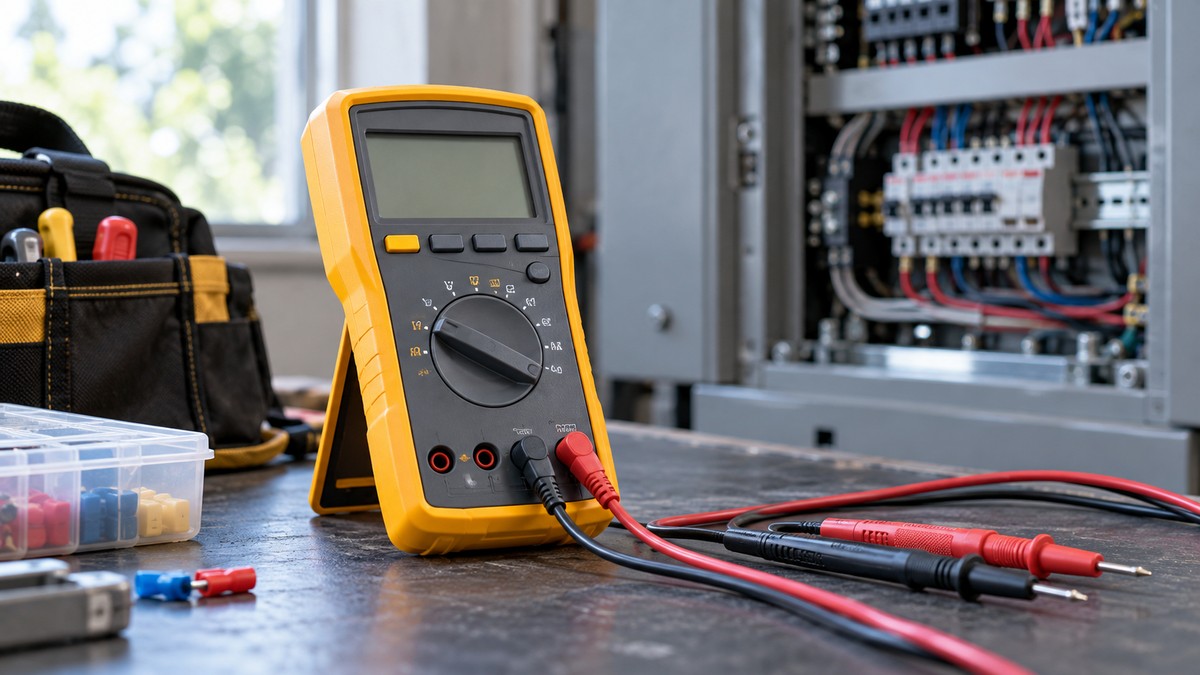
The Fluke 27 II is a handheld digital multimeter for voltage, current, resistance, continuity, diode, capacitance and frequency measurements. Fluke’s own users manual describes it as an average-responding meter, while its sister model, the 28 II, is a true-rms meter. That difference matters when your circuit carries distorted waveforms, so check it before you buy. This page covers the figures Fluke prints, the safety steps its manuals ask for, and the points to check before you choose a 27 II.
Quick answer
- The 27 II is an average-responding multimeter. The users manual says the 28 II is the true-rms model.
- The digital display shows 6000 counts. Only the 28 II offers a 19,999-count high-resolution mode.
- The Getting Started Manual prints CAT III 1000 V and CAT IV 600 V for the meter.
- The 27 II battery is rated at 800 hours typical with alkaline cells and the backlight off.
What the 27 II measures
The users manual lists the input functions as voltage, continuity, resistance, diode, capacitance and frequency. It adds temperature, but only for the 28 II. For current, the manual gives an input for 0 A to 10.00 A, and it notes a 20 A overload limit for 30 seconds maximum on that input. The manual also covers a MIN MAX recording mode, an AutoHOLD mode, and a fuse test procedure, with a separate section on replacing the fuses.
On AC voltage, the detailed specification table for the 27 II lists ranges of 600.0 mV, 6.000 V, 60.00 V, 600.0 V and 1000 V. The 1000 V range is printed with a resolution of 1 V. The table gives accuracy in the form of a percentage of reading plus a number of counts, and it notes that accuracy is specified for two years after calibration at 18 to 28 degrees C.
The 27 II and 28 II share most of the same function layout in the manual. The sections marked for the 28 II only include true-rms readings, the high-resolution mode, the 250-microsecond peak response setting, and the temperature function. If you need one of those, the 27 II is the wrong model.
Published ratings and figures
The table uses only figures printed in the three Fluke documents we opened. Where a document does not state a figure, the cell says so.
| Item | What the Fluke documents state | Where it is printed |
|---|---|---|
| Waveform response | Average-responding (27 II); true-rms (28 II) | Users Manual Rev. 2, 9/25 |
| Digital display | 6000 counts, updates 4 per second; 19,999 counts in high-resolution mode on the 28 II | Users Manual Rev. 2, 9/25 |
| Bargraph | 33 segments, updates 40 per second | Users Manual Rev. 2, 9/25 |
| Safety category | CAT III 1000 V and CAT IV 600 V | Getting Started Manual; Users Manual Rev. 1, 10/10 |
| Battery life | 800 hours typical, alkaline, backlight off | Users Manual Rev. 2, 9/25 |
| Size and weight | 1.80 x 3.95 x 8.40 in; 1.14 lb (517.1 g) | Users Manual Rev. 2, 9/25 |
| AC voltage ranges | 600.0 mV, 6.000 V, 60.00 V, 600.0 V, 1000 V | Users Manual Rev. 2, 9/25 |
| Current input | 0 to 10.00 A, with 20 A overload for 30 seconds maximum | Users Manual Rev. 2, 9/25 |
Safe use before you connect it
Fluke’s manuals ask you to read the safety information before the first use. The points below come from the Getting Started Manual and the users manual, and they apply every time you use the meter.
- Check the category label before you connect the meter. The printed rating is CAT III 1000 V and CAT IV 600 V, so the meter’s rating depends on the environment you are working in.
- Keep current readings within the 10 A input and its printed overload limit. The users manual gives 20 A for 30 seconds maximum on that input.
- Inspect the test leads for damage before use, as the Getting Started Manual asks. Do not use the meter if it operates abnormally.
- Use only the replacement fuses specified in the manual, and follow its fuse replacement steps.
Work on panels, service entrances and other live equipment belongs to a licensed electrician. A handheld meter’s rating is not a reason to open live equipment yourself.
What to check before you buy
- Decide between the 27 II and the 28 II. The 27 II is average-responding. If you measure distorted waveforms from variable-speed drives or electronics, the 28 II is the model the manual calls true-rms.
- Look at the category before the voltage. The 1000 V ranges sit within the CAT III 1000 V rating. Check that your work falls within the category, not only the voltage number.
- Plan for the battery and the fuses. The manual rates the battery at 800 hours typical with the backlight off. The fuse replacement section should be read before the first fuse fails.
- Check the manual revision. We opened two revisions of the 27 II users manual. The Rev. 2, 9/25 version is the newer one, and the Rev. 1, 10/10 copy is a third-party copy.
How we chose
This explainer covers the 27 II because the model is a separate search from the 28 II. We opened three Fluke documents on 2026-10-27: the current Fluke-hosted users manual (Rev. 2, 9/25), a third-party copy of the users manual at an earlier revision (Rev. 1, 10/10) hosted by Fluke-Direct, and the Getting Started Manual (PN 3368142, September 2009) hosted by Fluke. We used only the figures printed in those documents. We did not use Amazon, retailer pages, Wikipedia or forums for any figure.
What we could not verify
The three documents do not give a price, a current availability date or a comparison with other brands. We did not open the calibration information for the 27 II, so the performance tests and adjustment steps are not covered here. The Rev. 1 copy and the Rev. 2 manual differ in revision, and we have used the Rev. 2 figures wherever they are given.
Mistakes to avoid
- Choosing the 27 II for true-rms work. The manual names the 28 II as the true-rms model.
- Expecting the 28 II-only features on a 27 II, such as the temperature function or the high-resolution mode.
- Treating the 1000 V range as a general purpose rating. The category rating limits where you can use it.
- Ignoring the current overload limit. The manual gives 20 A for 30 seconds maximum on the 10 A input.
FAQ
Is the Fluke 27 II a true-rms meter?
No. Fluke’s users manual calls the 27 II an average-responding digital multimeter and identifies the 28 II as the true-rms model. Check the model number on the meter before you rely on true-rms readings.
What is the Fluke 27 II category rating?
The Getting Started Manual prints CAT III 1000 V and CAT IV 600 V. The Rev. 1, 10/10 users manual copy prints the same two ratings. Read the category as the environment limit, not just the voltage limit.
How many counts does the 27 II display?
The users manual lists 6000 counts for the digital display, updating four times per second. The 28 II has an additional 19,999-count high-resolution mode, which the 27 II does not offer.
How long does the battery last?
The users manual gives 800 hours typical with alkaline batteries and the backlight off. Real life depends on use, so treat the figure as the manufacturer’s typical value.
Can the 27 II measure temperature?
The users manual lists temperature as an input function only for the 28 II. If you need temperature readings, check the 28 II or a different meter.
Bottom line
Choose the 27 II when you need an average-responding handheld meter with a 6000-count display and the category rating Fluke prints. If your work includes distorted waveforms or temperature readings, the manual points to the 28 II.
Related guides
- How to Read Multimeter Symbols and Dial Positions explains the dial positions this meter uses.
- What Is a CAT Rating on a Multimeter explains the category numbers in this post.
- Best True Rms Multimeter compares true-rms meters for distorted waveforms.
Sources
- Fluke Corporation, “27 II/28 II Digital Multimeters Users Manual”, September 2009, Rev. 2, 9/25. Fluke-hosted: https://media.fluke.com/c76bf351-08cb-414e-90f8-b10800c17061_original%20file.pdf. Opened 2026-10-27.
- Fluke Corporation, “27 II/28 II Users Manual”, September 2009, Rev. 1, 10/10. Third-party copy hosted by Fluke-Direct: http://www.fluke-direct.com/app/webroot/pdfs/cache/www.fluke-direct.ca/fluke/multimeter/27_ii/manual/fluke_27_ii_multimeter_manual.pdf. Opened 2026-10-27.
- Fluke Corporation, “27 II/28 II Digital Multimeters Getting Started Manual”, PN 3368142, September 2009. Fluke-hosted: https://assets.fluke.com/manuals/2xii____gseng0000.pdf. Opened 2026-10-27.
As an Amazon Associate we earn from qualifying purchases.