Fluke 335 Clamp Meter: Uses, Safe Use and Stated Specs
As an Amazon Associate we earn from qualifying purchases.
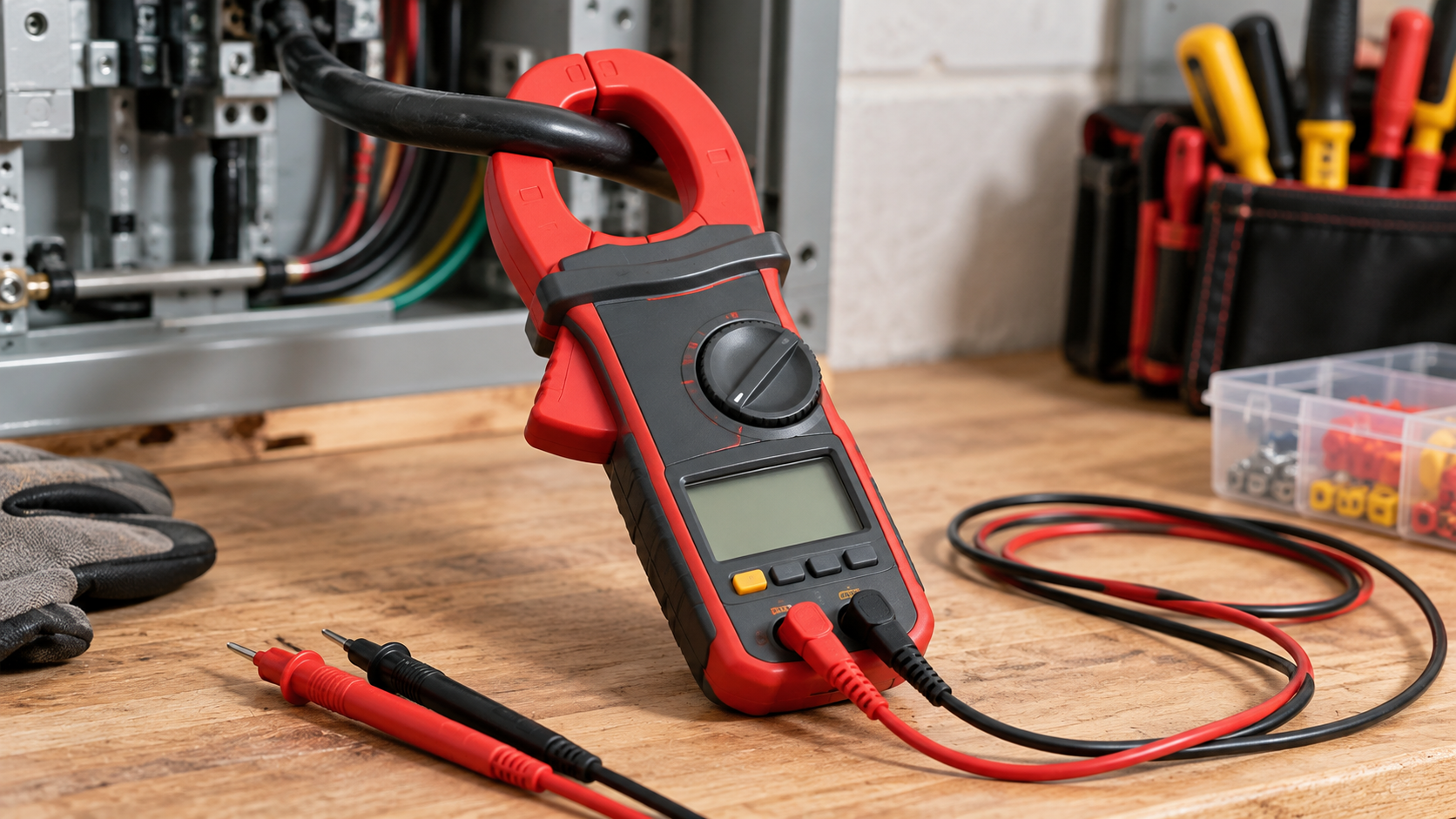
The Fluke 335 is a True RMS clamp meter with an inrush function. You open its jaws around one conductor to read AC current without breaking the circuit, and the Fluke instruction card also lists AC and DC volts to 600 V. The card rates the meter CAT III 600 V and does not state a CAT IV rating. The documents we opened do not give a DC current range for this model, so do not assume it reads DC amps. This guide covers its uses, safe use steps, stated specifications, and checks before you buy.
Quick answer
- Measures: AC current to 600 A with the clamp, AC and DC voltage to 600 V, inrush current, and continuity.
- Rating stated by Fluke: CAT III 600 V, pollution degree II.
- Check first: whether your meter falls in the Fluke recall for units made between 3 March 2008 and 27 February 2009.
- Not stated in the documents we opened: a DC current range and a CAT IV rating.
How we chose
This is an explainer about one model, not a ranking. We opened three Fluke documents on 2026-10-27 and used only what they state. We did not compare the 335 with other meters for this post. Where the documents are silent, the tables and the last section say so.
What the Fluke 335 is used for
A clamp meter reads current by sensing the magnetic field around one conductor, so the circuit does not have to be opened. That is the main reason to choose a clamp over a multimeter with test leads for current work. The 335 adds an inrush function, which captures the surge a motor draws when it starts. The Fluke calibration information describes the inrush reading as integrated over 100 ms.
The instruction card also shows a backlight, a data hold button, and an automatic off feature that the card lists as 20 minutes. The backlight and tactile barrier are listed for the 334 and 335 models. The card’s diagram labels a “currents cancel” case, which is covered in the safety steps below.
For voltage, the card lists AC and DC ranges up to 600 V. The sources do not describe trade-specific uses, so this post does not claim them. If your task is to check for voltage before you touch conductors, use a rated voltage tester first. A clamp meter reads current; it does not replace that check.
Stated specifications
The table below lists only figures stated in the Fluke documents we opened. A blank cell means the documents do not state that figure.
| Item | Stated for the 335 | Where stated |
|---|---|---|
| AC current | 0 to 600 A | Instruction card |
| AC and DC voltage | 0 to 600 V | Instruction card |
| Inrush integration | 100 ms | Instruction card; calibration information |
| Crest factor | 2.4 at 500 A; 2.0 at 600 A | Instruction card |
| Safety category | CAT III 600 V, pollution degree II | Instruction card; calibration information |
| Operating temperature | -10 to 50 °C | Instruction card |
| Storage temperature | -40 to 60 °C | Instruction card |
| Altitude | 2,500 m | Instruction card |
| Backlight | Yes, on the 334 and 335 | Instruction card |
| Battery | 1.5 V AA alkaline | Calibration information (parts list) |
| DC current range | Not stated in the documents we opened | |
| CAT IV rating | Not stated in the documents we opened |
Crest factor is the ratio of a waveform’s peak to its RMS value. A higher crest factor means a peakier waveform, and the card gives the 335’s crest factor limits at two current levels. Read the card for the full condition before relying on a reading from a distorted load.
How to use it safely
These steps follow the Fluke documents and general electrical safety practice. They do not replace the instruction card and the separate safety sheet that come with the meter.
- Read the instruction card first. The card tells the user to read the Fluke safety sheet before using the meter. We did not open that safety sheet.
- Check the circuit voltage against the rating. The calibration information says never to use the meter on a circuit with voltages higher than 600 V.
- Keep your hands behind the tactile barrier. The card lists a tactile barrier for the 334 and 335. Keep fingers behind it when you put the jaws around a conductor.
- Clamp one conductor at a time. The card’s diagram labels “currents cancel” when conductors carrying opposite currents pass through the jaws together, so a reading taken with both conductors inside the jaws does not show the current in one conductor.
- Replace the batteries when the low battery indicator appears. The calibration information’s warning says to replace the batteries as soon as the low battery indicator shows, because a weak battery can affect the readings.
- Use the inrush function only when you need the start-up reading. The card and the calibration information both describe the inrush function. Read the card for the button sequence before you rely on it.
- Leave panel and service work to a licensed electrician. A clamp meter rated CAT III 600 V is not a reason to open live equipment.
Points to check before you buy
- Recall status. Fluke’s recall notice covers certain 333 to 337 clamp meters made between 3 March 2008 and 27 February 2009, and the 335 is named in the notice. Fluke says to stop using an affected meter and return it for replacement. The problem described is a possible short on the circuit board that can cause inaccurate voltage readings, including a low or no reading on a live circuit. The notice lists affected serial number ranges in a table. The text we extracted did not include that table, so check the letter’s table against the serial number on the meter.
- The rating for your work. The stated rating is CAT III 600 V. A circuit above 600 V, or a job that needs a higher category, needs a meter rated for that work. The card does not state a CAT IV rating.
- The current you need. The card states AC current to 600 A. The documents we opened do not state a DC current range for the 335, so a DC current job needs a different check before you buy.
- The documents in the box. The card and the safety sheet are separate Fluke documents. Confirm that both come with the meter, and that the instruction card matches the model number on the meter.
Mistakes to avoid
- Assuming the 335 reads DC amps. The documents we opened do not state a DC current range.
- Using the meter on a circuit above 600 V.
- Ignoring a low battery warning. The calibration information ties battery replacement to dependable readings.
- Clamping both conductors of a cable and reading zero, which the card’s “currents cancel” diagram explains.
- Treating a clamp reading as proof that a circuit is dead. A clamp meter reads current. Confirm that a circuit is de-energized with a rated voltage tester before you touch conductors.
Frequently asked questions
Is the Fluke 335 CAT IV?
The Fluke instruction card states CAT III 600 V. It does not state a CAT IV rating, so do not use it for work that needs CAT IV.
Can the Fluke 335 measure DC current?
The three documents we opened do not state a DC current range for the 335. Do not assume it can measure DC current.
What does inrush mean on this meter?
Inrush is the short surge of current a motor draws when it starts. The calibration information describes the 335’s inrush reading as integrated over 100 ms.
How do I check whether my 335 is in the recall?
Compare the meter’s manufacture date and serial number with the recall letter. The letter covers units made between 3 March 2008 and 27 February 2009 and lists affected serial ranges in a table. If the meter is affected, stop using it and follow the letter’s return steps.
What battery does the 335 use?
The calibration information’s parts list shows a 1.5 V AA alkaline battery.
Is the 335 suitable for household mains?
The meter carries a CAT III 600 V rating, so compare that rating with the circuit you plan to measure. Panel and service work belongs to a licensed electrician.
Bottom line
Before you use or buy a Fluke 335, match its stated CAT III 600 V rating to the circuit and check the recall letter against the serial number. Use the meter for DC current only after you have confirmed a DC range for your exact model.
Related guides
For the rating system, read What Is a CAT Rating on a Multimeter. To compare clamp meters with multimeters, see Fluke Multimeter Lineup and Best True RMS Multimeter.
What we could not verify
- A DC current range for the 335, and whether it reads DC current at all. The tables we extracted are partly garbled, so we did not rely on them for this point.
- The contents of the Fluke safety sheet, which the instruction card tells users to read first. We did not open it.
- A user manual for the 335. The documents we opened are an instruction card, a calibration information document, and a recall letter.
- The serial number ranges in the recall letter. The text we extracted left out that table.
- Continuity thresholds and accuracy figures for the 335. The text we read did not give them clearly enough to quote.
Sources
- Fluke Corporation, “333, 334, and 335 Clamp Meter Instruction Card,” PN 1549865 (Rev. 3, 6/05). https://assets.fluke.com/manuals/333_____iceng0300.pdf (opened 2026-10-27)
- Fluke Corporation, “33X Clamp Meters Calibration Information,” PN 1618765 (Rev. 3, 4/06). https://assets.fluke.com/manuals/33x_____cieng0300.pdf (opened 2026-10-27)
- Fluke Corporation, “Important! Safety Notice and Recall of Certain Fluke Digital Clamp Meters” (2009). https://assets.fluke.com/Recall33x/IndiaCustomerLetter.doc (opened 2026-10-27)