Fluke 321 Clamp Meter: What Fluke’s Documents State
As an Amazon Associate we earn from qualifying purchases. Details
Quick answer
- Current: AC current from 0 to 400.0 A on the 321. The documents give AC accuracy of 1.8% plus 5 counts at 50 to 60 Hz, and 3.0% plus 5 counts at 60 to 400 Hz.
- Voltage: the range is stated as 0 to 400.0 V and 400 to 600 V. The documents give 1.2% plus 5 counts AC accuracy for 50 to 400 Hz.
- Safety rating: CAT III 600 V, pollution degree II. The safety sheet says not to use the meter on circuits above 600 V or above 400 Hz fundamental.
- Not stated: the documents do not describe a true-RMS measurement. They describe an average AC response.
What the Fluke 321 measures
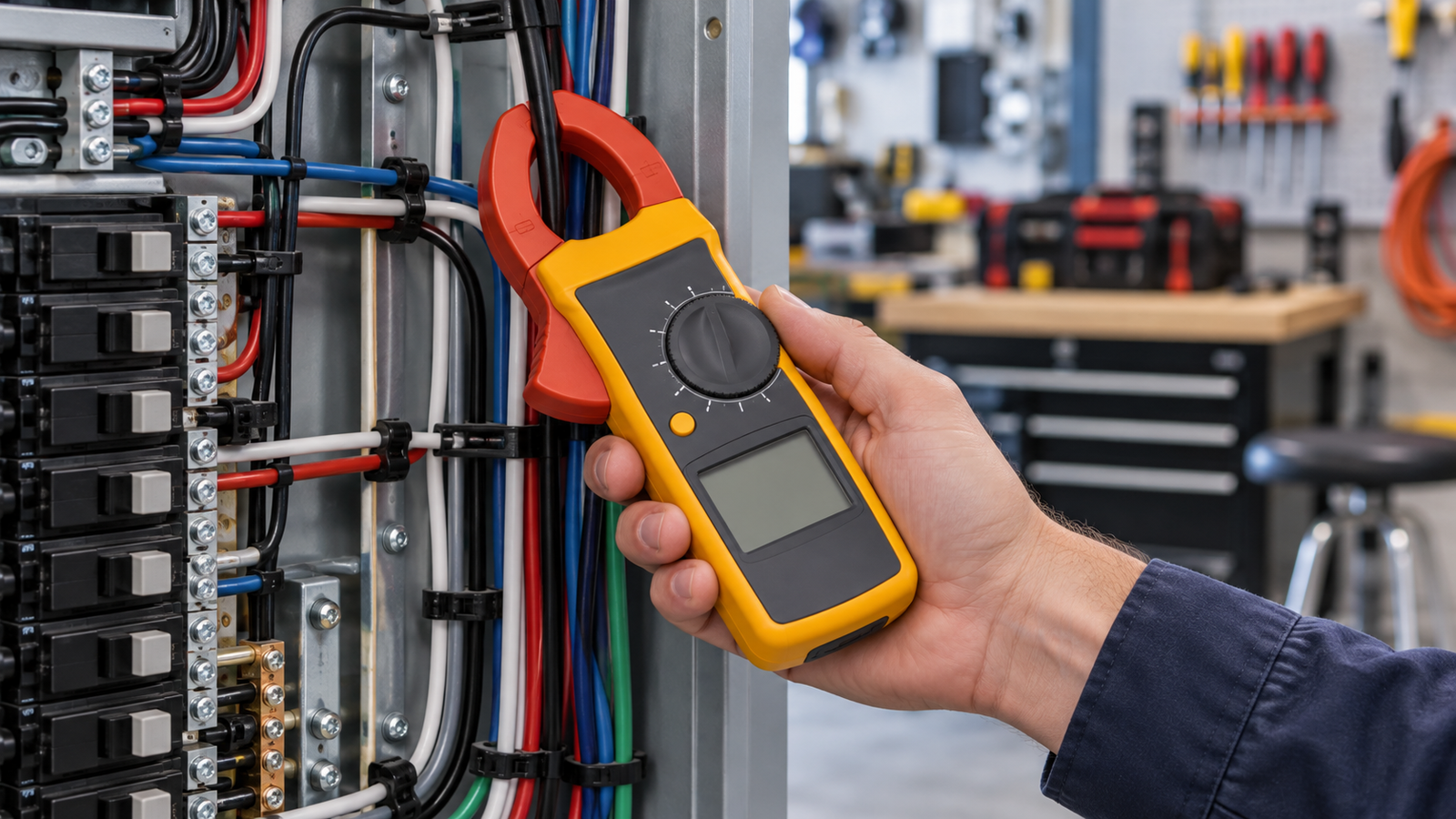
A clamp meter measures current without breaking the circuit. You open the jaw, close it around one conductor, and read the current on the display. The 321 does this for AC current only. The specification table in the calibration information lists one current function, “A” with an AC range from 0 to 400.0 A, and the instruction card shows the same range. The documents do not list a DC current function for the 321.
For background on how the jaw works, see How Clamp Meters Work. The same meter also has voltage and resistance functions. The instruction card lists AC and DC voltage ranges of 0 to 400.0 V and 400 to 600 V. A continuity function is also listed. Continuity is a simple check for a closed path, and the instruction card lists it as a separate function on the rotary switch.
The 321 has a jaw opening of 1 inch (26 mm). That is the largest conductor the jaw can close around. A conductor that is bigger than the jaw cannot be measured with this meter. The documents do not say how the jaw size relates to conductor insulation thickness, so do not assume that a cable of a given gauge will fit.
Accuracy: what the figures mean
Fluke gives accuracy as a percentage of reading plus a number of counts. Counts are the smallest step on the display. For AC current, the documents state 1.8% plus 5 counts at 50 to 60 Hz. At 60 to 400 Hz, the figure rises to 3.0% plus 5 counts. In practice this means the reading is less certain when the frequency is higher, and small readings have a larger error relative to the reading.
The calibration information adds a temperature note. Accuracy applies at 23 °C plus or minus 5 °C and 0 to 90% relative humidity. Outside 18 °C to 28 °C, the documents say to add 0.1 times the specified accuracy for each degree C. A meter used in a cold garage or a hot attic will therefore have a wider error band than the figures above.
The documents also list the average AC response. An average-responding meter is calibrated to read the average value of a waveform and scale it to a sine wave. A true-RMS meter reads the heating value of the waveform. For a clean sine wave the two give similar results. For distorted waveforms, such as those from variable-speed drives or electronic loads, they can differ. The sources do not say how large the difference would be on the 321, so this post does not make that claim.
Safe use: read the limits first
Electrical measurement can kill. The 321 is rated CAT III 600 V. CAT III describes equipment in fixed installations such as distribution panels, feeders, short branch circuits and lighting systems in large buildings. The category rating tells you the transient voltage the meter is designed to withstand. It does not make the meter safe on every circuit. Check the rating against the circuit before connecting anything.
The safety sheet gives these limits:
- Never use the meter on a circuit with voltages higher than 600 V, or a frequency higher than 400 Hz fundamental. The meter may be damaged.
- Never measure current while the test leads are inserted into the input jacks.
- Use extreme caution when working around bare conductors or bus bars.
- Use caution when working with voltages above 60 V DC or 30 V AC. Such voltages pose a shock hazard.
- Avoid working alone so assistance can be rendered.
- Do not use the meter or test leads if they look damaged.
The calibration information adds a check before each use. Inspect the case for cracks or missing plastic, and pay attention to the insulation around the connectors. Verify that the meter works by measuring a known voltage. If the meter behaves abnormally, stop using it. The protection may be impaired.
Work on mains panels, service entrances and live equipment belongs with a licensed electrician. A clamp meter is a diagnostic tool. It is not a substitute for a lockout procedure, and it does not tell you that a circuit is dead.
Power and battery
The calibration information says the meter takes two AAA batteries. It also says to replace them as soon as the low battery indicator appears, because weak batteries can give false readings. Disconnect the test leads before opening the battery door. The instruction card lists an automatic power-off after 30 minutes, which helps save the batteries when the meter is left on by mistake.
Environment and build
The documents give an IP rating of 40, an operating temperature of -10 °C to 50 °C, and a storage range of -40 °C to 60 °C. The altitude rating is 2000 m. These figures tell you the meter is suited to indoor and sheltered work. They do not describe how the meter performs in wet, dusty or outdoor conditions beyond the IP40 figure.
For cleaning, the calibration information says to use a damp cloth with mild detergent, and to remove all input signals first. It warns against aromatic hydrocarbons and chlorinated solvents, which can damage the plastic case.
Who the 321 suits
Based on the stated figures, the 321 fits a user who needs a simple AC current check on a conductor that fits the 1-inch jaw, with basic voltage and continuity checks as secondary functions. For a wider comparison of clamp meter types and what each function means, see Best Clamp Meter: AC Current, True RMS and Logging Compared. The clamp meter vs multimeter guide explains when a clamp is the right tool instead of a multimeter. The meter is not described for DC current, for true-RMS work on distorted waveforms, or for measurements above the stated ranges.
A user who needs DC current, inrush readings, or a stated true-RMS function should check other models. Those functions are not in the three documents for the 321, so the post does not claim them.
Buying checklist
- Current range: 400 A AC is the stated maximum. Confirm that your largest expected current is well below it.
- Jaw size: 1 inch (26 mm). Check the conductor or bundle diameter before you buy.
- CAT rating: CAT III 600 V. Match the rating to the circuit, not to the meter’s price or reputation.
- Waveform: the documents describe average AC response. If your work involves distorted waveforms, verify the function you need in a Fluke document before buying.
- Batteries: two AAA cells, with a low battery indicator.
- Accessories: the documents do not list included test leads. Check whether the test leads carry a CAT rating equal to or higher than the meter’s rating.
Mistakes to avoid
- Measuring current with the leads in the jacks. The safety sheet says this is not allowed, so unplug the leads before using the current function.
- Trusting the meter on a damaged case. The safety sheet says not to use the meter if the case or leads look damaged.
- Ignoring the temperature band. The stated accuracy applies within 18 to 28 °C. Outside that band the error increases.
- Expecting DC current. None of the three documents gives a DC current function for the 321.
- Using the meter above 600 V. The documents set this as the upper limit for the meter.
How we chose
This post covers one model: the Fluke 321. It is based on three Fluke documents that we opened and could read in full text on 2026-10-27: the instruction card (PN 1615194, Rev 1, 7/05), the English safety sheet, and the 32X calibration information (PN 1631636, October 2001). Each document is a third-party copy hosted outside Fluke’s own site. The copies were checked against the stated part numbers and dates. We did not rank the 321 against other meters, and we did not choose it for any reason beyond the question it answers.
What we could not verify
- The documents do not state a true-RMS function for the 321. They describe an average AC response only.
- The documents do not state a DC current range for the 321.
- The documents do not give a conductor insulation rating or the maximum cable diameter that fits the jaw beyond the 26 mm opening.
- The documents do not give a warranty period for a particular unit. Check the warranty terms with the seller or with Fluke directly.
- The three copies are third-party copies. We did not confirm them against Fluke’s own file server. Where a figure matters for your work, check it in the original document from Fluke.
FAQ
What is the maximum AC current the Fluke 321 measures?
The documents state an AC current range of 0 to 400.0 A. They do not state a DC current range for this model.
What CAT rating does the Fluke 321 carry?
The instruction card and calibration information state CAT III 600 V, pollution degree II. CAT III is for fixed installations such as distribution panels and branch circuits.
Is the Fluke 321 a true-RMS meter?
The documents do not describe the 321 as true-RMS. They describe an average AC response. Check the function you need before buying.
How many batteries does the Fluke 321 use?
Two AAA batteries, according to the calibration information. Replace them when the low battery indicator appears.
Can I measure current with the test leads plugged in?
No. The safety sheet says never to measure current while the test leads are inserted into the input jacks.
Bottom line
If you need a simple AC clamp meter with a 400 A range, a 1-inch jaw and a CAT III 600 V rating, the Fluke documents support the 321 for that job. Before you buy, confirm that you do not need DC current or a true-RMS function, because the three documents do not describe either.
Sources
- Fluke Corporation, “321, 322 Clamp Meter Instruction Card,” PN 1615194, Rev 1, 7/05. Third-party copy: https://core.instrumart.com/assets/320-manual.pdf. Opened 2026-10-27.
- Fluke Corporation, “321, 322 Clamp Meter Safety Sheet” (English). Third-party copy: https://docs.rs-online.com/2a66/0900766b801fba43.pdf. Opened 2026-10-27.
- Fluke Corporation, “32X Clamp Meters Calibration Information,” PN 1631636, October 2001. Third-party copy: https://docs.rs-online.com/06b3/0900766b801fba34.pdf. Opened 2026-10-27.