Fluke 333 Explained: What It Measures, Ratings and Safe Use
As an Amazon Associate we earn from qualifying purchases.
Fluke 333 Explained: What It Measures, Ratings and Safe Use
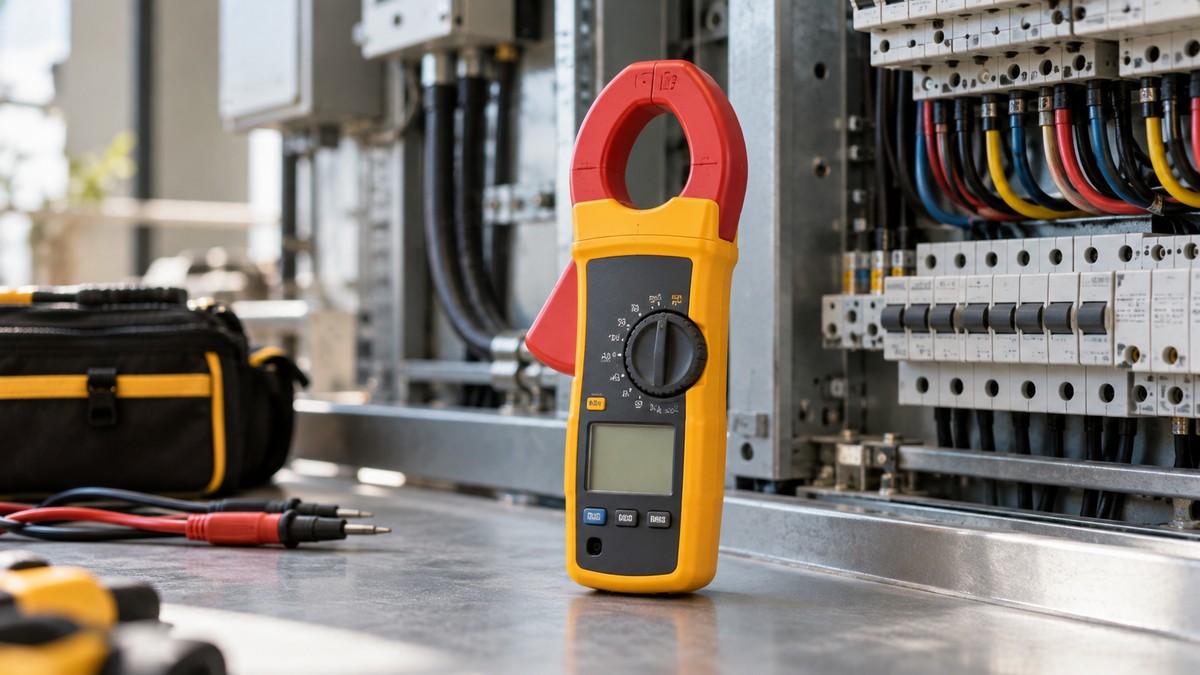
The Fluke 333 is a clamp meter. You open the jaws around one insulated conductor to read AC current, and you use the input jacks for AC and DC voltage and resistance. The Fluke documents we opened print an AC current range of 0 to 400 A for the 333 and a CAT III 600 V rating. This page covers those figures, the safety steps Fluke asks for before use, and the checks to make before you buy a 333 rather than a 334 or 335.
Quick answer
- The 333 reads AC current from 0 to 400 A through its jaws. The 334 and 335 are listed to 600 A on the same instruction card.
- The calibration information lists voltage ranges up to 600 V for the 333.
- Fluke’s printed rating is CAT III 600 V, pollution degree II.
- Read the 333-337 Clamp Meter Safety Sheet before the first use, and do not use the meter on a circuit above 600 V or above 400 Hz.
What the 333 measures
The 333 is the basic member of the 333, 334, 335, 336 and 337 clamp meter family that Fluke covers in its instruction card and calibration document. The instruction card shows the 333 with an AC current range of 0 to 400 A, and the 334 and 335 with 0 to 600 A. The calibration document gives the AC current accuracy for the 333 as 2 percent plus 5 counts at 50 and 60 Hz. It also lists voltage ranges up to 600 V, labelled K and L, with a 1 percent plus 5 count accuracy on the K range.
The calibration table marks the second current row, labelled A, as not applicable for the 333, 334 and 335. The documents we opened therefore do not give a second current range for this model. In plain terms, the printed data describes an AC current clamp with voltage inputs. If you need a DC current or starting-current function, check the model list before you buy.
Clamp meters are used for jobs where you need current on a single insulated conductor without breaking the circuit. The Fluke documents do not give a list of trades or jobs for the 333, so treat any use case you read elsewhere as an assumption to verify.
Published ratings and figures
The table below uses only figures printed in the three documents we opened. Where a document does not state a figure, the cell says so.
| Item | What the Fluke documents state | Where it is printed |
|---|---|---|
| AC current range | 0 to 400 A for the 333; 0 to 600 A for the 334 and 335 | Instruction card; calibration information |
| AC current accuracy | 2 percent plus 5 counts at 50 and 60 Hz | Calibration information |
| Voltage ranges | 0 to 600 V, listed as ranges K and L | Calibration information |
| Safety category | CAT III 600 V, pollution degree II | Instruction card; calibration information |
| Second current row (A) | Not applicable for the 333, 334 and 335 in the calibration table | Calibration information |
| Backlight | Shown on the instruction card against the 334 and 335 only | Instruction card |
| Battery life and weight | Not stated in the three documents we opened | Not applicable |
Safe use before you connect it
The safety sheet is the document Fluke asks you to read first. It applies to the 333, 334, 335, 336 and 337. Its English warnings include these points, which you should follow every time:
- Never use the meter on a circuit with voltages higher than 600 V or a frequency higher than 400 Hz.
- Never measure current while the test leads are inserted into the input jacks.
- Avoid working alone so that assistance can be given if something goes wrong.
- Use caution with voltages above 60 V DC or 30 V AC, because such voltages pose a shock hazard.
The calibration information also says to replace the batteries as soon as the low battery indicator appears.
Panel and service work belongs to a licensed electrician. A clamp meter with a CAT III 600 V rating is not a substitute for that training.
What to check before you buy
- Confirm the model number. The 333 and the 334 or 335 are printed with different current ranges on the instruction card. Buying the wrong one changes your maximum current by 200 A.
- Match the rating to your circuit. The printed rating is CAT III 600 V. The documents do not rate the 333 above that level, so do not plan work above it with this meter.
- Check the backlight need. The instruction card shows the backlight against the 334 and 335. If you work in dim spaces, read the current product page before you rely on a 333.
- Check the document date. The three documents we opened are dated between 2001 and 2005. Ask the seller for the current manual or product page before you buy, and confirm that the model is still sold.
How we chose
This explainer covers one model because the 333 is a specific meter people search by its number. We opened three Fluke documents for the 333 on 2026-10-27 and used only the figures they print. Two of the three are third-party copies of Fluke documents, hosted by Instrumart and RS Online. The safety sheet is hosted on Fluke’s own asset server. We did not use Amazon, retailer pages, Wikipedia or forums for any figure.
What we could not verify
We did not open a current user manual for the 333, so the feature list above comes from the instruction card and the calibration document only. The three documents do not give battery life, weight, dimensions or a current accuracy table for the 333 in the form a user manual would. They also do not say whether the 333 is still in production, and we did not check current availability.
Mistakes to avoid
- Using the 333 on a circuit above 600 V, which the safety sheet lists as the limit.
- Leaving the test leads in the input jacks while you measure current, which the safety sheet lists as a warning.
- Assuming the 333 has the same current range as the 334 or 335. The instruction card prints 400 A for the 333 and 600 A for the 334 and 335.
- Trusting a weak battery. The calibration information tells you to replace it as soon as the low battery indicator appears.
FAQ
Is the Fluke 333 rated for household mains?
Fluke prints a CAT III 600 V rating for the 333. The calibration information describes CAT III equipment as designed to protect against transients in fixed-equipment installations, and it sets 600 V as the limit for this rating. A printed rating does not make panel or service work safe for an untrained person. Use the meter only on circuits you understand, and leave panel work to a licensed electrician.
Does the Fluke 333 measure DC current?
The calibration information marks the second current row as not applicable for the 333, so the documents we opened do not show a DC current range for this model. If you need DC current, check the product page for a different model before you buy.
What is the difference between the 333 and the 334 or 335?
According to the instruction card, the 333 is listed to 400 A and the 334 and 335 are listed to 600 A. The backlight is printed against the 334 and 335. The documents we opened do not give a full side-by-side table, so read the instruction card for the exact feature set before you decide.
Does the 333 have a backlight?
The instruction card shows the backlight against the 334 and 335, and the 333 is not listed with one. If you need a backlit display, read the current product description before buying.
What should I read before the first use?
Read the 333-337 Clamp Meter Safety Sheet, then the instruction card. The safety sheet covers voltage limits, current measurement warnings and the caution level for voltages above 60 V DC or 30 V AC. The instruction card covers the controls and the low battery warning.
Bottom line
Confirm the model number, keep the 333 within its CAT III 600 V rating, and read the safety sheet before the first use. If the model number you find is a 334 or 335, the current range and backlight are different on the instruction card.
Related guides
- How to Use a Clamp Meter Safely, Step by Step covers the general clamp meter steps.
- What Is a CAT Rating on a Multimeter explains the category numbers used on this page.
- Best Clamp Meter for Motors compares meters for motor current checks.
Sources
- Fluke Corporation, “333, 334, 335 Clamp Meter Instruction Card”, PN 1549865, April 2001 Rev. 3, 6/05. Third-party copy hosted by Instrumart: https://www.instrumart.com/assets/333-334-335-manual.pdf. Opened 2026-10-27.
- Fluke Corporation, “33X ClampMeters Calibration Information”, PN 1618765, June 2001 Rev. 2, 12/03. Third-party copy hosted by RS Online: https://docs.rs-online.com/a1d0/0900766b8042d49a.pdf. Opened 2026-10-27. Written for qualified calibration personnel.
- Fluke Corporation, “333, 334, 335, 336, 337 Clamp Meter Safety Sheet”, PN 1565146, April 2001 Rev. 2, 11/01. Fluke-hosted: https://assets.fluke.com/manuals/333_____sseng0200.pdf. Opened 2026-10-27.
As an Amazon Associate we earn from qualifying purchases.