Klein CL1000 Clamp Meter: Specs, Safe Use and Buying Checks
As an Amazon Associate we earn from qualifying purchases.
Klein CL1000 Clamp Meter: Specs, Safe Use and Buying Checks
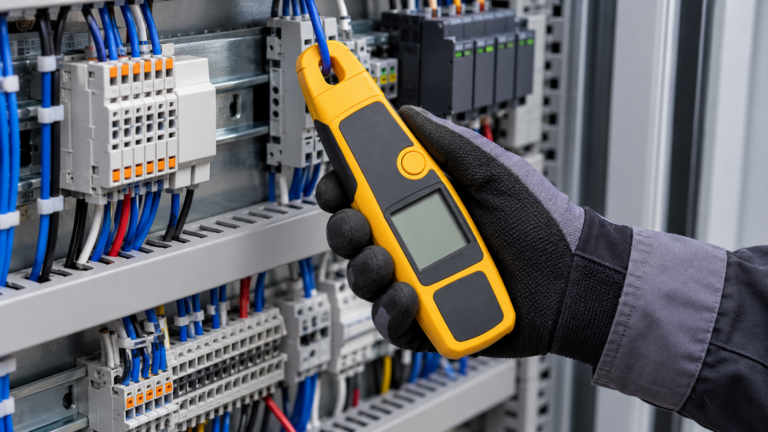
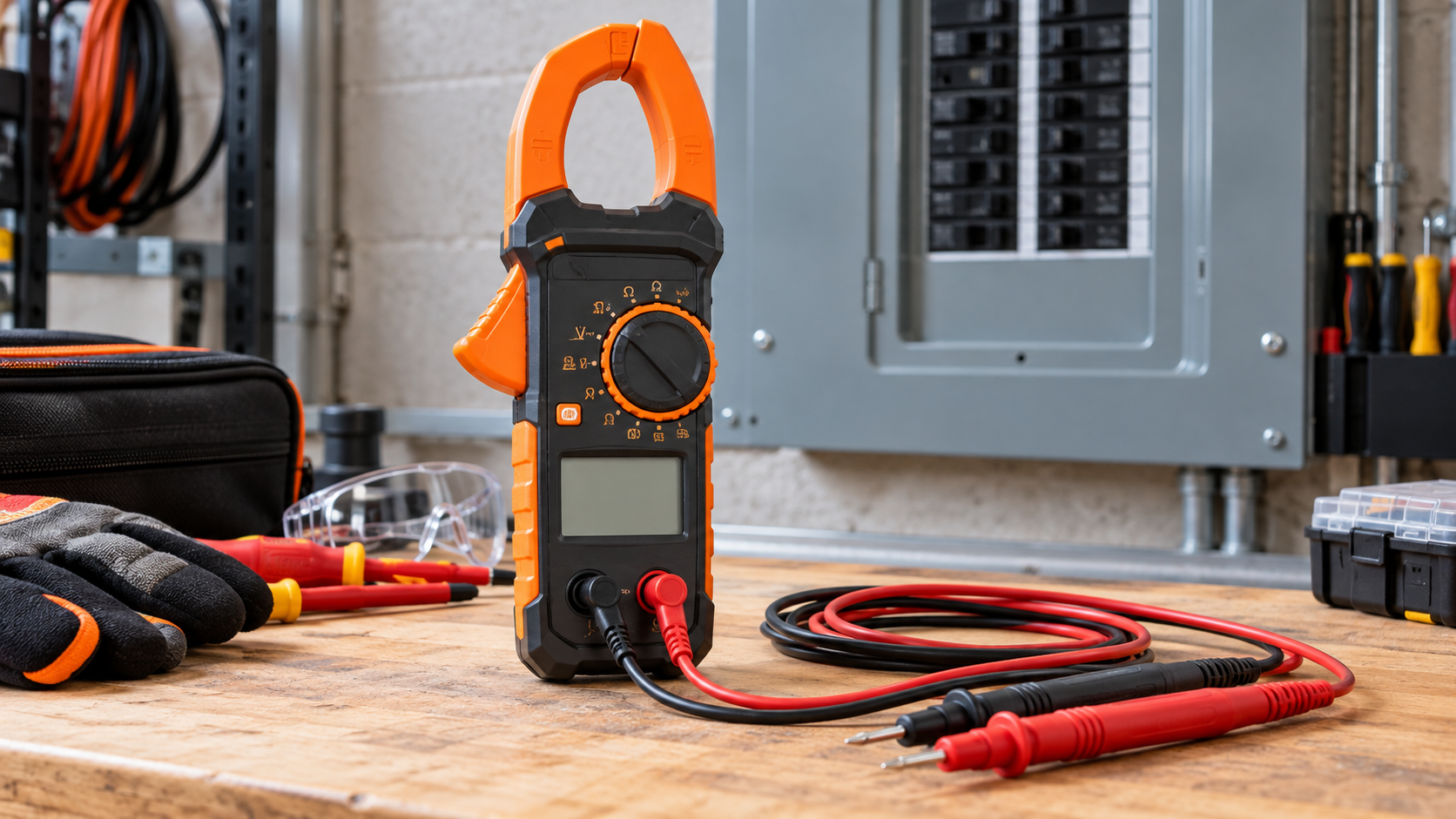
The Klein Tools CL1000 is an auto-ranging clamp meter. It measures AC current by clamping around one conductor, and it also measures AC and DC voltage, DC current at small levels, resistance, capacitance, frequency, and duty cycle through its test leads. The manual rates it CAT III 600V. Read the rating before you connect it to any circuit, because a meter’s category rating limits the circuits it is safe to use on.
How we chose
This post covers one model, the Klein Tools CL1000. A figure is included only when the manufacturer’s document states it. We opened three copies of the CL1000 manual family on 2026-10-27: the English manual on a third-party host, and the Spanish and Portuguese manuals on a Klein host. All three show the same revision, Rev. 11/13 B. Retail listings and memory were not used for any figure, and this post does not compare the CL1000 against other clamp meters.
Quick answer
- What it does: a clamp meter for measuring AC current without breaking the circuit, plus a standard set of voltage, resistance and continuity functions.
- Safety rating: the Klein manual states “Safety Rating: CAT III 600V.” Do not use it on a circuit whose category is above that rating.
- Current range: the manual lists AC current up to 400A on the clamp, with lower AC/DC current ranges through the test leads.
- Before you buy: confirm that the rating, current range and features match your work, and check the manual for the exact limits.
What the Klein manual says the CL1000 measures
The Klein Tools CL1000 Instruction Manual (document 139537T, Rev. 11/13 B) describes the meter as an auto-ranging clamp meter that measures AC and DC voltage, AC and DC current, resistance, capacitance, frequency and duty cycle. It can also test non-contact voltage, diodes and continuity.
The main ranges listed in the electrical specifications are:
| Function | Range stated in the manual | Notes from the manual |
|---|---|---|
| AC current (clamp) | 40A and 400A ranges | Clamp around one conductor; the manual says to center the wire in the guides for best accuracy |
| AC/DC current (small) | 400 µA and 2000 µA ranges | Test-lead input; current above 2000 µA will damage the instrument |
| AC voltage | 400 mV to 750V AC | Overload protection 750V RMS; frequency response 40 to 400 Hz |
| DC voltage | 400 mV to 1000V DC | Overload protection 1000V |
| Resistance | 400 Ω to 40 MΩ | Overload protection 600V RMS; the manual says not to measure resistance on a live circuit |
| Capacitance | 40 nF to 4000 µF | The manual says to safely discharge the capacitor first; large capacitors can take up to 60 seconds |
| Frequency | 9.999 Hz to 999.9 kHz | Frequencies above 1 MHz display “0.000Hz” |
| Duty cycle | 0.1% to 99.9% | Read in the frequency mode |
| Diode test | Up to 2.0V | Open-circuit voltage below 1.6V DC |
| Continuity | Buzzer below 30 | Open-circuit voltage below 0.44V |
| Non-contact voltage | About 25V AC | Detector on-voltage stated in the manual |
The display is a 3-3/4 digit LCD with 3999 counts, according to the front-panel label in the manual. The manual also lists a backlight and a worklight, auto/manual range, data hold, max/min, and a bar graph.
Reading the category rating
The category rating matters more than any single number on the front of the meter. The manual says: “Never use the meter on a circuit with voltages that exceed the category based rating of this meter.” It also says to use CAT III rated leads or higher, and it warns that the meter should not be used during electrical storms or in wet weather.
Think of the CAT rating as a limit on where the meter may be used, not only on how much voltage it can read. A CAT III 600V rating means the meter is designed for the category and voltage the manual states. If the circuit you are measuring is a different category, or has a higher voltage than the rating, the meter is not the right tool for that job.
Klein also states two additional limits in the fine print of the feature notes: do not attempt to measure more than 1000V DC or 750V AC or 2000 µA, and use caution with voltages above 60V DC or 25V AC RMS, which the manual describes as a shock hazard.
Safe use steps from the manual
The manual lists several steps that apply to any measurement with this meter:
- Before each use, verify the meter works by measuring a known voltage or current.
- Inspect the meter and test leads. Do not use them if they appear damaged.
- Make sure the leads are fully seated, and keep your fingers away from the metal probe contacts while measuring.
- Do not open the meter to replace batteries while the probes are connected.
- Replace the batteries when the low-battery indicator appears, because low batteries can produce false readings.
- For resistance or capacitance, shut off and lock out power to the circuit first. The manual says to do this unless you are measuring voltage or current.
- Keep hands below the line when measuring high current levels, as the feature details recommend.
These steps are the manufacturer’s instructions, not a complete safety plan. Work on live panels, service equipment, or any circuit you are not qualified to handle belongs to a licensed electrician. Do not use this meter to test a panel or service connection as a beginner. The manual’s warnings are part of the rating, so follow them every time.
How to use the clamp for current
Clamp meters are useful because the jaws measure current without breaking the circuit. The manual says to center one conductor in the jaw guides for the best accuracy, and it notes that opposing currents cancel out. If two conductors carry current in opposite directions through the same jaw, the reading can be low or zero. The manual suggests a line splitter in the USA when this happens.
The manual also states the accuracy for each range. For example, the 400A AC range is listed at plus or minus 1.9% of reading plus 8 digits, and the 40A range at plus or minus 2.9% plus 15 digits. The exact accuracy statement is in the electrical specifications section of the manual, and it should be read in full before you rely on a number.
Current above 2000 µA will damage the instrument when you use the small-current input. Use the clamp for large currents and the test-lead input only for small current measurements within the stated range.
Features that help in daily use
The manual lists several convenience features. Auto Power-Off shuts the meter down after 30 minutes of non-use, and you can disable it by holding the select button while turning the meter on. The Max/Min function saves the largest and smallest readings. Data hold freezes the display. The meter has a magnetic back for hands-free use on metal surfaces. The manual also says the worklight only works during AC current measurement.
Battery life is affected by the lights. The manual says that using the backlight or worklight drains the battery significantly. The meter takes two AAA batteries.
What the manual states about size and environment
The manual gives the following physical and environmental figures:
- Dimensions: 8.875 by 3.375 by 1.5 inches (225 by 86 by 38 mm)
- Weight: 11 oz. (303 g)
- Operating temperature: 0°C to 45°C (32°F to 113°F)
- Storage temperature: 0°C to 60°C (32°F to 140°F)
- Humidity: 80% maximum
- Operating altitude: 2000 meters
- Calibration: accurate for one year
Store the meter with the batteries removed if it will sit unused for a long period. Clean it with a damp cloth and do not use abrasive cleaners or solvents. The manual says to allow the meter to return to normal operating conditions after storage in extreme temperatures before using it.
Buying checklist
Before you buy a CL1000, check these points against your own work:
- Category rating: the manual states CAT III 600V. Confirm that this rating covers the circuits you plan to measure.
- Current needs: the clamp covers AC current up to 400A. If your work involves DC current through the clamp, the manual does not describe a DC clamp measurement; it lists DC current through the test-lead input only, in the 400 µA and 2000 µA ranges.
- Voltage needs: the manual lists AC voltage to 750V and DC voltage to 1000V.
- True RMS: the manual we opened does not state whether the meter is true RMS. Do not assume it is, and check the manual or the seller’s listing for that feature before you rely on it for non-sinusoidal waveforms.
- Jaw size: the manual copy we opened does not state the jaw opening. Check the jaw size before buying if you need to clamp a large cable or a bundle of wires.
- Lead rating: the meter uses CAT III rated leads or higher. Confirm the leads you own carry at least that rating.
- Model match: check that the model you are looking at is the CL1000 described here, using the model number and document number on the box or manual.
Mistakes to avoid
- Ignoring the category rating. A meter rated CAT III 600V is not a substitute for a meter rated for a higher category on a higher-energy circuit.
- Measuring resistance on a live circuit. The manual says not to do this. Power must be off and locked out for resistance and capacitance readings.
- Clamping around both conductors of a cable. The manual says opposing currents cancel, so the reading will not show the current you expect.
- Overloading the small-current input. Current above 2000 µA will damage the instrument.
- Using the meter with low batteries. The manual warns that low batteries can cause false readings that lead to shock.
- Forgetting the capacitor discharge step. The manual says to discharge a capacitor before measuring capacitance.
What we could not verify
The manual copies we opened do not state the following, so this post does not claim them:
- A true RMS rating.
- The jaw opening.
- The exact clamp dimensions for conductors.
- Any independent comparison with other clamp meters.
The three documents we opened do not address these points, so treat them as open questions for the manufacturer or the seller.
FAQ
Is the Klein CL1000 safe for household mains? The manual rates the meter CAT III 600V. Whether that suits a given job depends on the circuit’s category and voltage. Follow the manual’s warnings, and leave panel and service work to a licensed electrician.
Can the CL1000 measure DC current through the clamp? The manual describes AC current through the clamp, up to 400A. DC current is listed through the small-current input, in the 400 µA and 2000 µA ranges. Check the manual before you assume a DC clamp measurement.
What is the difference between the 40A and 400A AC current ranges? Both are AC current ranges listed in the manual. The 40A range has a finer resolution of 0.01A, while the 400A range resolution is 0.1A. Use the range that matches the current you expect, or let the meter auto-range.
Does the CL1000 have a non-contact voltage tester? Yes. The manual lists a non-contact voltage detector with an on-voltage of about 25V AC. A non-contact detector is a quick check, not a substitute for a voltage measurement with the leads.
How long does the battery last? The manual does not state a battery life figure. It says the backlight and worklight drain the battery significantly and that the meter takes two AAA batteries.
Where should I find the official manual? The English copy we opened for this post is a third-party host, and the Spanish and Portuguese copies are on a Klein host. Compare the document number and revision before you rely on any copy.
Bottom line
Choose the CL1000 only if its CAT III 600V rating, AC current range and features match your job, and follow the manual’s safety steps every time you use it.
Related guides
Sources
- Klein Tools, CL1000 Instruction Manual, document 139537T, Rev. 11/13 B, English. Third-party copy hosted on images10.newegg.com: https://images10.newegg.com/UploadFilesForNewegg/itemintelligence/Columbia/CL1000_Manual_English1447847958093.pdf. Opened 2026-10-27.
- Klein Tools, CL1000 Manual SP (Spanish), document 139538T, Rev. 11/13 B. Klein host: https://data.kleintools.com/sites/all/product_assets/documents/instructions/klein/CL1000_Manual_SP.pdf. Opened 2026-10-27.
- Klein Tools, CL1000 Manual PT (Portuguese), document 139814. Klein host: https://data.kleintools.com/sites/all/product_assets/documents/instructions/klein/CL1000_Manual_PT.pdf. Opened 2026-10-27.