Klein CL380 Clamp Meter: What the Manual Says
As an Amazon Associate we earn from qualifying purchases.
Klein CL380 Clamp Meter: What the Manual Says
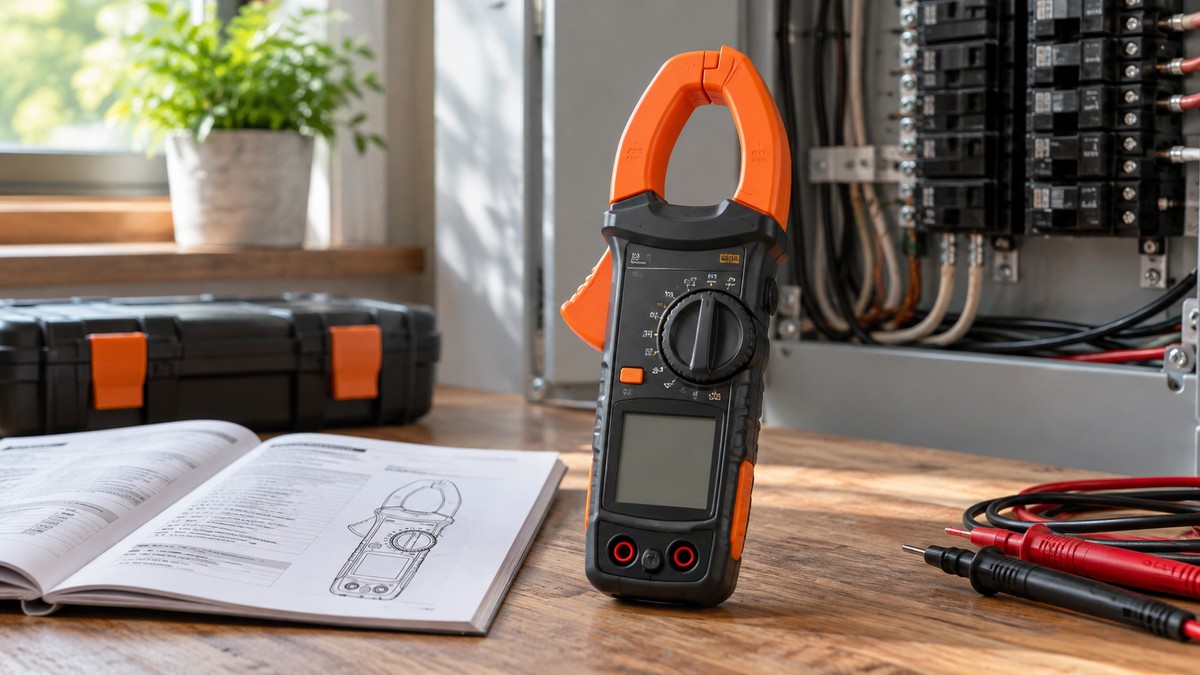
The Klein CL380 is an auto-ranging, true RMS digital clamp meter that measures AC and DC current through its jaw, along with AC and DC voltage, resistance, continuity, capacitance, frequency, diodes and temperature. Its stated current range is 400 A AC/DC, and its safety rating is CAT III 600 V. It suits someone who needs to read current on a live conductor without breaking the circuit. It is not a fit for household mains work without the proper training and a meter rated for the circuit, and the manufacturer lists the model as no longer in production.
Quick answer
- What it does: AC/DC current through the clamp, plus voltage, resistance, continuity, capacitance, frequency, diode and temperature readings, as listed in the Klein manual.
- Stated ratings: CAT III 600 V, Class 2, double insulation. The manual says to use only CAT III or CAT IV rated test leads.
- Status: Klein’s product page says the CL380 is no longer in production and names the CL390 as its successor.
- Before you buy: confirm you need a clamp reading (not just a voltage check), confirm the CAT rating covers your circuit, and check whether a replacement or a current model fits your budget.
What the CL380 is built to measure
A clamp meter reads current by sensing the magnetic field around a single conductor, so you do not have to open the circuit or put a probe in series with the load. That is the main reason people reach for a clamp instead of a multimeter. The Klein manual describes the CL380 as an automatically ranging true RMS digital clamp meter, which means the meter picks the measurement range on its own and reports the true root mean square value of the waveform rather than an average-responding estimate.
The manual gives these electrical ranges and limits for the main functions:
- AC current: 40.00 A and 400.0 A ranges, listed with an accuracy of 2.0% plus 9 digits. The manual lists a frequency range of 50 to 60 Hz for the current function.
- DC current: 400.0 A range with a 0.1 A resolution.
- Minimum current measurable: 0.3 A AC or DC, according to the manual.
- DC microamps: 200 µA range, resolution 0.1 µA, accuracy 1.0% plus 5 digits. Klein’s product page also lists this 200 µA DC microamp function.
- AC voltage: ranges from 400.0 mV up to 600 V, with a listed input impedance of about 10 MΩ and a frequency range of 45 to 400 Hz.
- DC voltage: ranges up to 600 V, with a maximum input of 600 V AC RMS or 600 V DC.
- Resistance: 400.0 Ω up to 40.00 MΩ.
- Capacitance: from 40.00 nF up to 4.000 mF.
- Temperature: measured with a thermocouple probe, with ranges stated in both °F and °C in the manual.
- Diode test: about 1 mA with an open circuit voltage of about 3.0 V DC.
- Continuity: an audible signal below 10 Ω, with a maximum current of 1.5 mA.
The display is listed as a 3-3/4 digit, 4000 count LCD. The manual also lists a sampling rate of 3 samples per second and an auto power-off after about five minutes of inactivity. The meter shows “OL” on overrange and a minus sign for negative polarity.
Safety ratings you need to read first
Safety comes before any measurement. The manual lists the CL380 as CAT III 600 V, Class 2, double insulation. CAT III is the measurement category the manual describes as applying to test and measuring circuits connected to the distribution part of a building’s low-voltage mains installation. The manual also says the meter is certified to IEC EN 61010-1, 61010-2-032 and 61010-2-033, and to the UL and CSA versions of those standards.
Those ratings are a ceiling, not a target. A CAT III 600 V rating does not mean the meter is suitable for every job on a 600 V system. Confirm the category of the point you are measuring, and do not use the meter on a circuit whose voltage or category is above what it is rated for. The manual states that the meter should never be used on a circuit with voltages that exceed its category rating.
Several specific warnings from the manual are worth repeating in plain language:
- Check the meter on a known voltage or current before each use.
- Do not use the meter during electrical storms or in wet weather.
- Do not use the meter or the test leads if they look damaged.
- Use only CAT III or CAT IV rated test leads.
- Use caution with voltages above 25 V AC RMS or 60 V DC, which the manual calls a shock hazard.
- Do not attempt to measure resistance or continuity on a live circuit.
- Replace batteries when the low battery indicator appears, because the manual warns that low batteries can cause false readings that lead to shock.
- Disconnect the leads from any voltage source before removing the battery door, and do not operate the meter with the battery door off.
Working on mains circuits can cause serious injury or death. If a task involves a service panel, a live feeder, or any circuit you are not sure how to isolate, stop and call a licensed electrician. A clamp meter does not make an unsafe task safe.
Non-contact voltage and the other functions
The manual lists a non-contact voltage (NCV) function among the symbols on the meter, and the Klein product description also refers to non-contact voltage testing. A non-contact check is useful for a quick “is something live here” screen, but it is a screening aid. It does not replace a voltage measurement with leads, and it can miss or misreport in some conditions. Treat any NCV indication as a reason to verify with a proper measurement, not as proof a circuit is dead.
The temperature function uses a thermocouple probe. The manual lists the temperature ranges in both Fahrenheit and Celsius, from -40 °F to 1832 °F and from -40 °C to 1000 °C, with the ranges broken into segments in the specification table. Note that the thermocouple probe is a separate accessory, so check that your kit includes it before you plan a temperature job.
Operating conditions
The manual states an operating altitude of up to 2000 m (6562 ft), a relative humidity below 95% non-condensing, and an operating temperature of 0 to 50 °C (32 to 122 °F). The storage range is -10 to 50 °C (14 to 122 °F). The stated accuracy applies between 18 and 28 °C (65 to 83 °F), and the manual says accuracy corrections are needed outside that range, at 0.1 times the quoted accuracy per degree. The manual lists the pollution degree as 2 and a drop protection rating of 2 m. It also gives the meter’s dimensions as 220 × 77 × 41 mm and its weight as 280 g with batteries.
Buying checklist for a clamp meter like this one
- Match the CAT rating to the work. Read the rating on the meter and the leads. The CL380 is listed at CAT III 600 V.
- Check what the clamp can and cannot read. The listed minimum measurable current is 0.3 A AC or DC, so very small currents need a different tool or the DC microamp function.
- Confirm the functions you need. Capacitance, temperature and diode checks are listed on the CL380, but each one has its own accuracy and range.
- Check the accessories. The manual calls for CAT III or CAT IV rated test leads, and temperature needs a separate thermocouple probe.
- Check the product status. Klein lists the CL380 as no longer in production and points to the CL390. A discontinued model may be harder to find new, and you should decide whether the older specs still meet your need.
Mistakes to avoid
- Using a clamp on a circuit above its category rating. The manual is explicit that the category rating is a limit.
- Measuring resistance or continuity on a live circuit. The manual says not to do this.
- Ignoring the low battery indicator. The manual links low batteries to false readings.
- Assuming an NCV beep means a circuit is dead. Use a proper voltage measurement to confirm.
- Clamping around both conductors of a cable. A clamp reads the net current through the jaw. This point is a general clamp-meter practice rather than a line from the manual, so verify it against your own meter’s guidance before you rely on it.
How we chose
This explainer draws only on three manufacturer sources: Klein Tools’ US product page for the CL380, Klein Tools’ UK product page for the CL380, and the English instruction manual Klein hosts for the CL380. Every specification above is taken from one of those pages or from the manual text. Where the sources do not state a figure, this article does not supply one. Wherever a point is general practice rather than a line from the manual, the text says so.
What we could not verify
- The manual does not state a jaw size, so no jaw diameter is given here.
- The sources do not give a manual document code, revision number or printed date for the English edition we opened, so the text cites the title and the hosting location only.
- The sources do not state a price, a warranty term or a replacement part number, and this article does not cover them.
- The manual’s accuracy figures apply only under the stated conditions. How the meter behaves outside them is not described in the manual.
FAQ
Is the Klein CL380 a true RMS meter?
Yes. The manual describes it as an automatically ranging true RMS digital clamp meter. True RMS matters most when the waveform is not a clean sine wave, because average-responding meters can misread distorted waves.
What is the maximum current the CL380 measures?
The manual lists a 400 A range for both AC and DC current, with a 40.00 A range for AC. The minimum measurable current is listed as 0.3 A AC or DC.
What CAT rating does the CL380 have?
The manual and both Klein product pages list CAT III 600 V, Class 2, double insulation. Use test leads rated CAT III or CAT IV, as the manual instructs.
Can the CL380 measure resistance on a live circuit?
No. The manual says not to attempt resistance or continuity measurement on a live circuit.
Is the CL380 still sold new?
Klein’s product page says the CL380 is no longer in production and names the CL390 as its successor. Check the current listing before you buy.
Does the CL380 measure small DC currents?
It has a DC microamp function listed at 200 µA with a resolution of 0.1 µA. The general current minimum is 0.3 A, so small currents outside the microamp function are not covered by the main current spec.
Bottom line
If you need a CAT III 600 V clamp meter for reading AC or DC current in a non-mains or appropriately rated circuit, the Klein CL380’s manual gives a clear set of stated ranges and warnings. Check the CAT rating against the circuit first, keep the leads and battery in good condition, and treat the discontinued status as a reason to compare it with the current replacement before you commit.
Related guides
- Best clamp meters: a guide to choosing one
- What a CAT rating means on a multimeter
- Clamp meter vs multimeter: which one you need
Sources
- Klein Tools, “Digital Electrical Tester, AC/DC Clamp Meter, Auto-Ranging, 400 Amp (CL380)”, product page, https://kleintools.com/product/CL380 (opened 2026-10-27)
- Klein Tools UK, “Digital Electrical Tester, AC/DC Clamp Meter, Auto-Ranging, 400 Amp – CL380”, product page, https://kleintools.co.uk/product/CL380 (opened 2026-10-27)
- Klein Tools, “CL380 Instruction Manual, 400A AC/DC Auto-Ranging Digital Clamp Meter (English)”, https://data.kleintools.com/sites/all/product_assets/documents/instructions/klein/CL380-EU_Manual.pdf (opened 2026-10-27)