Fluke 287 Multimeter: Uses, Safety Ratings and Specs
As an Amazon Associate we earn from qualifying purchases.
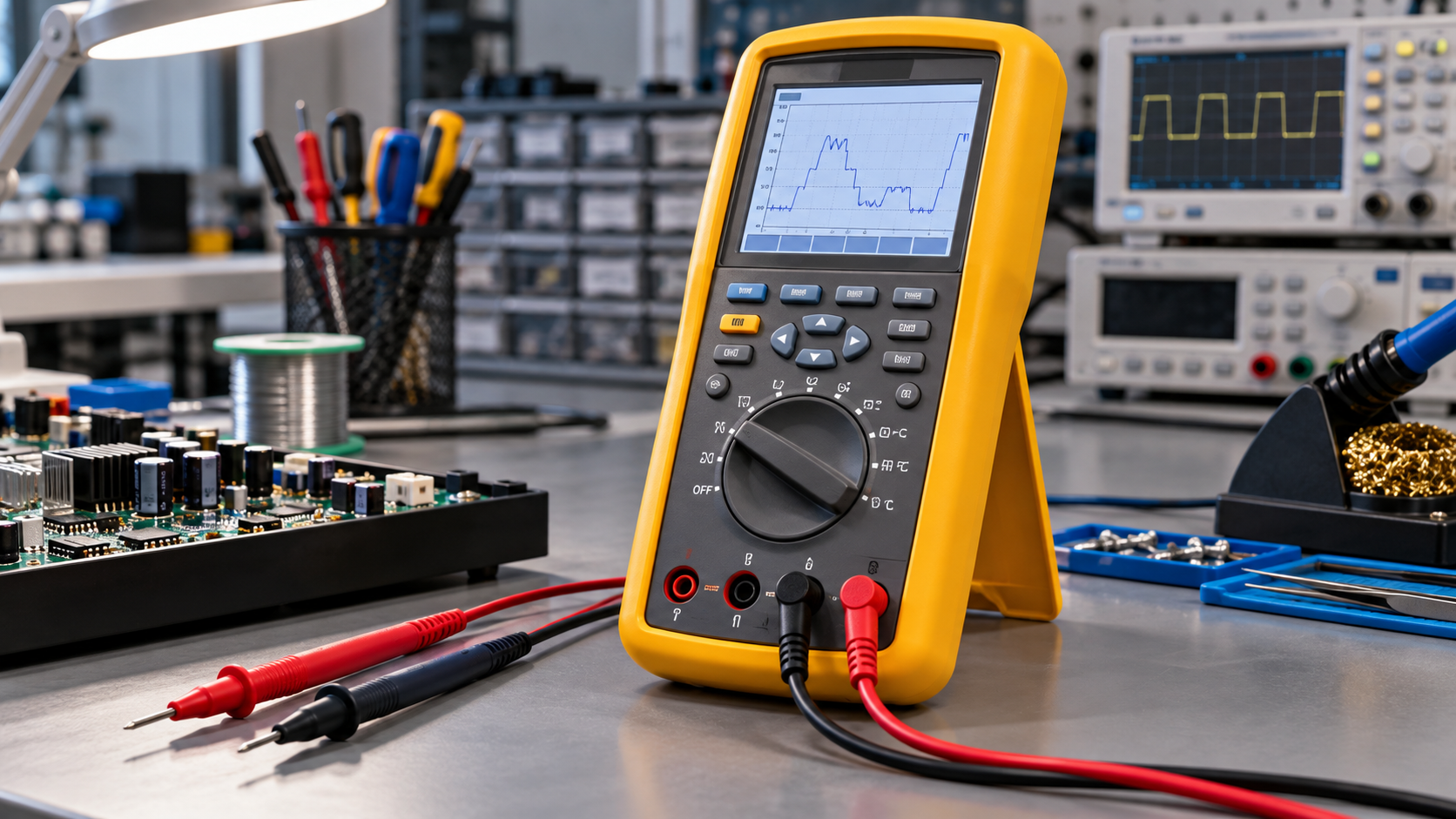
The Fluke 287 is a True-RMS digital multimeter with a data-logging function, a 50,000-count display and a set of fast capture modes. Fluke describes it for electronics and electrical work where readings change quickly and a record of the readings is useful. Its published safety ratings are split into two parts, CAT III 1000 V and CAT IV 600 V, and the category you need depends on where you work. This guide explains what the meter does, how to use it safely, and which figures Fluke states in its own documents.
Quick answer
- Best fit: electronics diagnostics, electrical troubleshooting in buildings, and any job where logged or peak readings are useful.
- Published ratings: CAT III 1000 V and CAT IV 600 V, as stated in the users manual and in the 2018 supplement.
- Current inputs: the mA and µA input is fused, and the A input is fused at 11 A, 1000 V. Check the fuse rating in the manual before replacing a fuse.
- Logging: the product page lists logging capacity in two different ways, so check the figure against the manual before relying on it.
What the Fluke 287 measures
The product page lists the main ranges. AC and DC volts run from 50.000 mV to 1000.0 V. AC and DC current run from 500.00 µA to 10.000 A. Resistance runs from 500.00 Ω to 500.0 MΩ. Capacitance runs from 1.000 nF to 100 mF. Frequency runs from 99.999 Hz to 999.99 kHz, and temperature is listed from -200.0 °C to 1350.0 °C. The AC bandwidth is stated as 100 kHz, and the product page describes True-RMS AC measurement as accurate on complex signals and non-linear loads.
The meter has more features than a basic handheld DMM. The product page describes a 50,000-count, 1/4 VGA display with a white backlight. The users manual includes sections on an Input Alert feature, peak capture, minimum and maximum recording, hold and AutoHold, and crest factor measurement. This guide does not describe how those features behave in detail, so read the relevant manual section before relying on one. These features help when a reading flickers or when a fault appears for a fraction of a second.
Logging is one of the key reasons people buy this model. The product page says battery life is 200 hours in logging mode. The page gives two different memory figures: one states logging memory of up to 10,000 readings in the specification table, while the overview says the meter can store up to 15,000 recorded events. Those figures disagree, so do not treat either one as settled until you have checked the manual edition you are reading.
Safety ratings and what they mean
A CAT rating describes the category of the circuit you measure and the energy that can be available at the point of test. The Fluke manual defines category II, III and IV as separate measurement levels, with category IV for the origin of the installation, such as the service entrance, and category III for the building distribution system, such as a distribution board and fixed wiring. The manual states two ratings for this meter: CAT III 1000 V and CAT IV 600 V. The supplement restates the same pair under IEC 61010-2-033, so the ratings are consistent across the two documents.
In practice, CAT III 1000 V suits measurements inside a building’s fixed wiring, including many panel-board and distribution points, provided you follow the procedures in the manual. CAT IV 600 V suits work at the origin of the installation, where the available energy is highest. The product page gives a maximum voltage of 1000 V between any terminal and earth ground. A higher voltage rating does not make the meter safer at a point where the category is lower. Match the category to the job first, then the voltage.
Fluke also states the meter meets CAN/CSA-C22.2 No. 61010-1-04 and IEC/EN 61010-1 2nd Edition with pollution degree 2 indoor use. These references describe the standard the meter was built to, but they do not replace the operating instructions. Read the safety information in the manual before you connect leads to a live circuit.
Safe use before you start
Electrical measurement can cause shock, arc flash, and injury. The manual’s safety section tells you to use proper protective equipment where the job requires it, and to use only the replacement fuses it specifies. As general practice, inspect the leads and case before each use, and take a cracked case, a damaged lead or a meter that behaves oddly out of service until it has been checked.
Current measurement needs a separate check. The supplement says to check the meter’s fuses before measuring current. The current inputs are protected by fuses, and the replacement fuse must be the one the manual specifies. The supplement lists 0.44 A, 1000 V for the mA and µA inputs, and 11 A, 1000 V for the A input, with interrupt ratings of 10 kA and 17 kA respectively. Use only the replacement fuses specified, because a wrong fuse can fail to protect the meter or the circuit.
A common safe habit, and one this guide recommends rather than a manual instruction, is to check the meter on a known live source before and after a voltage test. That confirms the meter and leads are working. Do not use a single meter reading as proof that a circuit is dead.
Step-by-step: measuring voltage
- Choose the measurement category your job requires, then confirm the meter’s CAT rating covers it.
- Inspect the leads and the meter case. Replace damaged leads before use.
- Check the meter on a known live source, then set the rotary switch to the voltage function you need.
- Connect the black lead to COM and the red lead to the V input, and make sure the leads are fully seated.
- Touch the leads to the circuit, read the display, then remove the leads before changing the function.
For a live circuit, keep your body clear of the conductor, keep your fingers behind the probe guards, and use one hand where you can. If the reading is unexpected, stop, check the function and the input jack, and test again on a known live source before you decide the circuit has a fault.
Specifications Fluke states
| Item | What the sources state |
|---|---|
| Display | 50,000 count, 1/4 VGA, white backlight (product page) |
| AC bandwidth | 100 kHz (product page) |
| Voltage | 50.000 mV to 1000.0 V (product page) |
| Current | 500.00 µA to 10.000 A (product page) |
| Resistance | 500.00 Ω to 500.0 MΩ (product page) |
| Capacitance | 1.000 nF to 100 mF (product page) |
| Frequency | 99.999 Hz to 999.99 kHz (product page) |
| Temperature | -200.0 °C to 1350.0 °C (product page) |
| Measurement categories | CAT III 1000 V and CAT IV 600 V (manual and 2018 supplement) |
| Current fuse protection | 0.44 A, 1000 V for mA and µA; 11 A, 1000 V for A (supplement) |
| Logging | 10,000 readings in one table, 15,000 events in the overview (product page) |
| Battery life | 200 hours in logging mode (product page) |
Checks before you buy
- Confirm the category for your work. If your work reaches the origin of an installation, CAT IV 600 V is the relevant figure. If you work inside fixed wiring, CAT III 1000 V is the usual figure. Do not assume the higher voltage number covers a lower category point.
- Keep spare fuses. The current inputs are fused. Buy the exact fuse type the manual names, and keep a spare in the case.
- Check the logging figure. The two memory figures on the product page disagree. If logging is your main use, confirm the figure in the manual edition you receive.
- Plan for the manual. The supplement changes several specifications, so use the users manual together with the supplement and check which edition matches your meter.
- Look at the accessories. The sources opened for this guide do not list which leads come in the box, so check the included leads and any accessory cost separately.
Mistakes to avoid
- Choosing a meter by its 1000 V figure alone, and then measuring at a point that requires a higher category.
- Replacing a current fuse with a non-specified part, because the replacement must match the rating in the manual.
- Measuring current with the leads still in the current jacks when you switch to voltage.
- Trusting a flickering reading without checking the function, the input jack and the leads.
- Using the logging figures from one source as if they were confirmed for every unit.
How we chose
This guide covers one model. It does not rank the Fluke 287 against other meters. The criteria were that each figure had to come from Fluke’s product page, Fluke’s users manual or Fluke’s manual supplement, and that the figure had to be checked against the text of a source opened for this guide. Where two Fluke sources disagree, both figures are shown.
What we could not verify
- The full accuracy tables for each range. The manual has them, but this guide does not reproduce every table.
- Which logging figure is correct for a given production unit, since the product page gives two.
- The lead set supplied in each package, because the sources opened for this guide do not list it.
- Long-term durability or performance in a specific job site. No source opened for this guide addresses it.
Frequently asked questions
Is the Fluke 287 rated for household mains?
Fluke states CAT III 1000 V and CAT IV 600 V. A household outlet is a category II point, and the Fluke manual’s definitions show that category III and IV are for points closer to the supply. The rating supports use on more demanding points, but you still need to follow the manual’s procedures and call a licensed electrician for panel or service work.
What is the difference between CAT III and CAT IV?
CAT IV is for the origin of the installation, such as the point where power enters a building. CAT III is for the building’s fixed distribution wiring. The manual gives the two categories side by side with their voltage ratings.
Does the Fluke 287 measure temperature?
The product page lists a temperature range from -200.0 °C to 1350.0 °C, which is a measurement that requires a suitable probe. Check the manual for the probe type and the procedure before you buy.
Why does the meter have a supplement?
Fluke issues supplements when a specification or safety standard changes after the manual is printed. The supplement here updates the fuse protection, the standards list and some specification notes, so read it alongside the users manual.
Is logging useful for a home workshop?
Logging helps when a reading changes over minutes or hours, such as a battery drain or an intermittent fault. For a single voltage check, the logging feature adds little, so decide on that need before paying for it.
Bottom line
The Fluke 287 is a capable True-RMS meter with a stated CAT III 1000 V and CAT IV 600 V rating, a wide range set and logging. Pick it when your work needs those features and the category you work at matches its rating. For simple low-energy checks, a lower-cost meter may be enough, provided its rating matches the job.
Related guides
For the wider Fluke range, read Fluke Multimeter Lineup: 7 Meters Compared by Stated Function. For Fluke clamp options and safe use, read Fluke Clamp Testers: Picks and Safe Use.
Sources
- Fluke Corporation, “Fluke 287 True-RMS Electronics Logging Multimeter” product page, https://www.fluke.com/en-us/product/electrical-testing/digital-multimeters/fluke-287. Opened 2026-10-27.
- Fluke Corporation, “287/289 True-rms Digital Multimeters Users Manual” (June 2007, Rev. 2, 3/09), https://media.fluke.com/f640860c-6f58-4c4c-8096-b10800c17e13_original%20file.pdf. Opened 2026-10-27.
- Fluke Corporation, “287/289 Users Manual Supplement, Issue 8” (1/18), https://assets.fluke.com/manuals/287_289_umeng0208.pdf. Opened 2026-10-27.