Klein Rt310
Klein RT310 Outlet Tester: What It Checks and Limits
As an Amazon Associate we earn from qualifying purchases.
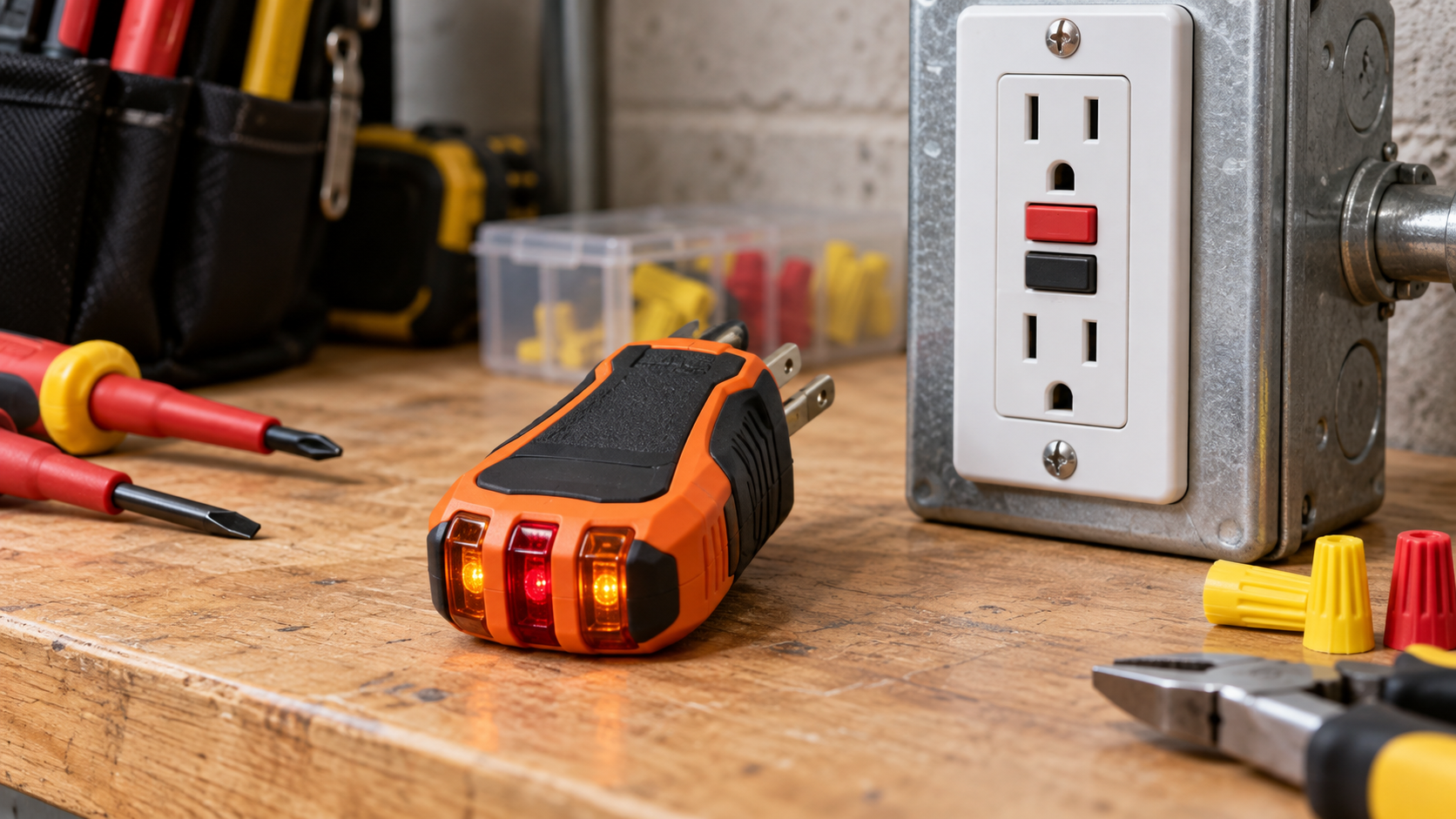
The Klein RT310 is a battery-powered AFCI/GFCI outlet tester for North American 120 V outlets. It reads the wiring condition of an outlet, then runs GFCI, AFCI, and 30 mA ground fault tests on compatible devices. This guide explains what the klein rt310 checks, how to use it safely, and which limits in Klein’s documents matter before you buy one.
Quick answer
- The klein rt310 checks wiring condition at a 120 V outlet and inspects GFCI and AFCI devices, according to the manual and sell sheet.
- It is rated CAT III 135 V and IP40, and it runs on three AAA batteries. It is for indoor use only.
- It detects common wiring problems only. The manual says to consult a qualified electrician to resolve wiring problems.
- Do not use it on higher voltage supplies, on a damaged unit, or to run tests on an incorrectly wired outlet.
What the klein rt310 checks
The manual describes the RT310 as a tester that checks the wiring condition at an electrical outlet and inspects GFCI and AFCI devices. The wiring condition indicators show whether the outlet is correctly wired or shows a fault. The product page adds that the tester can detect a dual-open fault, meaning an open neutral and an open ground at the same time.
The tester has three test functions that the manual describes separately: a GFCI test button, an AFCI test event, and a 30 mA ground fault test button. The GFCI and AFCI tests simulate the fault condition the device is meant to catch, so the device should trip. The manual also says the tester gives a Circuit Energized or Not Energized indication and a Hazardous Voltage Warning.
What the tester does not check
The manual states that this tester only detects common wiring problems. It does not identify uncommon wiring problems. That limit matters most when an outlet shows an unexpected reading. The manual’s answer is the same each time: consult a qualified electrician. This article does not offer a way to diagnose an unusual fault.
Electrical safety first
Electrical safety comes before any test. The manual’s warnings state that failure to observe them can result in severe injury or death, and it says not to attempt electrical testing on an incorrectly wired outlet. If the tester shows that an outlet is not wired correctly, the manual says not to start a GFCI, AFCI, or 30 mA test. Consult a qualified electrician.
The manual also warns against connecting the tester to higher voltage electrical supplies. The RT310 is designed for North American 120 V outlets. For a 240 V appliance outlet, a dryer, or an industrial supply, the RT310 is not the right tool. The tester is rated CAT III 135 V, and the manual states it is for indoor use only.
General electrical safety, not specific to the RT310: switch off the circuit at the panel before you open a box or touch conductors. Work inside a panel, a service entrance, or a wall box with energized wiring belongs to a licensed electrician. This guide does not describe any live panel work.
How to use the klein rt310 step by step
Start with a check of the tester. The manual says not to use the tester if it appears damaged in any way. Then verify operation before the first use by testing on a known live and correctly wired outlet. This check confirms the tester is responding, and it does not replace the tests on the outlet you are checking.
Power the tester on with the power button before you insert it into the outlet. The manual says the Power ON indicator lights when the tester is on. The tester powers off automatically after about 2 minutes of inactivity, so power it on again if the display goes dark. Insert the plug fully into the receptacle and read the wiring condition indicators.
If the outlet is energized, the Hazardous Voltage Warning and the Energized indicator light. The manual says the wiring condition indicator should show Correctly Wired before you run a GFCI, AFCI, or 30 mA test. If the indicator shows a fault, stop there and consult a qualified electrician.
For a GFCI test, press the GFCI test button on a correctly wired outlet and confirm the device trips. Reset the device by pressing its reset button. The manual notes that a device that does not reset after a test may be miswired, not installed correctly, or not functioning, and says to consult a qualified electrician if the circuit remains energized. The AFCI test and the 30 mA test follow the same logic, with the manual’s warnings applied. The manual also contains a separate warning about AFCI testing events, so read that warning in full before use.
Specifications the sources state
The Klein manual and sell sheet list CAT III 135 V, and the sell sheet lists IP40. The manual lists the battery as three 1.5 V AAA alkaline cells and the sell sheet describes the tester as powered by three AAA batteries. The product page lists a 2 m drop protection and a weight of 8.5 oz. The sources state the 120 V outlet use, the indoor-only use, and the automatic power-off after about 2 minutes.
Where the three sources do not give a figure, this article does not supply one. For example, none of the three sources opened here gives an operating temperature range or a battery life in hours.
Buying checklist
- Confirm the outlet type. The RT310 is designed for North American 120 V outlets, and the manual says not to connect it to higher voltage supplies.
- Confirm the tests you need. The manual describes GFCI, AFCI, and 30 mA ground fault tests as separate functions.
- Confirm the category and ratings. The sources list CAT III 135 V and IP40.
- Plan for the battery. Three AAA cells are required, and the tester powers off after about 2 minutes of inactivity.
- Plan for the limits. The tester detects common wiring problems only.
Mistakes to avoid
- Running a GFCI, AFCI, or 30 mA test on an outlet that shows an incorrect wiring condition. The manual says not to do this.
- Skipping the check on a known live and correctly wired outlet before use.
- Treating a clean indication as proof of a fully correct installation. The manual says the tester detects common wiring problems only.
- Using the tester on 240 V equipment or on a higher voltage supply. The manual says it is designed for 120 V outlets.
- Assuming the auto power-off protects you. The tester powers off after about 2 minutes of inactivity, but that is not a substitute for checking the outlet and the tester before each use.
How we chose
The model comes from the keyword list for this article. The sources are Klein documents: the RT310 instruction manual, the RT310 sell sheet, and the RT310 product page. All three were opened on 2026-10-27. The article covers the features, warnings, and specifications those sources state. It does not rank the RT310 against other outlet testers and does not recommend a purchase.
What we could not verify
The sources opened do not state how the tester performs on every outlet type, wiring arrangement, or household circuit. They do not describe its accuracy beyond the listed fault types. They do not give the tester’s performance on 240 V circuits, because the manual limits it to 120 V outlets. They also do not say how the tester responds to every GFCI or AFCI brand, so check the user manual for the device you are testing.
Where a source is silent on a point, this article says so. Read the manual that ships with your unit and the rating label on the tester before you rely on any figure here.
Related reading: for a broader look at outlet testers, see the outlet testing device roundup. For a GFCI-focused check, see the guide to checking a GFCI outlet, and for a meter-based method, see how to test an outlet with a multimeter.
Frequently asked questions
Does the klein rt310 work on 240 V outlets?
No, according to the manual. The RT310 is designed for North American 120 V outlets, and the manual says not to connect it to higher voltage electrical supplies.
Why does the klein rt310 shut off by itself?
The manual and product page describe an automatic power-off after about 2 minutes of inactivity. This is a battery-saving feature. Power the tester on again before the next check.
What does the Hazardous Voltage Warning mean?
The manual uses the Hazardous Voltage Warning indicator to show that the outlet is energized. Treat any energized outlet as hazardous, and keep hands and tools clear of the contacts during tests.
Can the klein rt310 find every wiring fault?
No. The manual states that the tester only detects common wiring problems and does not identify uncommon wiring problems. Consult a qualified electrician for any fault the tester cannot resolve.
Is the klein rt310 safe to use without an electrician?
The manual says to consult a qualified electrician to resolve wiring problems and warns against testing an incorrectly wired outlet. The tester is a diagnostic check, and any repair belongs to a licensed electrician.
Bottom line
Use the klein rt310 only on a 120 V outlet, confirm the wiring condition before any GFCI, AFCI, or 30 mA test, and call a qualified electrician for any wiring problem the tester shows.
Sources
- Klein Tools, RT310 AFCI/GFCI outlet tester instruction manual, https://data.kleintools.com/sites/all/product_assets/documents/instructions/klein/RT310-1390299ART%20-%20WEB.pdf (opened 2026-10-27)
- Klein Tools, RT310 outlet tester sell sheet, https://data.kleintools.com/sites/all/product_assets/documents/brochures/klein/82862_RT310OutletTesterSellSheet_WebReady.pdf (opened 2026-10-27)
- Klein Tools, AFCI/GFCI Outlet Tester RT310 product page, https://www.kleintools.com/product/RT310 (opened 2026-10-27)