Protmex HT607 Temperature Humidity Meter – Large LCD Backlight with Cover Review
As an Amazon Associate, this site earns from qualifying purchases. Nothing here comes from running the device, and no sales figures are included.
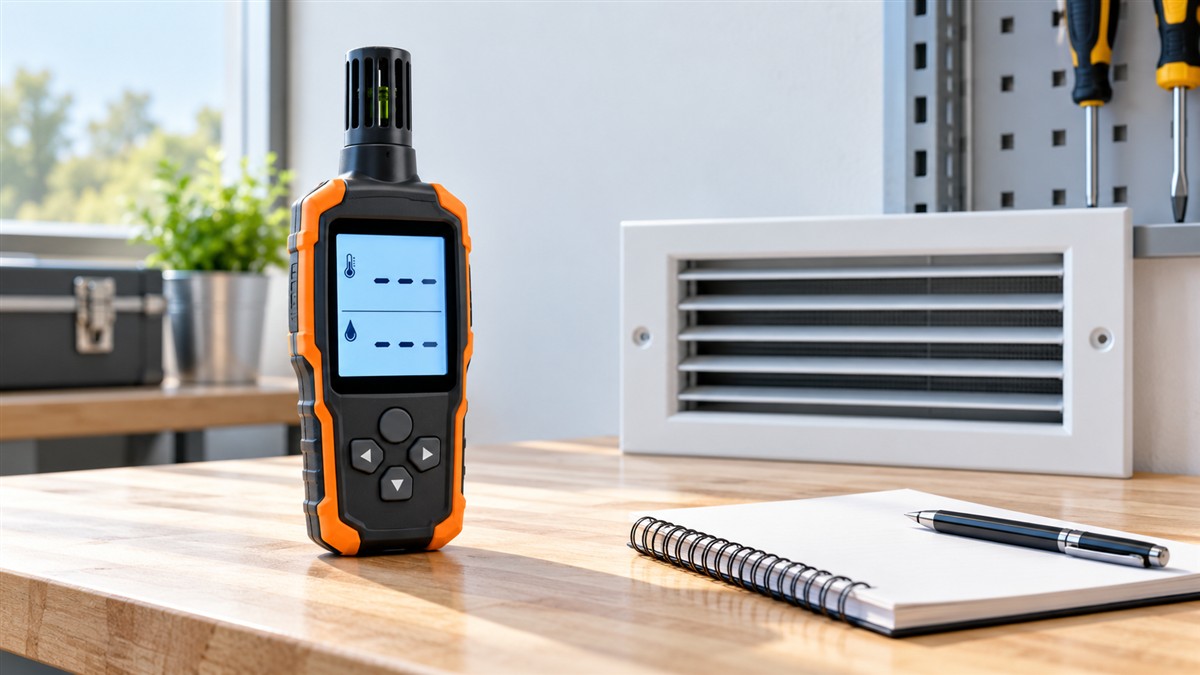
Most rooms get checked by one number: the temperature on the thermostat. Humidity is the number that quietly decides whether a wine cellar, a storeroom, or a workshop stays comfortable and dry. The Protmex HT607 is a small tabletop meter that shows four readings on one screen: ambient temperature, relative humidity, wet-bulb temperature, and dew point. It is built for a person who wants those readings in one place without a laboratory setup.
Who should buy, and who should skip it
Buy it if you want a compact meter for a room, a storage area, a basement, or a cellar where humidity needs watching. Skip it too if you need a meter with a stated ingress standard for harsh outdoor conditions, since none is given here.
Specifications, translated into use
- Ambient temperature range of -20 to 60 degrees Celsius (-4 to 140 degrees Fahrenheit). The range covers cold storage, indoor rooms, and warm spaces such as a machine room. The upper limit of 60 degrees Celsius is the figure to check if the meter will sit near heat.
- Relative humidity from 0.0 to 99.9 percent, with 0.1 percent resolution. Relative humidity is the amount of moisture in the air compared with the maximum the air can hold at that temperature. It is the main number to watch for mold risk, static, and material swelling.
- Four measurement modes. The meter shows ambient temperature, relative humidity, wet-bulb temperature, and dew point. You switch between them to read each figure.
- Large display. The copy describes a 2.26-inch LCD screen, which makes the readings easy to read from a short distance.
- Min and max readings. The meter tracks the lowest and highest values, which helps you see how a room moves over an afternoon or overnight.
- Tabletop mounting. The mounting type is tabletop, so it is meant to sit on a shelf or desk.
Accuracy: the figures that do not agree
Accuracy is the figure most buyers check first, and this is where the sources differ. The spec sheet lists temperature accuracy of plus or minus 0.5 degrees Celsius, and a second temperature-accuracy field repeats that value.
Humidity accuracy has no conflict. The copy gives plus or minus 3 percent relative humidity between 20 and 80 percent, and plus or minus 4 percent outside that band. Those figures are the ones to plan around for humidity-sensitive storage.
If you only need one figure for a room, read relative humidity alongside temperature. Dew point and wet-bulb add detail when a surface or an HVAC question depends on how much moisture the air carries at a given temperature, which is why the meter shows them together. Use them as a second opinion on the humidity reading rather than as a replacement for it.
Dew point and wet-bulb readings
Dew point is the temperature at which the air would reach saturation, so surfaces at or below that temperature collect condensation. It is the figure that tells you whether a cold wall, a window, or a cellar pipe will sweat. Wet-bulb temperature is a related reading used for evaporative cooling and some HVAC checks. The meter shows both alongside the ambient temperature and relative humidity, which lets you compare them without a calculator.
The dew point range has a conflict.
Where it fits: rooms, storage, and HVAC checks
The copy lists several scenes, including household, laboratory, HVAC, industry, meteorology, engineering, a wine cellar, a machine room, and a data storeroom. Each one has a different purpose, so match the meter to the one you have.
- Wine cellar or storage room. Watch relative humidity and temperature together. Stable readings matter more than a single high or low number.
- Basement or workshop. Check whether humidity rises after rain and whether surfaces near the walls approach the dew point.
- Machine room or equipment closet. Use the max hold after a long run to see the peak temperature the space reaches.
- HVAC and home comfort. Compare the ambient reading with the dew point to judge how humid a room feels at a given temperature.
- Storeroom for paper, textiles, or electronics. Keep humidity within the range your items need, using the humidity figures above.
Place the meter away from direct sun, heaters, vents, and the door, since each of these moves the reading away from the room’s average. A shelf at the middle height of the room is a practical starting point.
Once the meter is in place, give it a few minutes before you judge a reading. A meter that has just been moved, or one that was in a warmer or cooler room, reads its own surroundings first. Take the reading at the same time of day on each visit, so changes reflect the room rather than the daily cycle.
Display and convenience features
- Data hold. The hold function freezes a reading on screen so you can read it after moving the meter.
- Unit conversion. You can switch between Celsius and Fahrenheit.
- Backlight. The backlight helps in dim rooms and cellars.
- Low battery indicator. The meter shows when the batteries need changing, which helps before a long monitoring session.
- Auto power off. The meter shuts off after 30 minutes, which saves the batteries if the meter is left on the shelf.
Power, build, and care
The meter runs on three 1.5-volt AAA batteries, which are included. The housing is described as ABS, a plastic chosen for impact resistance. The copy describes a double-injection case and a protective cover for the sensor, and the title names a cover protector. The included list names a cloth bag and a user manual, so confirm the cover is in your package before you rely on it.
The meter weighs 4.16 ounces and measures 2.28 inches wide by 5.59 inches high, so it is light enough to move between rooms.
For care, wipe the case with a dry or slightly damp cloth. Keep the sensor clear of dust, and store the meter in the cloth bag between uses.
Strengths and limits
Strengths. The meter combines four readings in one compact unit with a backlit display. Relative humidity has a clear accuracy figure, the batteries are included, and the controls are simple. The tabletop design keeps it stable on a shelf. The min and max readings and the data hold help you read changing rooms.
The temperature accuracy conflict means you should plan around the larger figure. The dew point lower limit also needs confirmation before cold-space work.
How it compares within the category
Other products in the same category research show where this meter sits. These figures belong to those models and are not specifications of the HT607.
- Fluke 971 Temperature Humidity Meter: a 390-gram body, a backlit dual display, 99 record storage, a 1-year warranty, and a belt clip with a protective holster. It stores records, which the HT607 does not list. It is the option to weigh if you need a record over time.
- DANOPLUS Humidity and Temperature Meter: 3.36 ounces, a 2.32-by-6.57-inch footprint, and a stated temperature accuracy of 1.5 degrees Celsius. It is the comparison to weigh for a simple temperature and humidity check where you do not need the wet-bulb or dew-point readings.
The HT607 covers the same four readings as the Fluke model in a much lighter body, at 4.16 ounces. If you need stored records, the Fluke model’s memory matters more than any difference in the readings.
Packaging, battery type, and identifiers
The listing’s detail fields are worth checking against the box when it arrives. The battery description field reads alkaline, and the voltage field reads 1.5 volts for each cell. The included components field names three 1.5-volt AAA batteries, a color box, a cloth bag and a user manual, so the box should hold all four items.
The color field reads black, and the item weight is 4.16 ounces. The manufacturer field reads HUABO, while the brand field reads Protmex, and the part number field reads HB-1. If you need to contact support or look up the unit later, keep the part number and the manufacturer name with your purchase record, since the brand and manufacturer names differ.
The listing also names a Swiss-made chip for the sensor, described as top-notch. That is a construction claim, and the listing gives no accuracy beyond the figures set out above.
Buying checklist: check these before you order
- Decide whether you need the dew point and wet-bulb readings, or only temperature and humidity.
- Confirm the temperature accuracy figure, since the sources disagree.
- Confirm the dew point lower limit if you plan to check cold spaces.
- Check that the cover protector is in your package, since the included list names a cloth bag.
- Keep spare AAA batteries on hand for a long monitoring period.
- Confirm the placement spot is away from vents, heaters, and direct sun.
If the checklist fits your space, the meter is available here: Protmex HT607 Temperature Humidity Meter on Amazon.
Related reading: digital moisture tester options and multimeter picks.
Frequently asked questions
What does the wet-bulb reading add? It is used in evaporative cooling and some HVAC checks, and it appears alongside the ambient reading so you can compare them.
Why does the meter show dew point? It shows the temperature at which moisture condenses, which helps you judge whether surfaces will sweat in a given room.
Keep the meter dry and away from standing water.
The 30-minute automatic power off helps save the batteries between readings, and the low battery indicator shows when a change is due.
Final verdict
The Protmex HT607 is a compact, four-reading meter for rooms, cellars, workshops, and storage spaces where humidity and dew point matter as much as temperature. Its strengths are the four readings on one backlit display, the clear humidity accuracy figures, the included batteries, and the simple controls. Confirm the accuracy and the dew point limit with the manufacturer, decide whether you need records, and the meter is a practical choice for everyday monitoring. For logged records, look at a model that keeps them.