Klein CL320 Clamp Meter: Uses, Safety and Specs
Klein CL320 Clamp Meter: Uses, Safety and Specs
As an Amazon Associate we earn from qualifying purchases.
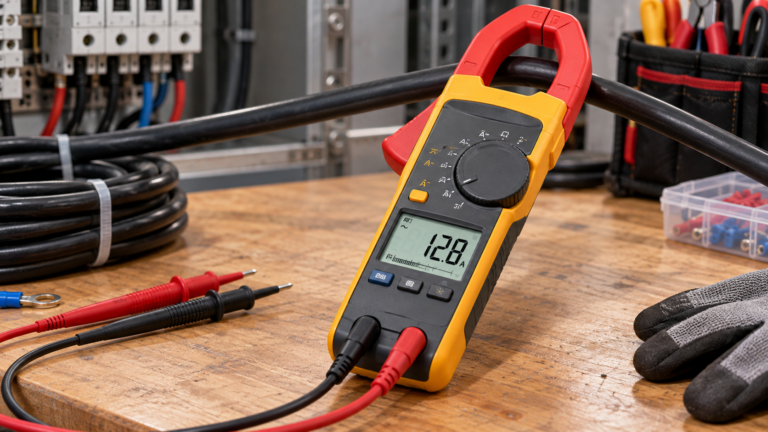
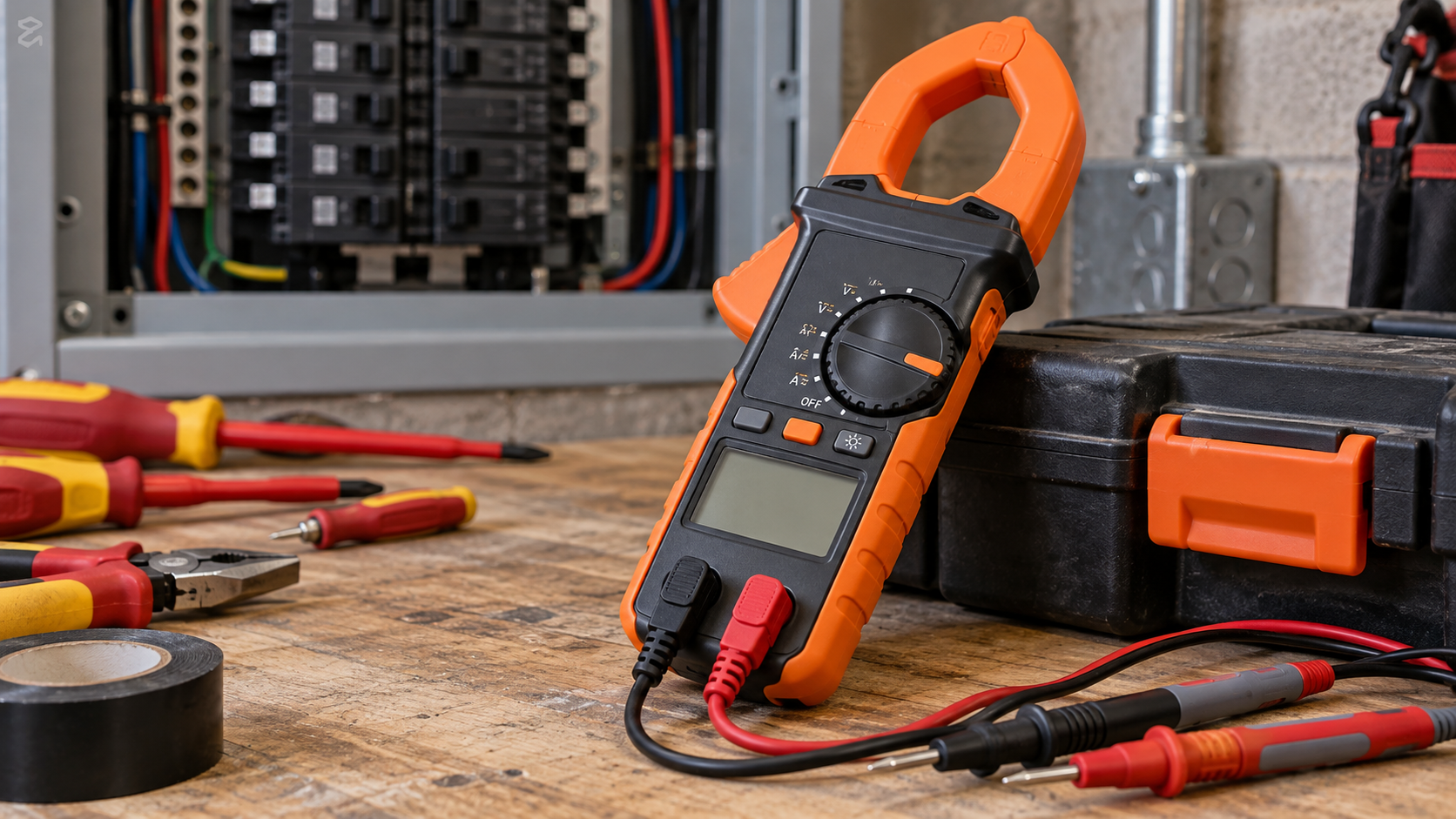
The Klein CL320 is an auto-ranging, true RMS clamp meter. Its jaw measures AC current up to 400 A without breaking the circuit, and the same meter also reads voltage, resistance, frequency, capacitance, diodes, and temperature. The manufacturer states a CAT III 600V safety rating in its manual. This article covers what Klein publishes for the klein cl320, how to use the clamp and the non-contact voltage function with care, and what to check before you buy.
Quick answer
- The Klein CL320 is a clamp meter that reads AC current up to 400 A through its jaw, along with AC and DC voltage, resistance, and other functions.
- The manual states a CAT III 600V rating, with a maximum input of 600V AC RMS or 600V DC.
- The non-contact voltage (NCV) function is a screening aid. The manual lists conditions where it may miss voltage, and says no indication does not prove a wire is dead.
- Before you buy, confirm that the CAT III rating fits your location, and that you do not need DC current through the clamp, which the manual does not list.
What the CL320 measures
The manual’s general description says the CL320 measures AC current through the clamp, AC and DC voltage, DC microamps, resistance, continuity, frequency, capacitance, and diodes through the test leads, and temperature through a thermocouple probe. The meter is described as automatically ranging True Root Mean Square (TRMS), so for most readings you do not choose a range yourself. Klein’s product page also says the clamp includes a non-contact voltage tester built into the jaw.
The manual gives the AC current range as 40 A and 400 A, with a 100 mA resolution on the 400 A range and an accuracy of plus or minus 2.0 percent plus 10 digits. The frequency range for the current function is 50 to 60 Hz. For AC voltage, the manual lists a frequency range of 45 to 400 Hz. These are the manufacturer’s figures, and they should be checked against the manual that ships with your meter, because revisions can change them.
What the ratings say
The manual lists the safety rating as CAT III 600V, Class 2, double insulation, with pollution degree 2. In simple terms, measurement category III covers test and measuring circuits connected to the distribution part of a building’s low-voltage system. The manual gives a maximum input of 600V AC RMS or 600V DC, and it says to use the meter only with CAT III or CAT IV rated test leads.
The manual also lists an operating altitude of 2000 m (6562 ft), a relative humidity below 95 percent non-condensing, and an operating temperature of 0 to 50 C (32 to 122 F). Drop protection is listed as 2 m (6.6 ft). The Klein 2026 Clamp Meter Selection Guide lists the CL320 as CAT III 600V, which matches the manual.
A CAT III rating is not a CAT IV rating. CAT IV covers the origin of a building’s low-voltage installation, such as the service entrance. The CL320 rating does not cover that location, and work at that point belongs to a licensed electrician.
Measurement limits to check against your job
The table below uses only the ranges and limits printed in the manual. Where the manual does not state a value for a function, the table says so.
| Function | Range or limit in the manual | Input note |
|---|---|---|
| AC current (clamp) | 40 A and 400 A ranges | Clamp reads AC current; the manual does not list DC current through the clamp |
| AC voltage | 400.0 mV to 600 V | 600V AC RMS maximum input |
| DC voltage | 400.0 mV to 600 V | 600V DC maximum input |
| DC microamps | 200 µA | The manual says not to attempt to measure more than 200 µA |
| Resistance | 400.0 ohm to 40.00 MΩ | Manual says do not measure resistance on a live circuit |
| Capacitance | Range up to 40.00 nF listed | Follow the manual’s capacitance steps before use |
| Temperature | -40 to 1000 C (-40 to 1832 F), per the product page | K-type thermocouple probe |
The table is a reading aid. The manual and the product page are the controlling documents for any figure you rely on.
How to use the clamp safely
For AC current, the manual has you set the function selector to the 40/400 A position and press the trigger to open the jaw. The manual warns against testing when the leads are not properly seated. Here is a routine built from the manual’s own warnings:
- Read the warnings and the rating label before you start.
- Confirm that the test leads are CAT III or CAT IV rated, and that they are fully seated in the jacks.
- Do not use the meter during electrical storms or in wet weather.
- Do not use the meter or the test leads if either appears damaged.
- Do not exceed 600V AC RMS or 600V DC on any input.
- Do not measure resistance or continuity on a live circuit.
These steps cover the meter, not the job. Work inside a live panel or service equipment should be done by a licensed electrician, even if the meter’s rating looks sufficient.
Non-contact voltage: what the manual says it can miss
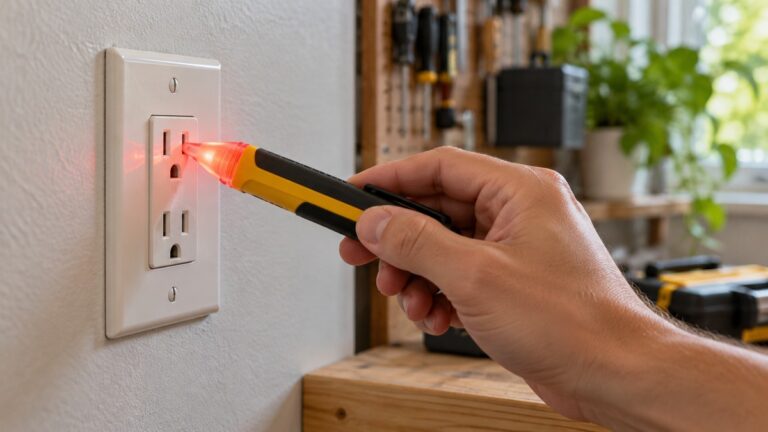
To start NCV, press and hold the SEL/NCV button. When voltage is detected, the red NCV light flashes or glows, the meter beeps, and dashes appear on the display. The manual says that if there is no indication, voltage could still be present. Before and after each use, the manual says to verify operation by testing a known working circuit that is within the rating of the unit. It also warns never to assume that neutral or ground wires are de-energized, because neutrals in multi-wire branch circuits may remain energized when disconnected.
The manual lists cases where the NCV tester will not detect voltage: the wire is shielded, the operator is not grounded or is isolated from an effective earth ground, or the voltage is DC. It lists more cases where detection may be missed, including a user who is not holding the tester, a user insulated by a glove, a partly buried wire or a wire in grounded metal conduit, distance from the source, and a voltage that is not a clean sine wave between 50 and 500 Hz. The manual also says the tester may not be compatible with some standard or tamper-resistant outlets. In practice this makes NCV a first screening step, not proof that a circuit is dead.
Features Klein lists
- A 4000-count LCD, with a backlight on the product page.
- Automatically ranging TRMS measurement, with Auto-Range, Data Hold, and Max/Min value functions.
- Auto power-off after about 10 minutes of inactivity.
- A jaw size of 1.6 inches (4.1 cm), listed on the product page.
- A test lead holder on the side of the clamp, and an optional magnetic hanger for hands-free use.
- A K-type thermocouple probe, a carrying case, test leads with CAT III and CAT IV safety caps, and 3 AAA batteries in the box.
What to check before buying
- The rating. The manual and the selection guide both say CAT III 600V. Confirm that this rating fits the circuits you will work on.
- The current type. The manual lists AC current through the clamp. If you need DC current through the jaw, this listing does not show that function.
- Low DC current. DC microamps up to 200 µA is listed through the test leads, not the clamp.
- Jaw size. Check that 1.6 inches fits the conductor you plan to measure, including any insulation.
- Voltage detection. If you need a confirmed voltage reading, the NCV function is not enough. You need a measurement with the test leads.
Mistakes to avoid
- Treating a silent NCV tester as proof of no voltage. The manual says no indication does not mean voltage is absent.
- Assuming a neutral or ground wire is safe to handle. The manual says never to make that assumption.
- Measuring resistance or continuity on a live circuit, which the manual forbids.
- Using test leads that are not CAT III or CAT IV rated with this meter.
- Trying to measure more than 200 µA on the microamp function.
How we chose
This is a model explainer, not a ranking. It covers one meter, the Klein CL320, and relies only on the three documents listed under Sources, all opened on 2026-10-27. The sections were chosen from what those documents state: functions, ratings, operating limits, NCV warnings, and the features Klein lists. The article does not rank the CL320 against other meters and does not include prices, customer feedback, or retailer listings.
What we could not verify
- The sources do not state DC current measurement through the clamp, so this article does not say the CL320 provides it.
- The sources do not give a battery life figure.
- The sources do not say how the meter suits a specific job, such as a particular HVAC or automotive task.
- The sources state the operating humidity and altitude, but this article does not extend those figures to other environments.
FAQ
Does the Klein CL320 measure DC current with the clamp?
The manual’s general description lists AC current through the clamp. The DC function it lists is DC microamps through the test leads, with a limit of 200 µA. If your work needs DC current through the jaw, check the current model listing before you buy.
Is the CL320 rated for household mains?
The manual states CAT III 600V. That is a rating, not a promise that every task is safe. Panel and service work belongs to a licensed electrician, and you should confirm the rating fits the circuit before you measure.
What does the NCV function do?
It signals the possible presence of AC voltage near an insulated conductor with a light and a beep. The manual says the function can miss voltage in several conditions, so a silent result is not proof that a wire is dead.
Are test leads included?
Klein’s product page lists test leads with CAT III and CAT IV safety caps in the box. The manual requires CAT III or CAT IV rated leads, so check the rating on any replacement leads you buy.
Why does the manual ask me to test a known working circuit?
The manual asks you to verify NCV operation before and after each use on a known working circuit within the meter’s rating. This confirms that the tester responds at the time you use it.
Does the meter include a temperature function?
Yes. The meter measures temperature with a K-type thermocouple probe, and the product page lists a range of -40 to 1000 C (-40 to 1832 F).
Bottom line
The Klein CL320 is a CAT III 600V clamp meter that reads AC current up to 400 A, with voltage, resistance, and other functions. Use the manual’s warnings as your starting rules, and treat the NCV function as a screening step only. If you are comparing clamp meters for a wider set of jobs, the AC clamp meter picks page covers related models. For the non-contact function on its own, read the non-contact voltage tester guide, and for the difference between average and true RMS readings, see the true RMS multimeter guide.
Sources
- Klein Tools, CL320 instruction manual (English). https://data.kleintools.com/sites/all/product_assets/documents/instructions/klein/CL320-Manual-%20WEB.pdf (opened 2026-10-27)
- Klein Tools, HVAC Digital Clamp Meter, AC Auto-Ranging 400 Amp, CL320 product page. https://www.kleintools.com/catalog/clamp-meters/hvac-digital-clamp-meter-ac-auto-ranging-400-amp (opened 2026-10-27)
- Klein Tools, 2026 Clamp Meter Selection Guide. https://data.kleintools.com/sites/all/product_assets/documents/brochures/klein/2026%20Clamp%20Meter%20Selection%20Guide.pdf (opened 2026-10-27)