How to choose a multimeter for thermocouple testing
As an Amazon Associate we earn from qualifying purchases.
How to choose a multimeter for thermocouple testing comes down to three checks: a DC millivolt range, a temperature input or function that suits the probe you will use, and a stated CAT rating that matches the circuit you work on. A thermocouple makes a very small voltage, so the meter’s low DC range and its resolution matter as much as its maximum voltage. The manufacturer listings below show which numbers are stated; where a listing is silent, this guide says so.
Electrical safety
Work on mains circuits can kill. Before you measure anything, check that the meter’s CAT rating suits the circuit you are testing, and read the rating from the listing or the manufacturer’s manual. Panel and service work belongs to a licensed electrician.
Thermocouple testing in this guide is a low-voltage bench task. OSHA’s rule for electrical testing work says that only qualified persons may perform testing work on electric circuits or equipment (29 CFR 1910.334(c)(1)). A Fluke article warns that a direct-contact meter can be dangerous if it is connected to a circuit voltage higher than its rating, and it describes fatalities during troubleshooting of higher-voltage equipment. Do not use a thermocouple meter as a mains tester.
A Fluke application note says the CAT rating should suit the electrical environment where you use the meter, that test leads should carry an equal or greater CAT rating, and that the rating is usually printed near the input jacks. Check all three before you connect anything.
Quick answer
- Pick a meter with a DC millivolt range. The Fluke 116, 117 and 115 listings each state 600.0 mV with 0.1 mV resolution.
- Check whether the meter has a temperature function, and whether the probe is included and what range the listing states.
- Confirm the CAT rating, the fuse rating on the current input, and the counts.
- Remember that the probe’s error is separate from the meter’s accuracy.
What a thermocouple puts out
A thermocouple is two dissimilar metals joined at one end. When that junction is at a different temperature from the other end, the circuit produces a voltage. Michigan Tech’s thermocouple lab describes this as the Seebeck voltage, which depends on temperature (Michigan Technological University, Experiment 5). Digilent describes the output as an extremely small DC voltage that is proportional to the temperature difference between the two junctions.
That small voltage is why the millivolt range matters. The meter has to read a few millivolts with useful resolution, so check the lowest DC range and its resolution on the listing before you buy.
The voltage tells you a temperature difference, not an absolute temperature. The UConn reference explains that you must know the absolute temperature of the reference junction to convert the voltage into an absolute reading. The Michigan Tech lab handles this with a thermistor and a polynomial, and Digilent notes that cold junction compensation is still needed when ice baths are removed. Choose a meter or probe setup that handles this step, or plan to measure the cold junction yourself.
Features to check on a listing
DC millivolt range and resolution. The Fluke 116 listing states DC millivolts at 600.0 mV with 0.1 mV resolution and accuracy of 0.5% + 2 counts. The Fluke 117 and Fluke 115 listings state the same DC millivolt range and accuracy. Treat these as examples of the numbers to look for, not as recommendations.
Temperature function and probe. The Fluke 117 and 115 listings state a temperature range of -40 °F to 752 °F with 0.2 °F resolution. The Fluke 116 listing says its box includes an integrated temperature probe, the 80BK. None of these pages states the thermocouple type of the probe in the text checked, so confirm the probe type in the manual before you buy.
Probe error. The Fluke 117 and 115 listings state that the temperature uncertainty does not include the error of the thermocouple probe. The 80TK sheet says the same about its basic accuracy: the figure excludes the error of the probe and the DMM. Add the probe’s own tolerance to the meter’s figure when you judge a reading.
CAT rating. The Fluke 116 and 117 listings state CAT III 600 V. A CAT rating tells you the meter’s measurement category and voltage limit. It does not make a meter safe for every circuit. The listing does not state a CAT rating for any product not checked here.
Fuse. The Fluke 117 listing states a fuse for the A input of 11 A, 1000 V FAST. Check the fuse rating on any meter you consider, and keep a spare that matches it.
Counts and display. The Fluke 116 listing states a display of 6,000 counts. More counts give finer steps on the same range, which helps when a thermocouple signal is small.
Input limits. The 80TK sheet states that the thermocouple input accepts a maximum of 60 V DC and 24 V AC. Do not apply mains voltage to a thermocouple input.
Two ways to read a thermocouple
Millivolt method. Read the voltage on a DC millivolt range, then convert it with a reference table. The NIST Temperature Scale Database states that it provides the thermocouple tables for the ITS-90 temperature scale. Because the reading depends on the cold junction, the table gives a correct temperature only when the reference junction is handled correctly.
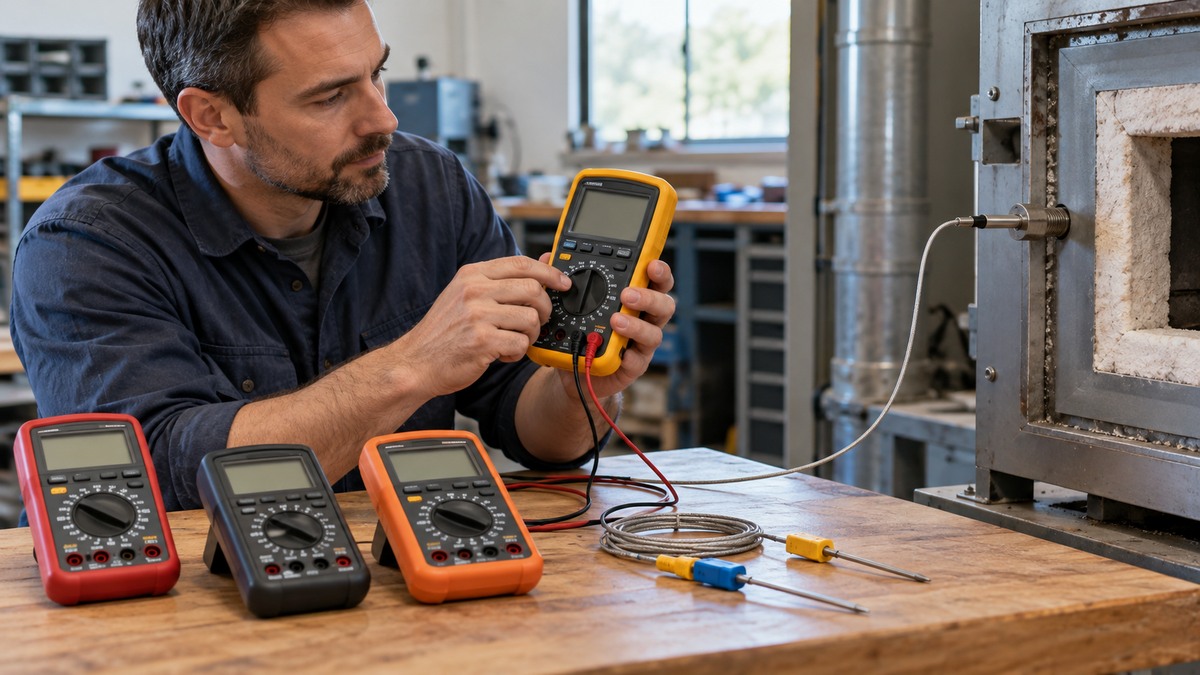
Converter method. The Fluke 80TK converter takes the output of any K-type thermocouple and gives 1 mV per degree, in Celsius or Fahrenheit. Its measurement range is -50 to 1000 °C. Its sheet says it accepts wire leads or mini thermocouple connectors. With a converter, the meter reads a temperature scale directly, but the converter’s own specification and the probe error still apply.
Built-in temperature function. A meter with a temperature function reads its probe and shows a temperature. Check its range against your job, and check whether the listing says how the cold junction is handled. The listings checked do not say, so the listing does not state the method.
How to read an accuracy figure
The Fluke listings print accuracy as a percentage of reading plus a number of counts, written as ±([% of reading] + [counts]). The percentage applies to the value you read, and each count is one step of the last displayed digit. On the 600.0 mV range with 0.1 mV resolution, one count is 0.1 mV, so the “+ 2” in 0.5% + 2 adds 0.2 mV to the error. This is the meter’s error only. The probe’s error is separate, as the probe notes above say.
Because the counts term stays fixed, the error is a larger share of a small reading. Worked from the stated figure, at 10.0 mV the 0.5% + 2 counts figure allows up to 0.25 mV of error, which is 2.5% of the reading. That is arithmetic from the listing, not a test result.
How we chose
The criteria in this guide come from the specifications that the sources state for thermocouple work: the millivolt range and resolution, the temperature range and probe note, the CAT rating, the fuse rating, the counts, and the input limits. The sources we opened were three manufacturer listings from one manufacturer, one copy of a converter instruction sheet, one NIST database page, three university or lab pages, one DAQ reference, and two safety pages. All were opened on 2026-10-21. This guide does not compare prices, reviews or ratings, and it does not rank the listings. Other meters on the market were not checked, so this guide does not say which meter is best.
What we could not verify
The sources we opened do not give a numeric sensitivity for any thermocouple type, so this guide gives none. The listings checked do not state a thermocouple temperature range for the Fluke 116, and they do not state the thermocouple type of the probes in their text. The sources do not give a cold junction accuracy for any meter. The sources we opened do not cover readings from any specific furnace, engine or appliance, and they do not give acceptance values for a thermocouple in service. The listing does not state a CAT rating for any meter outside the three checked.
Preparation
Before you test, check the meter’s fuse rating, the leads’ CAT rating, and whether the probe is the type the meter expects. Set the meter to a DC millivolt range or temperature function as its manual describes. Keep the thermocouple and the meter on a bench or a low-voltage circuit, not on a live panel or outlet. For a continuity check on leads and fuses, read the guide to continuity tests on a meter first. For the thermocouple test that follows a meter choice, see the step guide for testing a thermocouple with a multimeter.
Steps to choose the right meter
- Write down the temperature range you need, and compare it with the range the listing states.
- Check that the meter has a DC millivolt range and that the listing states its resolution.
- Check whether the probe is included, and what the listing says about its error.
- Confirm the CAT rating and the fuse rating on the listing or the manual.
- Check the counts, and decide whether you need a converter such as the one described in the 80TK sheet.
- Read the input limits, and do not exceed them.
Reading the results
A reading is only as good as the reference and the probe. Compare a millivolt reading with a table from the NIST database, and write down the cold junction temperature you used. The sources we opened do not say which readings are normal for a given process, so do not treat a single number as a pass or a fail.
Common mistakes
- Choosing a meter by its maximum voltage and ignoring the millivolt range. The thermocouple signal is small.
- Forgetting that probe error is separate from meter accuracy. The Fluke 117 and 115 listings state this.
- Assuming a CAT rating makes a meter safe for every circuit. The rating covers only its stated category and voltage.
- Applying more than the input limit. The 80TK sheet states 60 V DC and 24 V AC.
- Ignoring the cold junction. A millivolt reading without it gives the wrong temperature, as the UConn reference explains.
FAQ
Do I need a multimeter with a temperature function?
No. A meter with a DC millivolt range can read a thermocouple voltage, and a reference table then gives the temperature. A temperature function is simpler, but the listing must state its range and how the probe error is handled. The Fluke 117 and 115 listings do state a temperature range.
What does the millivolt range do for a thermocouple?
It lets the meter read the very small voltage the junction makes. Digilent describes that output as extremely small and proportional to the temperature difference between the junctions.
What CAT rating should my thermocouple meter have?
Read the rating from the listing or manual. Two of the Fluke listings checked give CAT III 600 V. The listing does not state a rating for any other meter in this guide, and a rating alone does not make a meter suitable for mains work.
Is the probe error included in the meter’s accuracy?
No. The Fluke 117 and 115 listings and the 80TK sheet all say the probe error is not included in the stated figure.
Can I use a thermocouple input to test mains voltage?
No. The 80TK sheet states a maximum of 60 V DC and 24 V AC at the thermocouple input. Mains testing is outside this guide, and OSHA limits testing work on circuits to qualified persons.
Why does the reference junction matter?
The voltage a thermocouple makes depends on the difference between the two junction temperatures. If the reference junction temperature is not known, the converted temperature is wrong, which is why the UConn reference and the Michigan Tech lab both handle it.
Bottom line
Choose a meter whose DC millivolt range, temperature function, probe note, CAT rating and fuse rating are stated on the listing or manual. If one of those is missing, the listing does not state it, so ask the manufacturer or check the manual before you rely on the meter.
Sources
- https://srdata.nist.gov/its90/main/
- https://www.fluke.com/en-us/product/electrical-testing/digital-multimeters/fluke-116
- https://www.fluke.com/en-us/product/electrical-testing/digital-multimeters/fluke-117
- https://www.fluke.com/en-us/product/electrical-testing/digital-multimeters/fluke-115
- https://xdevs.com/doc/Fluke/FLUKE%2080TK%20Instruction.pdf
- https://zeus.phys.uconn.edu/wiki/images/The_Basics_of_Thermocouples.pdf
- https://pages.mtu.edu/~tbco/cm416/Lab_5_Thermocouple_2k8.pdf
- https://digilent.com/reference/_media/daq-and-datalogging/specs/temperature_measurement.pdf
- https://www.osha.gov/laws-regs/regulations/standardnumber/1910/1910.334
- https://www.fluke.com/en-us/learn/blog/electrical/part-1-electrical-testing-safety-preparing-for-absence-of-voltage-testing
- https://dam-assets.fluke.com/s3fs-public/4100693_0000_ENG_A_W.PDF