Best Voltage Detector Tester: Compared by Specs
As an Amazon Associate we earn from qualifying purchases. Details
This guide sorts voltage detector testers by the job they do. A non-contact tool senses a field near a conductor and gives an alert, while a multimeter needs its probes on the conductor and gives a reading. Use the alert type and the stated voltage range to narrow the list, then check the CAT rating against your circuit before relying on the tool. The five picks below each come from their own listing, so confirm the fields on the product page before you order.
At a glance: the 5 picks, by sensing range and CAT rating
| Pick | Type | Sensing / measuring range | CAT rating |
|---|---|---|---|
| Klein Tools NCVT1P | Non-contact pen | 50-1000V AC, single range | CAT IV 1000V |
| Fluke 1AC II VoltAlert | Non-contact pen | 90-1000V AC (listing gives two possible floors — check which version) | CAT IV 1000V |
| MXCOIRTP MT01 | Non-contact pen, 3 sensitivity levels | 12V, 48V, 70V, all up to 1000V | Not stated — weight/dimensions also not given |
| TESMEN TM-510 | Full multimeter, smart auto mode | AC/DC 0.8V-600V; cannot measure current | CAT II 600V — lower than the two pens above |
| ZMIWNIED FS899L | Full multimeter, True RMS, 6000 counts | AC/DC voltage, current, resistance, capacitance | CAT III 1000V, CAT IV 600V |
Specs are from each product’s Amazon listing (full citations and individual write-ups in this guide’s sources section). Non-contact pens give an alert, not a numeric measurement; full multimeters measure directly but vary widely in CAT rating. The ZMIWNIED listing doesn’t confirm test leads are included — verify before ordering.
Quick answer
For a fast yes-or-no check at an outlet, switch or cord, buy a non-contact pen: the Klein Tools NCVT1P (50 to 1000V AC, CAT IV 1000V) or the Fluke 1AC II (nominally 90 to 1000V AC, CAT IV 1000V). If you also need a measured number, buy a multimeter with an NCV function instead. A detector alert is a first check only, and a silent detector does not prove a circuit is dead.
Mains electricity can kill. Check the stated category rating against the circuit, and leave panel or service work to a licensed electrician.
What decides the choice
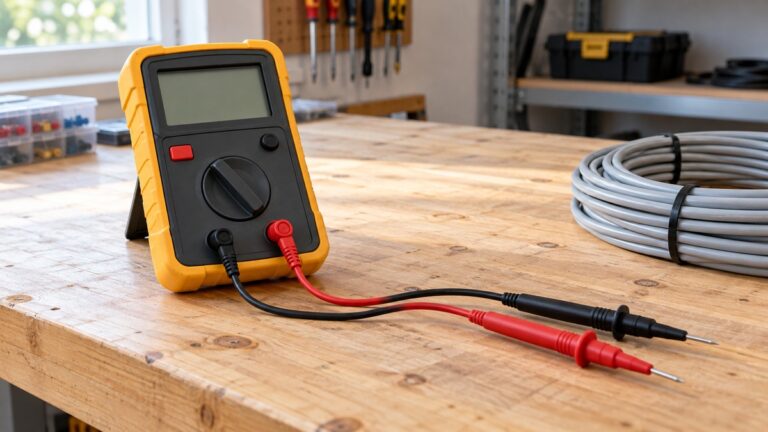
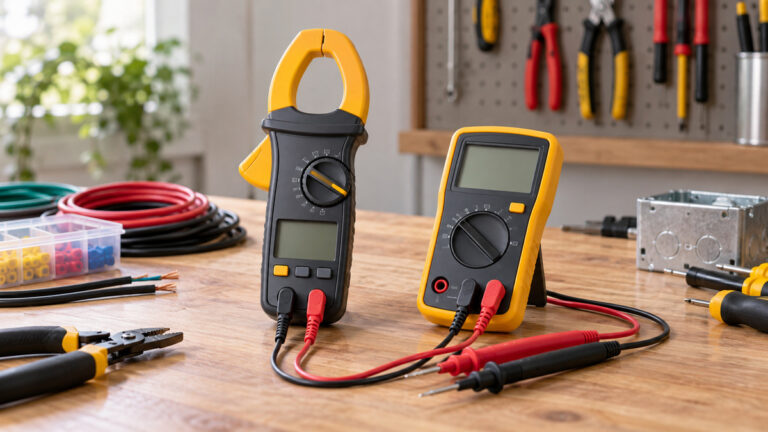
Start with the job. A non-contact tool senses a field near a conductor and gives you an alert. A contact tool, such as a multimeter, needs its probes on the conductor and gives you a reading. The two answer different questions, and the product pages below show how each type is described.
- Detection range. The lowest voltage a pen is intended to flag is the number to read first. The Klein lists 50V, the Fluke lists nominally 90V, and the MXCOIRTP lists 12V, 48V and 70V steps, all up to 1000V AC.
- Category (CAT) rating. Check the rating against the circuit you are testing. The Klein and Fluke list CAT IV 1000V. The ZMIWNIED FS899L lists CAT III 1000V and CAT IV 600V. The TESMEN TM-510 lists CAT II 600V.
- Alert versus reading. A beeper and LED tell you something is present. A display tells you how much, at least for the contact test. The pens in this guide give alerts. The two multimeters add a display.
- Power source. The Klein, Fluke and Neoteck pens list AAA batteries. The Fluke lists a battery life of more than a year. The ZMIWNIED lists a USB-C rechargeable battery with a 2-hour charge.
- What the tool cannot do. The TM-510 listing says it cannot measure current. Every pen here is for AC voltage detection only.
Who should buy which type
- Homeowner checking an outlet or switch before a repair: a non-contact pen with a CAT IV rating, then a meter or qualified help to confirm.
- Someone comparing live and neutral wires: a pen with adjustable sensitivity, such as the MXCOIRTP.
- Someone who wants one tool for beginners: a multimeter with an NCV function and a clear display, such as the TESMEN TM-510.
- Someone who wants a larger screen and more functions: a True RMS multimeter such as the ZMIWNIED FS899L.
Five detector testers compared
Klein Tools NCVT1P: pocket pen with a clear status light
The Klein Tools NCVT1P lists a 50 to 1000V AC detection range for cables, cords, circuit breakers, lighting fixtures, switches, non-tamper-resistant outlets and wires. A green LED shows it is working, and it flashes red with a beeping alert when it detects voltage. It has auto power-off, a 6.6-foot (2 m) drop rating, a weight of 22.68 g and a size of 5.5 x 0.72 x 1 inches. Two AAA batteries are included. The specification is listed as CAT IV 1000V.
Limitation: it has a single range with no sensitivity adjustment, and the listing names non-tamper-resistant outlets without describing tamper-resistant ones. For more Klein options, see our Klein non-contact voltage detector comparison.
Fluke 1AC II VoltAlert: self-testing pen from a known brand
The Fluke 1AC II lists nominal voltage sensing from 90V AC to 1000V AC, a flat tip, one high-intensity red LED, a continuous self-test, an audible or silent mode and a CAT IV 1000V rating. The tip glows red and a beeper sounds on detection. It uses 2 AAA alkaline batteries (included), the listed weight is 59 g, and the warranty is 2 years.
Limitation: the listing gives the range as 90V to 1000V or 200V to 1000V AC, so check which version you are buying. It has a higher floor than the 12V pens and no sensitivity control.
MXCOIRTP MT01: three sensitivity levels and a breakpoint finder
The MXCOIRTP MT01 lists three AC ranges (12V, 48V and 70V up to 1000V). It starts in low sensitivity mode, and pressing S steps to medium and then high, with the buzzer sounding once, twice or three times to tell you which mode you are in. It has a detection light, a tail flashlight that works only when the tester is off, a pen hook, a low-battery warning and auto power-off after 3 minutes without operation or signal. The listing includes a 1-year warranty.
Limitation: the listing does not give a CAT rating, a weight or dimensions, so check the product page for those. It also needs you to remember which sensitivity you are in.
TESMEN TM-510: smart multimeter with non-contact detection
The TESMEN TM-510 is a 4000-count auto-ranging multimeter with a smart auto mode, so you do not select a mode or range. It lists AC and DC voltage from 0.8V to 600V (AC accuracy of 1.2% plus 5 digits, DC of 1.0% plus 5), resistance, continuity and a non-contact voltage function with visual and audible alarms. Safety is listed as CAT II 600V with CE, UKCA and RoHS marks. It weighs 0.1 kg and ships with 2 test leads, a storage bag, 2 AAA batteries and a manual.
Limitation: the specification says it cannot measure current, and its CAT II rating is lower than the CAT IV 1000V on the Klein and Fluke pens.
ZMIWNIED FS899L: True RMS meter with a large colour screen
The ZMIWNIED FS899L lists a 6000-count True RMS auto-ranging design for AC and DC voltage, current, resistance and capacitance, a 4.8-inch colour screen, a built-in flashlight, Data Hold, NCV detection and USB-C charging with a 2-hour charge. The listing gives CAT III 1000V and CAT IV 600V, dual ceramic fuses and full-range overload protection. It includes two insulated alligator clips and an instruction manual.
Limitation: it is the most complex tool in the list and is overkill if you only need an alert. The listing does not give a weight or dimensions, and the included components list only an instruction manual and the clips, so confirm that test leads are in the box before you order.
An alert versus a measurement
The distinction matters most for the question “is this wire live?” A pen answers it quickly but gives no value. A multimeter gives a number but has to touch the conductor. In practice a person checking an outlet before a repair might use a pen first, then confirm with a meter of a suitable category.
The Neoteck listing describes telling live and neutral wires apart by alarm level. The YOWEXA YW-322 pen, covered in our Fluke non-contact voltage tester comparison, has a listing note that no alarm alone does not confirm the absence of voltage. Treat that as the rule for every pen.
Other options
The Neoteck PM8908C lists 12 to 1000V AC, a CE CAT III 600V mark, a 65 g weight, a 6.3 x 0.79 x 0.79 inch body, an 18-month warranty and the note that it is not suitable for Christmas light testing. Automotive test lights, such as a 3-48V digital light and a 6-24V DC light, are tools for vehicle circuits rather than household AC, so they are covered in other guides on this site.
Frequently asked questions
Can a voltage detector tester replace a multimeter?
No. The pens give an alert near a conductor and the listings do not describe a measured reading. A multimeter such as the TM-510 or FS899L gives readings, and both also include a non-contact function.
Why does the CAT marking matter?
It describes the environment a tester is designed for. The Klein and Fluke list CAT IV 1000V, the FS899L lists CAT III 1000V and CAT IV 600V, and the TM-510 lists CAT II 600V. Match the rating to the circuit you are testing.
Should I choose the widest advertised range?
Not automatically. A 12V floor can flag weaker signals, but a pen with several sensitivity levels also gives you one more setting to get wrong. Read what each setting means in the listing.
Do the batteries come with the tester?
For most of these, yes. The Klein lists 2 AAA batteries and the Fluke lists 2 AAA alkaline batteries. The TM-510 lists 2 AAA batteries. The MXCOIRTP listing does not mention batteries in the included components, so check before ordering. For other pens, see our AC voltage detector guide.
Bottom line
Pick the Klein NCVT1P or the Fluke 1AC II for a simple CAT IV rated pen, the MXCOIRTP if you want adjustable sensitivity, and the TESMEN TM-510 or ZMIWNIED FS899L if you also want a measured reading. Compare the range, category rating and included parts on the product page before you buy.