AC Voltage Detector: Options for Home and Shop
An AC voltage detector senses whether alternating-current voltage is present near an outlet, switch, cord or appliance, without touching the conductor. Detectors differ in the range they state, whether they offer a sensitivity setting, and how they signal: light, beep, vibration or silent. This guide compares six detectors returned by the Amazon Creators API. We report only what each listing states, we have not tested any of them, and a detector shows that voltage is present, so it does not replace a rated meter or a licensed electrician for panel or service work.
Quick answer
Check the stated detection range first, then the alerts and whether a sensitivity setting is offered. For low-voltage lines such as doorbells, look for a listing that states a range starting near 12 V. Use any detector as a first check only, and confirm with a proper meter before touching bare conductors.
| Product | Stated range | Key feature | Who it suits |
|---|---|---|---|
| Klein Tools NCVT1P | 50 to 1000 V AC | Beep with flashing LED | Everyday outlet and switch checks |
| Fluke 1AC II VoltAlert | 90-1000 V AC or 200-1000 V AC | Audible or silent mode | Pocket check with a mute option |
| Neoteck detector | 12-1000 V AC | Live and null alarm levels, flashlight | Home owners and DIY |
| KAIWEETS dual range | 12 V or 70 V to 1000 V AC | LCD signal display, buzzer | Low-voltage lines and outlets |
| FLIR VP54 | 24 to 1000 V AC | Sound, light and vibration alarms | Noisy places |
| Santronics 3115 | 50-1000 V AC | Silent detection | Quiet rooms |
Our picks, with what each listing states
#1 Pick

Image: Amazon Product Advertising API
Klein Tools NCVT1P Non-Contact Voltage Tester Pen, 50 to 1000V AC
- The listing states a 50 to 1000 V AC detection range.
- The listing says a green LED shows it is operational and it flashes red and beeps when voltage is detected.
- The listing describes auto power-off and a pocket clip.

#2 Pick

Image: Amazon Product Advertising API
Fluke 1AC II VoltAlert Non-Contact Voltage Tester, 90-1000V AC
- The listing gives a detection range of 90 V to 1000 V AC or 200 V to 1000 V AC.
- The listing says the tip glows red and a beeper sounds, with an audible or silent mode.
- The listing describes a continuous self-test.

#3 Pick
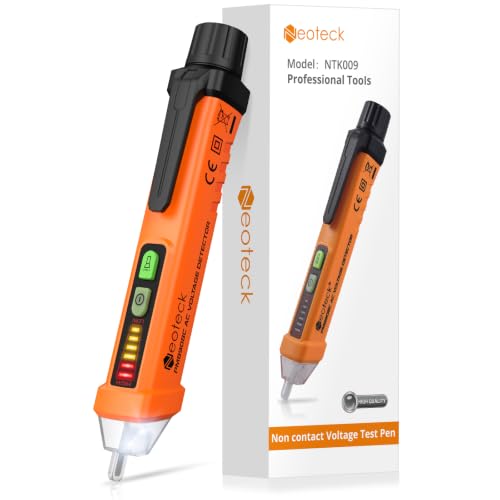
Image: Amazon Product Advertising API
Neoteck Non Contact Voltage Detector, 12-1000V AC
- The listing states a 12-1000 V AC range.
- The listing says different levels of alarm sound and LED help tell live and null wires apart.
- The listing notes it is not suitable for Christmas lights and describes a flashlight.

#4 Pick

Image: Amazon Product Advertising API
KAIWEETS Non Contact Voltage Tester, Dual Range
- The listing describes a dual range of 12-1000 V AC or 70-1000 V AC, set with an S button.
- The listing describes a red tip, a beep and an LCD signal display.
- The listing describes a flashlight, a low-power indicator and automatic power-off after 5 minutes.

#5 Pick

Image: Amazon Product Advertising API
FLIR VP54 Non-Contact Voltage Detector with Flashlight
- The listing says it detects 24 to 1000 V AC without touching a conductor.
- The listing describes sound, light and vibration alarms and two lights.
- The listing describes drop testing to 3 m and an operating range of -10 to 50 C.

#6 Pick

Image: Amazon Product Advertising API
Santronics 3115 AC Voltage Sensor, 50-1000 VAC
- The listing states a 50-1000 V AC detection range.
- The listing describes silent detection for quiet environments.
- The listing describes a slim polycarbonate body for a tool belt.

Five criteria to judge an AC voltage detector
- Stated range: low-voltage lines need a listing that states a start near 12 V, and a 90 V start would miss them.
- Alerts: light, beep, vibration or silent. Pick what you can notice where you work.
- Sensitivity: a dual-range or adjustable setting helps with low-voltage wiring but needs care.
- Self-test and power: look for a self-test or a low-battery indicator in the listing.
- Rating wording: read the category rating only as the listing words it, and confirm it against the product page.
Six-step checklist before you buy
- List the circuits you will check, from doorbell wiring to mains outlets.
- Compare their voltage with each stated range.
- Choose the alert style for your workplace.
- Check whether a sensitivity setting is offered.
- Note the battery and the self-test the listing describes.
- Plan a rated meter check before touching any bare conductor.
Common mistakes
- Treating a quiet detector as proof that a wire is dead.
- Using a detector whose stated range starts above the circuit voltage.
- Ignoring the listing note that one model is not suitable for Christmas lights.
- Skipping the self-test before use.
- Doing panel or service work that belongs to a licensed electrician.
How we choose these picks
These six picks came from several Amazon Creators API keyword searches for AC voltage detectors and non-contact voltage testers. A product made the list when the API returned its ASIN with an image and listing details. We used the title, bullet points and image and did not test any of them. Where a listing does not state a fact, we say so and do not guess.
FAQ
What does an AC voltage detector do?
It senses AC voltage near a conductor without contact and signals with a light, a sound or a vibration.
Which listings state a range that reaches 12 V?
The Neoteck and KAIWEETS listings state a 12 V start. The FLIR VP54 states 24 V.
Which one is silent?
The Santronics 3115 listing describes silent detection. The Fluke 1AC II offers an audible or silent mode.
Can a detector replace a meter?
No. A detector shows presence, and a meter gives a reading. Use a meter to confirm before touching bare conductors.
Final take: when not to buy
Skip a pen detector when you need an actual voltage reading, when the circuit is outside the stated range, or when the work is on a panel or service entrance, which belongs to a licensed electrician. A multimeter or a two-pole tester suits those jobs better. For a quick first check at an outlet, switch or cord, a pen whose listing states a range that covers your circuit is a sensible pocket tool.
Related guides
