Best Voltage Check
As an Amazon Associate we earn from qualifying purchases. Details
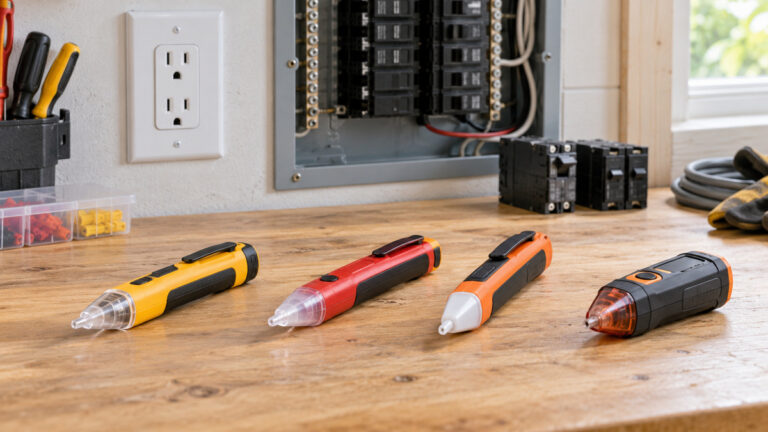
A quick voltage check answers one of two questions: is there voltage here, or how much? A non-contact pen answers the first by lighting up or beeping near a live conductor. A multimeter answers the second with a number on a display. This guide compares four pens and one multimeter so you can choose the right type for the job.
Electrical work can expose you to lethal energy. Never open a service panel or probe a live mains circuit unless you are qualified, and send panel or service work to a licensed electrician. Test a pen on a known live source before trusting a no-voltage signal, and follow the manual. The five products below were checked against their Amazon listings, and anything a listing does not state is marked as not stated.
Quick answer
For a fast yes or no near cables, switches and outlets, the Klein NCVT1P (50 to 1000V AC) and the Fluke 1AC II VoltAlert (90 to 1000V AC) are the two pocket pens with the most detail in their listings. The Neoteck starts lower, at 12V AC, and the MXCOIRTP lists 3 AC ranges. If you need a real reading, choose the AstroAI multimeter, which lists AC 200V/600V, 2000 counts and CAT II 600 V.
Comparison table
| Tool | Type | Stated range | Alert or display | Size or weight stated | CAT stated |
|---|---|---|---|---|---|
| Klein Tools NCVT1P | Non-contact pen | 50 to 1000V AC | Detection indicator; details not given in the facts available | Not stated | No |
| AstroAI multimeter | Digital multimeter | AC 200V/600V | 2000-count display | 0.15 kg | CAT II 600 V; CAT III 300 V |
| Neoteck detector | Non-contact pen | 12-1000V AC | LED lights when voltage is detected | 6.3 x 0.79 x 0.79 inches | No |
| Fluke 1AC II VoltAlert | Non-contact pen | 90-1000V AC | Audible beeper, silent mode, continuous self-test | 59 g; pocket-sized | Title mentions CAT but the figure is cut off; check the page |
| MXCOIRTP detector | Non-contact pen | 3 AC ranges; values not given | Not stated in the facts available | Not stated | No |
Product reviews
Klein Tools NCVT1P Voltage Tester Pen, 50 to 1000V AC
An orange and black non-contact voltage tester pen, battery powered. A bullet describes non-contact detection of AC voltage in cables, cords, circuit breakers, lighting fixtures, switches, non-tamper-resistant outlets and wires.
Who it suits: A homeowner or electrician who wants a pocket pen for a quick check at fixtures, switches and outlets.
Pros
- Clear list of where it detects voltage.
- Stated 50 to 1000V AC range in the title.
Cons
- No CAT rating stated.
- Range starts at 50V, higher than the Neoteck.
Skip if: you need a stated CAT rating or a measured value.
View the Klein NCVT1P on Amazon (affiliate link)
AstroAI Digital Multimeter Tester, 2000 Counts
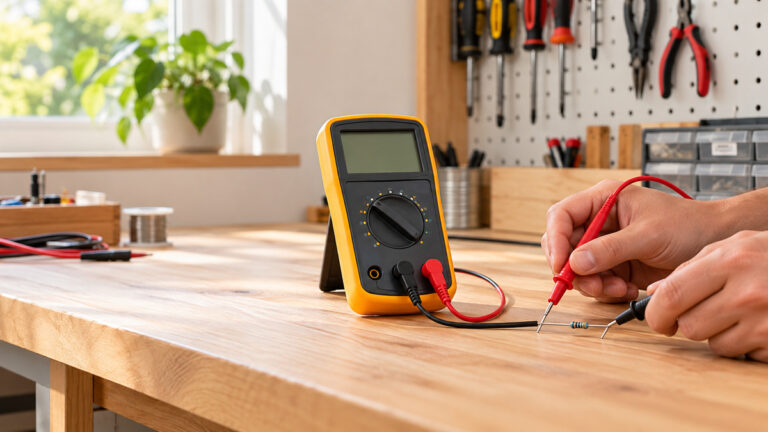
A compact blue multimeter that measures AC and DC voltage, DC current, resistance and diodes. The listing gives AC Voltage 200V/600V, DC voltage ranges 200mV/2V/20V/200V/600V at ±(0.5%+3), a 2000-count display, CAT II 600 V and CAT III 300 V, pollution degree 2 and fuse protection of F250 mA/250 V and F10 A/250 V. It weighs 0.15 kg. The box has the meter, a 9V 6F22 battery, two test leads and a manual.
Who it suits: Someone who needs an actual voltage reading, not only a live or dead signal.
Pros
- Gives a number on the display.
- CAT rating and fuse values stated.
- Leads, battery and manual in the box.
Cons
- Manual ranging, so you set the dial and the lead sockets yourself.
- Needs direct probe contact, so more care is needed than with a pen.
Skip if: you only want a pocket pen for a quick presence check.
View the AstroAI multimeter on Amazon (affiliate link)
Neoteck Non Contact Voltage Detector, 12-1000V AC
An orange pen that detects AC from 12 to 1000V. A bullet says the LED in the pen shines as long as voltage is detected, and another says the alarm sound and LED level help you tell a live wire from a null one. It measures 6.3 x 0.79 x 0.79 inches and is battery powered. The listing notes it is not suitable for Christmas light testing.
Who it suits: A user who wants a low 12V start of range in a simple pen.
Pros
- 12V start of range.
- LED and alarm levels.
- Pen-sized.
Cons
- No CAT rating stated.
- No numeric reading.
Skip if: you need a stated CAT rating.
View the Neoteck detector on Amazon (affiliate link)
Fluke 1AC II VoltAlert Non-Contact Voltage Tester
A red, pocket-sized pen for 90 to 1000V AC with an audible beeper. The listing gives a flat tip, 59 g, an audible or silent mode, a continuous self-test so you know it is working, and 2 AAA alkaline batteries included with typical battery life of more than a year. The title mentions a CAT rating, but the figure is cut off in the facts we have, so read it on the product page.
Who it suits: A user who wants a small, well-known pen with a self-test and a silent mode.
Pros
- Continuous self-test.
- Audible and silent modes.
- Batteries included and light at 59 g.
Cons
- Range starts at 90V, higher than the 12V and 50V pens.
- The CAT figure must be read on the page and matched to your circuit.
Skip if: you need detection below 90V AC.
View the Fluke 1AC II VoltAlert on Amazon (affiliate link)
MXCOIRTP Voltage Tester, Non-Contact, 3 Ranges AC
An orange, compact, battery-powered pen with 3 AC ranges in the title. A bullet says it suits checking circuit breakers, lighting fixtures, switches and outlets. The three range values are not given in the facts available.
Who it suits: A user who wants a choice of ranges for breaker, fixture, switch and outlet checks.
Pros
- 3 AC ranges.
- Described for breakers, fixtures, switches and outlets.
Cons
- No CAT rating stated.
- Range values and size are not stated.
Skip if: you need stated range numbers or a CAT rating.
View the MXCOIRTP detector on Amazon (affiliate link)
Buying checklist
- Decide between a yes or no pen and a meter that gives a number.
- Check the starting voltage: 12V (Neoteck), 50V (Klein), 90V (Fluke) or the three ranges of the MXCOIRTP.
- Look for the CAT rating. The AstroAI states CAT II 600 V. Read the Fluke page for its figure. The other pens do not state one.
- Check the alert: LED, beeper, silent mode or a display.
- Check batteries: the Fluke includes 2 AAA, the AstroAI includes a 9V battery.
- Test on a known live source before and after use.
Three buying situations
You want a pocket pen for outlets and switches: the Klein NCVT1P or the Fluke 1AC II. You want a low start of range: the Neoteck at 12V. You need to know how many volts: the AstroAI multimeter, used as its manual allows.
FAQ
What is the difference between a voltage pen and a multimeter?
A pen only signals that AC voltage is present. A multimeter such as the AstroAI shows a measured value, here AC 200V/600V on a 2000-count display. Use a pen for a quick check and a meter when you need a number.
Which pen starts at the lowest voltage?
The Neoteck, which lists 12-1000V AC. The Klein NCVT1P starts at 50V and the Fluke 1AC II starts at 90V. The MXCOIRTP lists 3 AC ranges, but the values are not given in the facts available.
Does the Fluke 1AC II have a silent mode?
Yes. The listing mentions an audible or silent mode, an audible beeper and a continuous self-test. It includes 2 AAA alkaline batteries.
Can I use these on household mains?
Only if the listing and manual say the tool suits the circuit. The AstroAI states CAT II 600 V and CAT III 300 V. The Klein, Neoteck and MXCOIRTP do not state a CAT rating, and the Fluke figure should be read on its product page. Panel and service work belongs to a licensed electrician.
What comes in the box with the AstroAI multimeter?
The listing names the AstroAI AM33D meter, a 9V 6F22 battery, two test leads and a user manual.
Should I test the pen before trusting it?
Yes. Check the pen on a known live source before and after a job so you know it works. The Fluke 1AC II adds a continuous self-test, but the habit still applies to every pen.
Final note
Choose the Klein NCVT1P or the Fluke 1AC II for a pocket presence check, the Neoteck for a 12V start of range, the MXCOIRTP for three AC ranges, and the AstroAI when you need an actual reading. Check the CAT line before any mains work and leave panel or service work to a licensed electrician.
For related reading, see Test an Electrical Outlet With a Multimeter Safely and How Do I Use a Voltage Tester Safely?.