How Do I Use a Voltage Tester Safely?
As an Amazon Associate we earn from qualifying purchases. Details
How do I use a voltage tester without turning a simple check into an electrical hazard? First identify the tester, read its manual, and confirm that its stated AC range and CAT rating suit the circuit. Work on mains circuits can kill. Do not open a panel or attempt service work; that belongs to a licensed electrician. For a non-contact detector, switch it on, verify its response on a known live source as the manual directs, bring the tip near the insulated test point, and read the maker-defined light, sound, or vibration alert. Recheck the tester afterward. This guide helps you decide whether a non-contact pen can answer your question, how to interpret it, and when a different instrument or professional is needed.
At a glance: sensing range and ready indication, by model
| Model | Sensing range | Ready / detection indication |
|---|---|---|
| Yowexa | 12-1000V AC (high sensitivity), 48-1000V AC (low sensitivity) | Requires proving on known live source before use; compares signal strength for live/neutral |
| Bosch | 24-1000V AC and 90-1000V AC modes | Self-test every 5 seconds; green = no voltage, red = detected, orange = low voltage; visual, audio, and vibration feedback |
| Klein Tools NCVT1P | Not stated in this excerpt | Green operating light; flashes red with a beep when voltage is detected |
| Fluke | Not stated in this excerpt | Continuous self-test; tip glows red and beeper sounds on detection |
| Southwire | Not stated in this excerpt | Green for operation/readiness; audible and visual indication on detection |
Figures are from each product’s own listing (full citations and model links in this guide’s sources section). These are non-contact AC presence detectors — none give a numeric voltage reading, and a CAT rating (separate from sensing range) must also match the circuit location per IEC measurement-category rules. Match every figure to that specific model’s manual, not another pen’s.
Quick answer
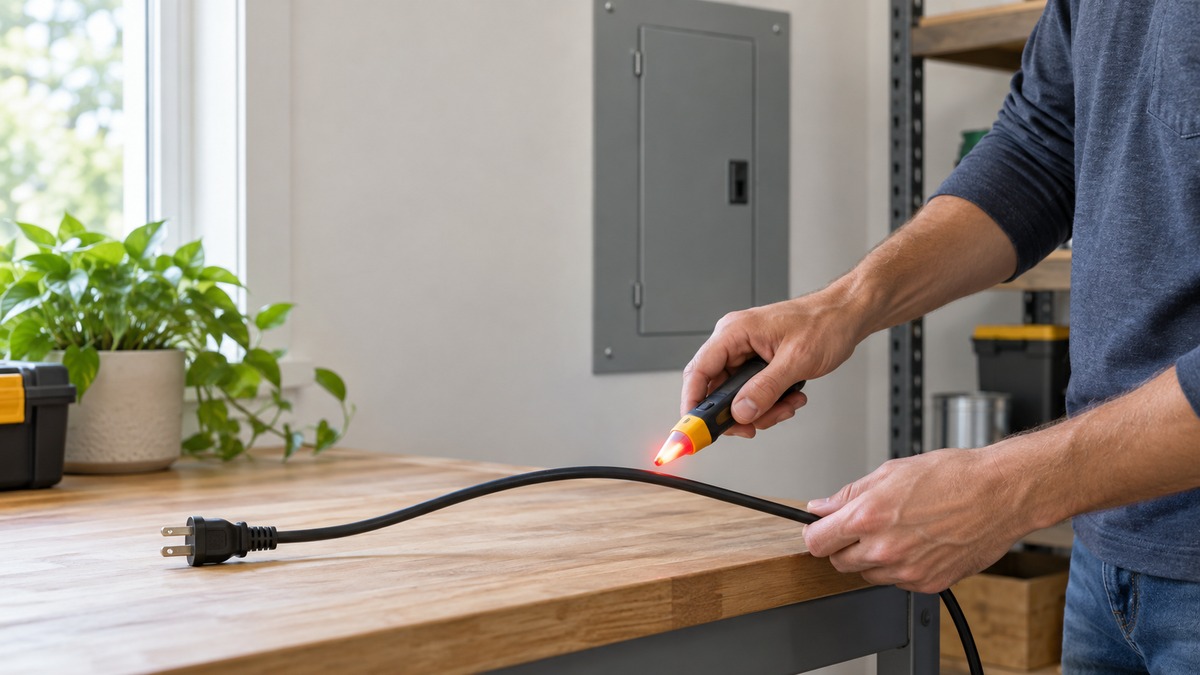
If you mean a non-contact voltage tester, use only the method in its manual. Check the case and batteries, select the specified sensitivity if the model offers one, and prove the tester on a known live source. Approach the intact cord, outlet opening, switch, or wire with the sensing tip without touching a conductor. Treat the model’s stated alarm as an indication that AC voltage is present. A silent result alone does not prove that a circuit is de-energized. Prove the tester again on the known live source. Stop if the tester behaves inconsistently, the wiring is exposed or damaged, or the task would require opening a panel. For a focused pen guide, see how to use a non-contact voltage detector.
Start by identifying the kind of tester
“Voltage tester” can describe different instruments. The six products here are non-contact AC detector pens. They do not provide a numeric voltage reading. An alert means the tester sensed AC voltage under the conditions described by its manual.
Do not transfer these steps to a contact tester or multimeter. If you need a numeric outlet measurement, start with using a voltage meter to test an outlet and the exact meter manual. For a plug-in device, use the receptacle tester guide.
Listed thresholds here begin at 12 V AC, 24 V AC, 50 V AC, 90 V AC, or 100 V AC. A 100 V AC threshold does not fit an expected 24 V AC signal. The CAT category and voltage must also suit the measurement location.
Why the CAT marking matters
CAT is not a synonym for detection range. Measurement category is an IEC classification for live circuits used in testing installations and equipment. The categories consider continuous energy available at that circuit point and possible impulse voltages. CAT II applies to measurements on circuits directly connected to a low-voltage installation. CAT IV applies at the source of the high-voltage installation.
The category and voltage marking belong together. A sensing range does not replace the CAT marking. IEC requirements call for the equipment’s transient withstand capability to be disclosed. Check the tester and manual rather than inferring suitability from its shape.
If the listing does not state a CAT rating, do not call the tester suitable for household mains. Each of the six testers below has a CAT claim in its title, specifications, or bullets. Match it to the manual. A tester with no marking is not one for panel work.
What you need before the check
You need the detector, its manual, correct batteries, and a manual-approved known live source for before-and-after checks. Do not dismantle equipment to create one. The goal is AC presence detection, not an exact value.
Inspect the instrument as directed. Stop for apparent damage. Confirm the model’s ready indication: Klein Tools and Southwire use green for operation or readiness; Fluke lists continuous self-test; Bosch lists self-test every 5 seconds.
Sensitivity is model-specific. Yowexa lists 12–1000 V AC at high sensitivity and 48–1000 V AC at low sensitivity. Bosch lists 24–1000 V AC and 90–1000 V AC modes. Do not assume another pen has either arrangement.
How to use a non-contact voltage tester step by step
1. Read the model manual before approaching the circuit
Find the operating sequence, battery directions, range, alerts, limitations, and CAT marking. If the manual is missing or markings are unreadable, do not guess.
Define the intended AC check. Listed examples include intact cords, outlets, switches, fixtures, and wires; they do not authorize dismantling them.
2. Confirm range and measurement category
Compare the expected circuit with the exact sensing range. A lower threshold is not a promise to identify every condition above it; follow the model instructions.
Check the CAT category and marked voltage for the location. Category and sensing range describe different limits; both must fit. Ask a licensed electrician if the match is unclear.
3. Switch on and confirm the ready state
Use the directed batteries. Turn the tester on and find its ready or self-test indication. Bosch lists green as no voltage, red as detected voltage, and orange as low voltage. Klein Tools uses green for operation and flashing red for detection.
Resolve low-battery or abnormal indications before use. Follow the maker’s meanings, not another pen’s color rules.
4. Prove the tester on a known live source
Use the manufacturer-directed known-live-source check. Yowexa expressly requires it before use. This confirms an immediate response, not the source’s precise voltage.
If the expected alarm does not occur, stop and follow the manual’s troubleshooting directions. For model-specific detail, consult how to use a voltage detector pen.
5. Approach the intact test point with the sensing tip
Keep your fingers in the specified holding area. Bring the tip near the intact test point using the directed orientation and distance. Never touch bare conductors or remove a panel cover.
Watch for the model’s defined response. Do not switch sensitivity during a yowexa check. On that model, a stronger or closer source can produce faster beeps and more lights; do not generalize this behavior.
6. Interpret only the alert defined for that model
On the Klein Tools NCVT1P, the listing says the green operating light changes to a flashing red light with a beep when voltage is detected. The Fluke listing says its tip glows red and its beeper sounds. Southwire lists audible and visual indication. Bosch lists visual, audio, and vibration feedback. These are presence alerts, not numerical readings.
Yowexa describes comparing signal strength for live and neutral identification, but says no alarm alone does not confirm absence of voltage. The comparison never proves a conductor is safe to touch.
7. Recheck the tester and decide what the result permits
Repeat the known-live-source check afterward. If its response changes, the intended result is unresolved.
A positive alert means the point cannot be treated as de-energized. A negative alert is not permission to touch wiring. Call a licensed electrician for exposed conductors, panel entry, mains repairs, or verified de-energization.
Products that fit this non-contact check
1. Klein Tools NCVT1P Voltage Tester, NCVT Pen, 50 to 1000V AC (Best overall)
Specs from the listing (checked 2026-10-10):
- Power Source: Battery Powered
- Item Weight: 22.68 g
- Specification Met: Cat Iv 1000v
- Included Components: Instructions and 2 x AAA 1.5 Volt Batteries
Pros
- Green operational indication changes to a flashing red light and beep when voltage is detected
- Listing states a 50 to 1000V AC power detection range
- Instructions and two AAA batteries are included
Cons
- The listed range does not cover signals below 50 V AC
Best for: A simple non-contact AC presence check with separate ready and detection indications
Skip if: The expected AC signal may be below 50 V AC
View on Amazon (affiliate link)
2. Neoteck Non Contact Voltage Detector 12-1000V AC Voltage Tester (Best lower threshold)
Specs from the listing (checked 2026-10-10):
- Power Source: Battery Powered
- Item Weight: 65 g
- Measurement Type: AC Voltage
- Included Components: 2×1.5V AAA batteries
Pros
- Listing states a 12-1000V AC range
- Audible beeps and an LED provide detection alerts
- Two 1.5 V AAA batteries are included
Cons
- The listing expressly says it is not suitable for Christmas light testing
Best for: AC presence checks where the expected signal may be below the starting ranges of most of the other testers
Skip if: You intend to test Christmas lights
View on Amazon (affiliate link)
3. Fluke 1AC II VoltAlert Non-Contact Voltage Tester, Pocket-Sized, 90-1000V AC, Audible Beeper, CAT (Best self-test)
Specs from the listing (checked 2026-10-10):
- Voltage sensing ranges: Nominally, 90 V AC to 1000 V AC
- Detector tip style: Flat-tip
- Light source: One high intensity red LED
- Batteries: 2 AAA alkaline batteries included; Typical battery life of greater than 1-year
Pros
- Continuous self-test is listed
- Audible and silent modes are available
- Two AAA alkaline batteries are included
Cons
- One bullet mentions an alternate 200 V to 1000 V AC range, so the exact variant must be checked
Best for: Users who want continuous self-test and a silent alert mode
Skip if: The expected AC signal is below 90 V AC
View on Amazon (affiliate link)
4. Non Contact Voltage Tester Pen, AC 12/48-1000V Electric Tester Pen (Best dual sensitivity)
Specs from the listing (checked 2026-10-10):
- AC Voltage Range: 12~1000V(High Sensitivity); 48~1000V(Low Sensitivity)
- Frequency: 50Hz/60Hz
- Alarm Mode: Sound and light alarm
- Safety Level: CAT.III 1000V; CAT.IV 600V
Pros
- High and low sensitivity modes have separately stated AC ranges
- Sound and 1-3 light indicators show detection strength
- The listing includes a low-battery alert and auto shutoff
Cons
- The listing says not to switch sensitivity during detection
Best for: Comparative AC checks that benefit from two selectable sensitivity modes
Skip if: You need DC detection or an exact voltage reading
View on Amazon (affiliate link)
5. Bosch GVD1000-17 Non Contact Voltage Tester Pen, HVAC & Electrician Tool (Best multi-alert)
Specs from the listing (checked 2026-10-10):
- Power Source: Battery Powered
- Item Weight: 4 ounces
- Item Dimensions: 7.95 x 1.77 x 2.48 inches
- Item Highlight: Detect 24-1000V AC with this electrical tester. Features IP67 rating, LED flashlight, and audio alerts for outlet testing.
Pros
- Visual, audio, and vibration feedback are listed
- Automatic self-test is stated to run every 5 seconds
- The listing states IP67 and CAT IV 1000V
Cons
- Its listed dimensions are larger than several conventional pen-shaped entries
Best for: Settings where vibration can supplement visual and audible detection alerts
Skip if: You want the smallest conventional pen format
View on Amazon (affiliate link)
6. Southwire Tester NCVD – Detects AC Voltage with Audible & Visual Alerts – Auto Power Off – Dual (Best narrow range)
Specs from the listing (checked 2026-10-10):
- Power Source: Battery Powered
- Style: Southwire 40116N Non-Contact AC Voltage Detector
- Specification Met: Cul Listed
- Item Type Name: Southwire 40116N AC Non-Contact Voltage Pen Tester, NCVT Detects 100-600VAC, Non-Contact Voltage Detector with LED Flashlight, 6' Drop Test Rated
Pros
- Green LED indicates that the tester is ready
- Listing states audible and visual AC indication
- Auto power-off is listed after 5 minutes of inactivity
Cons
- The included-components field does not state that batteries are included
Best for: Presence checks within its stated 100-600V AC range
Skip if: The expected source is outside 100-600V AC
View on Amazon (affiliate link)
Klein Tools NCVT1P: a straightforward ready-and-alert pattern
The Klein Tools NCVT1P detects 50–1000 V AC without contact. Its listing gives a simple indication scheme: green means the tester is operational, while a detected voltage produces a flashing red light and beep. The package includes instructions and 2 x AAA 1.5 Volt Batteries. Its specification field states Cat Iv 1000v, and the listing adds 6.6-Foot (2 m) drop protection.
Choose it when you want one stated AC range and distinct operating and detection signals. Skip it if your intended signal may be below 50 V AC, because that falls outside its listed range. It also does not give a numeric reading. Consult the Klein NCVT-3P guide only if that is the model in hand, since controls differ between models.
Neoteck PM8908C: the broadest listed lower threshold here
This pen lists a 12–1000 V AC range and uses audible beeps plus an LED indicator. Its listing says it can compare live and null wires by alarm level and names outlets, switches, circuit breakers, and wires as applications. Two 1.5 V AAA batteries are included. A bullet states CE CAT III600V RoHS Certificate.
Its 12 V AC threshold is the lowest listed here, matched only by the yowexa YW-322 in high-sensitivity mode, so it is worth a look when an expected AC signal is below the 24 to 100 V AC starting ranges of the Klein Tools, Fluke, Bosch and Southwire pens. Skip it for Christmas-light testing: the listing expressly says it is not suitable for that task. Also skip it if you need a numeric voltage, because its listed measurement is detection rather than a displayed value. Confirm the CAT marking and full instructions in the manual before using it around mains.
Fluke 1AC II: continuous self-test with audible control
The Fluke listing gives a nominal 90 V AC to 1000 V AC sensing range, a flat detector tip, one high-intensity red LED, and a beeper. It also lists continuous self-test and an audible/silent mode. The title states a CAT IV rating, while the battery field says 2 AAA alkaline batteries are included and lists typical battery life greater than 1-year.
Choose it if continuous self-test and the ability to silence the audible indication fit your work setting. Skip it for an expected AC signal below 90 V AC. One bullet also mentions a second 200 V to 1000 V AC range, so check the exact variant and manual rather than assuming which range applies. Silent mode also makes careful attention to the visual alert essential.
yowexa YW-322: selectable sensitivity for two stated ranges
The YW-322 provides two listed modes: 12–1000 V AC at high sensitivity and 48–1000 V AC at low sensitivity. It uses sound and light alarms, with 1–3 indicators tied to signal strength. The listing includes a flashlight, low-battery alert, auto shutoff, and 2 x 1.5 V AAA batteries. Its stated safety level is CAT.III 1000V; CAT.IV 600V.
Choose it when selectable sensitivity helps separate a broader search from a narrower check. Skip it if you are likely to change modes during a reading, because the listing says not to switch sensitivity during detection. Signal strength is not a voltage measurement, and no alarm does not prove absence of voltage. This model is for AC checks only.
Bosch GVD1000-17: three types of detection feedback
Bosch lists low-voltage detection at 24–1000 V AC and standard detection at 90–1000 V AC. Detection can produce color-coded visual cues, audio, and vibration. The listing says an automatic self-test occurs every 5 seconds. It also states IP67, a drop design of up to 6 feet, and certified CAT IV 1000V safety standards.
Choose this pen if vibration is useful where an audible alert may be hard to notice. Skip it if a compact pocket pen is your priority: its listed dimensions are 7.95 x 1.77 x 2.48 inches, larger than several conventional pen-shaped entries. The listing uses orange for low voltage and red for detected voltage, so read its manual instead of applying another brand’s color meanings.
Southwire 40116N: a defined household-range detector
Southwire states audible and visual indication across 100–600 V AC. A green LED shows that the tester is ready. Its listing also names a built-in flashlight and auto power-off after 5 minutes of inactivity. The title and item type identify CAT IV 600V and a 6′ drop test rating.
Choose it when the intended AC source lies within that narrower stated range and a ready light is desirable. Skip it for an expected signal below 100 V AC or above 600 V AC. The listing’s included-components field names the tester but does not state that batteries are included, so verify package contents before ordering. It detects presence and does not supply a numerical measurement.
Range check: choosing a detector range
Take a 24 V AC control wire as an example and compare each tester’s stated lower limit against it. The arithmetic only eliminates out-of-range choices; it does not establish field suitability.
For Bosch low-voltage mode, subtract the listed threshold from the example signal: 24 V AC − 24 V AC = 0 V AC of threshold margin. Check it in reverse: 24 V AC + 0 V AC = 24 V AC.
For the Neoteck and yowexa high-sensitivity modes, the calculation is 24 V AC − 12 V AC = 12 V AC above the listed threshold. Reverse verification gives 12 V AC + 12 V AC = 24 V AC.
For Klein Tools, the difference is 24 V AC − 50 V AC = −26 V AC. Confirming from the other direction, 50 V AC − 26 V AC = 24 V AC. Its listed threshold is therefore 26 V AC above the example signal.
Fluke starts at 90 V AC, so 24 V AC − 90 V AC = −66 V AC. The reverse check is 90 V AC − 66 V AC = 24 V AC. Southwire starts at 100 V AC: 24 V AC − 100 V AC = −76 V AC, and 100 V AC − 76 V AC = 24 V AC.
Bosch low-voltage mode, Neoteck, and yowexa high-sensitivity mode remain within their stated ranges. CAT marking, location, manual, and result type still determine suitability.
Common mistakes that make a voltage check unreliable
Treating silence as proof that power is off
No alarm can reflect the selected mode, the stated range, placement, battery condition, or a failed instrument. The yowexa listing explicitly says that no alarm alone does not confirm absence of voltage. Use the before-and-after known-live checks and stop before touching conductors.
Confusing detection range with CAT rating
A pen marked to detect up to 1000 V AC does not gain a suitable measurement category from that number alone. Range and installation category describe different things. Confirm both markings for the intended location.
Borrowing another model’s colors or controls
Green can indicate operational readiness on one model. Bosch lists green for no voltage and orange for low voltage. The correct meaning comes from the exact model manual, not a general memory of detector pens.
Selecting the wrong sensitivity and changing it mid-check
On a dual-range pen, the selected mode changes the stated lower limit. The yowexa listing warns against switching sensitivity during detection. Make the selection first, keep it fixed for the comparison, and follow that model’s instructions.
Expecting a number from a detector pen
These tools signal presence within a listed AC range; they do not display the circuit voltage. Do not infer an exact value from beep speed, light count, or perceived signal strength. Use an appropriate meter and its manual when the job requires a measurement.
Extending a screening check into live electrical work
A detector alert is not a reason to open a panel, move bare wiring, or attempt a repair. Mains circuits can kill. Panel and service work belong to a licensed electrician, as does any task requiring verified de-energization before conductor contact.
When to stop and call a licensed electrician
Stop for failed known-live checks, inconsistent alerts, unreadable ratings, damage, an out-of-range circuit, or a mismatched CAT marking. Do not proceed around exposed conductors or remove a panel cover.
Also stop when the result must establish that a conductor is safe to touch. A non-contact indication does not supply that proof. Follow the instrument manual and local electrical rules. This guide is not a substitute for a licensed electrician.
FAQ
How do you use a voltage tester on an outlet?
For a non-contact pen, follow its manual for the ready check, known-live check, tip position, and alert. Keep the tester outside the outlet and do not insert anything except as expressly directed for that model. If you need a task-specific overview, read how to test an outlet with a voltage tester.
Can a non-contact tester tell me the exact voltage?
No exact voltage is shown by the products here. They provide light, sound, or vibration indications when AC voltage is detected within their listed ranges. Choose a suitable voltage meter if your task depends on a numerical value.
Does no beep mean the wire is safe?
No. A silent response alone does not confirm absence of voltage. Check mode, range, battery condition, placement, and the before-and-after response on a known live source. Do not touch the wire based on silence.
What CAT rating do I need?
That depends on the measurement location and the instrument’s marked voltage. CAT II covers circuits directly connected to a low-voltage installation, while CAT IV applies at the installation source. Do not infer the correct category. Match the manual and markings to the task or ask a licensed electrician.
Why does my tester alert near one wire but not another?
The yowexa listing says its signal can vary with source strength or proximity and describes a comparative live/neutral method. That behavior is model-specific and is not a numeric reading. If the result is unclear, stop rather than concluding that the quiet wire is safe.
Can I use these pens for DC voltage?
All six testers are listed for AC detection. Their stated ranges use V AC. Do not use them as DC detectors unless the exact manufacturer’s manual expressly states that capability; select an appropriate instrument instead.
Should I use a voltage detector inside an electrical panel?
No beginner procedure here requires opening a panel. Mains panel and service work can expose lethal hazards and belongs to a licensed electrician. Keep the panel closed and arrange professional help.
Bottom line
Choose a non-contact voltage tester only when you need an AC presence screen, not an exact measurement. Its listed range and CAT marking must fit the circuit location. Prove it on a known live source before and after the check, interpret only its model-specific alarm, and never treat silence as permission to touch wiring. If the task requires panel access, exposed conductors, or verified de-energization, stop and call a licensed electrician.
Sources
- Measurement category: supports the CAT classification, category-location distinctions, energy and impulse context, and IEC transient-capability disclosure statement.