Live Wire Checkers
As an Amazon Associate we earn from qualifying purchases. Details
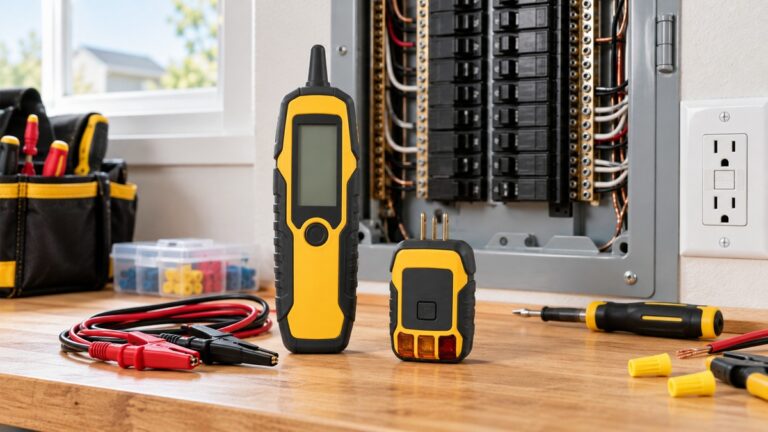
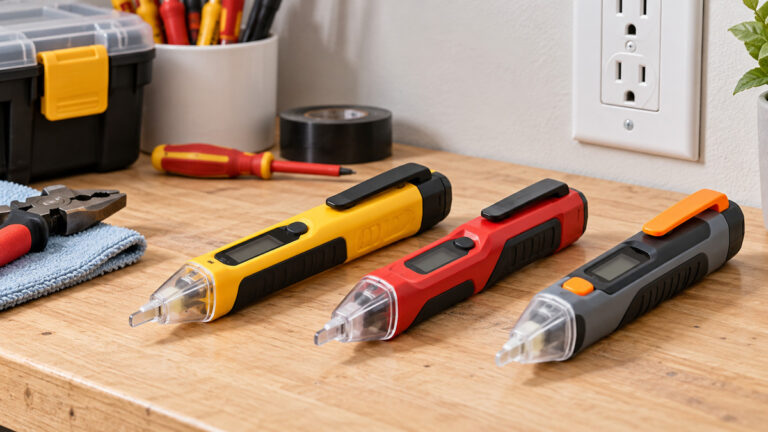
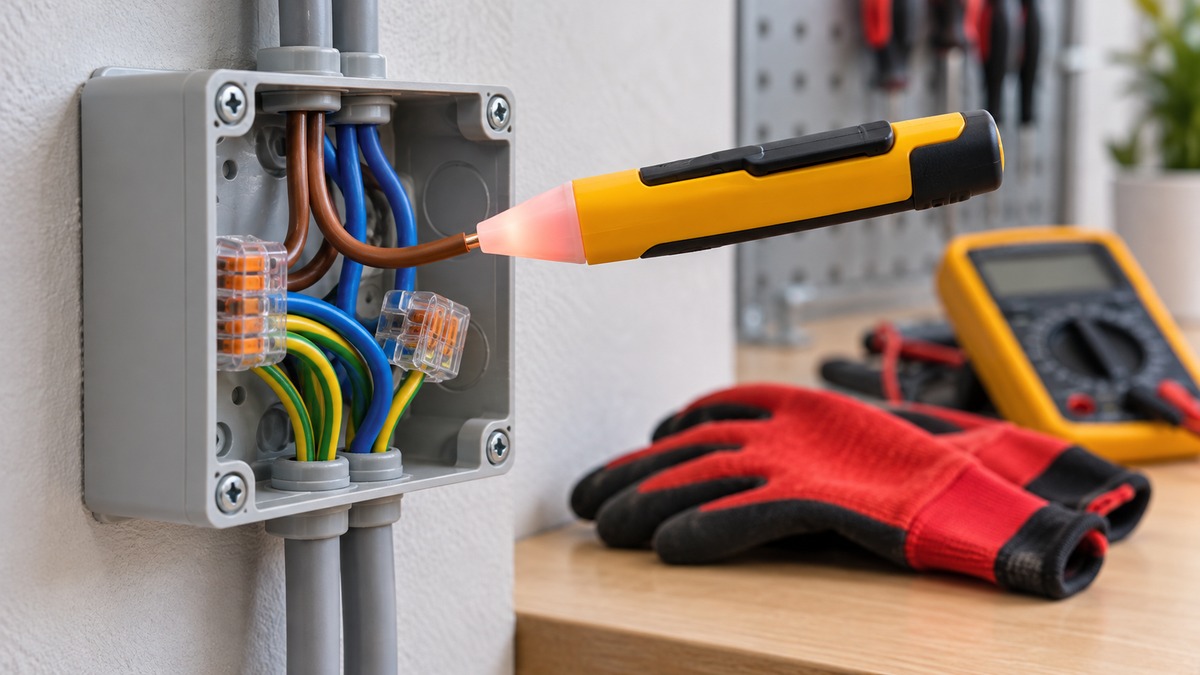
A live wire checker is a non-contact voltage tester. You hold the tip near a cable, cord, outlet, or switch, and it signals when AC voltage is present. It does not measure the voltage or confirm that a circuit is safe to touch. The five listings below are all non-contact AC testers whose title or bullets name live or AC wire detection. The details come from the listing text we read on 17 October 2026. We did not test any of them. Read the safety section before you use one, because a silent tester does not prove a wire is dead.
Quick answer
For a simple pocket tester with a wide range, the Klein NCVT1P (50-1000V AC) is the most familiar name in this set. For a tester that gives a choice of sensitivity, the dual-range CEM AC-15EX lists 12V and 100V starting points, and the dual-range pen from an unnamed maker lists a 12V high-sensitivity mode. The AstroAI VTS1000H combines a tester with a steel screwdriver and an LCD. The Neoteck listing is the only one that states a CAT rating in its bullets, and that rating is a manufacturer claim we did not verify. None of these tools replaces a multimeter or a test on a known live source.
What a live wire checker can and cannot tell you
A non-contact tester senses the electric field from AC voltage. It can show that voltage is present on a wire, cord, or switch leg. It cannot show the voltage level, the current, or whether a circuit is de-energized. Klein’s manual for its NCVT3P dual-range tester, which is not one of the five listings here, states that the tester should be checked before and after each use on a known working circuit within its rating. The same manual says that no voltage indication does not mean the circuit is de-energized. It also lists two NCVT3P modes, 70 to 1000V AC and 12 to 1000V AC, and says the tester turns off after 4 minutes of inactivity, while its flashlight turns off after 20 minutes.
The same Klein manual lists conditions where a non-contact tester may fail to detect voltage. It will not detect voltage on a shielded wire, on DC voltage, or when the operator is not grounded or is insulated by gloves or other materials. Detection may also fail when the wire is partially buried or in a grounded metal conduit. Those limits apply across this category, so treat them as a general warning, not a feature of one listing.
Comparison of the five listings
| Listing | Brand | AC range stated | Live or null wire | Other features (bullets) | CAT rating in bullets read |
|---|---|---|---|---|---|
| AC-15EX non-contact voltage tester | CEM | 12V-1000V and 100V-1000V dual range | Live/null wire tester (title) | Buzzer, breakpoint finder, flashlight; ATEX Ex ib IIB T4 per listing | Not stated; ATEX certification given instead |
| Dual-range electrical tester pen | Not stated in text read | 12-1000V high sensitivity; low sensitivity mode | Live wire detector (title) | Red tip and beeper; flashlight; red pointing light | Not stated |
| NCVT1P voltage tester | Klein Tools | 50-1000V AC (title) | Not in title; detects AC in wires (bullet) | Green-on, red-and-beep when voltage found; auto power-off | Not stated |
| Non-contact voltage detector, 12-1000V | Neoteck | 12-1000V AC (title) | Live and null wire by alarm level (bullet) | Pen lights on voltage; flashlight | Bullet: CE CAT III 600V (manufacturer claim) |
| VTS1000H voltage tester with screwdriver | AstroAI | 12V/70V-1000V dual range (title) | Live Wire Test (title) | Steel screwdriver at tail; LCD percentage display; backlit screen | Not stated |
Specs come from the listing titles and bullets, checked on 17 October 2026. Where a bullet makes a claim the listing does not back with a test report, we label it a listing claim.
The five listings
1. CEM AC-15EX non-contact voltage tester (B07RJ58GDB)
Best for: a dual-range check with a listed live and null wire function, plus a buzzer and a breakpoint finder.
Skip if: you need a CAT rating in the bullets. The bullets give an ATEX certification instead, and that is a different type of rating.
Listed specs: AC 12V-1000V and 100V-1000V dual range; live and null wire test; buzzer alarm; wire breakpoint finder; flashlight; switchable audible or silent mode; auto power-off; ATEX Ex ib IIB T4 certification per listing.
2. Dual-range electrical tester pen, live wire detector (B09ZXY4HVK)
Best for: switching between high and low sensitivity, for example at a switch or lamp where a weak signal may not register.
Skip if: you need a named maker for warranty or service. No maker appears in the listing sections checked.
Listed specs: high sensitivity for AC 12V-1000V; low sensitivity mode for higher voltages; visible and audible alarm, with the tip glowing red when high voltage is detected; built-in flashlight and red pointing light. The bullets also state a 3-year warranty as a listing claim.
3. Klein Tools NCVT1P voltage tester, 50-1000V AC (B099SJ6469)
Best for: a familiar pocket tester for AC wiring, with a green operation light and a red and beeping alert.
Skip if: you need a 12V low-end setting. The title gives a 50-1000V AC range, and the bullets do not list a lower range.
Listed specs: AC voltage detection in cables, cords, breakers, fixtures, switches, non-tamper-resistant outlets and wires; bright LED turns green when operational and flashes red with a beep when voltage is detected; 50-1000V AC; auto power-off; compact clip design; 6.6 foot (2 m) drop protection as a listing claim.
4. Neoteck non-contact voltage detector, 12-1000V (B01JYCVU2Q)
Best for: telling a live wire from a null wire by the alarm level, and a listing that gives a CAT rating in its bullets.
Skip if: you need the CAT rating verified. The bullet is a manufacturer claim, and we did not check it against a certificate.
Listed specs: non-contact AC voltage, 12-1000V; live and null wire differentiated by alarm sound level; the pen lights when voltage is detected; works as a flashlight; bullet states a CE CAT III 600V and RoHS certificate.
5. AstroAI VTS1000H voltage tester with screwdriver (B0DCNWJKZX)
Best for: a tester you can use as a screwdriver, with a backlit LCD and a percentage display.
Skip if: you do not want a screwdriver built into the tester. The tail includes a steel screwdriver, which adds weight.
Listed specs: dual range AC 12V/70V-1000V; live wire test; wire breakpoint finder; audible alarm; LCD percentage display; backlit screen; flashlight; red light and alarm when voltage is detected.
How to choose
Start with the sensitivity you need. A dual-range tester gives you a low setting for weak signals and a high setting for less sensitive use. Next, check the listed lower limit. Four of the five listings start at 12V AC, with a 70V low setting on the AstroAI. The Klein starts at 50V AC. All five list 1000V as the upper limit, so none covers a higher range. Then check the features that help you work: a flashlight is useful in a dark panel or under a sink, and a breakpoint finder helps you trace a broken wire. Finally, check the listing’s safety wording. Only one bullet in this set gives a CAT rating, and it is a manufacturer claim.
Worked example: checking a cord before you cut it
Suppose you want to confirm that a lamp cord is dead before you cut it. The sequence below follows the manual steps for this category, with the limits stated:
- Test the tester on a known live source within its rating. For the Klein NCVT1P, that means a source between 50V and 1000V AC. For the CEM AC-15EX, the listed range starts at 12V. Confirm that it signals.
- Hold the tip near the cord and watch for the signal. Note the result.
- Test the tester on the same known source again. If it no longer signals, the tester has failed, and the cord result cannot be trusted.
- A silent tester on the cord still does not prove it is dead. Retest the cord with a multimeter or another method before you cut it, and do not cut a live cord to find out.
This example is a sequence, not a measurement. It uses no numbers from the listings, and the outcome depends on the tester and the cord.
Mistakes to avoid
- Trusting a silent tester. The Klein manual says no indication does not mean the circuit is de-energized.
- Skipping the check on a known live source. The manual says to test before and after each use.
- Expecting a non-contact tester to work on shielded wire or DC voltage. The manual lists both as cases where detection fails.
- Testing a neutral or ground as if it were dead. The manual says neutrals in multi-wire branch circuits may be energized when disconnected.
Safety and the electrician line
A live wire checker is for a quick signal. It is not a substitute for a meter with a stated rating, and it is not a reason to open a panel. Panel and service work belongs to a licensed electrician. The CPSC home electrical checklist advises having an electrician check outlets and switches that are not working properly.
FAQ
Is a live wire checker the same as a multimeter?
No. A live wire checker signals that AC voltage is present. A multimeter measures voltage and other values. Use a multimeter when you need a number, and use a live wire checker as a fast first check.
Why test the tester before and after each use?
The Klein manual says to verify operation on a known working circuit before and after each use. That shows the tester was working during your check.
Can a non-contact tester detect DC voltage?
The Klein manual says the tester will not detect DC voltage. Check each listing for its own range, and do not assume a non-contact pen covers DC.
Which listing gives a CAT rating?
The Neoteck bullet states a CE CAT III 600V rating. That is a manufacturer claim, and this guide did not verify it.
Does a silent tester mean the wire is safe?
No. The manual says a silent tester does not prove a circuit is de-energized, and detection can fail in the conditions listed above.
Related guides
For a wider look at this category, read Best Live Wire Tester and Best Non Contact Voltage Checker. For the basics of the tool type, see How to Use a Non Contact Voltage Detector.
Sources
- Klein Tools, NCVT3P dual-range non-contact voltage tester instruction manual: manufacturer statement for a different model, used for the before-and-after check, the no-indication warning, and the detection limits. Labelled as the manufacturer’s statement.
- CPSC, Home Electrical Safety Checklist, Pub 513 (July 2008): used for the advice to have an electrician check outlets and switches that are not working properly.