How to Use a Clamp Meter Safely, Step by Step
As an Amazon Associate we earn from qualifying purchases. Details
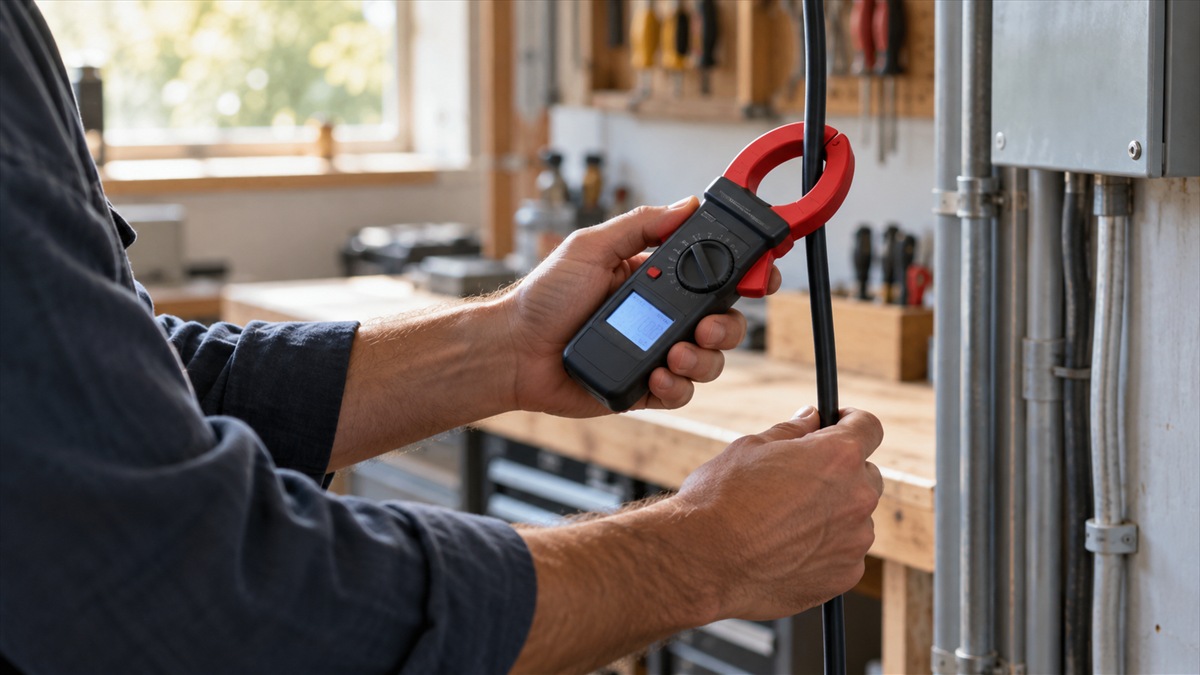
A clamp meter reads current without breaking the circuit. You open the jaws, close them around one insulated conductor, and read the value on the display. Before the jaws touch any wire, check the meter’s CAT rating against the point you plan to measure, because mains work can kill. Set the function to AC or DC current first, and confirm the jaws close fully around the conductor.
The steps below cover those safety checks, the basic measurement sequence, and the mistakes that cause misreadings, such as clamping both conductors of a cable at once. If a reading falls outside what you expect, or the work involves panel or service equipment, stop and bring in a licensed electrician.
At a glance: the 7 steps, in order
| Step | What to do |
|---|---|
| 1. Read the manual and labels | Find the CAT rating, voltage rating, and current types the clamp reads before starting |
| 2. Confirm the current type | Current transformer clamps read AC/pulse only; Hall effect clamps read both DC and AC — check your model before measuring DC |
| 3. Set function and range | Choose AC or DC current function per the manual; auto-ranging models select the range themselves |
| 4. Clamp a single conductor | Open jaws, enclose one conductor at a time per the manual’s guidance |
| 5. Close the jaws fully | A partially closed jaw can give an unclear reading |
| 6. Read the display | Use Data Hold/Max if available; check the unit symbol to confirm you’re reading amps, not something else |
| 7. Use leads for voltage | Clamp jaws measure current only — voltage requires the test leads on models that support it (e.g. FNIRSI states this explicitly) |
Figures and steps are from the clamp meter manufacturer manuals and reference sources cited in this guide’s sources section (Measurement category, Current clamp, OSHA electrical safety, True RMS converter). A true RMS converter gives a more accurate reading than an averaging meter on a distorted waveform — averaging meters rely on a correction factor valid only for sinusoidal input.
Quick answer
To read current, set the meter to the function your model uses for that current type, usually AC on a clamp. Open the jaws, place them around one conductor at a time, close them fully, and read the display. Freeze a reading with Data Hold if your model has it. If your model reads voltage, use the test leads rather than the jaws. Check the CAT rating before you start. If the work is inside a panel or at the service, stop and call a licensed electrician.
Safety before you clamp
Mains circuits can cause serious injury or death. OSHA lists the most frequent causes of electrical injuries as contact with power lines, lack of ground-fault protection, a path to ground that is missing or discontinuous, equipment not used in the manner prescribed, and improper use of extension and flexible cords. The ways OSHA lists to reduce that risk are insulation, guarding, grounding, electrical protective devices, and safe work practices. A clamp meter helps you read current. It does not replace any of those steps.
Measurement category matters for the same reason. Category II is for measurements on circuits directly connected to the low-voltage installation. Category IV is for measurements at the source of the high-voltage installation. The categories take into account the total continuous energy available at the point you measure and the occurrence of impulse voltages. A meter rated for a lower category may not suit a point where more energy is available. Find the CAT marking on the meter and in its manual before you clamp anything.
Transient withstand is the other rating to look for. IEC 61010-1 requires that the transient withstand capability of the equipment is made known to the user. If the manual or label gives no such figure for your model, do not assume one. Ask a qualified person or use a different meter.
Instructions carry legal weight in the workplace too. Under 29 CFR 1910.303(b)(2), listed or labeled equipment must be installed and used in accordance with any instructions included in the listing or labeling. Read the instructions that came with your meter before you use it on any circuit. Treat test leads with the same care OSHA asks for flexible cords. OSHA 29 CFR 1910.305 says those cords must be protected from accidental damage such as sharp corners, projections, doorways, and other pinch points.
Protective devices add a second layer, but they are not a substitute for a rated meter. A circuit breaker protects a circuit from current in excess of what the equipment can safely carry, and it can be reset. A fuse is a sacrificial device: once it has operated, it must be replaced. A residual-current device, also called a ground fault circuit interrupter (GFCI), interrupts a circuit when the current in the line and neutral conductors is unequal. These devices protect the wiring. They do not change the rating of your meter.
What you need
- A clamp meter with a CAT rating that suits the point you will measure.
- The manual for that exact model, including its function list and range notes.
- Test leads in good condition, if you plan to read voltage or resistance.
- A plan for the circuit: know what the conductor feeds and where it ends.
Choose the function for your job
Start with the kind of current you need to read. Clamps are typically used to read AC, so choose an AC clamp for alternating circuits. Choose a model whose listing or manual names DC current when the circuit is direct current, such as a vehicle’s electrical system, and confirm that DC current is named before you clamp. Choose a multimeter with test leads instead when voltage or resistance is the main reading, because the clamp jaws do not take those readings. Choose a recording clamp when the value changes over time and you need a trace rather than one number.
Step-by-step: taking a current reading
- Read the manual and the labels. Find the CAT rating, the voltage rating, and the current types the clamp reads. Do not start until you have these.
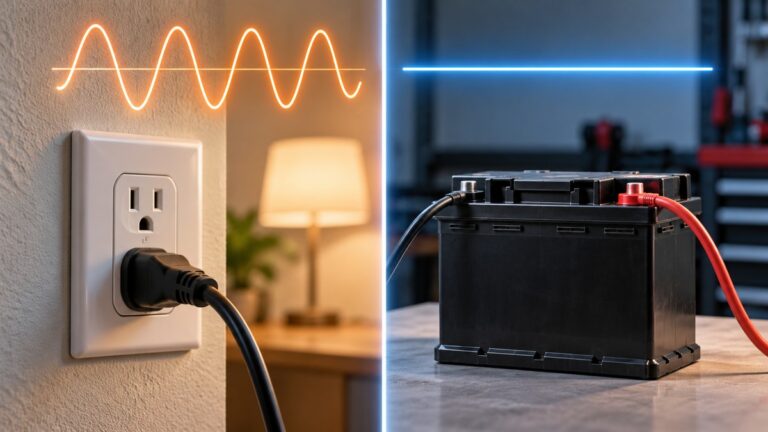
- Confirm the current type. Clamp meters are typically used to read AC. A current transformer clamp works only with AC or pulse waveforms. A Hall effect clamp measures both DC and AC. Check your model before you try to measure DC.
- Set the function and range. Choose the AC or DC current function the manual lists. On an auto-ranging model, the meter selects the range itself. On a manual-range model, choose the range the manual gives for the current you expect.
- Open the jaws and place them around a single conductor. Follow the manual on how many conductors to enclose at once. Clamping one conductor at a time keeps the reading tied to that conductor.
- Close the jaws fully. A jaw that is not fully closed can leave the reading unclear. Close them completely before you look at the number.
- Read the display. Use Data Hold to freeze the number on screen, and Max where your model offers it. Read the unit symbol on the display so you know whether you are looking at amps or something else.
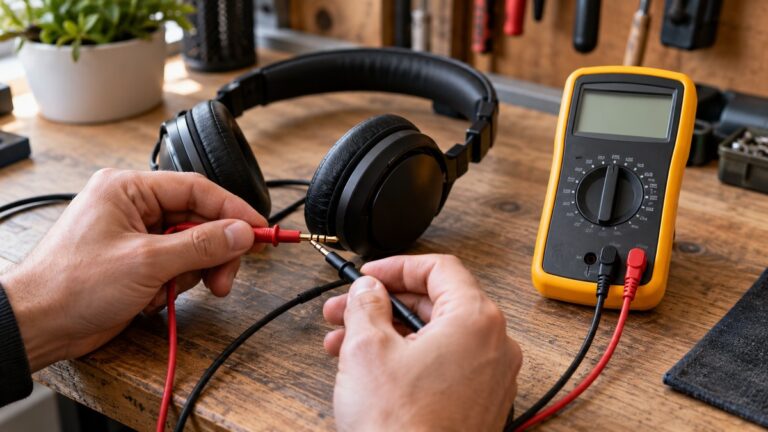
- Take voltage readings with the test leads only. On models that read voltage through leads, keep the jaws out of that job. The FNIRSI listing states that voltage measurement must be performed with the test leads and that the clamp jaws are for current measurement only.
Common mistakes
- Measuring DC current with an AC-only clamp. An AC-only clamp is not designed for direct current. Check the current type before you read.
- Ignoring the function list. Many models split AC current, DC current, voltage, and resistance into separate functions. A reading taken in the wrong function looks normal and is still wrong, so check the function icon and the unit on screen.
- Using the jaws for voltage. The jaws measure current. Voltage needs the test leads on models that support it.
- Picking a meter whose CAT rating is lower than the point you measure. The category depends on the energy available at that point, not only on the voltage.
- Trusting an averaging reading on a distorted waveform. A true RMS converter gives a more correct value than an averaging meter. Averaging meters use a correction factor that is valid only when the input is sinusoidal, so distortion or offsets lead to errors.
- Replacing a blown meter fuse with a different rating. Fuses have specific current and voltage ratings, breaking capacity, and response times. Use the rating the manual gives.
- Skipping the manual. Listed equipment must be used as its instructions say. The manual is where the CAT rating and the range rules live.
Products that fit this
Three clamp-style models are listed below. Each write-up relies on that listing’s own wording, so check the specs before you buy.
1. Klein Tools CL120 Digital Clamp Meter, Auto-Ranging 400 Amp AC (Auto-ranging AC clamp with backlight)
Specs from the listing (checked 2026-10-11):
- Model: CL120
- Measurement Type: Ammeter, Voltmeter, Ohmmeter
- Item Highlight: AC/DC Voltage, Resistance, Continuity, Non-Contact Voltage Tester Detection
- Item Weight: 9.76 ounces
- Item Dimensions: 8.45 x 3.51 x 1.51 inches
- Specification Met: Double Insulation Safety Rating, Ce Certified
Pros
- Auto-ranging selects the measurement range for you, as the listing states
- The backlit LCD is stated for low-light use, with a test lead holder on the side of the clamp
- Data Hold and Max are listed, with auto power-off after 10 minutes
Cons
- The listing names AC current for the clamp, so DC current through the jaws is not stated
- CAT III and CAT IV appear on the test lead safety caps, not as a rating for the meter body, so confirm the meter's own CAT rating before mains work
Best for: Electrical work where an AC current clamp with auto-ranging and a backlit display are the priorities.
Skip if: You need DC current through the jaws, or you need a meter rating for mains circuits stated on the listing itself.
View on Amazon (affiliate link)
2. FNIRSI DMC-100 Clamp Meter 9999 Counts TRMS, 600A AC/DC Amp Meter (Recording clamp for intermittent faults)
Specs from the listing (checked 2026-10-11):
- Model: FNIRSI-DMC-100
- Style: 10000 Counts AC Current
- Measurement Type: Ammeter, Multimeter, Ohmmeter, Voltmeter
- Unit Count: 9999 Count
- Item Weight: 6.72 ounces
- Item Dimensions: 7.7 x 2.91 x 1.14 inches
Pros
- The listing states AC and DC current up to 600 amps
- The listing describes storage of 8 sets of real-time data plus 30 sets of historical records
- A rechargeable 1500mAh lithium battery with Type-C charging is listed
- The listing names RV DC system analysis and residential appliance repair among its uses
Cons
- Voltage needs the test leads, since the clamp jaws measure current only
- The Style field reads AC Current while the title says AC/DC, so the listing is inconsistent; confirm DC current in the manual before relying on it
- No CAT rating for the meter appears in its listing, so check the manual before any mains work
Best for: Work where a recorded trace of changing current or voltage helps, as the listing describes.
Skip if: You need a simple AC-only clamp for occasional checks, or a meter whose mains rating is stated on the listing.
View on Amazon (affiliate link)
3. Fieldpiece Compact HVACR Clamp Multimeter SC260 – True RMS Clamp Meter with Temperature (Compact HVACR service clamp)
Specs from the listing (checked 2026-10-11):
- Model: SC260
- Style: Voltage Tester
- Included Components: Meter
- Measurement Type: Multimeter
- Item Dimensions: 3.5 x 3 x 9.1 inches
Pros
- Auto Select mode: Meter automatically detects when measuring capacitance or resistance measurements
- The listing states True RMS, temperature, capacitance and backlight, with NCV and amperage readings
- A sturdy swivel magnet is listed for hands-free readings
Cons
- Its Style field reads Voltage Tester while the title says clamp meter, so the listing is inconsistent; confirm the form factor before buying
- Included Components lists only the meter, so leads and a case are not named
- No CAT rating appears in its listing, so check the manual before mains work
Best for: Compact HVACR service work where capacitance readings and a swivel magnet for hands-free use matter.
Skip if: You need a clamp with a stated mains rating, or you want a model whose style field reads clamp meter.
View on Amazon (affiliate link)
When to stop and call a professional
- Stop before any work inside a panel or at a service entrance. Panel or service work belongs to a licensed electrician.
- Stop if the circuit you want to measure is above the meter’s CAT rating, or if you cannot identify what the conductor feeds.
- Stop if the leads are cracked, the jaws do not close, or the meter gives a reading you cannot verify.
- In a vehicle, disconnect and handle the battery safely. Never give a vehicle’s airbag or high-voltage hybrid or EV system any work at all.
Worked example: a rise in current on one cable
After the heater runs, the same conductor reads 9 A. The change is 9 minus 6 equals 3 A. Check the arithmetic: 6 plus 3 equals 9, so the two readings agree. The change tells you how much the load added on that conductor at that moment. It does not tell you whether the cable or breaker is adequate, because that depends on the wiring, the protective device, and local electrical rules. Take the reading again with the load running steadily before you draw a conclusion, and check the manual and local rules for the rest.
FAQ
Can a clamp meter measure voltage?
Some models can. On the FNIRSI model in this list, voltage must be measured with the test leads, and the clamp jaws are for current only. Check the function list in your own manual, because the setup differs by model. For a broader look at voltage checks, see How Do Voltage Testers Work.
Can a clamp meter measure DC current?
It depends on the clamp type. The current transformer design is limited to alternating and pulse signals, while a Hall effect design measures both DC and AC. The Klein listing names AC current for its clamp. If you need DC current, look for a model whose listing names it. For more on this question, see Can Clamp Meter Measure Dc Current.
Does a clamp meter need to break the circuit?
No. A clamp measures current without contact. You open the jaws around the conductor, close them, and read the display. You do not cut the wire or disconnect the load to take the reading.
What does a CAT rating mean?
CAT is a measurement category set by the International Electrotechnical Commission. It classifies live measurement circuits, usually in relation to a building. Category II covers circuits directly connected to the low-voltage installation, and category IV covers measurements at the source. Pick a meter whose rating suits the point you will measure. For the setup of a clamp on a conductor, see What Does a Clamp on Ammeter Measure.
Is a clamp meter the same as a multimeter?
No, though the two overlap. A multimeter measures voltage, resistance, and current, and some models add temperature or capacitance. A clamp meter adds a jaw for current measurement. Several clamp models here also combine voltage and resistance functions, so read each function list before you buy. For a multimeter-focused guide, see Best True Rms Digital Clamp Meter.
Why does my reading look wrong on a distorted waveform?
Averaging meters use a correction factor that is valid only when the input is sinusoidal. Distortion or offsets cause errors in that reading. A true RMS meter gives a more correct value in those cases. Check whether your model is true RMS in its manual.
Should I use a clamp meter inside a panel?
A clamp meter is a measuring tool, not a licence to open a panel. If you are unsure whether a task counts as panel work, stop and ask a professional before you touch anything. For a related everyday check, see How Do You Use an Electric Tester.
What if the reading is zero?
A zero reading can mean that no current is flowing, that the function is wrong, or that the jaws are not fully closed. Re-check the function and the jaw closure before you draw a conclusion. Do not assume the circuit is dead, because a clamp reads current and not voltage.
Bottom line
Choose a clamp meter when you need current without breaking the circuit. Choose a multimeter with test leads when voltage and resistance are the main job. Before any reading, check the CAT rating against the point you measure, and follow the manual. If the work is inside a panel, stop and call a licensed electrician.
Sources
- Measurement category, Wikipedia: CAT II and IV definitions and the role of impulse voltages
- Current clamp, Wikipedia: AC-only current transformer clamps versus Hall effect clamps
- OSHA electrical safety: most frequent causes of electrical injuries and ways to reduce risk
- 29 CFR 1910.303, Cornell LII: equipment used per the listing or label instructions
- 29 CFR 1910.305, Cornell LII: protecting flexible cords from damage
- True RMS converter, Wikipedia: averaging meters and distorted waveforms
- Circuit breaker, Wikipedia: overcurrent protection that can be reset
- Residual-current device, Wikipedia: interrupting unequal line and neutral current