What Is a Multimeter Jack
As an Amazon Associate we earn from qualifying purchases.
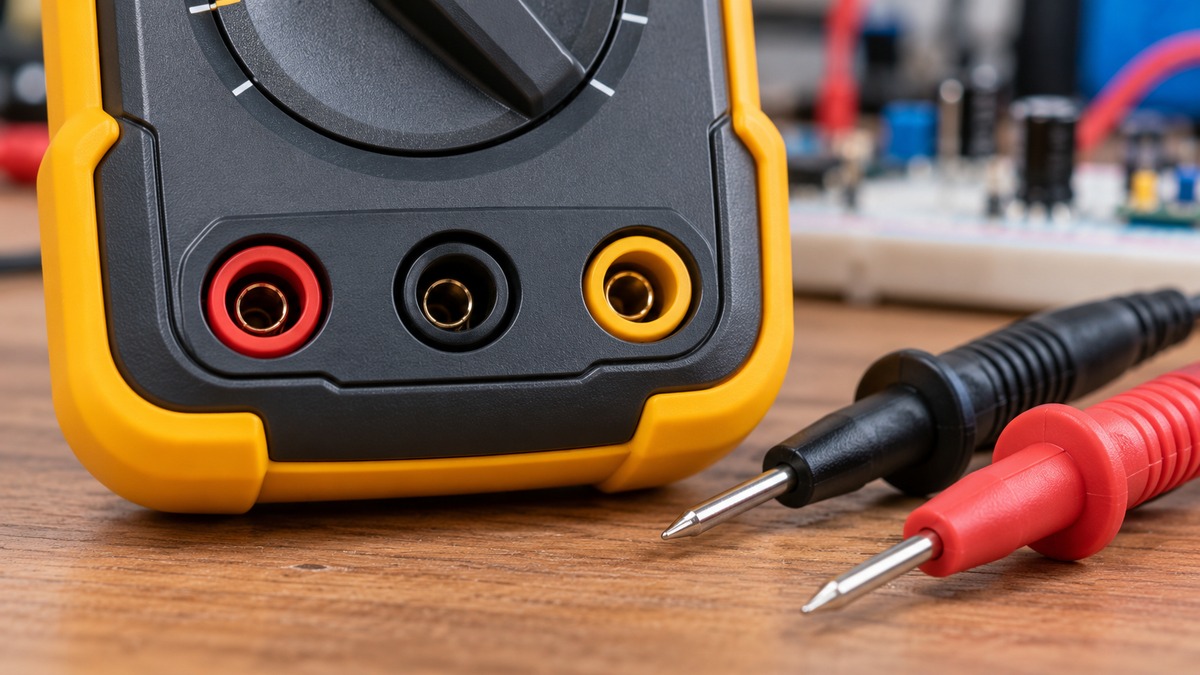
What is a multimeter jack? It is the socket on a meter’s front panel that takes the plug at the end of a test lead, and each jack belongs to a group of measurements. The manufacturer’s manual for each model says which jack serves which function, and the printed labels are the first clue. This explainer covers the jacks that most handheld meters share, why the current jacks are built differently from the voltage jack, and what a jack label does and does not tell you. It describes labels and ratings only. It does not give measurement steps.
Electrical safety
Work on mains circuits can kill. Before you measure anything, check that the meter’s CAT rating suits the circuit you are testing, and read the rating from the listing or the manufacturer’s manual. Panel and service work belongs to a licensed electrician.
This article covers labels, not circuits. It does not describe connecting a meter to an outlet, a breaker panel or service wiring, and it should not be read as a guide to live work.
A jack label does not give the category rating. The Fluke safety guide says CAT ratings are usually printed near the input jacks, so the jack is where you look, not where the value is set. The same guide advises choosing a tool rated for the highest category you could potentially use it in. The Klein MM400 manual states CAT III 600V for that model and says to use only CAT III or CAT IV rated test leads. The Fluke 87 manual describes that meter as a 1000V, CAT III instrument. Those figures belong to those models. For any other meter, the sources we opened give no CAT rating, so read the rating from that model’s manual before you connect anything.
Electric shock, electrocution, fires and explosions are the hazards that OSHA’s electrical standards are written to prevent. The federal rule on work practices also requires live parts to be de-energized before an employee works on or near them, subject to listed exceptions. A jack is not a safety rating in itself. Protection comes from the category, the input limits and the fuse that the manufacturer specifies for the model you own.
Quick answer
- COM is the shared return jack. The Fluke 87 manual calls it the return for all measurements.
- The voltage and resistance jack is labelled V on the Klein MM400, and that same jack also takes milliamp input behind a 500 mA fuse.
- Current jacks, labelled A, mA, 10A or I depending on the brand, carry the measured current through a low-resistance path and are fused or limited in the manual.
- A label names a group of measurements. It does not give the CAT rating, the fuse part or the protection for each function.
The jacks on a typical handheld meter
Meters differ in how many jacks they carry, and the set depends on the model. The Klein MM400 has three that matter here: a 10A jack, a COM jack and a V jack, which its front-panel legend numbers 3, 4 and 5. The Fluke 87 uses a common terminal, a voltage and resistance input, an A input and a milliamp and microamp input. The Keysight 34410A bench meter uses HI and LO input terminals and a separate current terminal. Labels differ by brand, so the names on one meter do not carry over to another without checking that model’s manual.
COM, the shared return
The Fluke 87 manual calls its COM terminal the common terminal and describes it as the return for all measurements. COM appears across that meter’s input rows. A COM label therefore tells you the jack is the shared return, not the maximum input. The maximum input for each function comes from the table or the specification for that function.
The Keysight 34410A does not use the COM name. Its HI and LO input terminals serve voltage, resistance and other functions, and its manual does not call LO a common terminal. Treat the two naming schemes as different until the manual for your meter says otherwise.
The voltage and resistance jack
On the Klein MM400 the V jack covers voltage. The MM400 specifications list an input impedance of 10M next to the voltage ranges, and a maximum input of 600V AC RMS or 600V DC. On the Fluke 87 input table, the voltage rows carry a 1000V maximum input. The Keysight legend describes its HI and LO terminals as the set for voltage, resistance and other functions. Those figures belong to those models, and another meter with a similar label can carry a different limit.
The V jack on the MM400 does not serve voltage alone. The manual says a fuse may blow if more than 500 mA is applied to the V jack, which means that jack also accepts milliamp input. A label that reads V does not settle which functions the jack serves. The manual does.
The current jacks
Current jacks pass the measured current through the meter itself, so their limits deserve the closest reading. The Klein MM400 has a 10A jack, with a 10A setting whose maximum input is 10 A AC RMS or DC and a 10 A, 600 V fuse behind it. The Fluke 87 lists its A input at 20.00 A, with a footnote that the continuous rating is 10 A and that 20 A is allowed for 30 seconds at most. Its milliamp and microamp input is marked fuse protected. The Keysight 34410A has a current input terminal labelled I, with a protection limit of 3 A rms, and its manual says the current protection includes a fuse on the rear panel.
Not every meter has current jacks. The Fluke fuse list includes models with no current input jacks, which therefore use no current fuses. Check the model’s manual before you assume a current input exists. For a different way of getting a current reading without a jack in the circuit, see how a current clamp works.
Why the current jacks differ from the voltage jack
The main difference is resistance. A voltage input is meant to read a source without drawing much current. The Fluke fuse article links the high input impedance of voltage-measuring inputs to a low chance of overcurrent. The MM400 figure of 10M for its voltage input fits that description.
A current input works the other way. To read current, the meter has to let that current pass through its own internal path, and the fuse article notes that current measuring inputs usually employ a simple shunt through which the measured current flows. Its example puts the shunt near 0.01 ohm, adds about 0.04 ohm for the test leads and reaches a total short of less than 0.1 ohm. A path that low is the reason the current jacks carry fuses.
The same article says manufacturers began putting a fuse in series with the test-lead jacks to guard against the common mistake of leaving leads in the current jacks. It also describes the danger of leaving leads in the amps jacks and then placing them across a voltage source. The sources we opened do not compare the failure of a voltage input with the failure of a current input in detail, so this article does not make that comparison.
In practice, the current jacks are the ones the manuals describe as fused or limited. The Klein MM400 fuses both its 10A jack and the V jack used for milliamp input. The Fluke 87 marks its milliamp input as fuse protected. The Keysight manual ties its current input to the current protection circuitry and a rear fuse.
What a jack label does and does not tell you
What a label tells you
- Which group of measurements the jack belongs to, such as COM, V, A or I.
- The maximum input the manual gives for that jack or function, such as 600V on the MM400 or 1000V on the Fluke 87 voltage rows.
- Whether the manual marks that input as fuse protected, and where the fuse rating appears.
- Which jacks to compare when you read the manual’s input table or front-panel legend.
What a label does not tell you
- The CAT category. The Fluke guide says it is usually printed near the jacks, which tells you where to look, not the value itself.
- The function the meter is set to. On the Klein MM400 a separate function selector switch sets that, and the Fluke 175 manual says a lead alert appears when the switch moves to or from the mA or A position.
- Whether the V jack also takes current. On the MM400 it does, behind a 500 mA fuse.
- Whether the meter has a current jack at all. Some Fluke models have none.
- Which fuse to buy. The Keysight manual says to replace its current fuse only with one of the specified type and rating, and the Fluke fuse list says not to substitute other brands or types.
- The input impedance for every function. The MM400 gives 10M for voltage; the sources we opened do not give one for every model.
If you are still choosing a meter rather than learning its labels, the multimeter buying guide on this site covers the trade-offs between models. Use it after you have read the manual for the model you are considering.
Label sets in three manuals
The table lists only what each manual states. Where a manual is unclear, the cell says so.
| Meter (manual) | Shared or return jack | Voltage and resistance | Current inputs | Fuse or limit the manual states |
|---|---|---|---|---|
| Klein MM400 | COM | V jack, also takes milliamp input | 10A jack | 500 mA/600 V fuse on the V jack; 10 A/600 V fuse on the 10A jack |
| Fluke 87 | COM, the common terminal | Voltage and resistance rows, 1000V maximum input on voltage rows | A input, 20.00 A (10 A continuous); milliamp and microamp input | Milliamp input marked fuse protected; the layout of the table does not show clearly which other rows carry the mark |
| Keysight 34410A | LO, not called common in the manual | HI, for voltage, resistance and other functions | I terminal, 3 A rms protection limit | Rear-panel current fuse; replace only with the specified type and rating |
Common mistakes
- Reading V as voltage only. On the Klein MM400 the V jack also takes milliamp input behind a 500 mA fuse, so the label alone misleads.
- Assuming every meter has a current jack. The Fluke fuse list includes models without one.
- Leaving leads in the current jacks. The Fluke 175 manual warns that a lead in the wrong terminal can blow a fuse and damage the meter, and the Fluke 87 manual describes an Input Alert that beeps when leads sit in the wrong input terminals. Both warnings target the same error.
- Replacing a blown fuse with a look-alike. The Keysight manual and the Fluke fuse list both say the replacement must match the specified type and rating.
- Applying one model’s limits to another. The 1000V and 10 A figures in this article come from the named manuals and apply to those models only.
FAQ
Is the COM jack the same on every meter?
No. The Fluke 87 manual calls COM the common terminal, while the Keysight 34410A uses HI and LO input terminals and does not call LO a common terminal. Read the input labels in the manual for the meter you own.
Does every multimeter have a current jack?
No. The Fluke fuse list includes models with no current input jacks, and those models use no current fuses. Look for an A, mA or I jack on the front panel, then confirm it in the manual.
Can the V jack take milliamps?
On the Klein MM400, yes. The manual lists a 500 mA fuse for that jack and warns that the fuse may blow when more than 500 mA is applied to it. Other models may differ, so check the manual for each one.
Does a jack label show the CAT rating?
No. The Fluke guide says CAT ratings are usually printed near the jacks, so the jack is a place to look. The rating itself comes from the manufacturer’s documents for that model.
Why does a current jack need a fuse?
The current path has very low resistance, so a voltage across it can push a large current. The Fluke fuse article links that risk to a common lead-placement mistake, and the Klein manual lists fuses on its milliamp and 10 A inputs.
What should I do when a fuse blows?
Do not swap in a different type. The Keysight manual says to use only the specified type and rating, and the Fluke fuse list says not to substitute other brands or types. The manual names the part that belongs in that jack.
How we chose
We limited this explainer to jack labels, input limits and fuse statements that a manufacturer manual or a manufacturer-run page gives for a named model. The criteria were that the page had to be a manual or a page from Fluke, Klein or Keysight, that it had to open with curl, and that every quote had to match the fetched text. No retailer listing supports a claim in this article. We opened twelve pages on 2026-10-22, cited nine, and set aside three. The Klein MM1000 manual was not cited because its text layout was hard to read, a second copy of the MM400 manual repeats the first, and a Fluke dual-impedance article covers a different topic. Procedures in those manuals were left out because the scope of this explainer excludes them.
What we could not verify
The sources we opened do not cover the jack labels of every multimeter sold, so the labels in this article describe the four manuals named in the sources list and the Fluke fuse list only. The Fluke 87 input table is hard to read in the fetched text, and the sources do not settle which individual rows carry its fuse mark, so check that row in the manual before relying on it. The sources give no CAT rating for lead sets sold apart from a named meter. The Fluke 175 manual covers a series, and the sources do not say which model in that series a reader owns. The sources do not say why any manufacturer chose its label names, and they do not describe clamp meter jacks. Input impedance for the Fluke 87 and the Fluke 175 was not verified in their specification tables.
Sources
- Klein Tools MM400 instruction manual: https://data.kleintools.com/sites/all/product_assets/documents/instructions/klein/MM400_1390110ART_WEB.pdf
- Fluke 87 users manual: https://assets.fluke.com/manuals/87______umeng0800.pdf
- Fluke 175 users manual: https://assets.fluke.com/manuals/175_____umeng0000.pdf
- Keysight (Agilent) 34410A user’s guide: https://sites.bu.edu/engcourses/files/2016/08/agilent34410.pdf
- Fluke, choosing the correct fuse for your tester: https://www.fluke.com/en-us/learn/blog/digital-multimeters/choosing-the-correct-fuse-for-your-tester
- Fluke, fuse list by model (KA-02781): https://my.fluke.com/en-us/article/KA-02781
- Fluke, guide to digital multimeter safety: https://fluke.com/en-us/learn/blog/safety/multimeter-guide
- OSHA, electrical safety: https://www.osha.gov/SLTC/electrical/
- 29 CFR 1910.333, Cornell Legal Information Institute: https://www.law.cornell.edu/cfr/text/29/1910.333