Hipot Tests Explained: What the High-Voltage Insulation Check Proves
As an Amazon Associate we earn from qualifying purchases.
Hipot tests, short for high-potential tests, apply a much higher voltage than normal operation to a product’s insulation and measure how much current leaks through. Manufacturers and test labs use them to check that insulation can take the voltage without breaking down. They are equipment tests for trained staff, not a home electrical check, and this guide does not cover running one.
Quick answer
- A hipot test is a high-voltage insulation check. Other names for it include dielectric withstand and dielectric strength test.
- A device passes when its insulation holds the prescribed voltage for the set time and leakage stays under the programmed limit.
- Hipot testing involves hazardous voltages. The sources say operators need training and the test area should keep untrained people out.
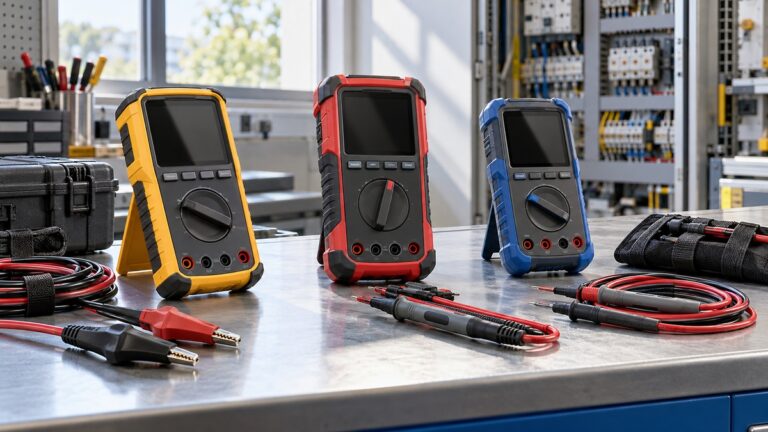
- A standard multimeter is not a hipot tester. The sources describe hipot testers as equipment that applies a programmed high voltage and measures leakage.
What a hipot test is
The name comes from “high potential.” Interpower, an equipment maker, says that dielectric voltage-withstand or dielectric-strength tests are often referred to as the High Potential Voltage “Hipot” test. So if a product listing or a standard mentions a dielectric strength check, it is usually describing the same family of tests.
The purpose is to find weak insulation before the product reaches a customer. Interpower describes the production-line version as a verification that there are no issues after manufacturing. Design testing is a different job: engineers use it to see how the insulation responds to extreme voltage and how much margin it has.
The test looks at the space between conductors and between live parts and the chassis or housing. Interpower explains that the goal is to keep the electrical field generated by the current to a minimum inside the product’s chassis or housing, which is typically measured in milliamps.
Dielectric withstand versus dielectric breakdown
Seaward, a test equipment maker, describes two common types. The first is the dielectric withstand test, which it calls the most common type of hipot test. In that test, a prescribed voltage is applied, normally in the realm of 1000 V or more for equipment powered from mains voltages.
The voltage is held for a defined time. Seaward says the hold time ranges from a few minutes for a type test to as low as a second for production testing. A pass means the device handles the voltage for that period without a breakdown.
The second is the dielectric breakdown test. Seaward explains that no maximum voltage is prescribed and there is typically no hold time. The voltage is raised gradually until the insulation breaks down, and the key number is the voltage at breakdown. Seaward also states that the test can be seen as destructive, so a breakdown test is used only in research and development environments.
Seaward concludes that the dielectric withstand test is the more acceptable method for proving safety where the product will be used as designed once the check is complete. For a buyer or a student, the practical point is simple: a withstand test checks a set voltage for a set time, while a breakdown test searches for the voltage where failure happens.
How the pass or fail decision works
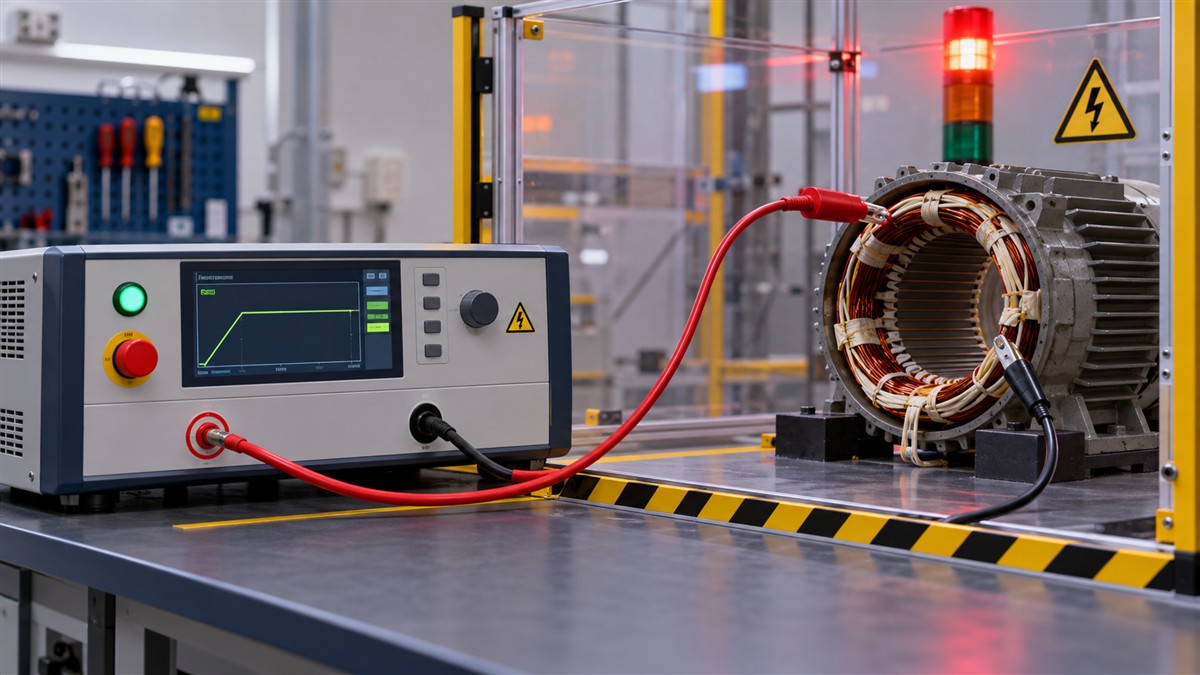
A hipot tester measures leakage current, the small current that flows from the high-voltage side through the insulation to the return terminal. Seaward describes a typical hipot test as having two test terminals, an output voltage source, and a return terminal into which leakage current flows and is measured by the test equipment.
Interpower says the greater the leakage, the greater the chance the test will fail according to the milliamp settings in the test parameters. The limit is programmed for the product. Interpower also gives a worked example: for a device whose operating voltage is 120 VAC, its tester would push 1240 volts into the device. That figure comes from one vendor’s example and shows the scale of the test, not a value to copy for any other product.
Passes are usually described in standards language. Interpower quotes the phrase “No breakdowns shall occur.” If a breakdown occurs, the result is a fail. Because the sources do not give one universal voltage, the required test voltage and time for any product come from its own standard and documentation.
Why hipot testing is for trained staff
The hazard is the main reason this test is not a home task. Interpower warns that if high voltage pushes through insulation it could flow to the surface of the device under test and destroy the product or worse, cause a severe shock to an end user. The same risk applies to the operator.
Cirris, a maker of test systems, quotes NFPA 70E, the electrical safety standard for workplaces, on shock effects. As Cirris quotes it, at about 40 mA the shock, if lasting 1 second or longer, may be fatal. Cirris also notes that at 10 mA a person may not be able to let go. Cirris does not present these as a complete safety plan. It says training, procedures and awareness alone are not as effective as eliminating access to the hazard, such as a suitable test enclosure, and implementing engineering controls.
Cirris also says personnel should be trained in the related hazards, safety protocols including high voltage discharge, proper use of safeguarding, personal protective equipment, and emergency procedures. Anyone with an electronic implant, or a condition where a sudden shock is dangerous, should keep away from high-voltage testing, according to the same source.
The practical rule for readers is clear. Do not attempt a hipot test with a multimeter, a non-contact pen or a bench meter. If your job requires a hipot test, follow your employer’s written procedure and have a qualified person run the equipment.
Where insulation resistance testing fits
People often search for hipot tests and insulation tests together, but they are not the same measurement. The three sources used here describe the high-voltage withstand test. They do not cover insulation resistance readings in megohms, so this guide does not make claims about those numbers. For that topic, read the linked guide on insulation resistance test equipment and the separate insulation resistance tester picks.
Cable work is another area where the two tests can overlap in a project plan. The cable insulation test guide covers the cable side. This article stays on the withstand concept and the pass or fail logic that the sources describe.
Hipot testers and product listings
A consumer listing for a DC hi-pot tester may use the same words, but the listing is still a product description. Read the stated voltage range, the hold time control, the leakage limit settings and the safety features before assuming it fits your job. The DC hi-pot tester review on this site shows how those listing fields look in one product. Do not treat a listing’s maximum voltage as a test instruction for your device.
If a listing does not state its output voltage, hold time or leakage range, the listing does not give enough information for a hipot job. Ask the equipment maker or the standard that governs your product.
For category ratings that apply to general meters, see what a CAT rating means on a multimeter and the 600 V CAT III rating guide. A CAT rating describes a meter’s use on mains circuits. It does not describe a hipot tester’s output.
How we chose
This guide needed sources that describe the test itself, not a retailer page. The selection criteria were: an equipment maker or testing company page, a page that explains dielectric withstand or breakdown testing, and a page that addresses hazards. Three pages met the criteria and were opened and read on 2026-10-27: Seaward (dielectric withstand versus breakdown), Interpower (hipot terms and pass or fail), and Cirris (hipot safety and the NFPA 70E quote).
Two pages were considered and not used. A Coilcraft hipot application note and an APC Technologies hipot page returned a bot-check page when opened, so they are not cited. A Vitrek workstation safety page also returned a bot-check page and is not cited.
What we could not verify
- The sources do not give a single test voltage, hold time or leakage limit that applies to all products. Those numbers come from each product’s standard.
- The NFPA 70E figures come through Cirris. The NFPA document itself was not opened.
- No source opened here gives a home-use procedure, and this guide does not supply one.
- The sources do not cover insulation resistance readings in megohms.
FAQ
Is a hipot test the same as a dielectric strength test?
Interpower says dielectric voltage-withstand or dielectric-strength tests are often referred to as the High Potential Voltage “Hipot” test. Those names all refer to the same family of tests.
What is the difference between a withstand test and a breakdown test?
Seaward says a dielectric withstand test applies a prescribed voltage for a defined hold time, while a breakdown test raises the voltage gradually with no maximum set and records the voltage at breakdown. Seaward describes the breakdown test as used mainly in research and development.
What does a hipot tester measure?
It measures leakage current through the insulation. Interpower says the greater the leakage, the greater the chance the test will fail against the programmed milliamp settings.
Can I do a hipot test with a multimeter?
No. A multimeter is not built to apply the programmed high voltage that a hipot tester applies. Hipot testing is for trained staff following a written procedure.
How dangerous is hipot testing?
Interpower warns that high voltage could cause a severe shock to an end user. Cirris, quoting NFPA 70E, says at about 40 mA a shock lasting 1 second or longer may be fatal. Cirris also says engineering controls such as a suitable test enclosure matter more than training alone.
Does a passing hipot test prove a product is safe for life?
No. Interpower notes that insulation degrades over time from nicks, cuts, heat and moisture, so a pass at one time is a result at that time. Ask the equipment maker or the standard for the requirements that apply to your product.
Bottom line
A hipot test checks whether insulation holds a set high voltage for a set time with leakage under a programmed limit. Treat it as equipment work for trained staff with a written procedure. For home electrical checks, use the meters and testers covered elsewhere on this site and call a licensed electrician for panel or service work.
Sources
- Seaward, “Dielectric Withstanding vs Breakdown Testing,” https://seaward.com/gb/news/view/dielectric-withstanding-vs-breakdown-testing (opened 2026-10-27)
- Interpower, “Many Names, Many Applications: The High Potential Voltage Hipot Test,” https://blog.interpower.com/infopower/many-names-many-applications-the-high-potential-voltage-hipot-test (opened 2026-10-27)
- Cirris, “Ideas for Improving Hipot Safety,” https://cirris.com/ideas-for-improving-hipot-safety/ (opened 2026-10-27; quotes NFPA 70E)