Oscilloscope for Beginners: The Specs That Matter
As an Amazon Associate we earn from qualifying purchases. Details
The short version: pick a two-channel scope whose bandwidth is several times the fastest signal you plan to look at, and whose sample rate is several times the bandwidth. Everything else is secondary for a first instrument.
Quick answer
- Bandwidth: Keysight recommends at least three times the highest sine frequency for analog work, and at least five times the highest clock rate for digital work.
- Sample rate: Keysight says it should be at least four to five times the scope’s specified real-time bandwidth.
- Channels: Two is the practical minimum, because two channels let you compare an input with an output. Tektronix notes that more channels add to the price.
- Mains safety: A scope is not a substitute for a meter rated for the circuit. Panel and service work belongs to a licensed electrician.
What a scope shows that a multimeter does not
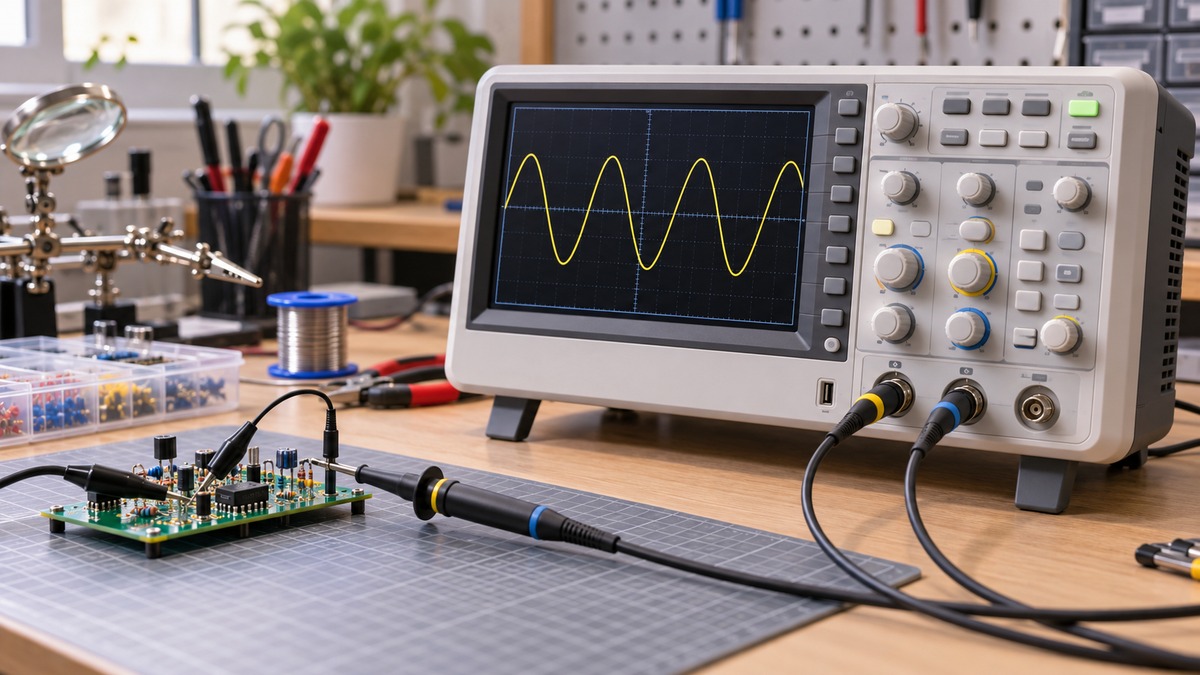
A digital multimeter gives you one number at a time, usually an average or RMS value. A scope draws the voltage against time. That lets you see a waveform’s shape, its frequency, how often it repeats, and whether a noise spike rides on top of a steady signal. For a beginner, the most common use is checking a switching signal, a sensor output, or a motor drive where a meter’s reading looks normal but the circuit still misbehaves.
The trade-off is that a scope takes more setup. You must set the time base, the vertical scale and the trigger, and you must connect a ground lead correctly. A multimeter answers “is there voltage?” in a second. A scope answers “what does the voltage look like?” and needs a few minutes of practice first.
Bandwidth: the first number to check
The Tektronix article describes bandwidth as “a key spec that determines the highest frequency your oscilloscope can measure accurately.” It gives a worked example: for a 20 MHz signal, it advises an oscilloscope with a bandwidth of at least 60 MHz. That is three times the signal frequency.
Keysight gives two rules depending on the work. For analog signals it advises a bandwidth “at least three times higher than the highest sine wave frequencies that you might need to measure.” For digital work it recommends “at least five times the highest clock rate in your systems.” The digital rule is the stricter of the two.
A beginner rarely needs more than a few tens of megahertz for hobby and home projects. Choosing a scope with bandwidth several times the signals you expect is a safer rule than buying the highest number on the shelf. Bandwidth above what you will use adds cost without adding usefulness for a first instrument.
Sample rate: how much detail the trace keeps
Sample rate is how many times per second the scope measures the input. Keysight states that the sample rate “should be at least four to five times higher than the scope’s specified real-time bandwidth.” Tektronix frames the same idea in signal terms: for a 20 MHz signal, it advises a sample rate of at least 200 MS/s.
Two points matter in practice. First, sample rate sets how fast an edge can be drawn without distortion. Second, the rate can drop when more channels are switched on. The Tektronix article notes that “the number of channels you turn on can reduce the sample rate.” If a beginner scope lists a high maximum sample rate, check whether that rate applies with one channel or with all channels active.
Channels: why two is the practical minimum
A single-channel scope shows one signal. Many real questions need two: an input and an output, a supply rail and a load, or a clock and its data line. Tektronix puts it plainly: “Two channels let you compare a component’s input to its output.” Four-channel scopes cost more, and the Tektronix article warns that extra channels add to the price. For a first instrument, two channels cover most early projects.
Other features to weigh, in order
- Probes. The probe matters as much as the scope. Use the probe supplied, and check its voltage rating before you connect it to anything. The listing or manual should state that rating.
- Display and controls. A clear screen and simple menus shorten the learning curve. Look for a scope that lets you adjust the time base and vertical scale without deep menus.
- Memory depth. Memory depth is a secondary spec for a first scope. The sources opened here do not rank it against the others, so treat it as optional.
- Trigger options. Edge triggering is the basic need. Other trigger types help with specific signals but are not required for a first project.
Safety: a scope does not change the mains rules
A common beginner mistake is to assume that a scope can measure anything a meter can. It cannot, and the sources opened for this post do not cover the safety rating of any specific scope. Before you connect any test equipment to a mains circuit, confirm the instrument and probe ratings for that circuit against the manufacturer manual. The listing or manufacturer manual must state the rating; if it does not, do not use the tool on mains.
Work on live mains wiring, panels and service equipment can kill. If the job involves those, hire a licensed electrician. A scope is a learning tool for low-voltage signals, sensors and electronics first.
How we chose
This post covers the criteria a beginner should check on any scope: bandwidth, sample rate, channel count, probes, and the safety limit of the circuit. It uses two manufacturer sources, both opened on 2026-10-27. The Keysight page is a current manufacturer guide. The Tektronix article is dated 2021-05-11 and is a general buying guide, so its figures are cited as the article states them. No product was selected, because no product listings were collected for this keyword. A future post that compares specific scopes would need its own listing data.
What we could not verify
- The sources opened here do not name a single best scope for beginners, so this post does not rank one.
- Prices, ratings and review counts are not part of this post. Check the listing for current specifications.
- The sources do not give a CAT rating for scopes, so this post does not state one.
- The sources do not describe a complete beginner test procedure. Follow the manufacturer manual for the specific scope.
Buying checklist
- Two channels, or four if the budget allows.
- Bandwidth at least three times the highest sine frequency you expect, and at least five times the highest clock rate for digital work.
- Sample rate at least four to five times the specified real-time bandwidth, with the channel count you actually plan to use.
- A probe supplied with the scope, with its voltage rating printed or listed.
- A manual or built-in help that you can read before the first project.
Mistakes to avoid
- Buying bandwidth you will not use. The rule of thumb sets the minimum; more adds cost.
- Ignoring the sample-rate drop with multiple channels. The Tektronix article names this effect directly.
- Using a scope on mains without checking ratings. The scope and probe need ratings that match the circuit.
- Skipping the ground lead instructions. Read the manual for where the ground lead goes before you connect it to a circuit.
FAQ
Do I need a scope if I already have a multimeter?
Not always. A multimeter answers voltage, current and resistance questions quickly. A scope is useful when the shape of a signal matters, such as a noisy supply or a switching signal. Many beginners start with a meter and add a scope later.
How much bandwidth is enough for a first scope?
Use the rule of thumb in the sources: at least three times the highest sine frequency you expect for analog work, and at least five times the highest clock rate for digital work. Then add a margin if the budget allows.
Why does sample rate matter?
Sample rate controls how finely the scope draws a fast edge. Keysight suggests at least four to five times the specified real-time bandwidth. A low sample rate can make a fast signal look slower or distorted.
Is two channels enough?
For most first projects, yes. Two channels let you compare an input with an output. Four channels add cost and can reduce sample rate when all are active.
Can a beginner scope measure mains voltage?
Do not assume so. The sources opened here do not give a safety rating for scopes. Use a meter or tester rated for the circuit, and hire an electrician for panel or service work.
Which scope should I buy?
This post does not pick a model. Compare the bandwidth, sample rate, channel count and probe ratings on the listing or manufacturer page, then match them to the signals you plan to measure.
Bottom line
For a first scope, pick two channels, a bandwidth several times your fastest signal, and a sample rate several times that bandwidth. Keep mains work for a meter rated for the circuit and for a licensed electrician.
Related guides
- Best Multimeter for DIY Projects: when a meter is the right first tool.
- Best True RMS Multimeters: why RMS matters when a signal is not a clean sine wave.
- Best Auto-Ranging Multimeters: a simpler meter for quick checks before you reach for a scope.
Sources
- Keysight Technologies, “Tips: How to Select an Oscilloscope Before you Buy – Part I,” https://www.keysight.com/blogs/en/tech/bench/2020/08/25/tips-how-to-select-an-oscilloscope-before-you-buy-part-i (opened 2026-10-27; page shows no date).
- Tektronix, “Choose the Best Oscilloscope to Buy,” https://www.tek.com.cn/blog/choose-best-oscilloscope-to-buy (opened 2026-10-27; article dated 2021-05-11).