Gift Ideas for Beginner Electricians: 6 Tools With Reasons
As an Amazon Associate we earn from qualifying purchases.
Gift ideas for beginner electricians work best when each item matches a real first job: checking whether a wire is live, reading a voltage, testing a receptacle, or stripping and crimping wire. This guide covers six items drawn from the listing details we collected, states what each listing says, and gives a reason to skip each one. It makes no ranking claim, and it does not name gloves or eye protection, because the listing details we collected do not include them.
Quick answer
- Start with a multimeter that carries a CAT III rating. The AstroAI DM130B listing states CAT III 600V, auto-ranging and a 4000-count display.
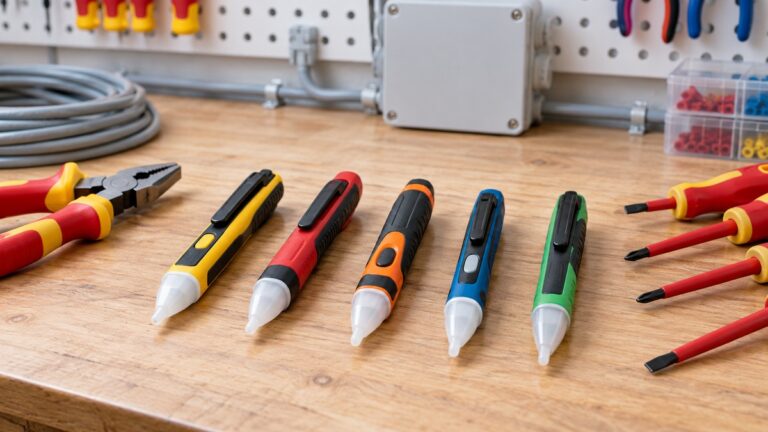
- Add a non-contact voltage tester for a fast presence check. The Fluke 1AC II listing covers 90 V to 1000 V AC and describes an alert, not a numeric reading.
- Match the leads to the meter. The Klein manual we opened says to use its meter only with CAT III or CAT IV rated test leads.
- Treat the crimper and the 9-in-1 stripper as hand tools. The stripper’s built-in tester has no CAT rating in its listing, so it does not replace a meter.
Why the safety rating comes first
The meter is usually the first gift a beginner will use, and its safety rating decides where it may be used. The Klein Tools manual for its MM300 meter, which we opened on 2026-10-20, describes CAT III as the category for test and measuring circuits connected to the distribution part of a building’s low-voltage mains installation. That is one manufacturer’s wording, not the full text of the wider standard, so we report it as the manual’s own description and nothing more.
The same manual says never to use the meter on a circuit whose voltage is higher than the rating for that category. It also says to use the meter only with CAT III or CAT IV rated test leads, and it warns that leaving off the CAT III or CAT IV shield raises arc-flash risk in those locations. For a gift, the meter and its leads have to be checked together, because the rating on one does not cover the other.
We did not open a source that defines CAT II or CAT IV in full. Where a listing states CAT IV, as the Fluke 1AC II listing does in its title, this guide reports it as the listing’s claim and adds no definition of its own.
What the six listings state
The table uses only what each listing states. A blank cell would mean we guessed, so every missing value reads “not stated” instead.
| Pick | Role | CAT rating (listing) | Range or rating (listing) | Auto-ranging (listing) | Contents or batteries (listing) |
|---|---|---|---|---|---|
| AstroAI DM130B | Multimeter | CAT III 600V | DC voltage up to 600V (spec table) | Yes (title) | Test leads, alligator clips, manual; three 1.5 V AAA cells named, inclusion not stated |
| Fluke 1AC II | Non-contact voltage tester | CAT IV (title) | 90 V to 1000 V AC, or 200 V to 1000 V AC | not stated | Two AAA alkaline batteries included |
| Young Dance 24-piece set | Test leads | Cat III 1000V, 10A | 1000V, 10A | not stated | 24 pieces, silicone insulation |
| Klein Tools CL120 | Clamp meter | CAT III and CAT IV safety caps on the test leads | 400 A AC (title) | Yes (title) | Carrying case, test leads, three AAA batteries |
| Klein Tools 34056 | Ferrule crimper | not stated | 10 to 22 AWG | not stated | Ratchet crimper, item weight 12.8 ounces |
| KAIWEETS 9-in-1 | Stripper with NCV tester | not stated | 10 to 18 AWG | not stated | USB-C charging cable, spare blade, hex wrench |
Here is the calculation behind the claim that a rating is easy to miss. The product file holds 290 active records, and 42 of them include a CAT mention in the listing text we collected. The share is 42 divided by 290, or about 14.5 percent. The count is a text search for CAT I, II, III or IV, so it counts mentions and does not confirm any rating. Most records in the set show no category in the text we collected, so each rating has to be read from the listing before you buy.
How to read the rest of a listing
After the rating, four more items decide whether a meter suits a beginner: the range setting, the counts, the fuses and the batteries. Each item below uses the wording of the listing, and any simplification is labelled as one.
Auto-ranging comes first. The DM130B and the CL120 are both described as auto-ranging. As a simplification, that means the meter chooses the measurement range itself, so the user does not set the range by hand. The listing does not say how quickly the meter does this, and we do not claim a speed.
Counts come second. The DM130B title gives 4000 counts. As a simplification, a count figure is the largest number the display can show before the meter moves to a new range, and a higher count gives finer steps on a given range. The listings do not state accuracy in the same form, so we do not compare accuracy across the six picks.
Fuses come third. The DM130B spec lists two fuses, F500mA/600V and F10A/600V. A fuse rating tells you how the current input is protected. The listing does not say how a user replaces a fuse, and this guide does not describe the procedure. If the recipient will use the current inputs, check the fuse ratings on the listing before buying.
Batteries come fourth. The DM130B spec table names three 1.5 V AAA cells. The 1AC II includes two AAA alkaline batteries, and the CL120 includes three AAA batteries. The DM130B listing does not say whether its cells are included, so check the box before you wrap the gift.
Matching the gift to the first job
A beginner’s first job is usually a check rather than a repair. In this guide, the checks are: is a wire live, what voltage is present, does a path have continuity, what current does a conductor carry, and does a crimp or a strip come out cleanly. Each pick answers one or two of these questions, and the cards below say which.
If the recipient’s work will be mostly outlets and fixtures, a meter with a stated CAT III rating plus a non-contact tester covers the basic checks, and the leads should match the meter. If the recipient will prepare more wire, the stripper or the ferrule crimper is the next step. If the recipient will measure current on a conductor, the clamp meter answers that question, provided the listing’s current range suits the work.
Keep one rule in mind as the list grows: a second tool is worth giving only when the first tool already answers the recipient’s current task. A clamp meter does not help someone who has not yet learned the meter’s rating rules, and a crimper does not help someone whose only task is checking outlets.
Write the recipient’s first job on the gift card and name the pick that covers it. That keeps the gift tied to a real task, which is the point of a beginner gift.
The six picks
Each pick below has the same four parts: what the listing says, what the gift is good for, when to skip it, and one limitation. Figures come from the listing records in our product file, dated 2026-10-11 and 2026-10-12. Where a figure is missing, the card says the listing does not state it.
1. AstroAI DM130B multimeter
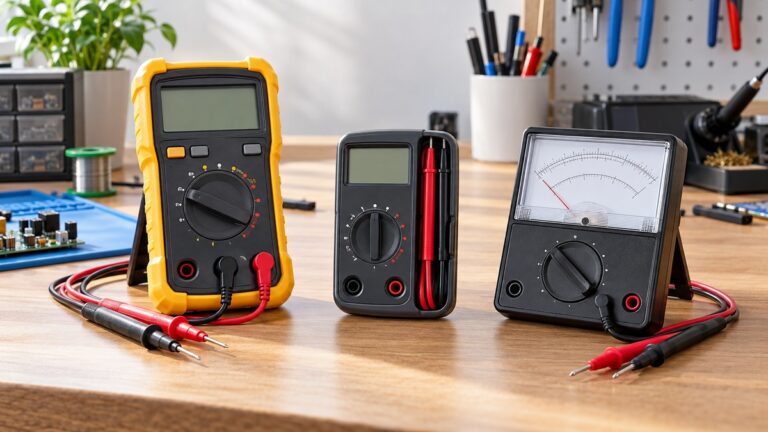
The listing says: it is auto-ranging with a 4000-count display, measures AC and DC voltage and current, resistance, continuity, capacitance, diodes and batteries, and includes an NCV function. The spec table lists CAT III 600V (EN 61010-1). Two fuses are named: F500mA/600V and F10A/600V.
Good for: a first meter for outlet checks, battery checks and general voltage work, when the recipient wants one instrument with the widest set of listed functions among these six picks.
Skip if: the work needs a CAT IV rating, or a true RMS reading, because the listing states neither.
Limitation: the listing does not say whether the batteries come with it. It shows three 1.5 V AAA cells and nothing more about the power supply.
2. Fluke 1AC II VoltAlert non-contact voltage tester
The listing says: the tip glows red and a beeper sounds when voltage is detected. The detection range is 90 V to 1000 V AC, or 200 V to 1000 V AC in a second mode. A continuous self-test runs, audible and silent modes are available, and the title gives CAT IV. Two AAA alkaline batteries are included, and the warranty is 2 years.
Good for: a quick presence check before someone touches a wire or a receptacle. The listing calls it pocket-sized, so it travels with the recipient.
Skip if: the recipient mostly works on 12 V or 24 V DC systems, since the listing’s range starts at 90 V AC and does not mention DC detection.
Limitation: the listing describes an alert, not a numeric voltage reading, so it does not replace a meter for measurements.
3. 24-piece multimeter test lead set (Young Dance)
The listing says: the lead wire is rated Cat III 1000V, 10A, with silicone insulation. The set has two 100 cm banana-plug leads, two 70 cm test-hook leads, two 2 mm extension probes, alligator clips, back probes and interchangeable probe tips, 24 pieces in all.
Good for: a recipient whose meter came without a complete lead kit, or who wants spare leads for a second meter.
Skip if: the meter already has leads whose rating matches the work.
Limitation: the brand on the listing is Young Dance. Fluke, KAIWEETS and INNOVA appear as compatible meters, and we did not confirm that compatibility.
4. Klein Tools CL120 clamp meter
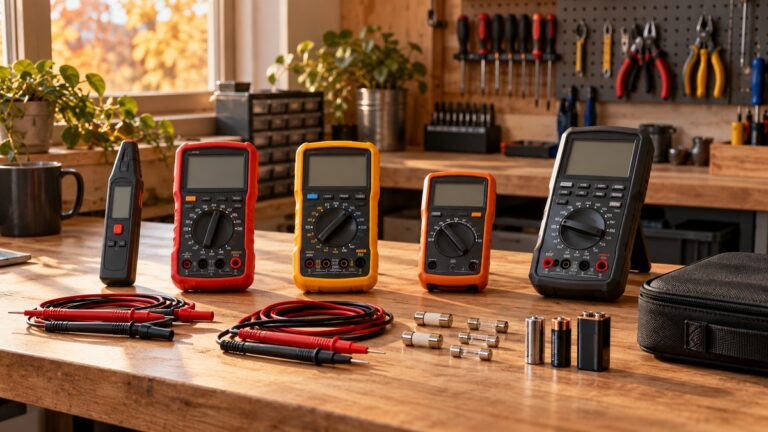
The listing says: it is an auto-ranging clamp meter with a 400 A AC title range. It measures AC current through the clamp and has a non-contact voltage tester in the jaw, while AC and DC voltage, resistance and continuity are measured through the test leads. The kit includes a carrying case, test leads with CAT III and CAT IV safety caps, and three AAA batteries.
Good for: a recipient who will measure AC current, where a clamp reads the current without the conductor being opened.
Skip if: the work needs DC current, which the listing does not state.
Limitation: the listing gives no DC current range and no resolution, and it points buyers to the manufacturer website for warranty terms.
5. Klein Tools 34056 ferrule crimper
The listing says: a hex crimper for 10 to 22 AWG stranded wire terminals, with six precision dies for 360-degree hex crimps and a built-in ratchet that adjusts to the ferrule size. The item weighs 12.8 ounces.
Good for: a recipient who will crimp ferrules onto stranded wire within that gauge range.
Skip if: the recipient only strips wire and never uses ferrules or terminals.
Limitation: the listing describes a crimping tool only. It describes no measuring function and states no CAT rating, so it cannot stand in for a meter.
6. KAIWEETS 9-in-1 stripper with NCV tester
The listing says: it handles 10 to 18 AWG wire and combines stripping, cutting and crimping with a built-in NCV tester. That tester has three modes: contact, non-contact induction, and a neon lamp backup. Visual and audible alerts are included. The battery is USB-C rechargeable with the cable included, the tool auto-shuts off after two minutes of inactivity, and the box includes a spare blade and a hex wrench with a 3-year warranty.
Good for: a recipient who wants one hand tool for stripping and crimping, with a voltage check on the same tool.
Skip if: the work needs a measuring instrument with a stated CAT rating or a stated voltage range.
Limitation: the listing states no CAT rating and no voltage range for the built-in tester. A separate meter is still needed.
Gifts we left out
The Fluke 87V listing gives a true RMS style, CAT III 1000V and CAT IV 600V ratings, a holster and a temperature probe. We left it out of a beginner list because its listing is built around industrial work, with features such as peak capture and a low-pass filter for drive and intermittent work. It can be a sensible step-up gift for someone who already owns a meter and has a clear use for those features, but nothing in the listing says a beginner needs them.
The Klein RT390 circuit analyzer is listed at CAT III 135V. Its listing describes wiring-fault detection, GFCI and AFCI tests, trip time, and 12 A, 15 A and 20 A load tests with voltage-drop readings. These are specialist receptacle and circuit functions. For a beginner it would be a second gift for someone who already does receptacle work, not a first one.
Gloves and eye protection are missing from the listing details we collected. We did not add a substitute, because a substitute would be a product with no listing behind it.
How we chose
We started from 374 product records in the local product file, of which 290 are active and 84 are rejected. We read only the active records and sorted them by role: multimeter, non-contact voltage tester, test leads, clamp meter, crimper and stripper. Within each role we kept the items whose listing gave enough detail to state a limit, and we left out records for specialist or industrial roles that a beginner would not need as a first gift.
The criteria are plain. The item has to suit a beginner’s first job. The listing has to state enough about rating, range or contents for us to name a limit. The item has to be a tool or a piece of gear, not a bundle of unrelated items. We did not use price, star ratings or review counts, because the records do not hold them and this guide does not publish them.
We did not rank the picks, and we did not claim any measurement. The order follows the job: meter, presence check, leads, clamp, crimper and stripper. Each listing date is shown in the section above, and any listing can change after that date.
What we could not verify
We have no independent check of any figure in this guide. Every figure comes from a listing record or from one of the four sources at the end. The CAT ratings are the listing’s claims unless a source says otherwise.
We could not verify durability, battery life, accuracy beyond what the listing states, or whether any item will meet a particular employer’s or trade’s requirement. The Young Dance set names Fluke, KAIWEETS and INNOVA as compatible meters. We did not confirm that compatibility, and the listing does not present those names as endorsements.
For CAT II and CAT IV we did not open a source that defines the category in full. The Klein manual defines CAT III. The Fluke 1AC II listing states CAT IV, and we report that as the listing’s claim.
The two extension pages we opened are dated 2017 and 2020. They describe general practice on GFCI testing and warning signs, and they may have been updated since. Check the current version of each publication before you rely on it.
This guide does not include prices, availability or star ratings, because the records we hold do not carry them. Check those on the listing itself before buying.
Buying checklist
Use this list before you wrap the gift.
- Confirm the meter’s CAT rating and voltage limit in the listing, and check that the leads carry a rating at least as high as the meter’s category.
- Check whether batteries come with the item. The 1AC II includes two AAA alkaline batteries and the CL120 includes three AAA batteries. The DM130B spec names three 1.5 V AAA cells but does not say whether they are included.
- Decide whether the recipient needs auto-ranging. The listings for the DM130B and the CL120 describe it. For the other picks, the listing does not state how range is selected.
- If the meter has fuses, note their ratings. The DM130B listing states F500mA/600V and F10A/600V fuses, and it does not say how to replace them.
- Keep the warranty information with the gift. The 1AC II listing states a 2-year warranty and the stripper listing states a 3-year warranty. The CL120 listing points buyers to the manufacturer website.
- Add a reminder card for the monthly GFCI button test and the storm and damage rules from the Klein manual.
Mistakes to avoid
- Treating the 1AC II as a meter. Its listing describes a detection range of 90 V to 1000 V AC and an alert, with no numeric reading.
- Giving leads without checking their rating. The Klein manual says to use its meter only with CAT III or CAT IV rated leads, and the 24-piece set lists Cat III 1000V, 10A.
- Assuming the clamp covers DC current. The CL120 listing states AC current through the clamp and AC and DC voltage through the leads. It does not state DC current.
- Assuming the stripper’s built-in tester is a meter. Its listing names NCV modes but states no CAT rating and no voltage range.
- Expecting a gift to replace training. OSHA names electrocution among the dangers of electrical work, and the sources we opened send installation and warning-sign work to a qualified electrician.
- Skipping the storm and damage rules. The Klein manual says not to use the meter during electrical storms or in wet weather, and to stop using a meter or lead that appears damaged.
Related guides
These live guides on this site cover the questions a buyer usually asks next:
- Best multimeter for home, car and beginners
- Digital multimeters for home use
- Hand-held digital multimeters compared
- NCV testers for home voltage checks
- How to use a non-contact voltage detector
- How voltage testers work, by type
- Testing an electrical outlet with a multimeter
- How to use a continuity tester
- AC voltage testers: range and safety picks
- Circuit detectors for breaker checks
Safety note
OSHA’s electrical pages say the agency’s electrical standards exist to protect workers from dangers such as electric shock, electrocution, fires and explosions. The same page lists lack of ground-fault protection among the most frequent causes of electrical injuries. Electrocution is one of the named dangers, so work on mains circuits carries a risk of death, and a gift does not change that.
Iowa State University Extension says ground fault circuit interrupters belong in bathrooms, laundry rooms, kitchens and outdoor areas, and that a qualified electrician should install them. Illinois Extension recommends testing GFCI buttons once a month and tells readers to consult a qualified electrician about warning signs, such as warm or discolored outlets, frequently tripped circuits or fuses, and smoky odors. A reminder card for the monthly GFCI test stays within what those pages say.
The Klein manual advises against using its meter during electrical storms or in wet weather. It also says to stop using a meter or test lead that appears damaged, and to keep the CAT III or CAT IV shield in place when testing in those locations. Put those rules on the gift card next to the meter.
Panel and service work is outside what this guide covers. Our recommendation is that it goes to a licensed electrician. None of the four sources we opened describes a beginner doing panel or service work, and this guide does not describe it either.
FAQ
What should be the first gift for a beginner electrician?
Start with a multimeter. In this set, the AstroAI DM130B listing names the widest range of basic functions, including AC and DC voltage, AC and DC current, resistance, continuity and capacitance, and it states CAT III 600V. Pair it with leads that carry a matching rating, and keep installation and warning-sign work with a qualified electrician, as the extension pages in the sources advise.
Can a non-contact voltage tester replace a multimeter?
No. The Fluke 1AC II listing describes an alert with a red tip and a beeper over a 90 V to 1000 V AC range, and it does not describe a numeric reading. A meter gives a value. Use the tester as a quick presence check, and do not assume it covers DC, because the listing does not mention DC detection.
What does a CAT III rating mean on a meter?
It is a measurement category. The Klein MM300 manual describes CAT III as the category for test and measuring circuits connected to the distribution part of a building’s low-voltage mains installation. The same manual says never to use the meter on a circuit whose voltage exceeds the category-based rating, so the rating limits where the meter may be used.
Do test leads need their own rating?
Yes. The Klein manual says to use its meter only with CAT III or CAT IV rated test leads. In this set, the 24-piece lead set lists Cat III 1000V, 10A, and the CL120 listing names CAT III and CAT IV safety caps on its leads. Check the leads against the meter before you wrap the gift.
Does a beginner gift need gloves or eye protection?
This guide does not name a model, because the listing details we collected include no gloves or eye protection. The Klein manual advises against using a meter during electrical storms or in wet weather. Check the rating printed on any protective gear and in its own listing before you buy it, and do not treat this guide as the basis for that choice.
Should a beginner test GFCI outlets?
The Illinois Extension page recommends testing GFCI buttons once a month, so a reminder card for that check fits within what the page says. The Iowa State Extension page says GFCIs should be installed by a qualified electrician, so installation and repair belong with a licensed electrician rather than with a beginner.
Bottom line
Give the meter first, match every lead to its category rating, and keep panel and service work with a licensed electrician. That one rule decides most of the picks in this guide.
Disclosure: as an Amazon Associate, we earn from qualifying purchases made through the links on this page, which use our own tracking tag.
Sources
- OSHA, Electrical (electrical standards and hazards overview). Opened 2026-10-20. https://www.osha.gov/electrical
- Klein Tools, MM300 instruction manual (CAT III definition, test lead rating, storm and damage rules). Opened 2026-10-20. https://data.kleintools.com/sites/all/product_assets/documents/instructions/klein/MM300_1390109ART_WEB.pdf
- Iowa State University Extension, “Plug Into Safety” (page dated 2017-05-15). Opened 2026-10-20. https://blogs.extension.iastate.edu/answerline/2017/05/15/plug-into-safety/
- Illinois Extension, “Respect electricity’s potential wrath” (news release dated May 7, 2020). Opened 2026-10-20. https://extension.illinois.edu/news-releases/respect-electricitys-potential-wrath