Best Checking Outlet Voltage
As an Amazon Associate we earn from qualifying purchases. Details
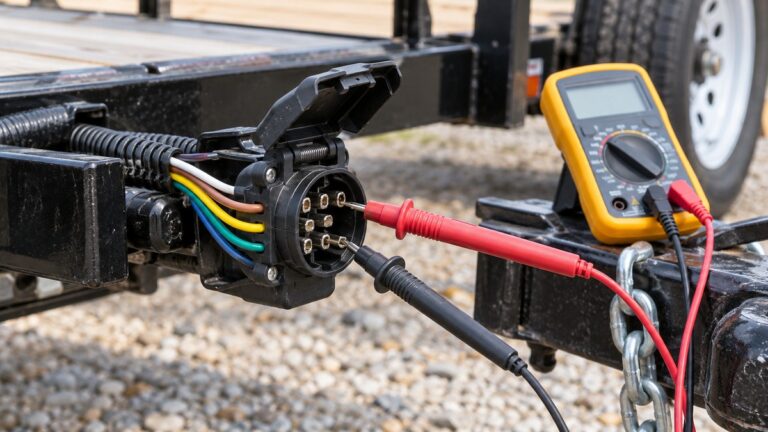
Checking outlet voltage can mean two different jobs: reading a number from a live receptacle, or learning whether voltage is present at all. A plug-in tester with an LCD gives a reading and a wiring result, a ground-fault tester with lights gives a pattern, and a non-contact pen only signals that AC voltage is nearby. This roundup compares six tools by the voltage ranges, safety ratings, and warnings their own listings state. Windows run from 12 to 1000 volts across the group, and several listings contradict themselves, so those conflicts are shown rather than hidden. Start with the quick answer, then check the range and rating lines before you plug anything in.
Quick answer
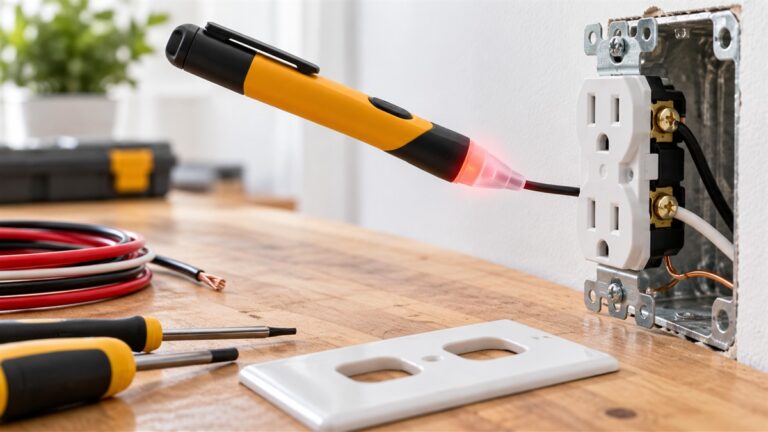
If you want a number on a screen, choose a plug-in tester with an LCD voltage readout: the Klein Tools RT250 (120 V receptacles) or the YOJOCK outlet tester (stated 90 to 250 V window). If you only need to know whether a conductor is live, choose a non-contact pen: the Southwire NCVD states 100 to 600 V AC and CAT IV 600 V. The Neoteck pen and the focemta kit give conflicting or split range statements, so read their range notes before you rely on them. The Westinghouse plug-in unit uses indicator lights, so it checks status and does not display a voltage figure on its listing.
What matters when checking outlet voltage
A reading or a presence signal
A readout tells you how many volts the receptacle delivers. A light pattern or beep tells you something is wrong or something is live. Only two of the six listings promise an on-screen voltage figure: the Klein RT250 lists a backlit LCD for voltage reading, and the YOJOCK says its display shows the actual voltage of each tested outlet. The three pens and the Westinghouse report presence or status. The focemta kit pairs a color-display pen with a lights-only outlet tester.
Stated voltage range
The Klein RT250 lists 120 V AC, standard three-wire receptacles. The YOJOCK lists 90 to 250 V AC. The Westinghouse lists 120 V AC at 60 Hz. The Southwire pen lists 100 to 600 V AC. The Neoteck pen is titled 12 to 1000 V AC, but its Minimum Operating Voltage field says 48 volts. The focemta pen offers two selectable ranges, 12 to 1000 V and 48 to 1000 V, and its outlet tester covers 90 to 135 V AC. A tool whose floor sits above your circuit will stay silent on a live conductor.
Safety category rating
Measurement category (CAT) ratings tell you where on an installation a tool is meant to be used. The YOJOCK lists CAT II 300 V. The Westinghouse lists compliance with UL 1436 for measurement Category II, Pollution Degree 2. The Southwire lists CAT IV 600 V. The Neoteck bullet lists CE CAT III 600 V, and the focemta kit lists CE CAT III 1000 V and CAT IV 600 V. The Klein RT250 listing gives no CAT line. Do not use a tool on a circuit its own listing does not cover.
Outlet types and warnings
The Southwire listing says the pen is not designed for use with Tamper Resistant (TR) outlets. The Neoteck says it is not suitable for Christmas light testing. The YOJOCK warns that its GFCI button may trip the household wiring system if used on regular receptacles, and says the GFCI test needs a current greater than 5 mA. Read these notes before you choose, because a pen that cannot reach the slot is no use on a tamper-resistant receptacle.
How to choose
- Choose the Klein Tools RT250 if you test standard 120 V three-wire outlets and want a backlit voltage readout, open neutral and open ground detection, and an auto-hold feature.
- Choose the YOJOCK outlet tester if you need a stated 90 to 250 V window with a displayed voltage, six wiring-fault indications, and a GFCI button.
- Choose the Westinghouse if you want a lights-only plug-in tester with a 6.5 ft (2 m) drop rating and a 2-year warranty.
- Choose the Southwire NCVD if you want a pen with a 100 to 600 V AC window, CAT IV 600 V, auto power off after 5 minutes, and you do not work on tamper-resistant outlets.
- Choose the focemta kit if you want a pen and a lights-only outlet tester in one purchase, and you accept that the voltage range note applies to the pen only.
- Choose the Neoteck pen only after you resolve the 12 V title versus 48 V field conflict with the seller.
For method and deeper comparisons, read our guide to testing an outlet with a multimeter, our AC outlet tester picks, and our non-contact voltage checker picks.
1. Klein Tools RT250 GFCI Outlet Tester with LCD Display, Electric Voltage Tester for Standard 3-Wire 120V Electrical Receptacles (Voltage readout)
Specs from the listing (checked 2026-10-17):
- Measurement Type: Voltmeter
- Voltage: 120 volts AC (standard 3-wire receptacles)
- Item Weight: 4.2 ounces
- Item Dimensions: 4.53 x 1.16 x 2 inches
- Specification Met: CSA
- Included Components: 2 x 1.5V AAA Alkaline Batteries and Manual
Pros
- Backlit LCD shows voltage and wiring condition
- Displays GFCI trip time
- Auto-Hold for hard-to-reach outlets
Cons
- Listing is limited to 120 V receptacles
- No CAT rating line on the listing
Best for: Homeowners and inspectors checking standard 120 V outlets
Skip if: You test 240 V receptacles
View on Amazon (affiliate link)
2. YOJOCK Outlet Tester Electrical GFCI Receptacle Detector with LCD Display, 90-250V (Wide window)
Specs from the listing (checked 2026-10-17):
- Voltage: 90 to 250 V AC
- Specification Met: CAT II 300V, CE
- Item Weight: 3.52 ounces
- Style: Outlet Tester
- Part Number: SocketT-107D
- Warranty: One-year guarantee stated in the bullets
Pros
- Color LCD shows the actual voltage of each tested outlet
- Six visual wiring-fault indications
- GFCI test button
Cons
- GFCI button may trip household wiring on regular receptacles
- CAT II 300 V is a lower category than the pens
Best for: Quick voltage and wiring checks at standard outlets
Skip if: You need a CAT III or CAT IV rating
View on Amazon (affiliate link)
3. Westinghouse Plug-in GFCI Receptacle & Outlet Tester, 3-Prong Electrical Socket Voltage Tester, 120V (Lights only)
Specs from the listing (checked 2026-10-17):
- Voltage: 120 volts AC, 60 Hz (from bullets)
- Specification Met: FCC, UL
- Item Weight: 4.6 ounces
- Part Number: GFCI125V10
- Warranty: 2-year Westinghouse warranty (from bullets)
Pros
- Neon lights indicate outlet status
- Listing states UL 1436, measurement Category II, Pollution Degree 2
- 6.5 ft (2 m) drop resistance stated
Cons
- Title says voltage tester, but the bullets describe status lights and no voltage readout
- A bullet carries another model code (GFI6302) in the frequency line
Best for: A simple status check across several 120 V receptacles
Skip if: You want a numeric voltage on screen
View on Amazon (affiliate link)
4. Southwire Tester NCVD – Detects AC Voltage with Audible & Visual Alerts – CAT IV 600V Safety Rating (Pen, CAT IV)
Specs from the listing (checked 2026-10-17):
- Detects: 100 to 600 V AC (from bullets)
- Specification Met: Cul Listed
- Model: 40116N
- Item Weight: 2.56 ounces
- Warranty Description: 2 Years
- Power: Battery Powered; auto power off after 5 minutes (from bullets)
Pros
- Audible and visual alerts
- CAT IV 600 V safety rating stated
- Built-in flashlight
Cons
- Not designed for Tamper Resistant (TR) outlets
- Title says dual flashlights while the item name says LED flashlight
Best for: Presence checks at outlets, switches, breakers, and fixtures
Skip if: Your outlets are tamper resistant, or you need a number
View on Amazon (affiliate link)
5. focemta Non-Contact Voltage Tester & Outlet Tester Kit, Color Screen Display (Two tools in a kit)
Specs from the listing (checked 2026-10-17):
- Pen ranges: 12 to 1000 V / 48 to 1000 V AC (pen only)
- Outlet tester: 90 to 135 V AC, indicator lights
- Specification Met: CE CAT. III 1000V / CAT. IV 600V
- Item Weight: 7.7 ounces
- Model: FTVT01
- Included Components: Electrical tester pen, outlet tester, two AAA batteries, user manual
Pros
- Dual-range pen with a color display and LED flashlight
- Audible and visual alarms with auto-shutdown
- Outlet tester included in the kit
Cons
- The range note applies to the pen only, not the outlet tester
- The outlet tester has no screen
Best for: A buyer who wants a pen and an outlet tester together
Skip if: You want a numeric outlet reading
View on Amazon (affiliate link)
6. Neoteck Non Contact Voltage Detector 12-1000V AC Voltage Tester (Pen, range conflict)
Specs from the listing (checked 2026-10-17):
- Range in title: 12 to 1000 V AC
- Minimum Operating Voltage: 48 volts AC (spec table)
- Model: PM8908C
- Item Weight: 2.29 ounces
- Item Dimensions: 6.3 x 0.79 x 0.79 inches
- Warranty Description: 18 Months
- Included Components: 2×1.5V AAA batteries
Pros
- Audible and LED alerts for live and null wires
- Built-in flashlight
- Bullet lists CE CAT III 600 V
Cons
- 12 V title floor conflicts with the 48 V spec field
- Not suitable for Christmas light testing, per the listing
Best for: A basic live or not live pen check once the range is confirmed
Skip if: You rely on the 12 V floor
View on Amazon (affiliate link)
Worked example: which range covers my circuit?
For example, a standard receptacle at 120 V sits 30 V above the YOJOCK’s 90 V floor and 130 V below its 250 V ceiling, so a reading is inside the stated window. A 240 V appliance outlet sits 10 V below that same ceiling, which still fits. The Klein RT250 lists 120 V only, so it is the wrong tool for the 240 V outlet. Now take a 24 V control circuit. It sits above the Neoteck’s 12 V title floor but 24 V below its 48 V spec floor, and the pen may not respond. The focemta pen avoids the ambiguity only if you pick its 12 V range for that circuit, since the 48 V range would miss it.
Safety before you test
OSHA’s electrical safety rule, 29 CFR 1910.333, says live parts to which an employee may be exposed must be deenergized before the employee works on or near them. It also lets testing that can only be done with the circuit energized be treated as work on or near live parts when deenergizing is infeasible. For circuits believed to be deenergized, OSHA requires a qualified person to use test equipment on the circuit elements and parts, and to check for energized conditions caused by induced voltage or backfeed. That is workplace regulation, and a homeowner is not an employee. The practical reading for this article is that a tester is for proving a circuit state, and anything beyond a plug-in or non-contact check belongs to a qualified electrician. Match the tool’s listed category to the circuit, and do not test a circuit outside the range the listing states.
FAQ
Can a plug-in tester show the exact voltage of an outlet?
Some can. The Klein RT250 lists an LCD for voltage reading, and the YOJOCK says its screen shows the actual voltage. The Westinghouse uses indicator lights and its listing mentions no voltage readout.
Is a non-contact pen enough for checking an outlet?
It confirms that AC voltage is present near the pen. It does not give a number. The Southwire pen lists 100 to 600 V AC, so it covers a 120 V outlet, but it states it is not designed for tamper-resistant outlets.
Why does the Neoteck listing show two different minimum voltages?
The title says 12 to 1000 V AC, while the Minimum Operating Voltage field says 48 volts. The listing does not resolve the conflict, so ask the seller before relying on the lower figure.
What does CAT II or CAT IV mean on a tester listing?
It is a measurement category rating that says where on an installation the tool is meant to be used. This article lists each tool’s stated category and flags where a listing gives none.
Will the GFCI test button trip my outlet?
It can. The YOJOCK listing warns that using the button on regular receptacles may trip the household wiring system, and says the test needs a current greater than 5 mA.
Does OSHA apply to my own home outlets?
OSHA regulates workplaces and employees, so it does not directly govern a homeowner. Its test-before-touch approach is still a sensible model, and a qualified electrician should handle anything beyond a simple check.
Which tool covers 240 V?
Of the six, the YOJOCK lists a 90 to 250 V window and the pens list higher ranges. The Klein RT250 and the Westinghouse list 120 V.
Bottom line
Choose by the question you need answered. For a number at a 120 V receptacle, the Klein RT250 is the direct fit. For a wider stated window with a displayed voltage, the YOJOCK covers 90 to 250 V. For presence only, the Southwire pen has the clearest rating, with CAT IV 600 V and a 100 to 600 V window. Resolve the Neoteck range conflict before use, remember that the focemta range note covers the pen only, and treat any circuit your tool’s listing does not cover as a job for a qualified electrician.
Sources
- OSHA 29 CFR 1910.333, selection and use of work practices: source for the deenergizing, energized-testing, and induced-voltage test requirements summarized in the safety section.