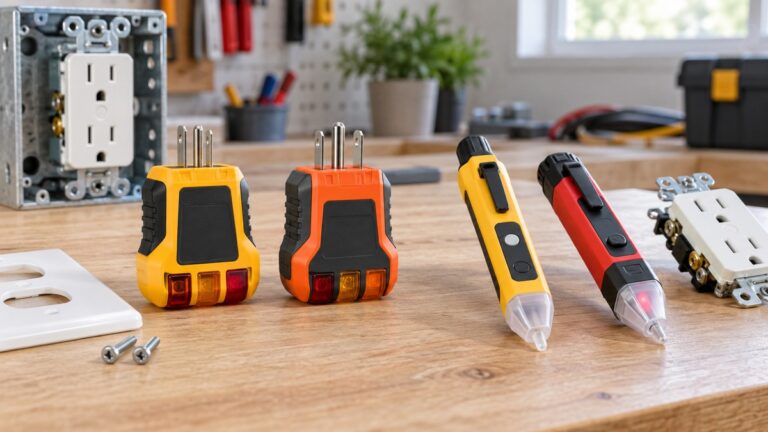
Best Breaker Tester for Outlets, GFCI and Panels
As an Amazon Associate we earn from qualifying purchases. Details
Breaker tester tools help you match an outlet to the breaker that controls it and check basic wiring at the outlet. This guide helps you decide which combination of breaker finder, GFCI check, voltage display, and accessory adapters fits your home, rental, or small workshop task.
You will learn what these tools can and cannot do, how CAT ratings and voltage ranges limit safe use, and which features matter for a breaker box tester job versus an outlet to breaker tester job. Work on mains circuits can kill. Use only a meter or tester with a CAT rating that suits the circuit, follow the instrument manual and local electrical rules, and leave panel or service work to a licensed electrician.
Quick answer
A breaker tester for home use is usually a two-piece breaker finder with a plug-in transmitter and a handheld receiver, plus an outlet check and a GFCI trip function. For a general outlet breaker tester need, choose a kit with a clear signal indicator, GFCI test, voltage display, and adapters for light sockets and 2-prong outlets. For a crowded panel, choose a model with learn and locate modes or adjustable sensitivity. For simple identification in a small apartment, choose a compact kit with audio and visual alerts. These plug-in kits do not measure load or test arc-fault breakers, so check the listing carefully.
What matters for a breaker tester
1. Breaker-finding method and panel conditions
These kits plug a transmitter into a 120V-style outlet and send a signal on the circuit. You scan the breakers with the receiver until the alert peaks. Adjacent breakers can pick up the same signal, so scanning twice, adjusting sensitivity, and checking the result by switching the suspect breaker off helps avoid error. If you work in a full breaker box with many adjacent breakers, a learn mode and a signal-strength display help more than a beep alone. Always confirm by checking that the outlet lost power.
2. Outlet wiring check and GFCI trip check
Most picks include an outlet tester that flags wiring patterns such as open ground, open neutral, open hot, or reversed connections with LEDs or an LCD message. The GFCI test sends a small fault to trip a GFCI breaker or GFCI receptacle so you can verify it opens. This confirms trip function at that moment, not protection for every future fault. If you need GFCI diagnosis detail, see Best Outlet and Gfci Tester and Best Ground Fault Circuit Interrupter Tester.
3. Voltage range, CAT rating, and limits
Each transmitter lists a supported outlet voltage range. Examples in this group include 90-135V, 90-120V AC at 50/60Hz, and 90-130V. Some listings also state CAT II 135V or CAT II 120V. Measurement category is a method of classification by the International Electrotechnical Commission of live circuits used in measurement and testing. Category II covers measurements on circuits directly connected to the low-voltage installation, while Category IV covers measurements at the source of the high-voltage installation. If the listing does not state a CAT rating, do not assume the tool is suitable for household mains. Follow the manual and local rules.
4. Readout, alerts, and lights for dark panels
Receivers use beeps, flashing LEDs, LCD signal bars, voltage readouts, and built-in lights. A backlit LCD helps inside a dim panel. A model with a large dual-color backlit screen or a signal-strength display reduces guesswork when two breakers respond. A built-in LED light or flashlight helps you read breaker labels without holding a separate light. Models with auto-shutdown and low-battery alerts help prevent interruptions during a long mapping session.
5. Adapters and kit contents for real outlets
An outlet to breaker tester job often involves more than a 3-prong outlet. Light-socket adapters, 3-to-2-prong adapters, and alligator-clip adapters let you connect the transmitter to fixtures and older outlets where allowed by the manual. A carrying case keeps transmitter, receiver, adapters, and manual together. Battery types differ by kit, including 9V, AAA, and AA combinations. Check the product listing for exactly what is included, because the listing controls what you receive.
1. Circuit Breaker Finder & GFCI Outlet Tester with Digital LCD Display, 90-135V Electrical Circuit (Best overall)
Specs from the listing (checked 2026-10-11):
- Brand: focemta
- Power Source: Battery Powered
- Style: Handy
Pros
- Listing states Brand: focemta
- Listing states Power Source: Battery Powered
Cons
- Its range stops at 135V, so higher-voltage circuits are excluded.
Best for: Mapping outlets on 90-135V circuits with an LCD showing voltage and signal strength.
Skip if: You need circuits above 135V.
View on Amazon (affiliate link)
2. AstroAI Circuit Breaker Finder Tool with GFCI Outlet Tester for 90–120V AC (Best for tight spaces)
Specs from the listing (checked 2026-10-11):
- Brand: AstroAI
- Power Source: Battery Powered
- Style: Circuit Breaker Finder
Pros
- Listing states Brand: AstroAI
Cons
- The fields provided do not state a CAT rating.
Best for: Tracing 90-120V receptacles with a beep, red flash and LED panel light.
Skip if: You need a stated CAT rating or voltages above 120V.
View on Amazon (affiliate link)
3. Goldeep Circuit Breaker Finder, GFCI Outlet Tester with Digital LCD Display (Best for more control)
Specs from the listing (checked 2026-10-11):
- Brand: Goldeep
- Power Source: Battery Powered
- Style: Circuit Breaker Finder
Pros
- Listing states Brand: Goldeep
Cons
- Its range stops at 135V, so it does not suit higher-voltage circuits.
Best for: A backlit LCD, NCV detection and 6 listed wiring faults in a dim panel.
Skip if: You need tracing above 135V.
View on Amazon (affiliate link)
4. Fluke BK120 SmartTrace Breaker Finder and Socket Tester (Best with socket tester)
Specs from the listing (checked 2026-10-11):
- Brand: Fluke
- Power Source: Battery Powered
- Style: Breaker Finder
Pros
- Listing states Brand: Fluke
Cons
- The fields provided do not state supported voltage or a CAT rating.
Best for: A breaker finder with a socket tester, NCV mode and LED flashlight.
Skip if: You need voltage and CAT confirmed in the listing.
View on Amazon (affiliate link)
5. Klein Tools ET350 4-in-1 Digital Circuit Breaker Finder with LED Work Light (Best feature set)
Specs from the listing (checked 2026-10-11):
- Brand: KLEIN TOOLS
- Power Source: Battery Powered
- Style: Circuit Breaker Finders
Pros
- Listing states Brand: KLEIN TOOLS
Cons
- The fields provided do not state supported voltage or a CAT rating.
Best for: A backlit LCD, bar graph, work light and GFCI trip time in one 4-in-1 tool.
Skip if: You need a stated voltage range or CAT rating.
View on Amazon (affiliate link)
6. Circuit Breaker Finder with LCD Display, GFCI Outlet Tester, 90-130V Electrical Circuit Tracer Tool (Best alternative)
Specs from the listing (checked 2026-10-11):
- Brand: VENLAB
- Power Source: Battery Powered
- Style: Circuit Breaker Finder
Pros
- Listing states Brand: VENLAB
Cons
- Its range stops at 130V and no CAT rating is stated.
Best for: A dual-color backlit screen, beeps, LEDs and a flashlight with three adapters.
Skip if: You need a stated CAT rating or more than 130V.
View on Amazon (affiliate link)
How to choose the right breaker tester for your task
Start with the circuit type. These tools are made for standard 120V-style branch circuits within the listed range. They are not a breaker load tester that applies a load to measure voltage drop, and they are not a substitute for an arc fault tester guide. If you need to evaluate voltage drop under load, see Best Outlet Load Tester and Best Extech Ct70 Ac Circuit Load Tester.
Next, match the kit to the panel. For a single outlet in a small panel, any clear audio-visual alert may be enough. For a full panel with twins or many shared neutrals, look for learn mode, dual sensitivity, or an LCD signal-strength readout. The product cards list what each listing states. If sensitivity adjustment is not stated, check the listing before you assume it is present.
Then check outlet diagnosis depth. Some transmitters list 6 common wiring faults, such as open ground and reverse polarity. Some show outlet voltage on an LCD. Some show GFCI trip time on the transmitter. Choose time display if you document GFCI checks, and choose simple red and green LEDs if you want fast pass and fail feedback. For related GFCI-only tools, see Best Klein Tools Rt310 Afci Gfci Outlet Tester and Best Sperry Instruments Gfi6302 Gfci Outlet Receptacle Tester.
Consider size and handling. Listed kit sizes in this group range from 8.7 x 5.1 x 1.8 inches to 11.98 x 2.13 x 1.36 inches. Listed weights include 0.9 pounds, 1.12 lb, and 8.32 ounces. Smaller kits store easily in a tote. Longer receivers reach across wide panels. If you have limited grip strength or work overhead, weight and anti-slip design matter. Read the dimensions in the listing and compare them with your storage space.
Finally, review safety information before buying. The required impulse withstand voltage varies from 500 V to 12,000 V across CAT and voltage combinations. That range shows why the correct CAT and voltage rating matter. The listing must state the CAT rating and voltage rating. If it does not, write down the model number and check the manufacturer’s manual. Never open a panel or touch service conductors. If you must remove a cover or see damaged wiring, heat marks, or moisture, stop and call a licensed electrician.
Buying scenarios
You rent an apartment and need to label two dead outlets. Choose a compact kit with a plug-in transmitter, beep plus flashing alert, and a light for a dim hallway panel. Confirm by turning the identified breaker off and checking that a lamp plugged into the outlet goes out. Keep a written map for next time.
You own a house with a full panel and unlabeled breakers. Choose a kit with LCD signal strength, learn mode or dual sensitivity, and light-socket and clip adapters. Plan a mapping session with a helper at the outlet while you scan. Verify each result twice before labeling.
You manage small rentals and check GFCI protection often. Choose a kit with GFCI trip testing plus trip-time display or clear trip-time feedback, plus a readable wiring-fault display. Test GFCI devices per the manual, record the outlet location and result, and recheck after any wiring change. For receptacle-pattern questions, see Best 3 Prong Outlet Tester.
Comparison table
| Kit type | Voltage range stated | Safety rating stated | Readout and alerts | Adapters and extras |
|---|---|---|---|---|
| Focemta transmitter plus receiver | 90-135V | CAT II 135V Safety Rating with ETL Compliance stated in bullets | LCD voltage plus signal strength, red/green indicators, trip-time display stated | Screwdriver, 9V plus 2x AAA batteries, manual, carrying case stated |
| AstroAI transmitter plus receiver | 90-120V AC at 50/60Hz | Listing does not state a CAT rating in the fields provided | Beep plus red flash, LED panel light, GFCI check stated | Transmitter, receiver, light socket, 3-to-2-prong, alligator clip adapters stated |
| Goldeep transmitter plus receiver | 90-135V stated in title context | CAT II 135V Safety Rating stated in bullets | Backlit LCD, red/green LEDs, NCV test stated | 2x AAA and 2x 9V batteries, 3-to-2-prong, light socket, alligator clip adapter, bag stated |
| Fluke receiver plus transmitter | Check the listing for supported voltage | Check the listing for CAT rating | Audible plus visual alerts, NCV mode, LED flashlight stated | BK120 Receiver and Transmitter stated |
| Klein 4-in-1 receiver plus transmitter | Check the listing for supported voltage | Check the listing for CAT rating | Backlit LCD, bar graph, work light, GFCI trip time stated | 4-in-1 Digital Circuit Breaker Finder stated |
| Venlab transmitter plus receiver | 90-130V | Check the listing for CAT rating | Dual-color backlit screen, beep plus LEDs, flashlight stated | 3-prong to 2-prong adapter, light socket adapter, alligator clip adapter, case stated |
The table uses only what each listing states. Where it says check the listing, the fields provided did not state that rating or range.
Time example: mapping outlets to breakers
This scenario is a small house mapping session. It shows how time adds up and why a clear alert and a helper save trips to the panel. The numbers are illustrative, not a product claim.
Define the scenario once. Assume 14 outlets to identify, 2 scans per outlet to confirm the signal, 45 seconds per scan, 60 seconds to walk between outlet and panel per outlet, and 30 seconds to label each breaker after confirmation.
Step 1: Scanning time. Multiply 14 outlets by 2 scans, which equals 28 scans. Multiply 28 scans by 45 seconds, which equals 1,260 seconds. Divide 1,260 seconds by 60, which equals 21 minutes. Recheck: 28 times 45 equals 1,260, and 1,260 divided by 60 equals 21.
Step 2: Walking time. Multiply 14 outlets by 60 seconds, which equals 840 seconds. Divide 840 seconds by 60, which equals 14 minutes. Recheck: 14 times 60 equals 840, and 840 divided by 60 equals 14.
Step 3: Labeling time. Multiply 14 outlets by 30 seconds, which equals 420 seconds. Divide 420 seconds by 60, which equals 7 minutes. Recheck: 14 times 30 equals 420, and 420 divided by 60 equals 7.
Step 4: Total time. Add 21 minutes plus 14 minutes plus 7 minutes, which equals 42 minutes. Recheck: 21 plus 14 equals 35, and 35 plus 7 equals 42.
The 42-minute total applies to this 14-outlet scenario only. It changes the buying choice because a backlit display, loud beep, auto-shutdown control, and low-battery alert matter more during a 42-minute session than during a single-outlet check. Bring a helper with a phone to reduce walks.
5 common mistakes
1. Expecting a load test from a finder
A breaker finder traces a signal. It does not apply a load and does not report voltage drop. If you bought the tool to perform a breaker load tester task, you picked the wrong category. Use a dedicated load analyzer for that purpose and follow its manual.
2. Assuming GFCI trip means full protection
A plug-in GFCI test checks whether that GFCI opened when tested. It does not prove wiring is correct everywhere, and it cannot test arc-fault breaker function. Read the LED or LCD message, reset per the manual, and retest after any change. For outlet-pattern help, see Best Open Ground on Outlet Tester.
3. Scanning once and labeling too soon
Neighboring breakers can give similar responses. Scan the panel twice as the manual directs, adjust sensitivity if the listing states that control, then switch the suspect breaker off and confirm the outlet is dead. Label only after confirmation.
4. Ignoring voltage range and CAT rating
A 90-120V AC tool is not for 240V dryer or range outlets. A tool without a stated CAT rating should not be assumed safe for mains work. Match the listing’s CAT rating and voltage rating to the circuit. If either is missing, check the listing or manual before buying. For 240V checks, see Best 240v Outlet Tester.
5. Opening the panel to get a stronger signal
Do not remove the panel cover to improve reception or to clip onto conductors unless you are qualified and the manual allows that method. Beginners should use only the plug-in transmitter method and scan outside the closed panel. Leave interior panel work to a licensed electrician.
Care, storage, and safe use
Store the transmitter, receiver, adapters, and manual in the case so small adapters do not get lost. Remove batteries for long storage if the manual advises it. Check that battery doors close and screw-sealed compartments are secure before use. One listing notes an IEC61010-1 screw-sealed battery compartment on the transmitter.
Test the receiver alert on a known outlet before starting. Use the built-in light instead of holding a separate flashlight near the panel. Watch for low-battery alerts during long sessions. Replace batteries with the type stated in the listing, such as 9V, AAA, or AA combinations.
FAQ
What does the focemta kit offer for a breaker tester job?
The focemta kit lists 90-135V operation, a CAT II 135V Safety Rating with ETL compliance in its bullets, an LCD that shows voltage and signal strength, and a trip-time display. It comes with a screwdriver, 9V plus 2x AAA batteries, a manual and a carrying case. Its range stops at 135V, so check the product page before using it on higher-voltage circuits.
How does the AstroAI differ for breaker tester?
The AstroAI kit lists 90-120V AC at 50/60Hz, a beep plus red flash on the right breaker, an LED panel light and a GFCI check. It includes a transmitter, receiver, light socket, 3-to-2-prong and alligator clip adapters. The fields provided do not state a CAT rating, so do not assume it suits household mains.
How does the Goldeep differ for breaker tester?
The Goldeep kit shows wiring status, voltage and signal strength on a backlit LCD, adds NCV detection and lists 6 common wiring faults. Its bullets state a CAT II 135V Safety Rating and a 90-135V range. It comes with 2x AAA and 2x 9V batteries, a 3-to-2-prong adapter, a light socket adapter, an alligator clip adapter and a bag.
How does the Fluke differ for breaker tester?
The Fluke BK120 SmartTrace is a breaker finder and socket tester with audible and visual alerts, an NCV mode and an LED flashlight. The listing data used here does not state its supported voltage or a CAT rating, so check the product page for both before you buy. The listing names a BK120 receiver and transmitter.
How does the KLEIN TOOLS differ for breaker tester?
The Klein Tools ET350 is a 4-in-1 breaker finder with a backlit LCD, a bar graph, a work light and a GFCI trip-time readout. The listing data used here does not state its supported voltage or a CAT rating, so confirm both on the product page before you buy. The listing names the 4-in-1 Digital Circuit Breaker Finder as the included item.
How does the VENLAB differ for breaker tester?
The VENLAB kit lists 90-130V, a dual-color backlit screen, beeps plus LEDs and a flashlight. It comes with a 3-prong to 2-prong adapter, a light socket adapter, an alligator clip adapter and a case. Check the product page for its CAT rating, which the fields provided do not state. Its range stops at 130V, so higher-voltage circuits are excluded.
Bottom line
Choose the focemta or Goldeep kit for 90-135V outlet mapping with a stated CAT II 135V rating and an LCD. Choose the AstroAI if your outlets are 90-120V and you want a beep, red flash and LED panel light. Choose the Klein ET350 for the 4-in-1 feature set with a trip-time readout, and the Fluke BK120 for a breaker finder with a socket tester. Choose the VENLAB for 90-130V circuits with a dual-color screen. If a listing does not state a CAT rating, do not treat it as suited to household mains.
Sources
- Reference source: an overview of measurement categories and CAT ratings