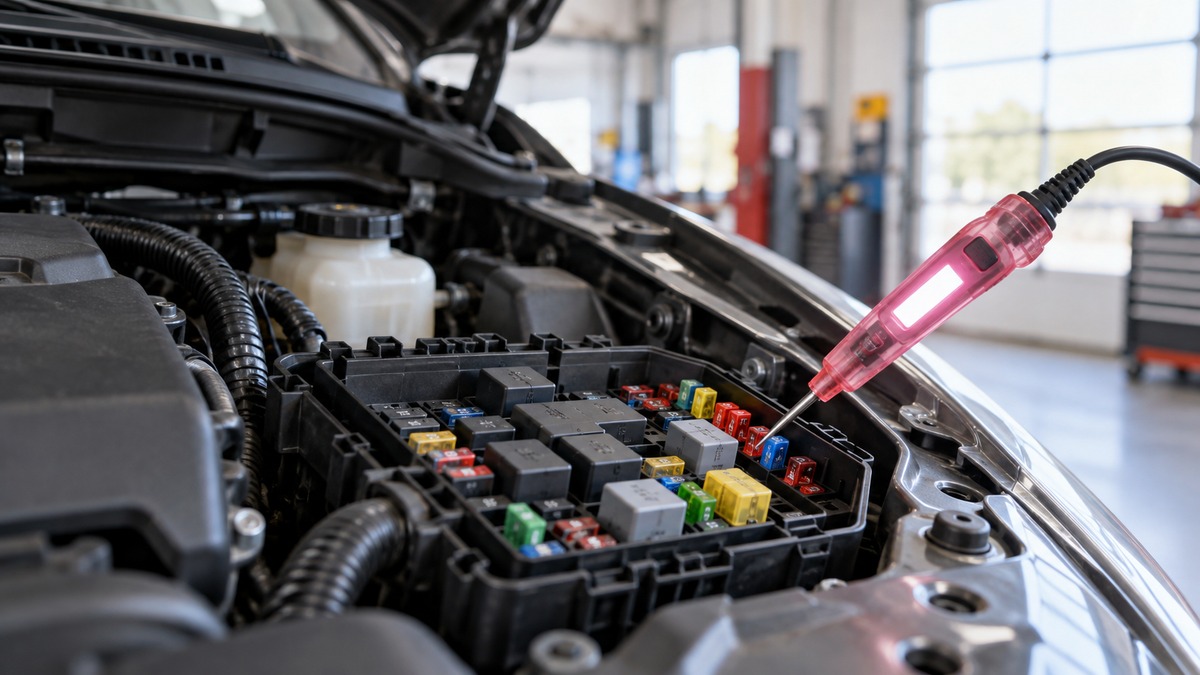
Autel PowerScan PS100 Circuit Tester Review: 12 to 24 Volt Vehicle Use
As an Amazon Associate we earn from qualifying purchases. Details
If you are considering the Autel PowerScan PS100 circuit tester, the first question is whether your circuit is a low-voltage vehicle circuit within the tester’s range. A circuit tester is built for a specific set of circuits, and it is not a substitute for a meter rated for mains. This review covers only what the listing states about the voltage range, measurement modes, breaker, cords, rating, warranty and included parts. It does not report any test of the tester on a vehicle, and it does not describe how to work on a vehicle’s electrical or airbag systems. Use the listing to decide whether the tester matches your work, and follow the vehicle maker’s manual and your local rules before you test any circuit.
Quick answer
The Autel PS100 is a small rose-colored circuit tester for automotive and low-voltage DC circuits. The title gives a 12 to 24 volt range, while the bullets say it works on 6 to 30 volt vehicle electrical systems, so check the range before you use it. The bullets describe four modes, including DC voltage with a resolution of 0.1 volt, and resistance and continuity checks. It has a resettable breaker and a 20-foot cord plus a 20-foot extension, and a cigarette lighter plug. The specs give a UL specification and a 1-year warranty from the manufacturer. The listing does not state a CAT rating.
What to check in a circuit tester
Four details decide whether this tester fits. Each one can rule it in or out.
1. Voltage range. The title says 12 to 24 volts, and the bullets say the tester covers 6 to 30 volt vehicle electrical systems. The two figures do not match, so use the lower range as the planning limit until the product page confirms the official range. A reading outside the confirmed range will not be valid.
2. Modes and resolution. The bullets describe four modes, selected with a mode button. The DC voltage mode has a resolution of 0.1 volt, and the bullets describe AC voltage, resistance and continuity checks, plus a component and signal mode in the item highlight. The bullets say the tester checks polarity and whether a circuit is positive, negative or open. Those are the listing’s descriptions, and this review does not test them.
3. Breaker, cords and plug. The bullets describe a resettable circuit breaker for overload protection, and a 20-foot cord plus a 20-foot extension. The bullets also describe a cigarette lighter plug for vehicle use. The breaker is a feature the listing describes, so do not rely on it as a safety guarantee. Check the cords for damage before each use.
4. Rating, standard and warranty. The specs give a specification of UL and a 1-year warranty from the manufacturer. The CAT system classifies live circuits used in measurement, and the source describes CAT II as circuits directly connected to the low-voltage installation and CAT IV as the source of the high-voltage installation. Without a stated category, do not use this tester on household mains.
Use these rules to choose:
- Choose this tester if you need to check a low-voltage vehicle circuit within the confirmed range, such as a trailer light or a fuse.
- Choose a different tool if you need to measure mains voltage, because the listing states no CAT rating for mains use.
- Choose a different tool if your circuit is outside the confirmed voltage range.
For other circuit tester options, the best circuit tester guide covers the category, and the what is a circuit tester used for guide explains the use.
1. Autel PowerScan PS100 Circuit Tester 2.0, 12-24V Power Circuit Probe Tool (Review verdict)
Specs from the listing (checked 2026-10-11):
- Specification Met: UL
- Warranty Description: 1 Year Warranty By the Manufacturer
- Item Dimensions: 1.18 x 1.18 x 0.39 inches
- Included Components: 1 X Circuit Tester
- Item Highlight: Electrical Short Open Circuit Finder, AC/DC/Resistance/Component/Signal/Test Light Automotive, 20ft Extension Cord
Pros
- Four modes with a DC voltage resolution of 0.1 volt, per the bullets
- Resettable breaker and 20-foot cords, per the bullets
- 1-year manufacturer warranty, per the specs
Cons
- Voltage range conflicts: 12 to 24 volts in the title, 6 to 30 volts in the bullets
- No CAT rating stated, so not for mains
- Included components list only the tester
Best for: A reader who needs a compact tester for low-voltage vehicle circuits within the confirmed range.
Skip if: Skip if you need mains voltage measurement, a CAT rating, or a use outside the confirmed voltage range.
View on Amazon (affiliate link)
The Autel PS100 circuit tester
The PS100 is a small, rose-colored tester, measuring 1.18 by 1.18 by 0.39 inches. The specs list the measurement type as multimeter, the style as circuit tester, and the power source as battery. The model label is A-M017-00-US. The included component is one circuit tester, and the item highlight names it as an electrical short and open circuit finder with AC, DC, resistance, component, signal and test light functions.
The tester fits a reader who wants a compact probe for vehicle circuits, such as checking a fuse, a light or a ground, and who keeps the cords in good condition. The bullets compare it with power probe tools that have P.P.3 and P.P.4 functions, at what the maker describes as half the price, which is the maker’s claim.
The listing has several things to check. The voltage range conflicts between the title and the bullets. The included components field lists only the tester, so check the cords and the cigarette lighter plug on the product page. The bullets describe the tester as a top pick among professionals, which is the maker’s claim and is not a test result. The specs give a 1-year warranty, and the bullets repeat that claim.
Who should skip it: a reader who needs mains voltage measurement, a reader who needs a CAT rating, and a reader whose vehicle circuit is outside the confirmed range.
Vehicle safety
Vehicle circuits can still be dangerous. Disconnect the battery or handle it safely before you probe a circuit that involves the battery, as the vehicle’s manual describes. Do not work on airbag systems or high-voltage hybrid or electric vehicle systems with this tester. The listing describes low-voltage vehicle use only, and this review does not give guidance for those systems. If the circuit is outside your training, ask a qualified technician.
The OSHA electrical overview lists contact with power lines, lack of ground-fault protection, a path to ground that is missing or discontinuous, equipment not used in the manner prescribed, and improper use of extension cords as the most frequent causes of electrical injury. The same page lists insulation, guarding, grounding, electrical protective devices and safe work practices as ways to reduce the risk.
Worked example: how a 12-volt reading sits inside the 24-volt top
Compare that reading with the top of the title’s range, so you can see the margin the range leaves.
- Top of the title’s range: 24 volts, from the title.
- Reading in this example: 12 volts.
- Margin below the top of the range: 24 minus 12 = 12 volts.
Check the arithmetic again. 24 minus 12 is 12. The example shows that a 12-volt reading sits 12 volts below the title’s top. Because the bullets give 6 to 30 volts, the example also falls inside that wider range. Confirm the range on the product page before you rely on either figure.
Why the breaker matters, and what it is not
The bullets describe a resettable circuit breaker in the tester. The Wikipedia overview of circuit breakers says a breaker protects a circuit from current above what the equipment can safely carry, and that it can be reset to resume operation, unlike a fuse. The listing does not say which circuit the tester’s breaker protects, so keep the rated voltage and the probe connections correct.
What a circuit tester is for
The Wikipedia overview of test lights says a test light, or voltage tester, checks whether electricity is present and is simpler and less costly than a multimeter. The Autel is a circuit tester in that family, with extra modes for resistance and continuity. Properly designed testers include features that protect the user from accidental shock, but the listing does not describe those features, so check the manual before you probe a live circuit.
Cords and the extension
The bullets describe two 20-foot cords, and an extension. OSHA’s wiring rules say flexible cords must be protected from accidental damage, from sharp corners, projections and doorways. Run the cords where people and vehicle doors will not pinch them, and support them so they are not damaged in place. Replace a cord that is cut or cracked before using the tester again.
Five common mistakes
- Trusting one voltage range. The title says 12 to 24 volts, and the bullets say 6 to 30 volts.
- Using it on mains. The listing states no CAT rating.
- Working on airbag or hybrid systems. This review does not cover those systems, and the listing describes low-voltage vehicle use only.
- Skipping the cord check. The tester comes with two 20-foot cords, so check them for damage.
- Trusting the breaker as a guarantee. The breaker is a described feature, not a safety guarantee.
FAQ
What voltage does it cover?
The title says 12 to 24 volts, and the bullets say 6 to 30 volts for vehicle systems.
How many modes does it have?
The listing lists four operating modes, and a mode button chooses among them.
What cords are included?
The bullets describe a 20-foot cord and a 20-foot extension.
Does it have a CAT rating?
The listing states no CAT rating.
How long is the warranty?
The specs give 1 year from the manufacturer.
Is it for mains use?
No. The listing describes vehicle and low-voltage use, and it states no CAT rating.
Bottom line
The Autel PS100 suits a reader who needs a compact tester for low-voltage vehicle circuits, such as a fuse, a light or a ground, within its confirmed range. The listing conflicts on the voltage range, states no CAT rating, and gives a 1-year warranty. Confirm the range on the product page, disconnect the battery before probing circuits that involve it, and do not use the tester on mains or on airbag and high-voltage systems.
Sources
- OSHA, Electrical overview: the most frequent causes of electrical injury and the ways to reduce the risk.
- Measurement category, Wikipedia: CAT II for circuits directly connected to the low-voltage installation, and CAT IV for the source of the high-voltage installation.
- Circuit breaker, Wikipedia: protects a circuit from current in excess of what the equipment can safely carry; can be reset unlike a fuse.
- Test light, Wikipedia: a test light checks for the presence of electricity; properly designed test lights protect the user from shock.
- 29 CFR 1910.305, OSHA wiring methods (Cornell LII): flexible cords must be protected from accidental damage and supported in place.