Ayitam 600-Amp Clamp Meter Review: AC-Only Current and CAT III Rating
As an Amazon Associate we earn from qualifying purchases. Details
If you are considering the Ayitam clamp meter, the first question is whether you need AC current only, because this listing says it does not measure DC current. A clamp meter reads current without breaking the circuit, and the jaw size and the rating decide which conductors it can read and where it can be used. This review covers only what the listing states about current range, jaw size, voltage, resistance, safety standards, display, batteries and parts. It does not report any test of the clamp on a circuit, and it does not describe how to take a reading on any live conductor. Use the listing to decide whether the meter matches your work, and follow the manual and your local electrical rules for any measurement.
Quick answer
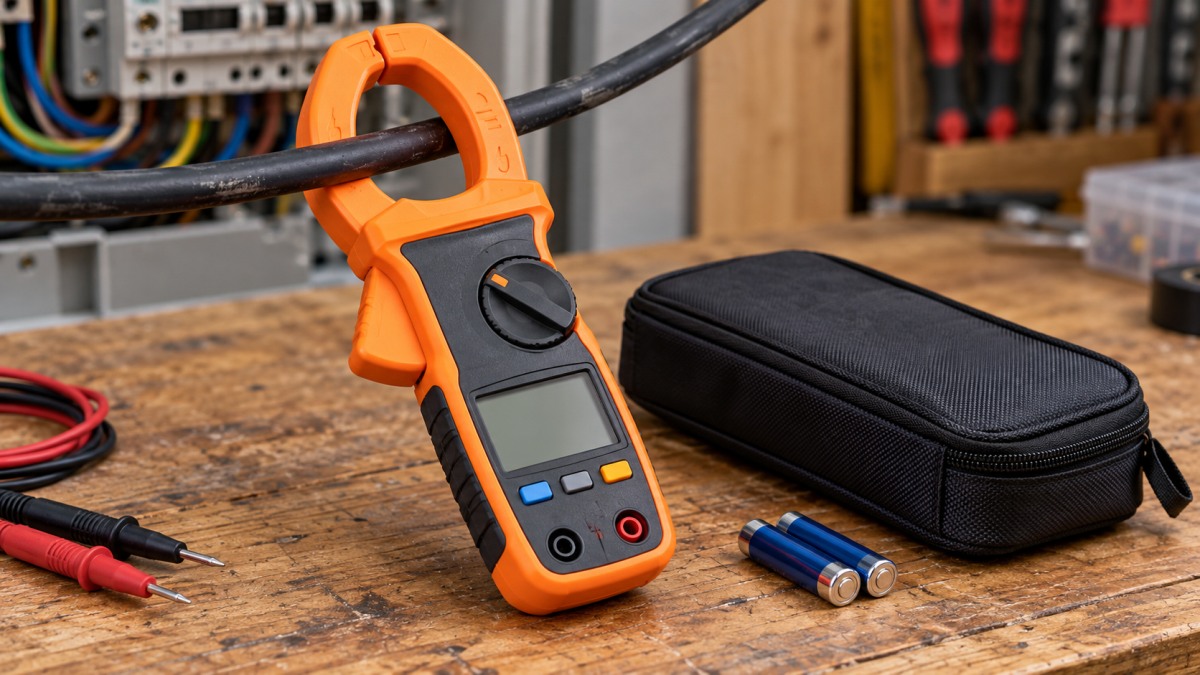
The Ayitam is an orange, battery-powered auto-ranging clamp meter that the listing says measures AC current up to 600 amps. The bullets say it does not measure DC current, and that its jaw takes conductors up to 24 millimeters, about 0.94 inch, without interrupting the circuit. It also measures AC voltage up to 600 volts, DC voltage up to 600 volts and resistance up to 20 megohms, with a 2,000-count display. The bullets state a CAT III 600 volt double insulation rating and cite IEC 61010-1 and IEC 61010-2-032. The kit includes two AAA batteries and a soft case, and the listing states no warranty term.
What to check in a clamp meter
Four details decide whether this clamp fits. Each one can rule it in or out.
1. Current type and range. The specs give AC current from 0 to 600 amps, with an accuracy of plus or minus 3 percent of the reading plus 15 digits. The bullets say the meter does not measure DC current. The Wikipedia overview of current clamps says clamps are typically used to read alternating current, and that the Hall effect type can also measure DC. The listing does not name its clamp type, so do not assume a DC reading from the title alone.
2. Jaw and conductor size. The bullets give a jaw capacity of 24 millimeters, or 0.94 inch, for AC current in a conductor. Measure the cable or bar you plan to clamp, because a conductor larger than the jaw will not close around it. The bullets describe clamping without interrupting the circuit, which is the clamp’s basic use.
3. Rating and standards. The bullets say the clamp is built to IEC 61010-1 and IEC 61010-2-032 and to double insulation CAT III 600 volts. The CAT system classifies live circuits used in measurement, and the source describes CAT II as circuits directly connected to the low-voltage installation and CAT IV as the source of the high-voltage installation. A CAT III 600 volt rating covers only that category and voltage, so check it against the circuit before you measure. The specs field says only “Iec.”
4. Display, battery and weight. The display shows up to 2,000 counts and has a backlight. The specs list the item weight as 371 grams and the net weight as 174 grams, which differ, so check the product page before you rely on either figure. The battery is two 1.5-volt AAA cells, and the bullets say the kit includes two AAA batteries.
Use these rules to choose:
- Choose this clamp if you need an AC current clamp up to 600 amps with a 24-millimeter jaw and a CAT III 600 volt rating, and you will check the rating for your circuit.
- Choose a different clamp if you need DC current, because the bullets say the meter does not measure it.
- Choose a different clamp if your conductor is larger than the 24-millimeter jaw.
For a wider look at clamp types, the best AC DC current clamp meter guide covers both AC and DC designs, and the can clamp meter measure DC current guide answers that question directly.
1. Clamp Meter Auto-Ranging Multimeter AC Current 600 A, AC/DC Voltage (Review verdict)
Specs from the listing (checked 2026-10-13):
- AC current: 0-600A±(3.0%rdg+15dgt)
- Specification Met: Iec
- Max display: 2000 counts
- Included Components: clamp meter, probe pens, batteries, user manual,soft packing case
- Item Weight: 371 g
Pros
- AC current up to 600 amps, per the specs
- 24-millimeter jaw, per the bullets
- CAT III 600 volt double insulation stated, per the bullets
Cons
- Does not measure DC current, per the bullets
- Weight given as 371 grams and 174 grams in different fields
- No warranty term stated
Best for: A reader who needs an AC current clamp up to 600 amps with a CAT III 600 volt rating, and a basic multimeter in one tool.
Skip if: Skip if you need DC current, a conductor larger than the 24-millimeter jaw, or a rating beyond CAT III 600 volts.
View on Amazon (affiliate link)
The Ayitam clamp meter
The Ayitam is a modern-style, orange clamp meter made of ABS, with a model label of PM2018A and a part number of PM2018. The listing gives the item dimensions as 7.95 by 2.52 by 1.34 inches, and the included components as the clamp meter, probe pens, batteries, a user manual and a soft packing case. The highlight names AC current, AC and DC voltage, resistance, NCV, LPF, diodes, continuity and a backlight.
The meter fits a reader who needs to read AC current on a branch circuit or a service cable, and who also wants a basic multimeter in the same tool. The bullets describe the non-contact voltage detector as detecting voltage above 90 volts AC and beeping with a backlight flash.
The listing has several things to check. The bullets say AC current only, while the highlight lists DC voltage and not DC current, so read the function list carefully. The weight figures differ between fields. The bullets describe the non-contact detector as a way to find voltage, which it does within its listed threshold, but it is not a replacement for testing a conductor with the meter’s voltage function. The listing gives no warranty term.
Who should skip it: a reader who needs DC current, a reader with a conductor bigger than the 24-millimeter jaw, and a reader who needs a CAT rating beyond the CAT III 600 volt figure.
Electrical safety first
Mains electricity can kill, and a clamp meter is used on live conductors. The CAT rating must suit the circuit you measure, and the listing’s CAT III 600 volt figure is not a rating for higher-voltage or higher-energy installations. The OSHA electrical overview lists contact with power lines, lack of ground-fault protection, a path to ground that is missing or discontinuous, equipment not used in the manner prescribed, and improper use of extension and flexible cords as the most frequent causes of electrical injury.
Follow the manual, and work only on circuits you are trained to handle. Ask a licensed electrician to handle any panel or service work, because the listing’s clamp is not a substitute for that training.
Worked example: how a 20-amp load sits below the 600-amp range
Compare that load with the top of the listed current range, so you can see how far the reading sits below the range top.
- Top of the AC current range: 600 amps, from the specs.
- Load in this example: 20 amps.
- Room below the range top: 600 minus 20 = 580 amps.
Check the arithmetic again. 600 minus 20 is 580. The example shows that a 20-amp load sits well inside the 600-amp range. The accuracy of plus or minus 3 percent plus 15 digits applies to the reading, so a low reading on a high range can carry more relative error, and the listing does not describe how the meter behaves at the bottom of its range.
Why an AC-only clamp is a design choice
The bullets say the clamp measures AC current and not DC current. The Wikipedia overview of current clamps says the current transformer type works only with AC or pulse waveforms, while the Hall effect type can measure both DC and AC. The listing does not name the clamp type, so treat the AC-only limit as the rule for this meter and check the product page for the sensing method.
Non-contact voltage and what a test light does
The bullets describe a non-contact voltage detector that beeps and flashes above 90 volts AC. The Wikipedia overview of test lights says a test light is simpler than a measuring instrument and often suffices to check whether a conductor is live, and that non-contact test lights can detect voltage on insulated conductors. A detector like this one answers a yes-or-no question about live voltage. It does not give a measured value, so use the meter’s voltage function when you need a reading.
Listed equipment and its instructions
OSHA’s general electrical requirements say that conductors and equipment must be approved, and that listed or labeled equipment must be installed and used in accordance with the instructions in its listing or labeling. The Ayitam bullets cite IEC 61010 standards and a CAT III 600 volt rating. Use the clamp as the manual describes, and do not treat the listed standards as a reason to use it on a circuit outside its rating.
Five common mistakes
- Expecting a DC reading. The meter reads AC current only, so a DC reading is outside what it can show.
- Clamping a conductor that does not fit. The jaw takes conductors up to 24 millimeters.
- Treating CAT III 600 volts as a universal rating. Check the rating for each circuit.
- Trusting one weight. The listing gives 371 grams and 174 grams.
- Relying on the detector alone. The non-contact function detects voltage above 90 volts AC, and it is not a substitute for testing.
FAQ
Does it measure DC current?
No.
How large a conductor does the jaw take?
The bullets give 24 millimeters, or 0.94 inch.
What current range does it give?
The specs give AC current from 0 to 600 amps.
What rating does it state?
The bullets state double insulation CAT III 600 volts and cite IEC 61010-1 and IEC 61010-2-032.
What batteries does it use?
Two 1.5-volt AAA batteries, and the kit includes two.
Does it come with a warranty?
The listing states no warranty term.
Bottom line
The Ayitam clamp meter suits a reader who needs an AC current clamp up to 600 amps, with a 24-millimeter jaw, a CAT III 600 volt rating and a basic multimeter in one tool. The listing does not measure DC current, its weight figures differ, and it states no warranty. Confirm the conductor size, check the CAT rating against the circuit, and follow the manual and your local electrical rules before any measurement.
Sources
- Current clamp, Wikipedia: clamps are typically used to read AC; the Hall effect type can also measure DC.
- Measurement category, Wikipedia: CAT II for circuits directly connected to the low-voltage installation, and CAT IV for the source of the high-voltage installation.
- OSHA, Electrical overview: the most frequent causes of electrical injury and the ways to reduce the risk.
- Current clamp, Wikipedia: the current transformer type works only with AC or pulse waveforms; the Hall effect type measures both DC and AC.
- Test light, Wikipedia: a test light checks for the presence of electricity; non-contact test lights can detect voltage on insulated conductors.
- 29 CFR 1910.303, OSHA electrical general requirements (Cornell LII): equipment is acceptable only if approved; listed or labeled equipment is used per its instructions.