Best Voltage Detector Fluke Picks and Alternatives
As an Amazon Associate we earn from qualifying purchases. Details
A voltage detector fluke buyers search for is usually a Fluke non contact voltage detector pen that beeps and lights near AC voltage. This guide helps you decide whether the classic Fluke 1AC II voltage detector fits your work, or whether a dual-range or low-voltage pen fits better for doorbells, thermostats, and troubleshooting.
You will learn what AC range, sensitivity modes, alerts, power, size, and CAT rating to check, plus how to use a voltage detector pen safely for first checks. Work on mains circuits can kill. The meter CAT rating must suit the circuit, and panel or service work belongs to a licensed electrician. Follow the instrument manual and local electrical rules.
Quick answer
For most homeowners, the Fluke 1AC II voltage detector is the simplest choice because the listing states nominally 90 V AC to 1000 V AC, audible beeper, red LED tip, continuous self-test, and CAT IV rating mention. It fits standard outlet, switch, and breaker first checks where you do not want extra modes.
Choose a dual-range pen such as 12V-1000V / 48V-1000V if you also check low-voltage controls, doorbell wiring, or need to separate live from neutral more carefully. Choose an always-on model with no switch if you worry about forgetting to turn the tester on. This article never replaces an electrician. If you are unsure, stop and ask a professional. For background steps, see How to Use a Non Contact Voltage Detector.
What matters for a Fluke-style voltage detector
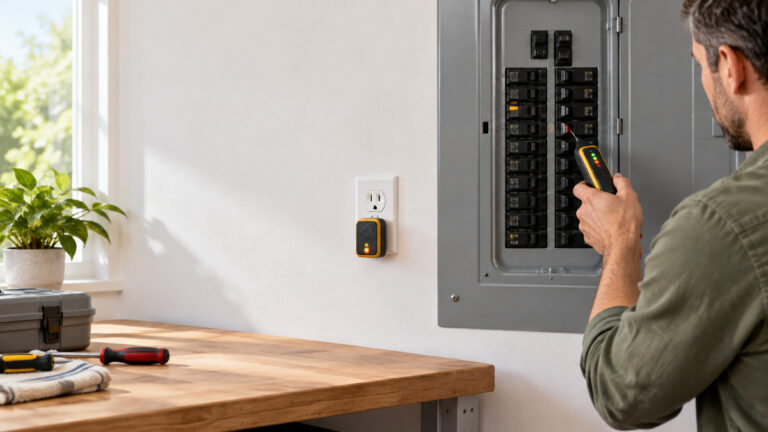
A non-contact voltage tester senses the electric field around an energized AC conductor. You hold the tip near the wire or slot. It lights and beeps when voltage is present. It does not prove a circuit is dead by itself. Always test on a known live source before and after, then confirm with a contact meter when needed.
1. AC detection range and low-voltage need
Range is the first filter. The Fluke 1AC II voltage detector listing states nominally 90 V AC to 1000 V AC, with bullets also mentioning 200 V to 1000 V AC as an application note. That fits household mains checks in the US.
Other pens list 12-1000V AC, 50-1000V AC, or selectable 12V-1000V / 48V-1000V ranges. A common rule of thumb is to use the higher-sensitivity setting to find a weak field, then switch to lower sensitivity to narrow down which conductor is hot. That is a simplification; always follow the manual.
If you need a 12 Volt Non Contact Voltage Detector for doorbell, thermostat, or control wiring, a 90 V minimum will not help. The same applies to a search for fluke dc voltage detector: the pens here detect AC voltage. The listings do not state DC non-contact detection, so check the product listing if you need DC.
2. Single range versus selectable sensitivity
Single-range pens are simple. You turn them on, test a known live source, then test the unknown wire. The Fluke 1AC II, Santronics 3000, Neoteck, and Klein NCVT1P styles follow this pattern, with fixed ranges stated in their data.
Selectable-sensitivity pens add High and Low modes. The VENLAB listing states High for 12V-1000V and Low for 48V-1000V. The yowexa listing states high sensitivity 12-1000V and low sensitivity 48-1000V. MXCOIRTP and similar listings describe three sensitivity modes selected with an S button.
More modes help in crowded boxes, but they add a mistake risk: testing in the wrong mode. If you want the simplest Fluke Voltalert how to use style workflow, stay with a fixed-range pen.
3. Alert type: light, sound, and silent mode
All picks use sound and light alarms. Differences matter in noisy rooms. The Fluke 1AC II listing states one high intensity red LED plus beeper and Audible/Silent mode. The Klein NCVT1P listing states green LED when operational and flashing red plus beeping when voltage is detected. The yowexa listing states 1-3 signal indicators by signal strength with faster beeps for stronger signals.
Check whether you can mute the beeper for occupied homes, whether the tip is easy to see in daylight, and whether the pen includes a flashlight. A flashlight helps in panels and closets, but it does not change detection.
4. CAT rating and where you may use it
Measurement category (CAT) is a method of classification by the International Electrotechnical Commission (IEC) of live electric circuits used in measurement and testing of installations and equipment, usually in relation to a building. The categories take into account the total continuous energy available at the given point of the circuit and the occurrence of impulse voltages.
Measurement category II is for measurements performed on circuits directly connected to the low-voltage installation. Measurement category IV is for measurements performed at the source of the high-voltage installation. The required impulse withstand voltage varies from 500 V (CAT II, 50 V) to 12,000 V (CAT IV, 1000 V).
For buying, the rule is direct: the meter CAT rating must suit the circuit. Quote a CAT rating only if it appears in that listing. The Fluke 1AC II data includes a CAT IV rating mention. The Klein NCVT1P data states Cat Iv 1000v. The yowexa data states CAT III 1000V and CAT IV 600V. The Neoteck data states CE CAT III 600V. The Santronics data mentions CAT IV. If a listing does not state a CAT rating, do not call the meter safe for household mains. Do not open panels or touch service conductors. That work belongs to a licensed electrician.
5. Power, size, and everyday carry
Most pens use 2 x AAA batteries. The Fluke 1AC II listing states 2 AAA alkaline batteries included with typical battery life of greater than 1-year. The Klein NCVT1P listing states instructions and 2 x AAA 1.5 Volt batteries included with auto power-off. The yowexa listing states 2 x 1.5V AAA batteries included with auto shutoff and pocket clip.
Weight and length affect pocket carry. Listed examples include 59 g for the Fluke 1AC II, 22.68 g for the Klein NCVT1P, 65 g for the Neoteck, 46.2 g for the Santronics 3000, and 45 g for the yowexa. Listed lengths include 5.5 x 0.72 x 1 inches for Klein, 6.3 x 0.79 x 0.79 inches for Neoteck, and 5.95 x 1 x 1.1 inches for yowexa. Check the listing for current dimensions before buying a holster or case.
1. Fluke 1AC II VoltAlert Non-Contact Voltage Tester, Pocket-Sized, 90-1000V AC, Audible Beeper, CAT (Best overall)
Specs from the listing (checked 2026-10-10):
- Voltage sensing ranges: Nominally, 90 V AC to 1000 V AC
- Light source: One high intensity red LED
- Batteries: 2 AAA alkaline batteries included; Typical battery life of greater than 1-year
- Item Weight: 59 g
- Model: FLUKE-1AC-A1-II
- Included Components: Fluke-1AC-A1-II ACV Detector 90-1000V with 2 AAA Alkaline batteries
- Warranty Description: 2 years
Pros
- Nominal 90-1000V AC range fits standard mains first checks
- Audible beeper with silent mode plus continuous self-test
- 2 AAA batteries included with greater than 1-year typical life
Cons
- Fixed high lower limit will not find low-voltage control circuits
- Listing dimensions look like package size, verify pen length before buying a case
Best for: Homeowners wanting a simple fixed-range Fluke pen for outlets and switches
Skip if: You need low-voltage detection or DC detection; listing states AC only
View on Amazon (affiliate link)
2. Klein Tools NCVT1P Voltage Tester, NCVT Pen, 50 to 1000V AC (Best lightweight)
Specs from the listing (checked 2026-10-10):
- Measurement Type: Voltmeter
- Item Weight: 22.68 g
- Item Dimensions: 5.5 x 0.72 x 1 inches
- Included Components: Instructions and 2 x AAA 1.5 Volt Batteries
- Specification Met: Cat Iv 1000v
Pros
- 50-1000V AC range for outlets, switches and breakers
- Green operational LED plus flashing red and beep on detection
- 22.68 g with auto power-off and pocket clip
Cons
- No selectable sensitivity steps for crowded boxes
- No flashlight stated in the listing
Best for: Renters and DIYers wanting light pocket carry with clear status light
Skip if: You need adjustable sensitivity or low-voltage control detection
View on Amazon (affiliate link)
3. 3000 Non-Contact Voltage Tester, Always-On AC Voltage Detector 50-1000VAC, CAT IV Certified (Best always-on)
Specs from the listing (checked 2026-10-10):
- Brand: Santronics
- Item Weight: 46.2 g
- Item Dimensions: 5.58 x 0.5 x 0.75 inches
- Model: 3000
- Unit Count: 1 Count
Pros
- No on/off switch so pen is ready when pulled from pocket
- 50-1000V range with LED and audible alert for outlets and boxes
- 46.2 g pen-size body in high-impact polycarbonate
Cons
- Listing does not state battery type or battery life
- No sensitivity switch or flashlight stated
Best for: Maintenance users who want grab-and-test without a power button
Skip if: You want silent mode or low-voltage detection below 50V
View on Amazon (affiliate link)
4. Neoteck Non Contact Voltage Detector 12-1000V AC Voltage Tester (Best low-voltage reach)
Specs from the listing (checked 2026-10-10):
- Style: AC 12-1000V
- Measurement Type: AC Voltage
- Item Weight: 65 g
- Item Dimensions: 6.3 x 0.79 x 0.79 inches
- Included Components: 2×1.5V AAA batteries
- Specification Met: CE
Pros
- 12-1000V AC range helps with lower-voltage AC troubleshooting
- Live/null distinction by alarm levels plus LED flashlight
- 2×1.5V AAA batteries included, 65 g pocket pen
Cons
- AC only; listing notes not suitable for Christmas light testing
- Single fixed low end with no High/Low switch
Best for: DIYers who need 12V low-end reach for switches and fixtures
Skip if: You need a stated CAT IV rating or selectable sensitivity
View on Amazon (affiliate link)
5. Non Contact Voltage Tester Pen, AC 12/48-1000V Electric Tester Pen (Best dual sensitivity)
Specs from the listing (checked 2026-10-10):
- AC Voltage Range: 12~1000V(High Sensitivity); 48~1000V(Low Sensitivity)
- Frequency: 50Hz/60Hz
- Safety Level: CAT.III 1000V; CAT.IV 600V
- Item Weight: 45 g
- Item Dimensions: 5.95 x 1 x 1.1 inches
- Power Supply: 2 x 1.5V AAA batteries(Included)
Pros
- Selectable 12-1000V and 48-1000V modes narrow the hot wire
- 1-3 signal lights with faster beeps for stronger fields
- CAT III 1000V/CAT IV 600V with low-battery alert and auto shutoff
Cons
- Must select sensitivity before detection, confusing for absolute beginners
- For AC checks only; must test on known live source before use
Best for: Troubleshooters working in crowded boxes with adjacent wires
Skip if: You want a no-settings Fluke-style fixed-range pen
View on Amazon (affiliate link)
6. VENLAB Voltage Tester, Non Contact Voltage Detector, Circuit Tester Dual Range Voltage Sniffer (Best lights and pointer)
Specs from the listing (checked 2026-10-10):
- Brand: VENLAB
- Model: VD-200
- Item Weight: 0.05 kg
- Included Components: 1*Voltage Tester 2*AAA Batteries
- Color: Blue
Pros
- Dual 12V/48V-1000V ranges with red/yellow voltage cues
- Built-in flashlight plus red pointing light for dark areas
- Tester plus 2 AAA batteries included, 0.05 kg carry
Cons
- Listing does not state a CAT rating, verify manual before mains use
- Two-color signal system takes practice to interpret reliably
Best for: Home users wanting dual range plus flashlight and pointer
Skip if: You require a printed CAT III or CAT IV marking for mains work
View on Amazon (affiliate link)
Fluke voltage detector picks and close alternatives
The product cards above show specs. The notes below explain who each pen fits, using only what each listing states.
Fluke 1AC II for simple mains first checks
This is the classic fluke voltage detector pen many readers mean by fluke 1ac ii voltage detector or fluke 2ac voltage detector searches. The listing title states Fluke 1AC II VoltAlert Non-Contact Voltage Tester, Pocket-Sized, 90-1000V AC, Audible Beeper, CAT IV Rating. Specs state nominally 90 V AC to 1000 V AC, flat-tip, one high intensity red LED, 2 AAA alkaline batteries included, 59 g, and 2 years warranty description.
It fits homeowners and DIYers who want one fixed range for outlets, switches, cords, and breakers without mode buttons. Bullets state continuous self-test, tip glows red with beeper on detection, and Audible/Silent mode. That self-test and silent option are useful for quick voltage detector how to use checks.
Limits: the 90 V lower limit will not find low-voltage control circuits. The listing dimensions of 10.24 x 7.5 x 1.46 inches look like package size, so check the listing for pen length. Skip it if you need low-voltage detection or DC detection.
Klein NCVT1P for lightweight pocket carry
This Klein pen is an alternative when you want a lighter pen with operation indicator. The listing states Klein Tools NCVT1P Voltage Tester, NCVT Pen, 50 to 1000V AC, with 50 to 1000V AC power detection range, 22.68 g weight, and 5.5 x 0.72 x 1 inches size. Included components are instructions and 2 x AAA 1.5 Volt batteries.
It fits renters and homeowners who want clear status: bright LED illuminates green when operational and flashes red with beeping alert when voltage is detected. Bullets also state non-contact detection in cables, cords, breakers, lighting fixtures, switches, non-tamper-resistant outlets, and wires, plus auto power-off and 6.6-Foot (2 m) drop protection.
Limits: the listing states Specification Met Cat Iv 1000v, but confirm the exact CAT marking in the manual before use near higher-energy circuits. The fixed single range is not a low-voltage control tester. Skip it if you need adjustable sensitivity or a flashlight. See also Best Klein Non Contact Voltage Detector.
Santronics 3000 for always-on use with no switch
This pen fits people who worry about leaving a tester switched off. Bullets state always-on detection with no button to push, 50 to 1000 volts detection, high-intensity LED plus audible beep, and non-flammable high-impact polycarbonate body. Specs state 46.2 g weight, 5.58 x 0.5 x 0.75 inches size, and 1 count unit.
It fits maintenance staff and landlords who want grab-and-test operation for outlets, wires, and junction boxes. The bullet claim about separating hot from neutral without false positives is useful in crowded boxes, but still verify with a contact meter before touching conductors. The data mentions CAT IV safety standards, so verify the printed marking on arrival.
Limits: always-on means battery drain depends on design; the listing does not state battery type, battery life, or auto-off. The listing does not state a flashlight or sensitivity switch. Skip it if you want mute control or low-voltage detection below 50 V.
Neoteck 12-1000V pen for lower-voltage AC checks
This pen fits buyers who need a lower starting point than 90 V. The listing states Neoteck Non Contact Voltage Detector 12-1000V AC Voltage Tester, 12-1000V AC range, 65 g weight, 6.3 x 0.79 x 0.79 inches size, and 2×1.5V AAA batteries included. Bullets state live and null wire distinction through different alarm sound and LED indicator levels, plus LED flashlight.
It fits DIYers checking switches, outlets, lighting fixtures, circuit breakers, and wires where a lower threshold helps narrow a fault. The listing states CE CAT III 600V RoHS Certificate in bullets, which is more specific than many low-cost pens. Warranty description states 18 Months.
Limits: it is AC only; the listing does not state DC detection. The note says not suitable for Christmas light testing, so do not buy it for that task. Skip it if you want selectable sensitivity steps or a stated CAT IV rating. For method help, see How to Use a Non Contact Voltage Tester on Wires.
Yowexa dual-sensitivity pen for crowded boxes
This pen fits troubleshooting where signal strength matters. Specs state AC Voltage Range 12~1000V High Sensitivity and 48~1000V Low Sensitivity, 50Hz/60Hz frequency, sound and light alarm, 45 g weight, 5.95 x 1 x 1.1 inches size, and 2 x 1.5V AAA batteries included. Safety Level states CAT III 1000V and CAT IV 600V.
Bullets state live/neutral comparison by signal strength, 1-3 signal indicators, faster beeps for stronger or closer sources, low-battery alert, LED flashlight, auto shutoff, and pocket clip. That combination helps when two wires run side by side and both cause some beeping.
Limits: the manual warns to select sensitivity before detection and avoid switching during detection. Beginners may find that confusing at first. The pen is for AC voltage checks only; test on a known live source before use. Skip it if you want a one-button Fluke-style tool with no settings. Compare ranges in Best Ac Dc Non Contact Voltage Detector.
VENLAB dual-range pen with red pointing light
This pen fits users who want High/Low modes plus work lights. Bullets state High for Testing 12V-1000V and Low for Testing 48V-1000V, tip glows red with high-frequency beeper for high voltage and yellow light with low-frequency beep for low voltage, plus built-in flashlight and red pointing light. Specs state Model VD-200, Blue color, 0.05 kg weight, and 1xVoltage Tester 2xAAA Batteries included.
It fits home repairs where you move between brighter and darker areas and want both a flashlight and a pointer for marking the suspect cable. Customer Service states 3 years warranty and lifetime technical support in bullets, which is useful for first-time buyers with questions.
Limits: the listing does not state a CAT rating, so do not treat it as proven for household mains beyond a first indication; check the product listing and manual. Color signals vary by brand, so learn this pen signals before relying on them. Skip it if you need a stated CAT III or CAT IV marking. For comparison with a meter that adds contact measurement, see Non Contact Voltage Tester vs Multimeter.
How to choose a voltage detector fluke style tool
Start with the circuit you will check most. For standard receptacles and lighting, any listed 50-1000V, 90-1000V, or 12-1000V pen will respond. For doorbell transformers, thermostats, or controls, you need a pen that lists lower-end sensitivity. For a search like fluke detector or fluke 1ac ii voltage detector pen, confirm the exact model number FLUKE-1AC-A1-II and the 90-1000V marking on arrival.
Next, decide on controls. Fixed-range pens reduce errors. Selectable High/Low pens help isolate the hot conductor but require you to set the mode first. Always-on pens remove the power-button step but may use batteries differently. If stealth matters, pick a model with silent mode.
Then check safety markings. Read the CAT marking printed on the tester, not just the web title. Confirm voltage rating, battery door security, and tip condition. IEC 61010-1 clause 5.4.1(g) requires that the transient withstand capability of the equipment is made known to the user. If the maker does not state it, ask or choose a tester that does.
Finally, plan verification. A non-contact indication alone never proves dead. Test the pen on a known live outlet, test the unknown location, then retest on the known live outlet. If the result decides whether you touch a wire, confirm with a contact voltage tester or multimeter and follow How Do I Use a Voltage Tester. When the task involves a breaker panel, service conductors, or anything you do not understand, stop and call a licensed electrician.
| Pen | Listed AC range | Alerts and modes | Power and size from listing | Safety marking in data |
|---|---|---|---|---|
| Fluke 1AC II | Nominally 90 V AC to 1000 V AC | Red LED, beeper, Audible/Silent, self-test | 59 g, 2 AAA included | CAT IV rating mention |
| Klein NCVT1P | 50 to 1000V AC | Green OK, flashing red plus beep, auto off | 22.68 g, 5.5 x 0.72 x 1 inches, 2 AAA included | Cat Iv 1000v stated |
| Santronics 3000 | 50 to 1000 volts | LED plus beep, always-on, no switch | 46.2 g, 5.58 x 0.5 x 0.75 inches | CAT IV mention |
| Neoteck PM8908C | 12-1000V AC | LED plus beeps, flashlight | 65 g, 6.3 x 0.79 x 0.79 inches, 2 AAA included | CE CAT III 600V in bullets |
| Yowexa YW-322 | 12-1000V High, 48-1000V Low | 1-3 lights, beeps, flashlight, auto shutoff | 45 g, 5.95 x 1 x 1.1 inches, 2 AAA included | CAT III 1000V, CAT IV 600V |
| VENLAB VD-200 | 12V-1000V High, 48V-1000V Low | Red/yellow lights, beeps, flashlight, pointer | 0.05 kg, tester plus 2 AAA included | Listing does not state CAT rating |
Planning example with two listed thresholds
This example shows why the lower limit changes what you can find. It uses only thresholds taken from the listings above, labelled our planning estimate, with every step shown.
Assume our planning estimate compares a fixed pen with a 90 V lower threshold against a pen with a 12 V lower threshold, plus a 48 V Low mode and a 50 V fixed pen. No other loads or distances are included.
Step 1: Gap between fixed mains pen and low-voltage pen. Subtract low threshold from high threshold. 90 V minus 12 V equals 78 V. Re-check by addition: 12 V plus 78 V equals 90 V. The gap is 78 V.
Step 2: Gap between 90 V threshold and 50 V threshold. Subtract smaller from larger. 90 V minus 50 V equals 40 V. Re-check: 50 V plus 40 V equals 90 V. The difference is 40 V.
Step 3: Gap between Low mode 48 V and High mode 12 V. Subtract High from Low. 48 V minus 12 V equals 36 V. Re-check: 12 V plus 36 V equals 48 V. The mode span is 36 V.
Step 4: Share of 1000 V top range represented by 78 V gap. Divide gap by top range, then multiply by 100. 78 V divided by 1000 V equals 0.078. 0.078 times 100 equals 7.8%. Re-check: 7.8% divided by 100 equals 0.078, and 0.078 times 1000 V equals 78 V.
Decision: choose the 90 V Fluke style for simple mains first checks. Add or choose a dual-range pen with 12 V High sensitivity if low-voltage controls are in scope. In both cases verify on a known live source and confirm dead with a contact instrument before touching anything.
5 common mistakes with a fluke non contact voltage detector
- Trusting silence as proof of dead. A dead battery, wrong mode, thick insulation, or shielded cable can mute the pen. Test known-live, then unknown, then known-live again. Confirm with a contact meter before touching.
- Using a fixed high-threshold pen for low-voltage controls. Doorbell and thermostat circuits may sit well below the fixed mains threshold. If you need those checks, pick a pen that lists lower-end sensitivity and learn How to Use a Voltage Reader.
- Ignoring the CAT marking. A pen without a stated CAT rating is not proven for mains use. Read the body marking and manual. Never use a tester with cracked housing or a loose battery door on live circuits.
- Testing in the wrong sensitivity mode. On High/Low pens, High finds weak fields and Low narrows the hot wire. Set the mode before approaching the wire. Practice on a known outlet first, as shown in How to Use a Voltage Meter to Test an Outlet.
- Opening a panel because the pen beeped. A beep near a breaker does not qualify you to remove a dead-front or touch bus bars. Panel and service work belongs to a licensed electrician. Also avoid airbag wiring and high-voltage hybrid or EV systems; disconnect and handle batteries safely per the vehicle manual.
Care, batteries, and when to stop
Store pens dry with tips protected. Remove batteries for long storage if the manual allows. Replace weak AAA cells promptly; low voltage can cause missed indications. The yowexa data specifically lists a low-battery alert, while Klein lists auto power-off and Fluke lists greater than 1-year typical battery life. Check the listing for what your pen includes.
Inspect before each use. Look for cracks, a damaged tip, or a battery door that will not latch. Retest function on a known live source. If the pen behaves oddly near known voltage, replace batteries and retest. If it still behaves oddly, retire it.
Stop and get help for buzzing panels, warm breakers, burning smells, repeated tripping, or any sparking. Those signs point to faults that a pen cannot diagnose. A licensed electrician has the rated tools and training for that work.
FAQ
How do I use a voltage detector pen for an outlet check?
Check the manual and the detailed guides for outlet check steps, including testing the pen on a known live outlet before and after. For full steps see How to Use a Non Contact Voltage Detector and How to Use a Voltage Detector Pen. Confirm dead with a contact meter before touching wires.
What is the Fluke 1AC II voltage detector range?
The listing states nominally 90 V AC to 1000 V AC, with bullets noting 200 V to 1000 V AC for wide application use. That range fits standard mains first checks, not low-voltage controls. For the dedicated model page see Best Fluke 1ac A1 Ii Ac Voltage Detector.
What is the difference between Fluke 1AC II and Fluke 1LAC II?
The 1AC II in this data is a 90-1000V AC pen for mains checks. The 1LAC II family is normally the low-voltage version for lower AC thresholds, but this article data does not list its specs. Check the product listing for exact range and CAT marking. See Best Fluke 1lac a Ii Low Voltage Detector.
Can a Fluke voltage pen detect DC voltage?
The pens in this guide list AC ranges only, such as 90-1000V AC or 12-1000V AC. The listings do not state non-contact DC detection. If you searched fluke dc voltage detector, use a contact multimeter on the correct DC setting or choose a tool that explicitly lists DC in its specs. See Best Ac Dc Non Contact Voltage Detector.
Why does my non-contact tester beep on both wires?
Stray fields, close spacing, or High sensitivity can make neutral or nearby wires beep. Switch to Low sensitivity if your pen has it, increase tip distance slightly, and compare signal strength between conductors. For false-positive causes see Best Non Contact Voltage Tester False Positive. Never assume the quieter wire is safe to touch.
Do I need true RMS or counts for a voltage detector pen?
No. True RMS and display counts apply to multimeters that measure waveforms and display numbers. A pen only indicates presence of AC voltage with light and sound. If you need values, use a multimeter such as Best Fluke 117 Electrician’s Multimeter with Non Contact Voltage.
Which Fluke pen should a beginner buy first?
Most beginners checking outlets, lamps, and switches should start with the fixed-range Fluke 1AC II style because it has no sensitivity switch to set wrong. Add a dual-range pen later if you troubleshoot doorbells or thermostats. Learn the steps in How to Use Voltalert 1ac a Ii.
Bottom line
Choose the Fluke 1AC II if you want the simplest fixed-range mains indicator with self-test and silent mode. Choose a dual-range pen if low-voltage controls are in scope. Choose always-on if you fear leaving the tester off, and lightweight Klein if pocket weight matters. Whatever you pick, test known-live before and after, confirm dead with a contact instrument, respect the CAT marking, and leave panel or service work to a licensed electrician.
Sources
- Measurement category: CAT definitions, CAT II vs CAT IV use, and impulse withstand range