How to Use the VoltAlert 1AC II Voltage Detector
As an Amazon Associate we earn from qualifying purchases. Details
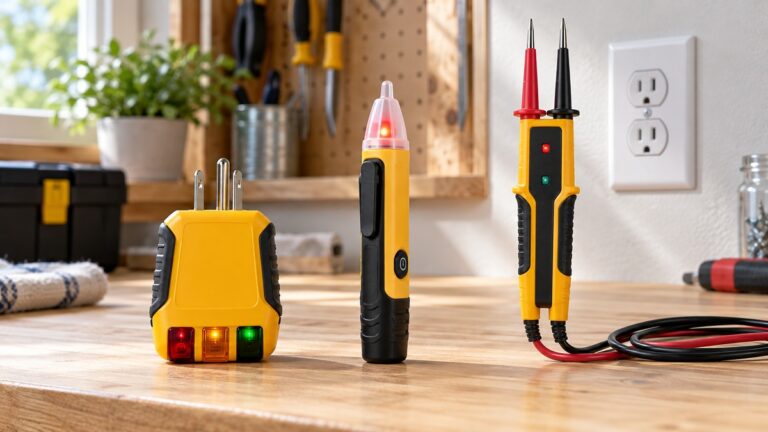
The Fluke 1AC II VoltAlert is a pocket non-contact voltage tester. Its listing gives a detection range of 90 V to 1000 V AC and says the tip glows red and a beeper sounds when voltage is found. The listing has no instruction manual, so the steps below are general safety practice built around the listing’s stated features.
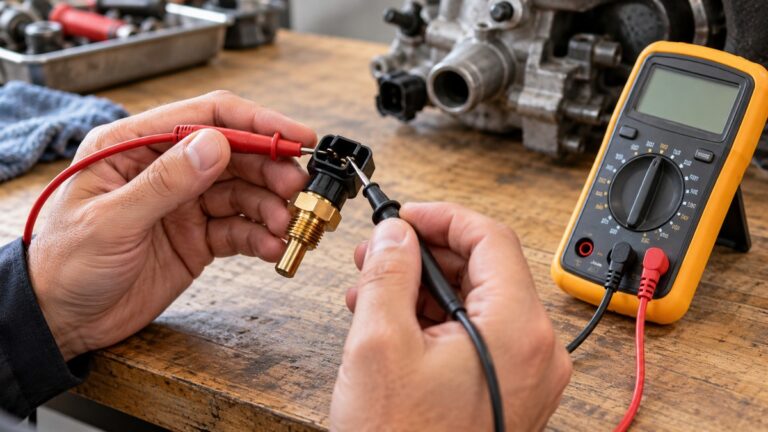
Quick answer: hold the VoltAlert tip close to the conductor, watch for the red glow and listen for the beeper, and confirm the tester works before and after each check. If you need to read a voltage value or test a low-voltage DC circuit, the VoltAlert is the wrong tool, because its listing gives no DC or numeric readout. For a 12 V automotive circuit, the listing’s 90 V lower limit means it will not detect that voltage.
What the listings say about the VoltAlert and its alternatives
Four non-contact voltage testers appear in the research set for this keyword. The Fluke listing is the only VoltAlert model, and the others are included as alternatives that cover different ranges. The figures below are as each seller states them, and the listing data was checked on 11 October 2026.
| Tester | Stated AC detection range | Signal (as listed) | Power (as listed) |
|---|---|---|---|
| Fluke 1AC II VoltAlert (B000EJ332O) | 90 V to 1000 V AC, or 200 V to 1000 V AC | Tip glows red and beeper sounds; audible or silent mode | Alkaline |
| Klein Tools NCVT1P (B099SJ6469) | 50 V to 1000 V AC | Green LED when working, red flash and beep when voltage is found | Battery powered, auto power-off |
| Neoteck Non Contact Voltage Detector (B01JYCVU2Q) | 12 V to 1000 V AC | LED and audible beeps by alarm level | Battery powered |
| MXCOIRTP Voltage Tester (B0D7LWBYVW) | 12 V, 48 V, 70 V to 1000 V AC (three ranges) | Buzzer and sensitivity modes | Battery powered |
Before you start: check the tester and the circuit
The Fluke listing says the VoltAlert has a continuous self-test, so you always know it is working. Use that as your first check each time you pick it up. The Klein listing gives a similar check: a bright green LED shows the tester is operational. If the tester does not show its normal state, do not rely on a silent result from it. Use a different tester, or have the tester checked, before you decide a wire is dead.
Also check the range you need. The VoltAlert’s stated lower limit is 90 V AC in its main range, so it is not designed to detect a low-voltage circuit such as a 12 V battery line. The MXCOIRTP and Neoteck listings start lower, at 12 V, which matters if you work on automotive or low-voltage wiring.
Step 1: Set the range and sensitivity
The Fluke listing states two voltage ranges, 90 V to 1000 V AC and 200 V to 1000 V AC, and an audible or silent mode. Choose the mode that suits the place you work. A silent mode helps when a beep would be a distraction, but it removes the audible warning, so keep the red tip indication in view. The listing does not describe how the two ranges are selected on the tool, so read the printed instructions for that step.
Step 2: Hold the tip near the conductor
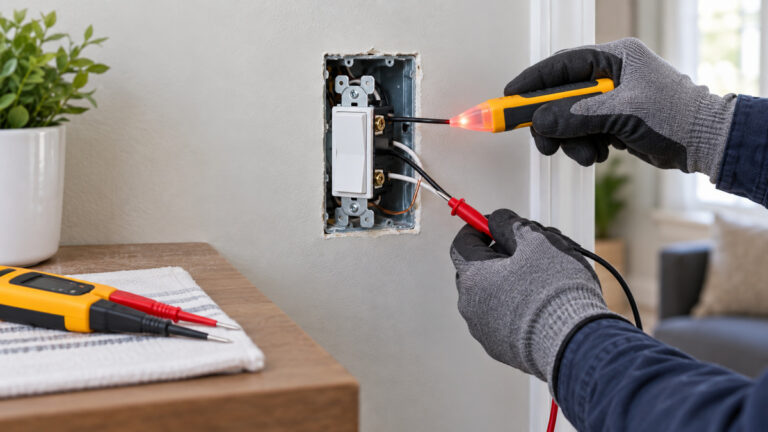
Bring the tip close to the wire, cord or socket you want to check. The listing says the tip glows red and a beeper sounds when voltage is detected. Move slowly along the conductor and keep your hand clear of the metal parts. Non-contact testers can read live voltage through insulation, so a strong signal from a cord does not tell you which conductor carries the voltage. Check each conductor separately if that is what you need to know.
Step 3: Read the signal, and confirm with a second check
A red tip and a beep mean the tester has sensed AC voltage in its range. No signal does not prove the circuit is dead. A cable can be live but shielded, or the tip may be too far from the conductor. The Klein listing describes its detection as working in cables, cords, circuit breakers, lighting fixtures, switches, non-tamper-resistant outlets and wires, which shows the kinds of places a non-contact check covers. Confirm with a meter that reads voltage before you rely on a no-signal result.
Step 4: Recheck the tester after the job
Test the VoltAlert again on a known live source after you finish. This shows that the tester still responds at the end of the job, which is the same self-check you ran at the start. Store the tester where the tip cannot be damaged, and replace the battery when the tester no longer shows its normal state. The Fluke listing says it uses alkaline power, so keep spare cells on hand if you use it often.
How we chose these four
The four testers were kept because each listing gives an AC detection range, a signal method and a power source in the listing data. The VoltAlert is the subject of the guide. The other three are the non-contact testers in the research set that give enough detail to compare. The listings do not give the same level of detail for each tester, so the comparison is limited to what each seller states. None of the figures below comes from a test performed for this site.
- Stated range: the lowest AC voltage each tester is listed to detect. This decides whether a tester covers a low-voltage circuit at all.
- Signal: how the tester tells you it has found voltage, such as a red tip, a beeper or an LED.
- Power: the battery type or power source stated in the listing.
Worked example: which tester covers a 120 V outlet and a 12 V line
Take two checks. First, a standard 120 V household outlet. The Fluke VoltAlert’s main range starts at 90 V and runs to 1000 V, so 120 V sits inside it. The Klein range of 50 V to 1000 V also covers 120 V, and so do the Neoteck and MXCOIRTP ranges. All four testers therefore cover a 120 V outlet on paper.
Second, a 12 V automotive line. The VoltAlert’s stated lower limit is 90 V, which means 12 V is 78 V below the bottom of its main range. The Klein range starts at 50 V, which is still above 12 V. The Neoteck range starts at 12 V, so 12 V is at its lowest edge. The MXCOIRTP first range is listed at 12 V. For a 12 V line, a 12 V-rated tester is the only one of the four whose listing says it reaches that voltage. Check the range on the tester in your hand before you rely on it.
What the listings do not say
The Fluke listing does not give a sensitivity figure, a distance at which it detects voltage, or how the two ranges are selected. The listing also does not give a numeric voltage reading, so you cannot use the VoltAlert to measure how much voltage is present. The item weight and dimensions are stated inconsistently: the Fluke listing gives 59 g for weight and lists dimensions of 10.24 x 7.5 x 1.46 inches, which are shipping figures rather than the tester’s size. Check the printed label on the tester if you need its size.
None of the listings gives an independent comparison of how well each tester detects voltage through insulation. The Klein and Fluke listings both carry CAT IV ratings, but the listings do not explain what those ratings mean for your work. Read the safety section of the manual before you use any of these testers on a live circuit.
Frequently asked questions
What voltage range does the Fluke 1AC II VoltAlert detect?
The listing states 90 V to 1000 V AC, and a second range of 200 V to 1000 V AC. It does not state detection for DC voltage.
Does the VoltAlert show a voltage number?
No. The listing describes a red tip and a beeper, not a numeric display. Use a multimeter if you need a voltage value.
Can the VoltAlert be used in silent mode?
The listing says it has an audible or silent mode. In silent mode the beeper is off, so keep the red tip indication in view.
Which alternative covers a 12 V circuit?
The Neoteck listing gives 12 V to 1000 V AC, and the MXCOIRTP listing gives a 12 V range as its first option. The Klein listing starts at 50 V, so it does not cover 12 V.
Is the VoltAlert a multimeter?
No. The listing describes it as a non-contact voltage tester. It does not list DC voltage, current or resistance functions, so use a multimeter for those checks.
Conclusion
For a quick, non-contact check of AC voltage on a cord, outlet or switch, the Fluke VoltAlert is a sensible choice, provided the voltage is within its 90 V to 1000 V range. For lower-voltage automotive lines, look at a tester whose listing starts at 12 V. Before any check, confirm the tester’s self-test and the range printed on it. For more on how these testers work, see how do voltage testers work, how to use a non-contact voltage detector, and best NCV tester. For the Klein model specifically, see best Klein non-contact voltage detector, and for the Fluke line, see best Fluke non-contact voltage tester.
Check the Fluke 1AC II VoltAlert on Amazon · Klein NCVT1P on Amazon · Neoteck Non Contact Voltage Detector on Amazon · MXCOIRTP Voltage Tester on Amazon