Fluke 375: What Fluke Publishes on Ranges and Ratings
As an Amazon Associate we earn from qualifying purchases.
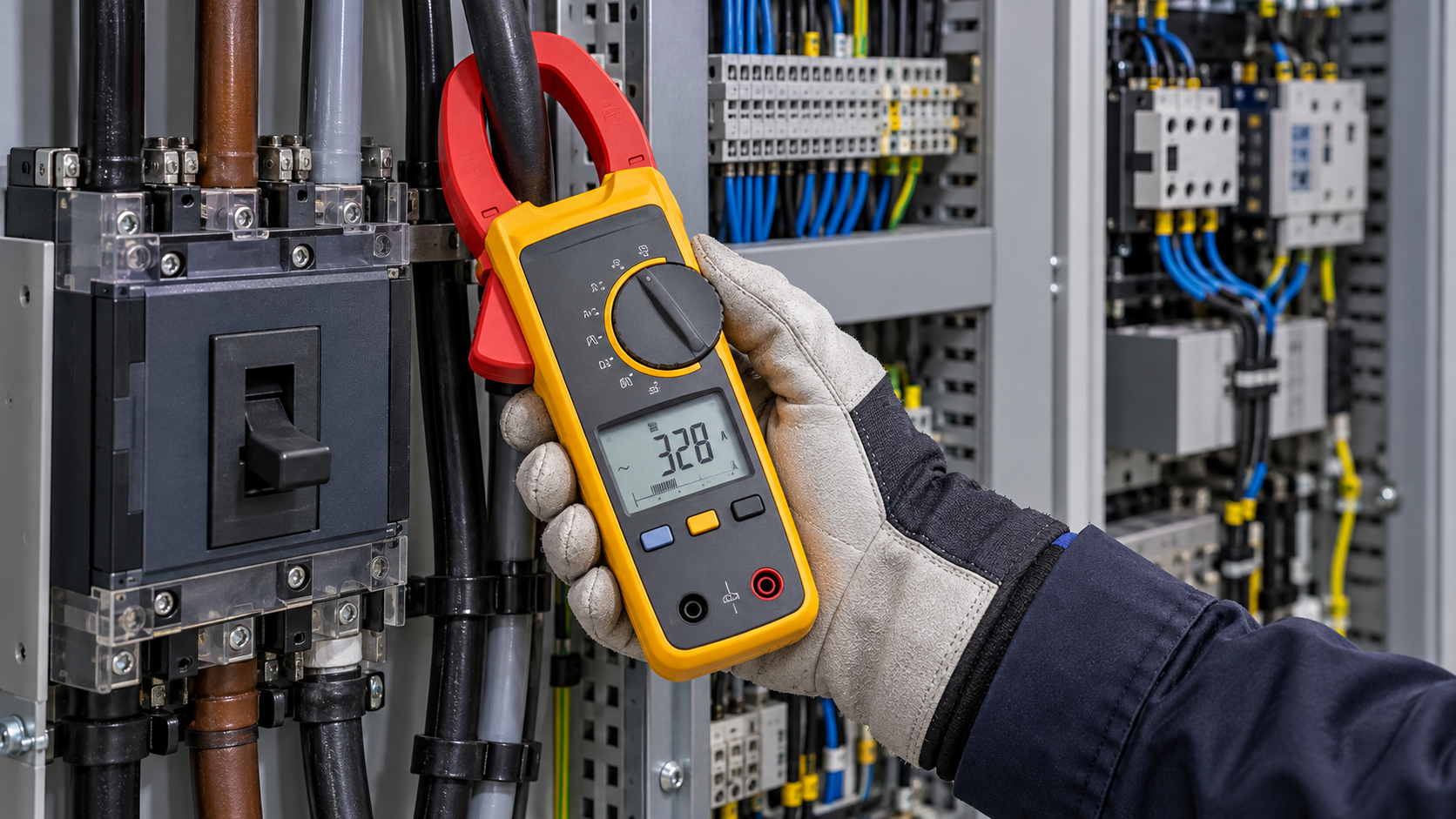
The Fluke 375 is a true-RMS AC/DC clamp meter in Fluke’s 374 and 375 series. It sits above the 374 in the documents: it adds frequency measurement, a 500 mV DC range, an integrated low-pass filter and a resistance range that the 374 does not have.
Quick answer
- Jaw current: 600 A AC and DC through the fixed jaw, according to the technical data and the product page.
- iFlex current: 2500 A AC with the optional iFlex flexible probe, which is sold separately.
- Voltage: 600 V AC and DC on the 375, according to the product page’s specification table. The product page’s overview text says 1000 V, but its table gives 1000 V for the 376, not the 375.
- Safety rating: CAT III 1000 V and CAT IV 600 V, stated in the technical data and the product page.
- Power: two AA alkaline batteries, per the product page.
What the 375 is built to measure
The technical data describes the 374 and 375 as work-horse clamps with true-RMS AC voltage and current measurement, which means they are meant to read distorted waveforms from non-linear loads as well as sine-wave loads. The 375 adds frequency measurement to 500 Hz, measured through the jaw and through the iFlex probe, and a resistance range of 60 k ohm, while the 374 is listed with a 6000 ohm resistance range. The technical data also lists capacitance measurement to 1000 microfarad, inrush recording and min and max recording.
In practice, the 375 suits a technician who measures motor starting current, checks the load on a feeder, or reads voltage and current on a drive or a non-linear load. A homeowner who wants to check a single extension cord, a light fixture or a thermostat circuit has a much smaller job, and a meter with a smaller jaw and a lower rating is usually the more appropriate choice for that job.
Stated specifications
The table below uses the technical data and the product page. Where the two disagree, both figures are shown.
| Item | Stated figure | Source |
|---|---|---|
| AC current via jaw | 600 A, 0.1 A resolution, 2 % plus 5 digits | technical data |
| DC current via jaw | 600 A | technical data; product page |
| AC current via iFlex (optional) | 2500 A, 0.1 A resolution, 3 % plus 5 digits | technical data |
| AC voltage | 600 V, 0.1 V resolution | technical data; product page table (375 row) |
| DC voltage | 600 V, 0.1 V resolution; accuracy 1.5 % plus 5 digits (technical data) or 1 % plus 5 digits (product page) | technical data; product page |
| Resistance | 60 kilo-ohm on the 375, with continuity detection | technical data |
| Capacitance | 1 microfarad to 1000 microfarad | technical data; product page |
| Frequency | to 500 Hz, through jaw and iFlex | technical data |
| Jaw opening | 34 mm | product page |
| Weight | 388 g | product page |
| Safety rating | CAT III 1000 V, CAT IV 600 V | technical data; product page |
| Warranty | three years | technical data; product page |
The product page’s table gives 2 percent plus 5 digits for AC current through the jaw over 10 to 100 Hz, and a higher figure from 100 to 500 Hz. The technical data gives one 2 percent figure without a frequency band. A reader who needs the accuracy of the jaw at a specific frequency should use the product page’s band or the full manual.
The technical data also describes the recording features in more detail. The min, max, average and inrush recording is there to capture variations automatically, so a technician can leave the meter on a motor or feeder and read the recorded values afterwards instead of watching the display. The technical data describes the inrush function as measuring motor starting current, and the integrated low-pass filter on the 375 is described as allowing use in noisy electrical environments while keeping readings stable. The documents do not give a recording depth or the length of a recording session, so a reader who needs that figure should confirm it with Fluke before relying on the feature for a long study.
The iFlex probe
The iFlex is a flexible current probe that expands the AC current range to 2500 A and lets the user measure on conductors that the fixed jaw cannot close around. The technical data says it is sold separately, and the product page says the iFlex is not included in the package with the 375. The product page gives the iFlex probe diameter as 7.5 mm.
Two points matter before buying. First, the 2500 A figure is an AC figure with the probe connected, and the technical data gives it a 3 percent accuracy band rather than the 2 percent of the jaw. Second, a flexible probe reads only where it is wrapped properly, so a loose wrap or a poor position around a conductor changes the reading. The FC manual describes the probe as giving increased display flexibility and access to awkward conductors.
Safety and use
Mains work carries real risk. Fluke’s documents state CAT III 1000 V and CAT IV 600 V for the 375. Those figures describe the meter’s protection against transients in a given installation category. They do not make every task safe, and they do not replace the procedures a site or an employer requires. Panel, breaker and service-entrance work belongs to a licensed electrician.
The FC manual, which covers the FC variant of this family, includes a caution not to use the meter in CAT III or CAT IV environments without the protective cap on the test probe. A reader should check whether the same caution applies to the non-FC 375 in the manual that ships with the unit, and should keep the probe caps fitted when working on energized conductors.
Measuring current in a conductor that is energized is a clamp task, and the jaw should close fully around one conductor only. Clamping around both the live and neutral conductors of a cable cancels the reading, A near-zero current reading does not show that a circuit is dead. Confirm dead-or-live with a voltage test before touching any conductor.
Keep the jaw clean and closed. A jaw that does not close properly gives a reading that is not reliable. Inspect the leads and clamp before each use, and do not use a meter whose case or jaw is damaged.
The product page says the meter comes with batteries, a soft carrying case and a three-year warranty. Its model list names TL75 test leads and two AA alkaline batteries. Check the items list for your specific unit before assuming a set of leads comes in the box.
Where Fluke’s documents disagree
- Voltage on the product page: the overview text says the meter measures voltage to 1000 V, but the product page’s specification table gives 600 V for the 374 and 375 and 1000 V for the 376. This post uses the table.
- DC voltage accuracy: the technical data gives 1.5 percent plus 5 digits. The product page gives 1 percent plus 5 digits. Use the manual that ships with the unit for a precise figure.
- Jaw accuracy by frequency: the product page gives two bands, while the technical data gives one figure. Both are reported above.
How we chose
This post covers one model. It does not rank the 375 against the 376 or other clamp meters. The three documents listed in Sources were opened on 27 October 2026. The technical data is dated 7/2010, and the FC manual covers the FC variant, so the post uses each source only for the statements it covers and says which variant each statement applies to.
What we could not verify
- The English user manual for the non-FC 375 was not among the documents opened. The FC manual covers the FC variant, and its statements are labelled as such.
- The documents opened do not give a separate CAT rating for the iFlex probe on its own. The probe’s rating should be read from the probe’s own documentation.
- The technical data is dated 2010, and the product page has no visible date. Where the two sources differ, this post reports both.
- The documents opened do not state current availability, price or the contents of any retail package.
Buying checklist
- Confirm you need the 375 rather than a meter with a smaller current range, and that 600 A through the jaw is enough.
- Decide whether you need the 2500 A iFlex range, and budget for the probe separately.
- Check the CAT rating against the most demanding installation category you will work in.
- Check that the jaw opening of 34 mm fits the conductors you need to measure.
- Confirm the items list for your specific unit, including test leads and batteries.
FAQ
What is the current range of the Fluke 375?
The technical data states 600 A AC and DC through the jaw, and 2500 A AC with the optional iFlex probe.
Does the 375 measure 1000 volts?
The product page’s specification table gives 600 V for the 375. Its overview text mentions 1000 V, but the table gives 1000 V for the 376. The rating of CAT III 1000 V describes transient protection, not the voltage range of the 375.
What safety rating does the 375 carry?
The technical data and the product page both state CAT III 1000 V and CAT IV 600 V.
Is the iFlex probe included?
The product page says it does not include the iFlex probe, which is sold separately.
Can the 375 measure frequency?
Yes. The technical data lists frequency measurement to 500 Hz, through the jaw and the iFlex probe, for the 375.
What batteries does it take?
Two AA alkaline batteries, according to the product page.
Bottom line
Fluke’s documents describe the 375 as a 600 A jaw clamp with a 2500 A iFlex option, rated CAT III 1000 V and CAT IV 600 V. Before buying, check the voltage figure against the table rather than the overview, decide whether you need the iFlex range, and confirm the accuracy band that matters for your work. For mains work, match the rating to the installation category and leave panel and service work to a licensed electrician.
Related reading: for a larger Fluke clamp, see Best Fluke 1000 Amp Clamp Meter. For the wider Fluke range, see Fluke Multimeter Lineup: 7 Meters Compared by Stated Function. For accessories, see Best Fluke 179 Accessories: 4 Straps and Cases Compared.
Sources
- Fluke Corporation, “374 and 375 True-rms AC/DC Clamp Meters Technical Data”, 3801511B, 7/2010. https://media.fluke.com/a94a1624-6e31-408c-a519-b1060067ba6a_original%20file.pdf (opened 2026-10-27)
- Fluke Corporation, “374 FC/375 FC/376 FC Clamp Meters Users Manual”, Sep 2015 Rev.2 4/20 (FC variant). https://my.fluke.com/_entity/annotation/e0b059b3-b3c3-ed11-83ff-6045bd0067ea (opened 2026-10-27)
- Fluke Corporation, “Fluke 375 True RMS AC/DC Clamp Meter” product page. https://www.fluke.com/en/product/electrical-testing/clamp-meters/fluke-375 (opened 2026-10-27)