Fieldpiece Sc640
As an Amazon Associate we earn from qualifying purchases. Details
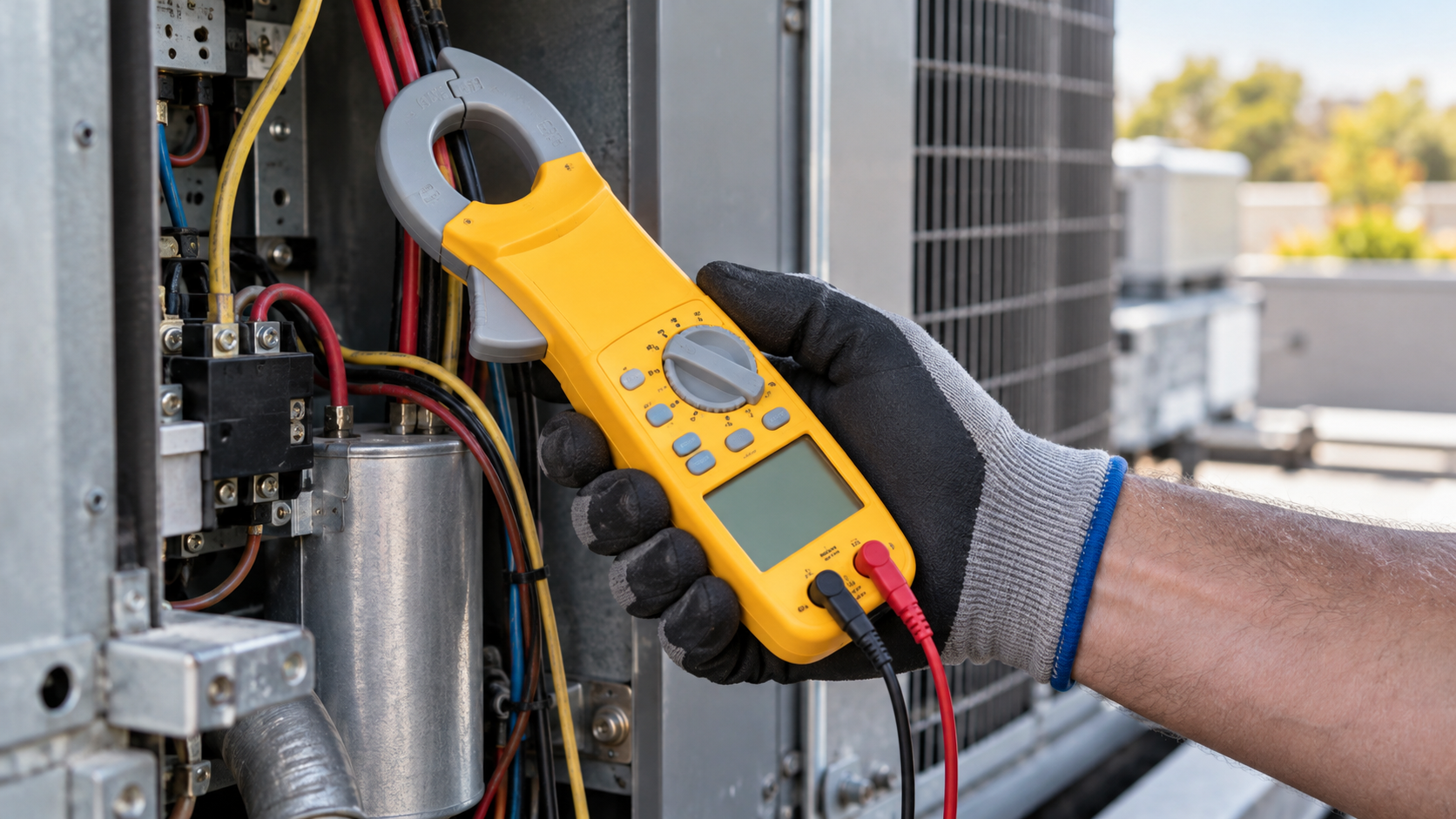
The Fieldpiece SC640 is a 400 A AC swivel-head clamp meter aimed at HVACR technicians. It measures AC current through the clamp, AC and DC voltage through the test leads, and adds inrush current, capacitance, temperature, duty cycle and microamp DC functions, according to the manufacturer. This explainer covers what each function does, the ratings printed in the operator manual, the safe-use steps the manual gives, and what a buyer should confirm before purchase.
Quick answer
- The SC640 is a clamp meter with a 400 A AC clamp, True RMS readings and a swivel head, per the Fieldpiece product page.
- The operator manual lists CAT III 600V, class II and pollution degree 2 for the meter.
- Inrush capture, the jaw flashlight and the dial backlight are SC640 features in the sources we opened. The manual marks the backlight as “SC640 only.”
- Do not clamp above the rated 400 A AC, do not apply voltage to the jacks when the dial is on microamps, and check the NCV function on a known live wire before use.
What the SC640 measures
The Fieldpiece product page lists the core functions: True RMS, inrush current, capacitance, temperature, duty cycle and microamps DC. It also lists 400 amps AC through the clamp and resistance up to 50 megaohms with 0.1 resolution. For a homeowner or hobbyist, the practical split is simple. The clamp reads current in a conductor without breaking the circuit. The test leads read voltage, resistance, continuity and the other functions on the dial.
True RMS matters when the waveform is not a clean sine wave. The product page names True RMS as a standard feature, but it does not explain the waveform limits in detail. Read the operator manual for the exact measurement category and frequency behaviour before you rely on the reading in a variable-speed drive circuit.
Inrush is the feature most HVACR buyers ask about. The operator manual describes it as a way to “Measure the starting amp draw of a compressor with Inrush current feature (SC640 only).” That makes inrush a model-specific function. If you are comparing a cheaper SC620 or another Fieldpiece clamp, confirm that the inrush mode is present before you assume it.
Microamps DC appears in the feature list, but the sources we opened do not give a DC clamp current figure. Treat the microamp function as a test-lead function for small DC currents, and confirm the range on the printed specification for your exact variant.
Electrical ratings in the operator manual
The operator manual, which covers the SC620 and SC640 together, lists CATIII 600V, class II and pollution degree 2. It also lists overload protection of 600 VDC or 600 VAC rms and says “Do not apply more than 600VDC or AC rms.” Those figures are the limits to write down before you start a job.
The manual gives the non-contact voltage (NCV) range as 24 VAC to 600 VAC at 50 to 60 Hz. That range describes the NCV detector only. It is not a substitute for a meter reading, and the manual says to test a known live source before using the NCV function.
Power is a single standard 9-volt battery. The manual gives typical alkaline battery life as 200 hours for the SC620 and 100 hours for the SC640. The backlight is described as a 60-second duration with auto-off, in blue, and the manual marks it as SC640 only.
Safe-use steps from the manual
Most safety problems with clamp meters come from skipped steps rather than from the meter itself. The operator manual gives several steps that should be part of every job:
- Disconnect and unplug the test leads before opening the case. The manual places this warning first in its safety list.
- Test the NCV function on a known live wire before using it. A working NCV test on a known source tells you the detector is responding. It does not tell you a circuit is dead.
- Isolate capacitors from the system and discharge them before measuring. The manual gives this instruction in its capacitance and variable-speed-drive notes.
- Do not apply voltage to the jacks when the rotary dial is on microamps. The manual says even low voltages can cause a current overload in that setting.
- Do not exceed the rated 400 A AC of the clamp. The manual repeats this limit in its high-frequency current note.
- Use only Type K thermocouples with the temperature input.
- Never ground yourself while taking electrical measurements. Keep fingers behind the finger guards and stand on dry footing where practical.
Mains electricity can kill. A CAT III rating tells you the meter is built for certain circuit categories, not that every outlet, panel or service conductor is safe to open. Panel, service and any uncertain live-circuit work belongs to a licensed electrician.
Who the SC640 suits
The product page and the operator manual both position the SC640 for HVACR work: compressors, blowers, fans and the wiring around them. Those are the jobs where the inrush mode, the swivel head and the jaw flashlight earn their place. A homeowner who only needs to check a single household outlet or a battery will often find a simpler meter covers the job, and the SC640 adds features that add nothing to that task.
The swivel head lets you read current in a tight space without twisting the whole meter. The jaw flashlight lights the clamp area, and the dial backlight helps you see the selected function in a dark cabinet. The product page lists those features together with lead storage, a test lead holder and a heavy-duty magnetic strap. Those accessories are practical, but they do not change any electrical rating, so check the ratings separately.
The operator manual also covers a frequency function and a variable-frequency drive note. Read those parts of the manual before you use the meter on a drive-controlled motor, because a drive can produce a waveform that a meter reads differently from a plain sine wave. The manual frames True RMS sensing as the way to take more accurate AC readings on variable-frequency drives, and it asks users to follow its guidance on those circuits.
Using the rating limits in practice
Write the three limits on the meter before the first job: 400 A AC through the clamp, 600 VAC or VDC on the voltage inputs, and CAT III 600V as the stated category. Those three numbers answer most of the questions a technician asks in the field. If a circuit needs more than 600 V, or if the job sits in a category the manual does not list for this meter, the SC640 is the wrong tool for that job. Stop, and use a meter whose listing states the required rating.
The clamp limit is the one most often exceeded by accident. A motor starting current can briefly rise above the steady running current, which is why the inrush mode exists. The manual’s inrush feature is for measuring that starting draw in a controlled way, not for pushing the clamp past its rated 400 A AC. If you expect a reading near the limit, pick a higher-rated clamp rather than relying on the meter to show an overrange.
Before you buy: a short checklist
- Confirm the model number. The SC620 and SC640 share an operator manual, but battery life, backlight and inrush mode differ.
- Confirm the category rating on the listing. The sources we opened state CAT III 600V for the SC640. If the listing does not state a category, do not assume one.
- Decide whether you need the inrush mode. It is the reason many HVACR buyers pick the SC640 over a basic clamp.
- Decide whether you need the jaw flashlight and the dial backlight. Both are listed as SC640 features in the sources we opened.
- Check the battery type. The SC640 uses one 9-volt battery, so spare batteries are a simple, low-cost item to plan for.
- Check the current range you need. The clamp rating in the sources we opened is 400 A AC. They do not give a DC clamp current figure for the SC640.
How we chose
This explainer is limited to the manufacturer pages and documents listed in the Sources section. We opened the Fieldpiece SC640 product page, the operator manual for the SC620 and SC640, and the 2020 SC series line-up sheet on 2026-10-27. We did not compare the SC640 with other meters for accuracy, and we did not rank it. The line-up sheet lists the SC640 next to other SC series models, which is why we used it only to confirm where the model sits in the range.
What we could not verify
The sources we opened do not give a full accuracy table for every range. They do not give a DC clamp current figure. The line-up sheet is a multi-column layout, so we did not take ratings from it except where the operator manual also states them. The sources do not say how the SC640 performs in wet or dusty conditions beyond the operating temperature range shown on the product page. Check the current manual revision and the printed label before relying on any figure not quoted here.
Mistakes to avoid
- Treating the 400 A rating as a DC rating. The sources we opened give 400 A AC for the clamp.
- Leaving the dial on microamps while the leads are on a live circuit. The manual warns that the jacks must not be given voltage in that setting.
- Skipping the NCV check. The manual asks you to test the NCV function on a known live wire before using it.
- Buying on model number alone. SC620 and SC640 share a manual, but the SC640 carries the inrush mode and the backlight.
FAQ
Is the Fieldpiece SC640 rated for CAT III?
The operator manual for the SC620 and SC640 lists CATIII 600V, class II and pollution degree 2. Check the label and listing for the variant you are buying.
Does the SC640 measure DC current through the clamp?
The sources we opened list 400 A AC for the clamp and microamps DC as a function. They do not give a DC clamp current figure, so do not assume one.
What battery does the SC640 use?
The operator manual says a single standard 9-volt battery, with typical alkaline life of 100 hours for the SC640.
Does the SC640 have a backlight?
The manual describes a blue backlight with a 60-second auto-off and marks it as SC640 only.
Bottom line
The Fieldpiece SC640 is a 400 A AC clamp meter with inrush capture, microamp DC and a documented CAT III 600V rating in its operator manual. Use it within those limits, follow the manual’s safe-use steps, and leave panel and service work to a licensed electrician. For a wider view of clamp meter types, read Best Clamp Meter: AC Current, True RMS and Logging Compared and Clamp Meter vs Multimeter: Which One Do You Need? before you choose between a clamp and a multimeter.
If you are learning the basic steps for taking a clamp reading, read How to Use a Clamp Meter Safely, Step by Step first, then return to the SC640 checklist above.
Sources
- Fieldpiece Instruments, “SC640 – 400A Loaded Swivel Clamp Meter” product page. https://www.fieldpiece.com/product/sc640-loaded-clamp-meter/ (opened 2026-10-27)
- Fieldpiece, “Operator’s Manual, Models SC640 SC620” (v28). https://resources.fieldpiece.com/wp-content/uploads/2020/11/Opman-SC620-640-v28.pdf (opened 2026-10-27)
- Fieldpiece, “SC260 SC440 SC480 SC640 SC680 Compact Clamp Meter” line-up sheet, 2020. https://www.fieldpiece.com/wp-content/uploads/2021/02/SC-SeriesClampMeterLine2020-05.pdf (opened 2026-10-27)