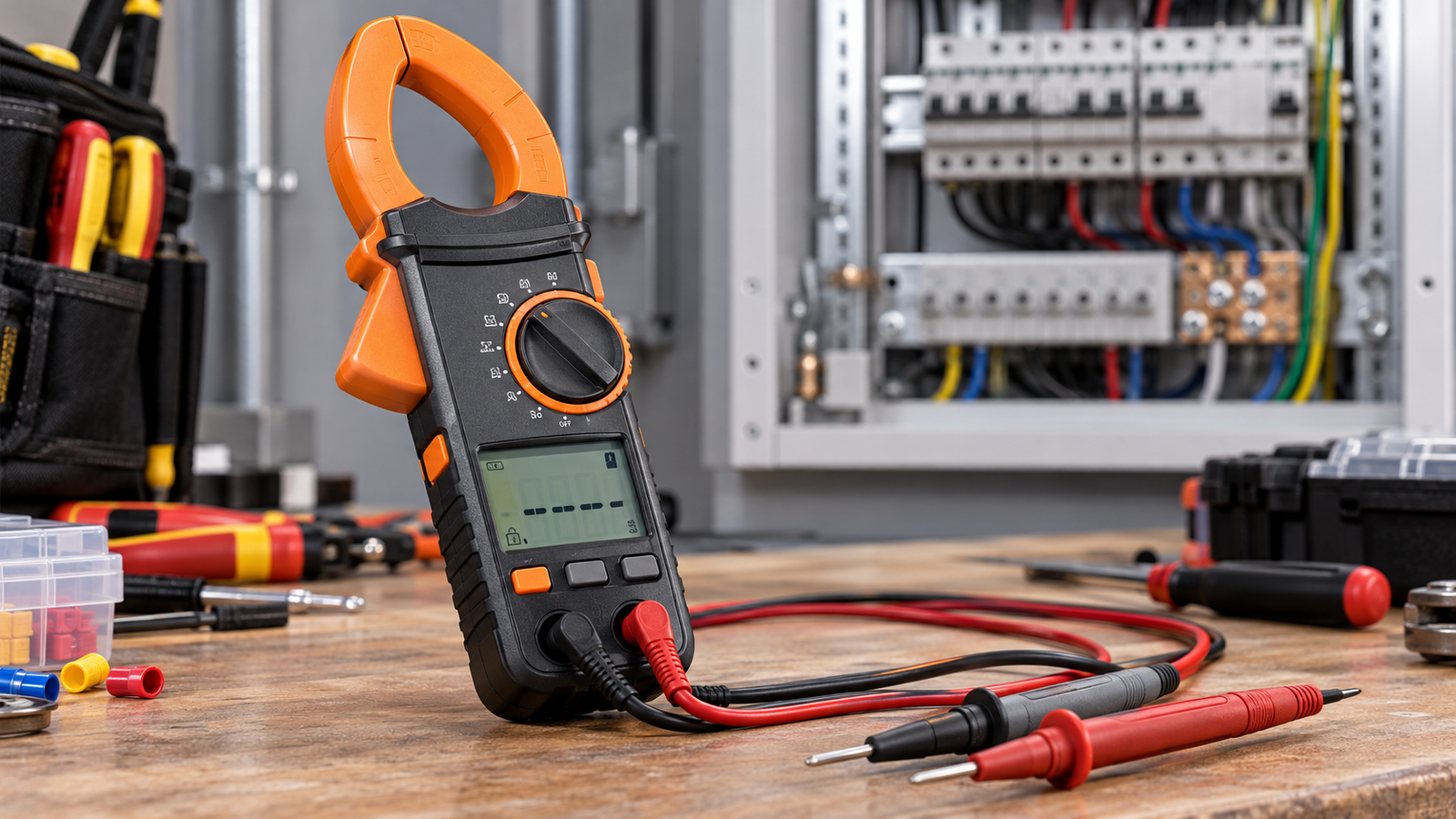
Klein Cl390
As an Amazon Associate we earn from qualifying purchases.
The Klein CL390 is a 400 A AC/DC auto-ranging clamp meter. Klein lists it with true-RMS measurement, non-contact voltage detection, and a CATIII 600V safety rating. It is built for electricians and maintenance workers who need to read current without breaking a circuit. It is not a substitute for a meter with a higher rating when the work sits closer to the service entrance, and the published sources do not present it as one.
Quick answer
- The CL390 clamps around a conductor to read AC and DC current up to 400 A, and it also reads voltage, resistance, capacitance, frequency, continuity, diodes and temperature through its test leads and thermocouple.
- Klein rates it CATIII 600V, Class 2, double insulation. Use it on circuits within that category and voltage.
- The jaw opens to 1.6 inches (4.1 cm). Check that the jaw fits your conductor, and clamp around one conductor at a time.
- Panel and service work belongs to a licensed electrician, whatever the meter’s rating.
What the CL390 measures
A clamp meter reads current by sensing the magnetic field around a conductor, so the circuit does not need to be opened. Klein’s product page lists current measurement for AC and DC up to 400 A, with the clamp. The same page lists voltage up to 600 V AC and DC, frequency from 10 Hz to 60 kHz for 8 V to 220 V AC RMS, capacitance up to 4000 µF, and resistance up to 40 MΩ. The page also lists a DC microamp range of 200 µA, a diode test, continuity, duty cycle, and temperature with a K-type thermocouple, from -40 to 1000 °C.
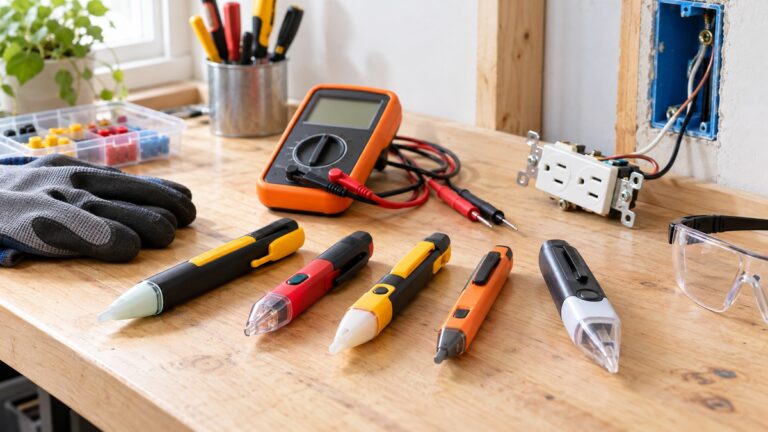
The clamp is not the only sensor. Klein lists non-contact voltage (NCVT) detection, which lets you check for the presence of voltage without touching a conductor. A non-contact detector gives an indication, not a measurement, and it can miss voltage, so use it as one check among several and never as the only proof that a circuit is dead.
In practice this means the CL390 covers the typical work of an electrician or HVAC technician: checking load current on a branch, confirming a circuit is energized before work, and measuring voltage, continuity and resistance at the terminal with the test leads.
Safety ratings: CATIII 600V
Klein’s product page states the safety rating as CATIII 600V, Class 2, Double Insulation, and the manual repeats it. Measurement category ratings describe where in an installation a meter can be used safely. Fluke’s safety guide gives the working rule: choose a tool rated for the highest category you could potentially use it in, and select a voltage rating to match or exceed those situations.
The guide describes CAT III as fixed building distribution, such as switchgear, distribution panels, feeders, and short branch circuits fed from those panels. CAT II covers single-phase receptacle-connected loads, such as appliances and portable tools plugged into an outlet. The CL390’s CATIII 600V rating therefore covers distribution-level work up to 600 V. It does not cover the origin of the installation, where the utility connects, which the guide assigns to CAT IV.
The rating covers the meter. The manual’s safety section and the test leads have their own ratings, and the guide notes that test probes should match or exceed the meter’s category. Inspect the leads, the clamp jaw and the battery compartment before each use.
How to use the CL390 safely
- Read the manual’s safety section first. The manual is the source for warnings specific to this unit, and it lists the measurement categories it covers.
- Select the function before you connect. Choose current, voltage, resistance or another function on the dial, and confirm the input jack for the test leads.
- Clamp one conductor at a time. Current readings are taken around a single conductor. Clamping a cable with both the supply and return inside the jaw cancels the field and reads near zero, so keep the jaw around one wire.
- Use the lead inputs for voltage. Klein lists the maximum input for voltage, resistance and the other lead functions at 600 V AC RMS or 600 V DC in the manual. Do not exceed it.
- Use data hold and the other display modes to read in place. Klein lists data hold and a max/min function, so you can capture a reading while your hands stay on the work.
The manual’s continuity check gives an audible signal below a set resistance and a maximum test current of 1.5 mA. A continuity check should only be made on de-energized circuits, which is the usual lockout practice, so confirm the circuit is off before you test.
Published specifications that matter before buying
The product page lists the display as a 4000 count reverse-contrast LCD, with an auto power-off feature that turns the meter off after 10 minutes. Klein lists a 2 m (6.6 ft) drop protection rating. The manual lists the weight at 10.26 oz (291 g) including batteries. The page lists three AAA batteries and a carrying case, test leads, a thermocouple and instructions in the box.
For AC current the manual lists an accuracy of plus or minus 2.0 percent plus 9 digits on the 400 A range. For DC voltage on the 400 V range it lists plus or minus 1.0 percent plus 8 digits. These are the manufacturer’s figures. Read the full accuracy table in the manual for the range you plan to use.
How we chose
This article covers one model and does not rank it against other clamp meters. The sources we opened were Klein’s CL390 product page, the CL390 instruction manual, and Fluke’s multimeter safety guide for the category definitions. We read each for the function list, ratings, specifications and safety wording, and we summarize only what those documents state.
What we could not verify
- The product page and retailer listings differ on the display count, so this article uses the count from Klein’s product page. Check the box and manual for the actual display.
- The sources we opened do not give the full DC current accuracy table, so this article does not quote a DC current accuracy figure.
- The sources we opened do not describe the CL390’s performance on a specific installation. Check the circuit’s voltage and category yourself.
- The manual copy we opened is hosted on a retail image server rather than on Klein’s own site. Check the Klein site for the current revision.
Who the CL390 suits
The CL390 suits electricians, HVAC technicians and maintenance workers who need a single clamp meter for AC and DC current up to 400 A and a CATIII 600V rating. Its size and weight are small enough for a tool bag. A homeowner who only checks an appliance’s current draw may find a simpler clamp meter adequate, but the rating and the clamp jaw still need to match the job.
Buying checklist
- Confirm the CATIII 600V rating matches the highest category and voltage you will meet.
- Check that the 1.6-inch jaw fits the conductors and cables you work on.
- Confirm the functions you need are on the published list, such as DC current, capacitance or temperature.
- Check that the test leads carry a rating equal to or higher than the meter.
- Note the battery type and the auto power-off behavior, so you do not lose a reading.
Mistakes to avoid
- Clamping both supply and return. The field from the two conductors cancels, so the reading is near zero even with current flowing.
- Relying on non-contact detection alone. A non-contact detector indicates voltage, but it can miss it. Confirm with a proper voltage measurement at the terminals.
- Testing continuity on a live circuit. A continuity check is for de-energized circuits.
- Assuming the CATIII 600V rating covers the service entrance. The guide places the origin of the installation in CAT IV.
Frequently asked questions
Can the Klein CL390 measure DC current?
Klein’s product page lists AC and DC current measurement with the clamp, up to 400 A. Check the manual’s DC current table before relying on a small DC reading, since the sources we opened do not quote a DC current accuracy figure.
Is the CL390 safe for household mains?
Klein rates it CATIII 600V, which covers distribution-level work within that voltage. Household outlets fall in CAT II in the guide’s examples, so the rating covers them. The rating does not make unsafe work safe, and panel work belongs to a licensed electrician.
What does the non-contact voltage function do?
Klein lists NCVT as a function. It indicates the presence of voltage without touching a conductor. It is an indication, not a measurement, so confirm with a proper test before you trust a zero result.
How big a wire can the jaw clamp?
The product page lists a jaw size of 1.6 inches (4.1 cm). Measure your conductor and insulation before you buy, since insulation thickness reduces the space inside the jaw.
Does the CL390 turn itself off?
Yes. Klein lists an auto power-off feature that turns the meter off after 10 minutes.
Bottom line
Buy the Klein CL390 when you need a 400 A AC/DC clamp meter with a published CATIII 600V rating and a 1.6-inch jaw. Clamp one conductor at a time, confirm voltage with a proper test, and leave service-entrance and panel work to a licensed electrician.
Sources
- Klein Tools, “AC/DC Digital Clamp Meter, Auto-Ranging 400 Amp” (CL390), product page. https://www.kleintools.com/catalog/clamp-meters/acdc-digital-clamp-meter-auto-ranging-400-amp (opened 2026-10-27)
- Klein Tools, “CL390 400A AC/DC Auto-Ranging Digital Clamp Meter” instruction manual, PDF copy. https://images.homedepot-static.com/catalog/pdfImages/91/911f79cf-7c5b-4090-b199-637e92dc1568.pdf (opened 2026-10-27)
- Fluke Corporation, “Guide to digital multimeter safety.” https://fluke.com/en-us/learn/blog/safety/multimeter-guide (opened 2026-10-27)
Related guides: Klein Tools digital clamp meter, best Fieldpiece clamp, and Klein Tools multimeter lineup.