Innova 3320 Multimeter: Uses, Safe Use and Specs
As an Amazon Associate we earn from qualifying purchases.
The Innova 3320 is a handheld auto-ranging digital multimeter that Innova describes for automotive and household use. It measures AC and DC voltage, DC current up to 10 A, resistance, diodes and continuity, and it includes a battery load test with three color LEDs. Before you rely on it for any mains or unknown circuit, read the safety section below, because the maker’s own manual limits it to 600 V AC/DC and states a measurement category that is lower than many modern meters.
Quick answer
- Best fit: checking car battery voltage, fuses, continuity and low-voltage DC circuits, and general household voltage checks up to 600 V.
- Hard limits: do not measure above 600 V AC/DC, do not measure a circuit whose voltage you do not know, and do not use the 10 A DC jack for more than the short time the manual allows.
- Rating to check: the manual states “Measuring circuit category II” and “Pollution Degree 2”. The product page states no CAT rating beyond “UL Listed”.
- Power and fuse: two AA batteries, and a 0.315 A/250 V, 5 x 20 mm GMA-type fuse for the mA input.
What the Innova 3320 measures
The meter is built around one rotary selector. The manual lists auto-ranging for AC volts, DC volts, resistance, AC milliamps and DC milliamps. A separate DC10A position covers 0 to 10 A DC. The manual’s introduction says the meter is designed to measure AC voltage, DC voltage, batteries, DC current, AC current, resistance, diodes and continuity. Those functions cover the everyday jobs of a driveway or garage: checking whether a battery holds charge, following a voltage drop along a wire, finding a blown fuse by continuity, and confirming that a 12 V accessory circuit has power.
The product page describes the auto-ranging function as one that “Automatically selects the correct measurement range.” That feature removes the need to pick a range by hand for most voltage and resistance readings. It does not remove the need to pick the correct function. A beginner who sets the dial to resistance on a live wire will get a wrong or unstable reading, and the manual warns against that directly.
The battery test is a separate position with four ranges and three LEDs. According to the manual, green means fully charged, and red means discharged. The manual adds that a battery that is completely dead, or nearly dead, may not give a clear reading, and that battery life depends on the current drawn by the device the battery powers. The LED test is a quick indicator of state of charge. It is not a load test that proves a battery can start an engine, and the manual does not claim that it is.
Safe use before you start
Electrical work can kill, and a multimeter is only as safe as the person holding it. Before any measurement, the manual asks you to read the warnings, inspect the leads, and use the correct terminal, function and range. It also tells you to use one hand where possible, keep your body clear of live parts, and never ground yourself while you take an electrical reading. These are not optional courtesies; they are the manufacturer’s stated conditions for using the instrument.
The manual says not to apply more than the rated voltage, and it sets the upper limit clearly: do not attempt to measure voltages above 600 V AC/DC, and do not take measurements when the voltage is unknown. The Innova blog page on measuring AC and DC voltage repeats the same limit, and it warns that the COM terminal should not exceed 300 V AC/DC measured to ground. Read both statements before you connect the meter to anything that is not a low-voltage battery or a known small circuit.
The manual also states that voltages around 60 V DC or more can pose a shock hazard. That threshold matters for car electrical systems, hybrid and electric vehicles, solar arrays and battery banks, where DC voltages can be higher than many people expect. The manual’s resistance section adds that you should never take a resistance measurement on an energized, live circuit. Disconnect the battery, or switch off the power, before measuring resistance or continuity.
The DC current position needs particular care. The manual says the DC10A range is not fused. It also says not to take more than 10 seconds for a measurement in that position, and the product page’s FAQ gives a different figure: a waiting period of at least 15 minutes between 15-second tests. The two sources disagree, so use the shorter limit to be safe. The current function is for short checks, such as a parasitic draw check where the current is already known to be low, and it is not a substitute for a clamp meter on a running circuit.
Two more points belong in every safety check. First, the manual says that a low battery indicator appears on the display and that the battery should be replaced when it does, because readings can become unstable. Second, the meter is designed to shut off after 15 idle minutes. A meter that has shut off has not stopped being a live hazard in the circuit you were measuring, so turn the selector to off and disconnect the leads before you move on.
Step-by-step: measuring voltage safely
The Innova blog’s voltage steps match the manual. Follow them in this order every time.
- Confirm the expected voltage is below 600 V AC/DC. If you do not know the voltage, stop and find out first.
- Plug the black lead into the COM jack and the red lead into the V jack.
- Turn the selector to ACV or DCV for the type of voltage you expect.
- Keep one hand behind your back or in a pocket, and touch the red lead to the positive side of the circuit and the black lead to the negative side.
- Read the display, then remove the leads before changing the function or range.
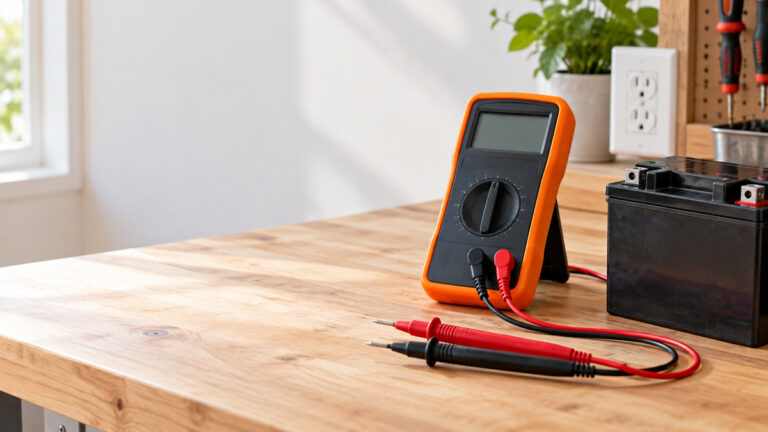
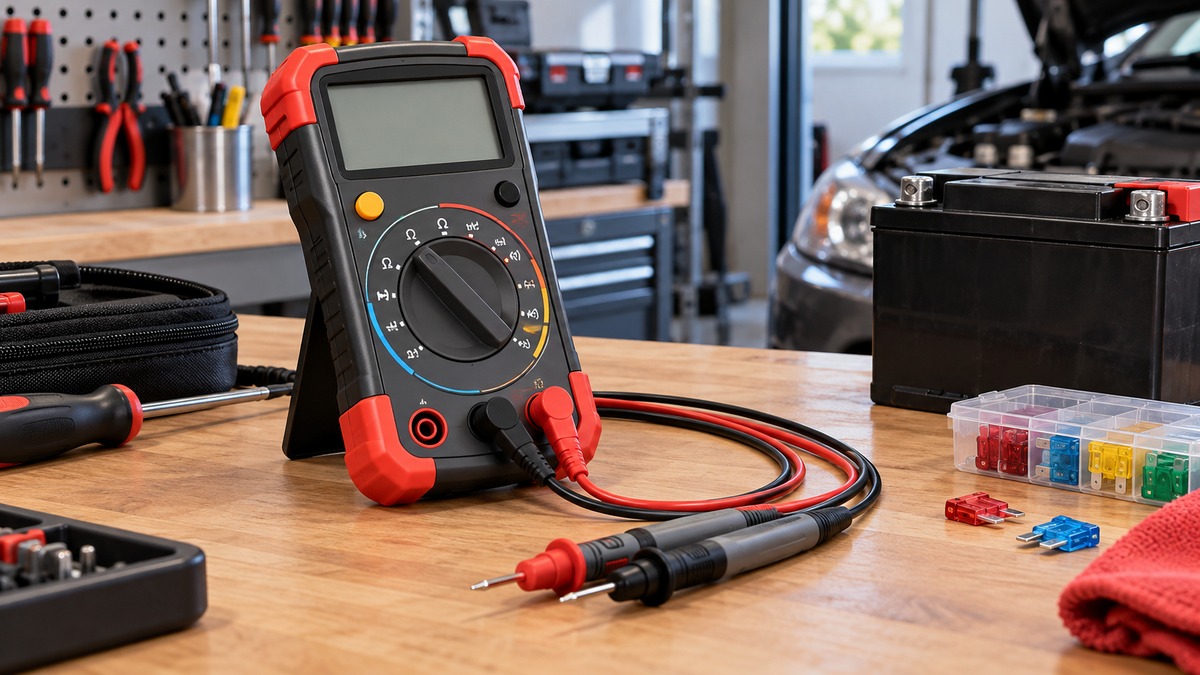
For a car battery, the same steps apply, with the engine off and the meter set to DCV. A reading near 12 V with the engine off is a common check, but the 3320’s specifications do not state a voltage accuracy you can compare against a battery chart, so treat the number as a rough guide and compare it with the battery maker’s stated voltage. Do not work on airbag wiring, high-voltage hybrid or EV components, or any system the manual does not cover.
Specifications Innova publishes
The table below uses only figures from the sources listed at the end of this guide. “Not stated” means the sources opened for this guide do not give the figure.
| Item | What the sources state |
|---|---|
| Voltage limit | 600 V AC/DC maximum (manual and blog) |
| Input impedance | 10 MΩ (manual and product page) |
| DC current | 0 to 10 A, unfused, 10 seconds maximum per the manual |
| Measurement category | Category II, Pollution Degree 2 (manual); product page gives no CAT rating |
| Fuse | 0.315 A/250 V, 5 x 20 mm, GMA type (manual) |
| Batteries | Two AA (manual and product page) |
| Auto shut-off | After 15 idle minutes (manual) |
| Safety approval | UL Listed (product page) |
| Resolution and accuracy by range | Accuracy tables are in the manual; this guide does not reproduce them |
Checks before you buy
- Match the work to the rating. A category II rating suits low-energy measurements on outlets and small loads. It does not suit work at a service panel, a motor control centre, or other points that can deliver high fault current. For that work, buy a meter with a higher category rating and follow the advice of a licensed electrician.
- Check the current jack. The DC10A jack is unfused. A meter with a fused current range is a different design, so compare the two before buying if current is your main use.
- Plan for the fuse. The mA input is fused at 0.315 A. Keep a spare fuse of the exact type the manual names.
- Confirm the battery type. The manual and the product page both say AA, so do not assume AAA from a retailer’s description.
- Know what it does not do. The sources opened for this guide do not describe clamp current measurement, true RMS, capacitance or temperature, so do not expect those functions.
Mistakes to avoid
- Measuring resistance or continuity on a live circuit. The manual says not to.
- Leaving the leads in the current jacks when you switch to voltage. Check the jack before every measurement.
- Using the 10 A position for longer than the manual allows, because the range is unfused.
- Assuming an auto-ranging meter removes all risk. Auto-ranging picks the range, but it does not check that the voltage is safe for the meter.
- Ignoring a low battery indicator, because unstable readings can look like a real problem in the circuit.
How we chose
This guide explains one model rather than ranking it against others. The criteria were simple: the figures had to come from the manufacturer’s manual, the manufacturer’s product page, or the manufacturer’s own how-to page, and each figure had to be checked against the text of a source opened for this guide. Where two manufacturer sources disagreed, both figures are shown. The guide does not claim that any meter was compared side by side, and it does not rank the 3320 against other Innova or competitor models.
What we could not verify
- The full accuracy tables for each range, because the manual’s tables were not reproduced here.
- A CAT rating above category II for this model. The product page does not state one, and the manual states category II.
- The exact DC10A time limit. The manual says 10 seconds and the product page FAQ says 15-second tests with a 15-minute wait. The sources do not agree.
- Whether a given meter in a shop will still read correctly after heavy use, since no source addresses durability beyond the warnings.
Frequently asked questions
Is the Innova 3320 safe for household mains?
The manual rates the measuring circuit at category II and says not to measure above 600 V AC/DC. It does not describe the meter as suitable for service panels or other high-energy points. Use it only for the low-energy checks the manual describes, and call a licensed electrician for panel or service work.
Does it measure AC current?
The manual lists AC milliamp ranges and a DC 10 A position. The sources opened for this guide do not describe a clamp for AC current, so do not expect to measure current on a running wire without breaking the circuit.
What battery does it use?
Two AA batteries, according to the manual and the product page. The battery compartment is opened by removing the rear panel as the manual directs.
Why does the meter turn off by itself?
The manual says the meter shuts off after 15 idle minutes to save the battery. Switch it on again before taking a reading.
Can I use it to test a car battery?
The battery test function gives a three-LED state-of-charge indication. For a voltage check, use the DCV range with the engine off, and compare the figure with the battery maker’s stated voltage. The meter does not state a load-test result.
Bottom line
The Innova 3320 is a simple auto-ranging meter for low-energy voltage, current, resistance and battery checks, with a stated limit of 600 V AC/DC and a category II rating in the manual. Use it for car and household checks that fit that limit, and leave service panels and unknown high-energy circuits to a meter and a person with the right rating.
Related guides
For a wider look at voltage testers, read Voltage Testers Compared: 5 Picks. For measuring current without breaking a circuit, read Fluke Clamp Testers: Picks and Safe Use.
Sources
- Innova, “Auto-Ranging DMM 3320 Owner’s Manual” (Rev. B, English), https://csr.innova.com/Content/Manual/Innova/100912_3320_93-0041_RevB_Manual_E_Version_Final_downloadable.pdf. Opened 2026-10-27.
- Innova, “How to measure AC/DC voltage,” https://www.innova.com/blogs/fix-advices/how-to-measure-ac-dc-voltage. Opened 2026-10-27.
- Innova, “Innova Auto-Ranging DMM 3320” product page, https://www.innova.com/products/auto-ranging-dmm-3320. Opened 2026-10-27.