Fluke 88: What the Fluke Documents State
Quick answer
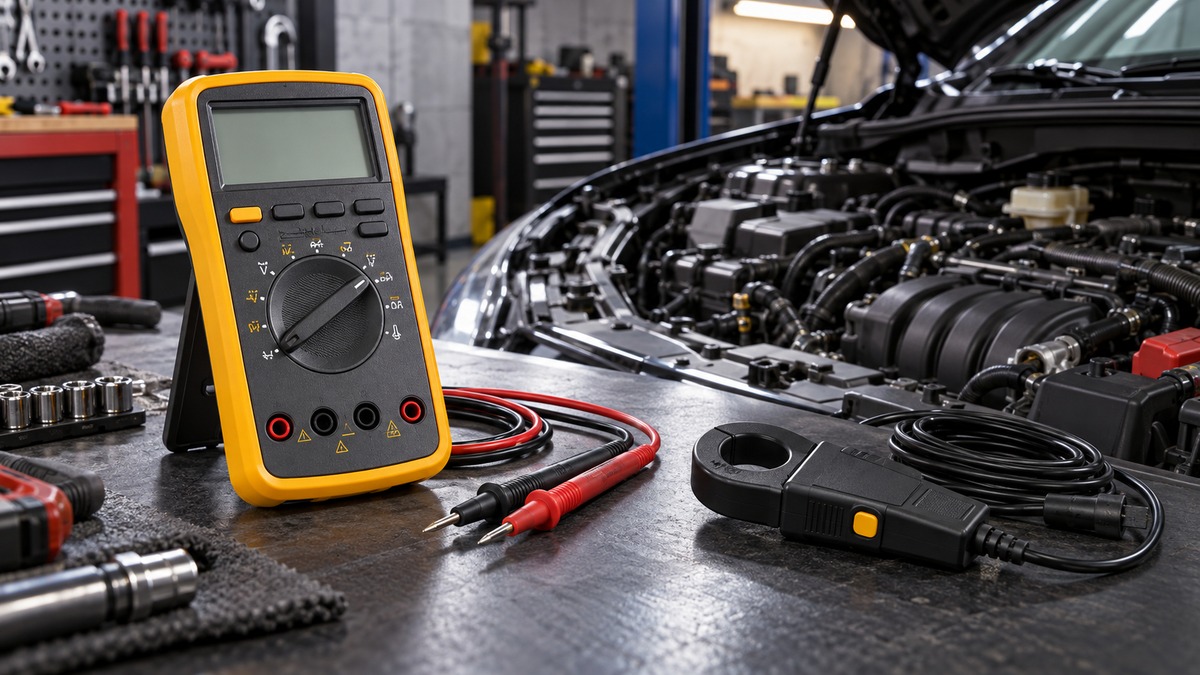
- What it is: a handheld, battery-operated automotive multimeter. The 88V manual describes it as measuring voltage, current, resistance, frequency, temperature, RPM, pulse width and duty cycle.
- True RMS: Fluke’s product page answers a buyer question directly: the 88V is not a true-RMS meter.
- Safety, 88V: the manual lists Measurement Category III 1000 V and Measurement Category IV 600 V.
- Safety, original 88: the service manual is titled for IEC 61010 CAT II meters only, so a CAT II label is the one to look for on an older unit.
Which model you are looking at
Fluke’s current product is the 88V, sold as the “Fluke 88V Deluxe Automotive Multimeter”. The 88V users manual is the document that matches the product page. The service manual we opened is for the original Fluke 88, and it is marked “For IEC 61010 CAT II Meters Only”. Its overvoltage notice also refers to Overvoltage Category II.
Check the label on the meter before you follow any instruction in this article. If the label says 88V, use the 88V manual. If it says only 88, and the model is older, use the service manual’s rating, which is CAT II. Do not assume the two models carry the same category rating.
What the 88V is built to measure
The 88V manual’s introduction describes the meter as a handheld, battery-operated device used to measure voltage, current, resistance, frequency, temperature, RPM, pulse width and duty cycle. Its table of contents includes sections for a MIN MAX recording mode, automotive applications, measuring RPM, the no-load voltage of a battery, and testing the current fuses.
The manual includes an automotive section that covers measuring RPM with an inductive pickup. The pickup is a separate accessory. Read the RPM section before you attach it to an ignition or engine circuit. The manual also covers checking a battery’s no-load voltage, which is a basic test for a car battery at rest.
True RMS: the answer Fluke gives
True RMS describes a reading that stays accurate on distorted waveforms, such as those from variable-speed drives or electronic ballasts. The 88V product page includes a question from a buyer asking whether the meter is true RMS. Fluke’s answer on the page reads: “No, the Fluke-88V is not a True RMS meter.” The same page explains that automotive measurements are usually made on DC circuits, and that a true-RMS meter is not needed for that work.
If your work includes distorted AC waveforms, such as motor drives, electronic ballasts or HVAC controls, choose a true-RMS meter instead. The 88V is a DC-focused automotive tool in Fluke’s own description.
Safety ratings and what they mean
Work on mains circuits can kill. The 88V manual’s safety information lists Measurement Category III, 1000 V, Pollution Degree and Measurement Category IV, 600 V, Pollution Degree. A category rating states the highest transient voltage and voltage to earth the meter is designed for in that category. It is not a promise that the meter is safe on every circuit in that category.
The manual’s safety section also says: do not use the meter if it is damaged, use only the replacement fuses specified, replace the battery as soon as the battery indicator appears, and make sure the battery door is closed before use. The manual also says to remove power before connecting the meter in a circuit. Follow that step every time.
Automotive work is not mains work, but the same rule applies to the battery and charging system. Disconnect and handle batteries carefully. Do not use this meter to test airbag circuits or high-voltage hybrid or EV systems. The sources do not cover those systems, and their safety procedures belong to the vehicle manufacturer.
Fuses and the battery
The 88V manual has a section titled “Testing the Fuse” and another titled “Replacing the Fuses”. It says to use only the replacement fuses the manual specifies, and it warns that a fuse with the wrong rating can leave the input unprotected. Read those two sections before you test or replace a fuse in the meter itself.
The manual states that the meter uses a single 9 V battery. The battery-replacement steps are in the manual’s battery section. Replace the battery when the battery indicator appears, and close the door before using the meter.
Skip if
- You need true-RMS measurement. Fluke states the 88V is not a true-RMS meter.
- Your model label says 88 and the unit is older. Check the rating on the label against the CAT II service manual before you use it on a circuit above low voltage.
- You need a clamp for current. The sources describe the 88V as a multimeter with test-lead inputs, not a clamp meter.
How we chose
This article covers one product line, the Fluke 88, and the model Fluke sells under that line today. It uses three documents opened on 27 October 2026: the 88V users manual, the 88V product page and the original 88 service manual. The criteria are the functions and safety statements those documents publish. It does not rank the meter against other automotive multimeters, and it does not describe any test by the author.
What we could not verify
- The sources do not state the accuracy figures for the 88V in the summary sections we read. Read the specification tables in the full 88V manual before relying on a figure.
- The sources do not confirm whether an original Fluke 88 and the 88V share the same input ratings, beyond the CAT II statement in the service manual.
- The sources do not give a complete list of the accessories that ship with the meter, the RPM pickup included.
- The sources do not give a price, a warranty length for a particular region, or a shipping time.
FAQ
Is the Fluke 88V a true-RMS meter?
No. Fluke’s product page states that the 88V is not a true-RMS meter, and explains that automotive work is usually done on DC circuits.
What CAT rating does the 88V carry?
The 88V users manual lists Measurement Category III, 1000 V and Measurement Category IV, 600 V.
What rating does the original Fluke 88 carry?
The service manual for the original 88 is titled “For IEC 61010 CAT II Meters Only” and refers to Overvoltage Category II. Check the label on your meter.
Can the 88V measure RPM?
Yes, with the inductive pickup. The manual has a section titled Measuring RPM with Inductive Pickup.
What battery does the 88V use?
The manual states a single 9 V battery.
Can I test the meter’s own fuse?
The manual has a section titled Testing the Fuse. Read it before you test, and use only the replacement fuses the manual specifies.
Bottom line
The Fluke 88V is a DC-focused automotive multimeter with RPM capability when used with the pickup, and Fluke says it is not true RMS. Its published category markings are CAT III 1000 V and CAT IV 600 V. If your label says only “88” and the unit is older, use the CAT II figure from the service manual and do not assume the newer rating applies.
Related guides
- Best Fluke 1507 Test Leads: What to Check Before You Buy covers test leads and their ratings for Fluke meters.
- Fluke Multimeter Lineup: 7 Meters Compared by Stated Function compares Fluke meters by the functions their makers state.
- Best Fluke 179 Accessories: 4 Straps and Cases Compared covers accessories for a Fluke meter kit.
Sources
- Fluke Corporation, “Model 88 V Automotive Multimeter Users Manual”, PN 2166623, https://assets.fluke.com/manuals/88v_____umeng0100.pdf (opened 2026-10-27)
- Fluke Corporation, “Fluke 88V Deluxe Automotive Multimeter” product page, https://www.fluke.com/en-us/product/electrical-testing/digital-multimeters/fluke-88v (opened 2026-10-27)
- Fluke Corporation, “88 Automotive Meter Service Manual For IEC 61010 CAT II Meters Only”, PN 666856, https://assets.fluke.com/manuals/88______smeng0100.pdf (opened 2026-10-27)