How to Choose a Multimeter for Checking Drone Batteries
As an Amazon Associate we earn from qualifying purchases.
How to choose a multimeter for checking drone batteries comes down to three checks: a DC voltage function that reads the whole pack, a CAT rating stated on the listing or the manual, and probe access to each cell at the balance connector. The sources we opened do not name a meter model for drone packs, so this guide sets out what to check on any listing and how to read the pack. The steps stay at bench level on low-voltage lithium packs.
Electrical safety comes first
Work on mains circuits can kill. A drone pack is a low-voltage battery, but the same meter rules apply to any work you do with the meter, and this guide does not cover outlets, panels or service wiring. The Ontario bulletin on multimeters says that making contact with a live circuit can result in serious injury or death.
Check the meter’s CAT rating before you measure anything. The bulletin says to use only multimeters that display both the CSA logo (or equivalent) and the CAT (I, II, III, or IV) designation, and it notes that categories I through IV apply to low-voltage test equipment below 1000 V. Fluke advises choosing a meter rated for the highest category you could potentially use it in. If the listing does not state a CAT rating, the listing does not state a CAT rating, and you should treat the meter’s category as unknown for any circuit that needs one.
Fluke also advises that you assume every electrical component in a circuit is energized until you have positively discharged it. Treat a pack that has just been used or charged the same way. Shock occurs when the human body becomes part of an electrical circuit.
Shorts are a separate risk. SparkFun warns to be careful not to create a short between the two terminals when you measure with probes. The Tattu Plus 1.0 manual says not to short-circuit the connector, because doing so creates a safety risk.
Panel and service work is outside this guide. The sources we opened do not address who may carry out that work.
Quick answer
- Pick a meter with a DC voltage function, a CAT rating stated on the listing or manual, and a voltage rating that fits the work.
- Measure the total pack voltage at the main leads, then each cell at the balance connector.
- Compare each reading with the manufacturer’s range for that pack, not with a general figure.
- A multimeter reads voltage, not internal resistance. The sources we opened describe a separate analyser for that job. For a dedicated tester that reads battery voltage, see our battery voltage tester roundup.
How we chose
We looked for pages that state the facts a reader needs to check a pack: voltage limits, storage levels, the balance connector layout, and the meter ratings that matter. Manufacturer manuals came first, including the Tattu Plus 1.0 manual, the Rotorama LiPo manual and the Gensace safety manual. Safety bodies and electrical references came next, including the Ontario bulletin, Fluke and the Ramapo College policy. Drone and hobby guides were used for procedure, including Grepow, Sphere Drones, Zbotic, Oscar Liang, SparkFun, RC Airplane World and an agricultural drone maker’s knowledge base.
Each page was opened with curl on 2026-10-21, and each quoted sentence was checked against the fetched text. Pages that returned 403, 404 or 429 were not used. Forum threads were not used for any figure. Retailer and blog pages were used only for facts that a manual did not give, and never for a safety claim.
The criteria for a pack-check meter are a DC voltage function, a stated CAT rating and voltage rating, and probe tips that reach the balance connector without bridging two pins. Our own assumption is that a DC pack reading does not need the true RMS distinction. Fluke’s true RMS article explains that average-responding meters assume a pure sine wave, and it discusses waveforms rather than battery packs. The sources we opened do not say whether true RMS matters for a pack check.
What to check on the meter
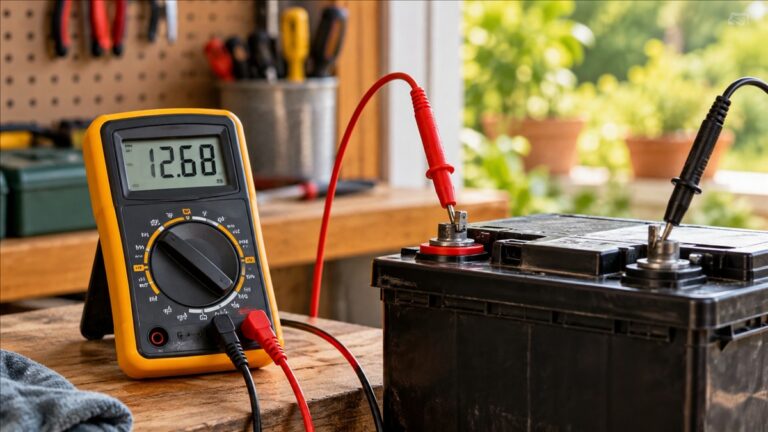
- DC voltage. Fluke’s DC guide tells you to insert the black probe into the COM jack and the red probe into the V jack, then read the display. Most modern meters detect polarity automatically, according to the same guide. For a wider set of meters that measure DC voltage, see our guide to DC voltage meters.
- CAT rating. Take it from the listing or the manufacturer’s manual. Where the listing does not state it, write it down as not stated.
- Voltage rating. The bulletin says to check and ensure that the meter’s voltage rating is appropriate for the work you do.
- Counts and resolution. The sources we opened do not say how many counts a pack check needs.
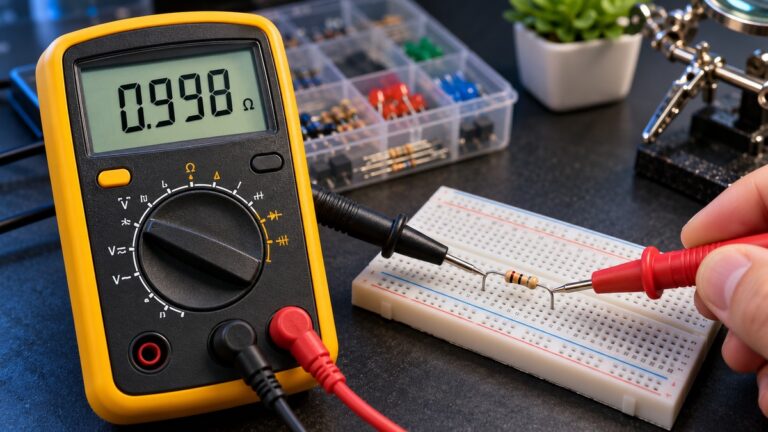
- Continuity mode. Oscar Liang describes continuity mode as a check for a low-resistance electrical path between two points. It is useful for the pack leads before you connect a pack.
- Probe tips. The sources we opened do not name a tip size for balance connectors.
Preparation
Count the cells before you measure. RC Airplane World explains that the balance connector has one wire per cell plus a negative, so a 2S pack has three wires and a 3S pack has four.
Know the chemistry. The Rotorama manual says never to exceed 4.20 V per cell, or 4.35 V per cell for LiHV. The Gensace manual gives a ceiling of 4.22 V per cell for its own packs, so the two manufacturers differ slightly and the figure on your pack’s manual wins. The Reedy warning sheet says LiHV mode is compatible only with lithium batteries with a nominal voltage of 3.8 V per cell, and it tells you to refer to the battery’s own instructions to determine the cell count and charge rate.
Set the meter to DC volts before the probes touch the pack.
Steps for a pack check
Step 1: Inspect the pack
Look for bulges, punctures, or leaks before you measure. Sphere Drones says damaged batteries should not be used, because they pose safety risks. A swollen pack should be handled as a damaged pack, and the sources we opened do not describe a safe way to test one.
Step 2: Check the leads for a short
Oscar Liang describes a continuity check on the battery lead, between positive and negative, before the battery is connected. He says that if there is a persistent short between positive and negative, something is wrong and you should not connect the battery. The check is a build check, but the same logic applies to a pack that has been stored or handled roughly.
Step 3: Measure the total pack voltage
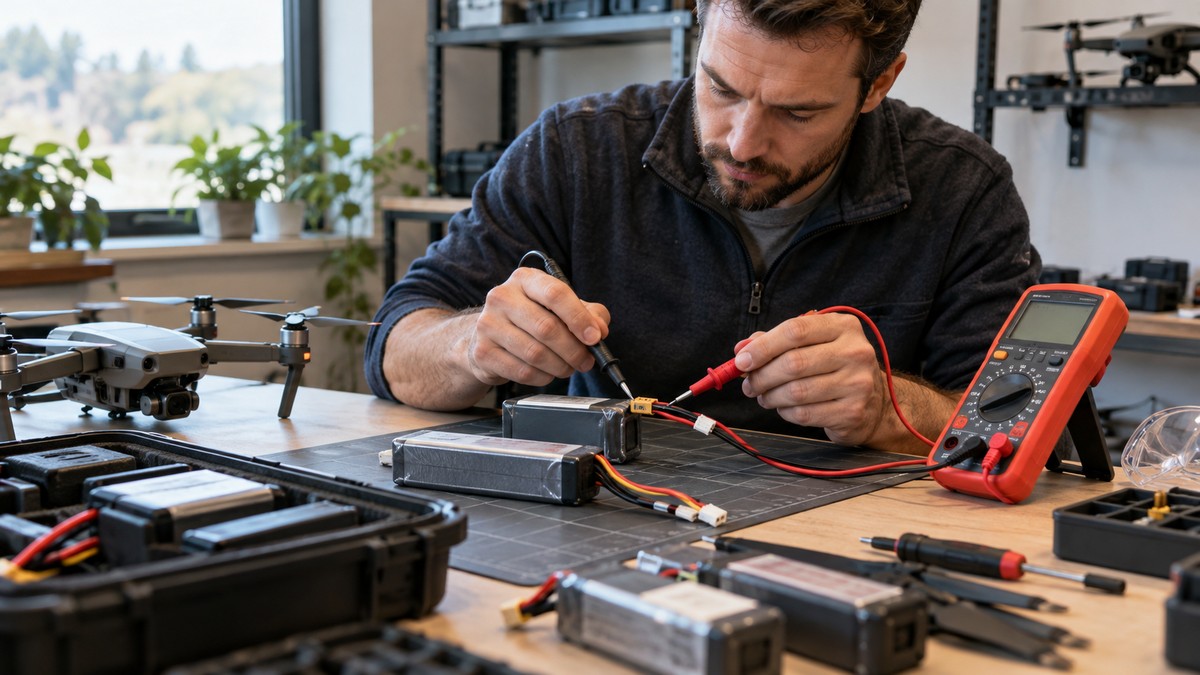
Grepow advises using a multimeter or a battery checker to verify the total voltage and the individual cell voltages through the balance port. Sphere Drones advises comparing the reading with the manufacturer’s specified voltage range for the specific battery. Use the range in that pack’s manual, not a general range.
Step 4: Read each cell at the balance connector
RC Airplane World describes the method. Read the highest reading first, which is the total pack voltage. Then move the meter lead to the next terminal along the connector and calculate the difference between the two readings. That difference is the voltage of the first cell. Continue along each terminal until you reach the last one, whose reading is the voltage of the last cell.
Step 5: Check the spread between cells
The Tattu Plus 1.0 manual suggests checking each cell when the voltage difference between cells is greater than 30 mV. It recommends balance-charging and discharging the pack for two cycles in that case, and it says to report to the manufacturer for further guidance if the cells cannot be balanced. The 30 mV figure comes from that one manual, and the sources we opened do not give a spread limit for other packs.
Step 6: Check the storage level
If the pack will sit idle, compare the cell voltages with the storage range. Grepow gives a storage voltage of about 3.8 V to 3.85 V per cell, and the Gensace manual gives a storage range of 3.80 V to 3.90 V per cell. The Ramapo College policy advises storing with a 50 to 70 percent charge. The Tattu Plus 1.0 manual says that if a pack is not used for more than 5 days, it should be discharged to 40 to 70 percent. The voltage and percentage figures are not mapped to each other by any source we opened, so use the pack’s own manual.
Step 7: Probe with care
Keep the probe tips apart while you read the connector. SparkFun says to be careful not to create a short between the two terminals when measuring with probes. A short that lasts longer than a moment is a reason to stop and check the pack, not to keep probing.
Reading the results
For a standard LiPo cell, the Rotorama manual gives 4.20 V per cell as the maximum, and it says not to discharge below 3.0 V per cell because that causes permanent damage. The Gensace manual gives 3.0 V per cell as the lower limit for its packs. Grepow describes deep discharges below 3.0 V to 3.3 V per cell as damaging, and it advises landing a drone when a pack reaches about 3.3 V per cell under load.
A cell at 0 V is a warning sign. Grepow says that if any cell is at 0 V, the battery is likely dead. The Tattu Plus 1.0 manual says that a pack left at seriously low voltage for a long time can enter deep sleep, and that it must be turned on manually and charged right away.
For a larger pack, the Agrispray knowledge base gives a worked example. It says the total voltage for 14 cells at normal discharge is 42 volts or above, which is 3.0 V per cell across the pack. That example is specific to one agricultural pack and does not set a rule for other packs.
Internal resistance is a separate measure. Grepow says a healthy LiPo cell typically has an internal resistance below 10 mΩ, and that a significantly higher value indicates an aging battery. Sphere Drones says that specialised battery analysers can measure internal resistance. The sources we opened do not describe a multimeter method for internal resistance.
Voltage sag is the drop in terminal voltage when current is drawn. Zbotic says excessive sag triggers premature low-voltage warnings or auto-land and return-to-home actions. The sources we opened do not describe a multimeter reading under load, so a sag figure from a resting reading would not be a sourced result.
Common mistakes
- Reading only the total. Grepow lists the total and the individual cell voltages together. A total that looks normal can hide one weak cell.
- Using a pack with damage. Sphere Drones says to look for bulges, punctures or leaks first, and to stop using a damaged pack.
- Mixing up chemistry. The Reedy sheet warns that charging a standard 3.7 V per cell LiPo in LiHV mode can overcharge it, with risk of damage, fire or explosion. Check the chemistry on the pack before you set any charger or read any limit.
- Leaving a pack full or empty. Grepow says that keeping a battery fully charged (100%) or fully depleted (0%) for extended periods causes significant degradation.
- Probing with the tips touching. A short between the two probe tips or between two connector pins can damage the pack, as SparkFun and the Tattu manual both warn.
Frequently asked questions
Can a basic multimeter check a drone battery?
Yes, for total voltage and per-cell voltage. Grepow says a multimeter or battery checker can verify both through the balance port. The sources we opened do not say a basic meter can measure internal resistance.
What should a stored LiPo cell read?
Grepow and the Gensace manual put storage at about 3.8 V to 3.90 V per cell. The Ramapo policy describes storage at 50 to 70 percent charge. Use the pack’s own storage figure where the manual gives one.
How low can a cell go before it is damaged?
The Rotorama manual says 3.0 V per cell is the limit below which permanent damage can occur. Grepow describes 3.0 V to 3.3 V per cell as the range where deep discharge causes damage.
Does the meter need true RMS?
Probably not for a DC pack reading, though no source we opened says so. Fluke’s article discusses waveforms, not battery packs.
What if one cell reads 0 V?
Grepow says the battery is likely dead. It also calls recovery of a deeply discharged battery risky and says it can cause a fire, so the sources we opened do not support a home recovery step.
What we could not verify
The listing does not state a CAT rating, counts or fuse rating for any meter in this guide, because we opened no meter listing for a drone pack. Treat those fields as not stated until a listing or manual states them.
No source we opened gives a multimeter method for internal resistance or for voltage under load. The 30 mV spread limit comes from one manual, and the sources do not give a spread limit for other packs. The sources do not say how to identify a cell count from the pack label alone, so count the balance connector wires instead.
The licensed-electrician point for panel and service work is not stated in any source we opened, so this guide does not make that claim. Work that involves outlets, panels or service wiring falls outside this guide.
Sources
- https://www.ihsa.ca/pdfs/safety_bulletins/safety_bulletin_multimeters.pdf (opened 2026-10-21)
- https://www.fluke.com/en-us/learn/blog/safety/multimeter-guide (opened 2026-10-21)
- https://www.fluke.com/en-us/learn/blog/digital-multimeters/how-to-measure-dc-voltage-with-a-digital-multimeter (opened 2026-10-21)
- https://www.fluke.com/en/learn/blog/digital-multimeters/when-do-you-need-a-true-rms-multimeter (opened 2026-10-21)
- https://www.grepow.com/blog/comprehensive-drone-battery-troubleshooting-guide.html (opened 2026-10-21)
- https://www.grepow.com/blog/what-is-the-internal-resistance-of-a-drone-battery.html (opened 2026-10-21)
- https://www.grepow.com/blog/everything-about-storing-your-lithium-polymer-lipo-batteries-battery-monday (opened 2026-10-21)
- https://www.spheredrones.com.au/resources/blog/guide-checking-drone-battery-health (opened 2026-10-21)
- https://zbotic.in/drone-battery-voltage-sag-why-it-happens-and-how-to-fix-it/ (opened 2026-10-21)
- https://oscarliang.com/multimeter-fpv/ (opened 2026-10-21)
- https://cdn.shopify.com/s/files/1/0836/7770/8622/files/6_Tattu_Plus_1.0_Manual.pdf (opened 2026-10-21)
- https://www.rotorama.com/assets/docs/fb0216fe4657e33cc1a8c59479f7d2d0/43727-1/manual-lipo-en_6acdd6731818d.pdf (opened 2026-10-21)
- https://www.freeflysystems.com/wp-content/uploads/2021/11/Gensace_safety_manual.pdf (opened 2026-10-21)
- https://web.ramapo.edu/ehs/wp-content/uploads/sites/13/2019/09/Lithium-Ion-Battery-Policy-2019.pdf (opened 2026-10-21)
- https://img2.associatedelectrics.com/pdf/cars_and_trucks/shared/Reedy_HV-LiPo-Charger-Warning-Sheet.pdf (opened 2026-10-21)
- https://learn.sparkfun.com/tutorials/single-cell-lipo-battery-care/how-much-power-is-left (opened 2026-10-21)
- https://www.rc-airplane-world.com/balancing-lipo-battery-packs (opened 2026-10-21)
- https://knowledgebase.agrispraydrones.com/battery-voltage-testing-using-a-multimeter (opened 2026-10-21)