How to Choose a Multimeter for E-Bike Batteries
As an Amazon Associate we earn from qualifying purchases.
How to choose a multimeter for e bike batteries comes down to one check: the meter must read DC volts over a range above the pack’s rated voltage, and its CAT rating must suit the work. Every page we opened that covers e-bike packs tells you to set the meter to DC volts, so a meter without a DC setting is not a fit. The sources do not name a meter model for pack work, and they do not give a single rating that every pack needs. This guide covers the voltage check, the safety ratings the sources do state, and the limits they leave open.
Electrical safety comes first
Work on mains circuits can kill. A University of Virginia electrical safety page says that electric current through the body, even at levels as low as 3 milliamps, can cause injury or death. Before you measure anything, check that the meter’s CAT rating suits the circuit you are testing, and read the rating from the listing or the manufacturer’s manual. Panel and service work belongs to a licensed electrician.
The last point is site policy. The sources we opened do not say who may do panel or service work, so treat it as a rule for this site rather than a finding from those pages.
Fluke’s safety guide says shock occurs when the human body becomes part of an electrical circuit. The same guide tells readers to choose a tool rated for the highest category they could potentially use it in, and it notes that the ratings are usually located near the input jacks. A second Fluke article warns that tools with the wrong rating for an environment raise the risk of electric shock, and it advises choosing voltage ratings above the highest voltage you expect to measure.
CAT ratings (CAT II, CAT III and CAT IV) describe the installation category a meter is built for. One manufacturer’s listing for a single meter reads “Safety rated CAT III 1000 V, CAT IV 600 V.” That rating belongs to that model only. None of the sources we opened says which category suits an e-bike pack, so do not assume that a meter reading DC volts is rated for every battery job.
Lithium-ion packs add a fire hazard. The MIT and Cal Poly lithium-ion guidance documents both say that a battery needs only an internal short circuit to start a series of reactions that may lead to a fire. Both also name 60 V as the level above which assembled lithium-ion batteries may present electrical shock and arc hazards. The pack voltages in Optibike’s table run from 37 V to 52 V, which sit below that figure. The sources do not say what the 60 V line means for a pack’s terminals, so treat it as a reference point and not as permission to probe a pack freely.
Cornell’s micromobility guidance says that damaged lithium-ion batteries can overheat, catch fire and even explode. The MIT guidance advises disposing of damaged or puffy batteries promptly, so a swollen pack is a reason to stop the check.
Quick answer
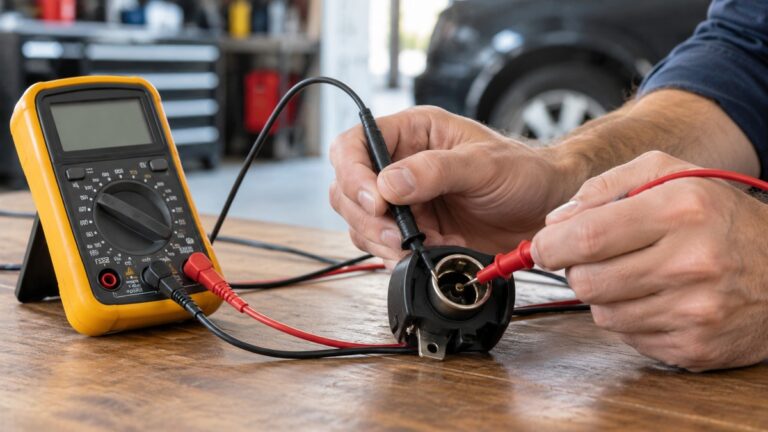
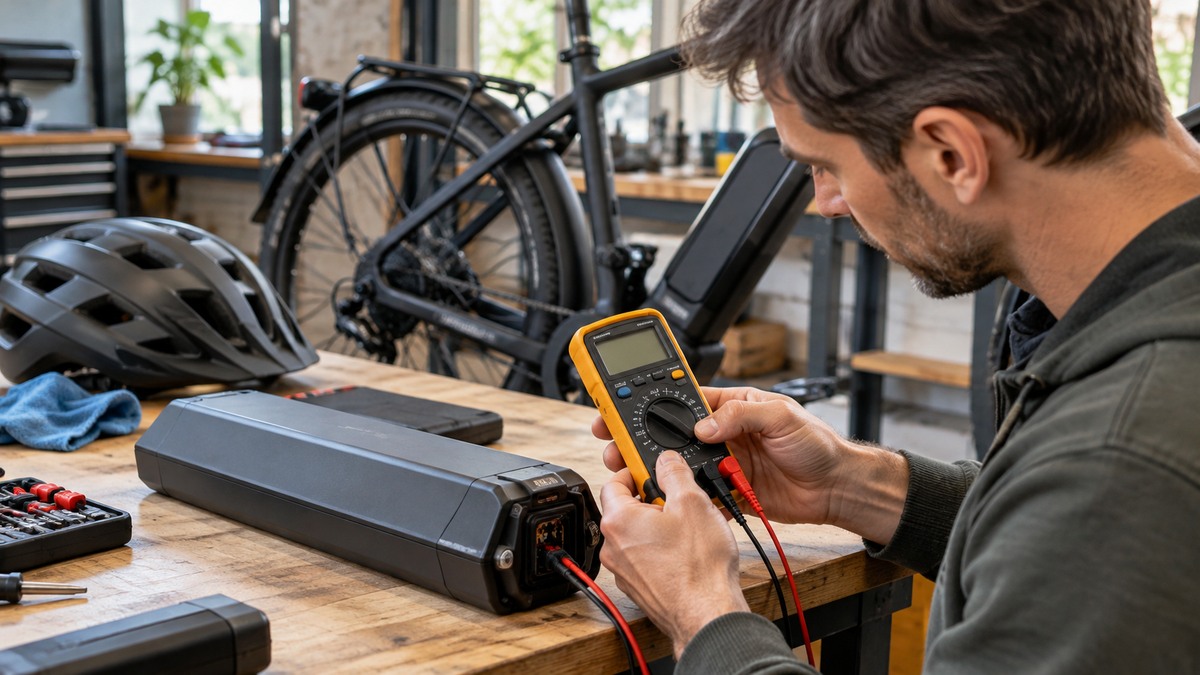
- Set the meter to DC volts, with the red lead in V/Ω and the black lead in COM.
- Choose a range above the pack’s rated voltage, then compare the reading with the normal range for your pack.
- Read the CAT rating from the meter or its listing, and do not treat that rating as proof that a meter suits household mains.
- Wait an hour after riding, and turn the bike off with the battery detached before you start.
What to have ready
Gather a digital multimeter with a DC volts setting, the pack’s rated voltage from its label or manual, and a dry, well-lit area with room to work. Levy’s guide asks readers to work in a well-ventilated, dry area, away from flammable materials. It also says to turn the bike off and detach the battery before you start. Ridereview adds that a battery which has been ridden recently should rest for at least an hour before the reading, because the reading is more accurate after rest.
Check the pack terminals and the probe tips before you connect anything. A DIY battery-pack guide warns that cables can suddenly swing away and cause a short circuit, so keep metal objects clear of the pack. The same guide says not to wear rings or metal bracelets near a battery, and it advises taping stripped cable ends so they cannot touch. That guide is written for people building packs, not for a manufacturer, so use its advice as general handling practice.
Step-by-step voltage check
The steps below combine what the four e-bike and battery pages say. Where a step rests on one source only, the text says so.
- Turn the bike off and detach the battery. Levy’s step-by-step guide starts with this step.
- Set the dial to DC volts. Fluke’s battery guide says to set the dial to VDC, which is DC volts. That page is written for car batteries, so read its lead-acid caution as a general reminder only.
- Put the leads in the right jacks. Fluke’s setup recap says the red lead goes in the V/Ω jack and the black lead goes in COM.
- Choose a range above the rated voltage. Levy advises choosing a setting greater than the voltage rating of the e-bike battery. If the meter has a fixed range, pick the one that covers the pack’s rating.
- Touch the probes to the terminals. Ridereview and Levy both say to connect the red probe to the positive terminal and the black probe to the negative terminal, with the terminals marked + and -.
- Read the voltage and compare it. Use the normal range for your pack, covered in the next section.
Optibike’s guide for its own packs measures the voltage at the charge port rather than the battery terminals. Use the measuring point your manufacturer names, and do not invent a new one.
Reading the result
The sources give different targets, so use the figures for your own pack. Optibike publishes a normal range of 42 V to 58.8 V for its 52 V packs, with a half charge at 51.8 V and an empty reading at 42 V. For its 37 V packs, the normal range is 30 V to 42 V, with a full charge at 42 V. Levy’s readiness article says a 36-volt battery should read close to or slightly above 36 volts when fully charged. Optibike’s 37 V full-charge figure of 42 V and Levy’s figure of about 36 V do not agree, and neither source gives a figure for a 48 V pack. Read the two figures as a range, and use the number printed for your pack where one exists.
Ridereview’s rule is simpler: the reading should fall within the range the battery manufacturer specifies. A reading that sits significantly below that range may mean the pack is not working properly, according to the same page. That is a first check and not a diagnosis. Levy describes a separate capacity test that needs a specific tool to measure amp-hours, and the voltage check does not replace it.
A reading near the top of the range after a full charge is what the sources describe as normal. A reading well below the bottom of the range, after the rest period, is what the sources describe as a reason to look further. The sources do not say how far below the range is too far, so the figure is a judgment, and the pack’s documentation should decide it.
Buying checklist
- A DC volts setting with a range above the pack’s rating. Levy’s guide makes this the core check.
- A CAT rating printed on the meter or stated in its listing. Fluke says the rating is usually near the input jacks. If the listing does not state a CAT rating, the sources we opened give no basis for using that meter on a pack.
- Jacks marked V/Ω and COM. Fluke’s setup recap uses these jacks for voltage readings.
- A stated voltage range in the listing or manual. Read the range from the listing rather than the box.
For a broader look at meters that cover different jobs, see our multimeter roundup. For a quick voltage check with a simpler tool, see our battery voltage tester guide.
Common mistakes
- Measuring straight after a ride. Ridereview says to wait at least an hour so the reading is more accurate.
- Choosing a range below the pack’s rating. Levy says the range must be greater than the battery’s voltage rating.
- Reading the voltage as capacity. Levy separates the voltage check from the capacity test, which needs a specific tool.
- Letting a loose cable or a metal object bridge the terminals. The DIY pack guide warns that a loose cable can swing away and cause a short circuit.
- Treating a CAT rating as a mains safety claim. The listing does not state a CAT rating for pack work, and the sources do not say that any meter is safe for household mains.
- Testing a charger on the wall. This guide does not cover the charger or its mains plug, which the sources treat as a mains activity.
Charging and storage notes from the sources
Cornell’s micromobility guidance says the charging device should plug directly into a wall outlet, and it says extension cords and power strips are strictly prohibited. It also says to use only the battery and charging units that came with the device, and to disconnect them once they are fully charged. Utah State University Extension advises charging only while you can monitor the device, and it warns against charging under a pillow or blanket because heat can build up. The same page says overnight or unattended charging can increase risks.
If a voltage reading suggests the pack or charging system has a fault, the sources say to have the repair done by a qualified professional. Cornell states that device repairs should go to a qualified professional, and it asks owners to inspect batteries regularly for warning signs.
Frequently asked questions
Which meter setting should I use on an e-bike battery?
Use the DC volts setting. Fluke’s battery guide sets the dial to VDC and places the red lead in the V/Ω jack. The e-bike pages describe the same DC setting for the pack’s terminals.
What voltage should a healthy pack show?
That depends on the pack. Optibike lists a 42 V to 58.8 V normal range for its 52 V packs. Levy expects a 36-volt pack to read close to or slightly above 36 volts when charged. Check the rating printed on your pack before you compare any reading.
Can a meter with a CAT rating check a household outlet or a charger plug?
The sources do not support that use. They say mains work can kill and that the CAT rating must match the circuit, and the listing does not state a CAT rating for pack work. A meter used on a battery pack is not, for that reason alone, a meter for household mains.
Does a voltage reading show how much charge is left or how much capacity remains?
It shows a voltage at one moment. Levy’s guide treats capacity as a separate test that needs a specific tool, and the sources we opened do not describe that test in detail.
Why does the rest period matter?
Ridereview says a recently used battery should rest for at least an hour before testing, because the rest gives a more accurate reading. That page is the only one we opened that makes this point, so treat it as one source’s advice.
Should I measure at the terminals or at the charge port?
Levy describes the terminals. Optibike describes the charge port for its own packs. Use the measuring point your manufacturer names, because the two sources do not describe the same point.
How we chose
We kept this guide to the check that the sources describe: a DC voltage reading of a pack taken with the bike off. We kept a claim only when an opened page states it, and we matched each quoted sentence against the fetched text. The buying checklist uses four criteria: a DC volts range above the pack’s rating, a CAT rating stated for the meter, jacks that match the DC setting, and handling advice for the terminals. We opened 14 pages that returned readable text on 2026-10-21. Four e-bike brand and retailer pages returned 429 or 403 and do not count. We did not recommend any meter model or brand, because the sources do not rank meters for e-bike work.
What we could not verify
The sources we opened do not give a capacity figure, a state-of-charge method for lithium packs, or a safety standard for testing e-bike packs. They do not name a CAT rating that suits e-bike pack work, a meter count, a fuse rating, or a method for measuring pack current. They do not say whether true RMS matters for a DC pack reading. Panel and service work is outside this guide, and so is any work on the charger or its mains plug. The Fluke rating above is one model’s listing, not a rule for every meter. The pack voltage ranges come from two manufacturer and retailer pages for specific packs, and they do not apply to every pack on the road.
Bottom line
Set the meter to DC volts, pick a range above the pack’s rating, and compare the reading with the figures for your own pack. Treat every CAT claim as a limit to check against the listing or manual.
Sources
- https://www.fluke.com/en-us/learn/blog/safety/multimeter-guide (opened 2026-10-21)
- https://www.fluke.com/en-us/learn/blog/renewable-energy/the-right-solar-tools-based-on-cat-and-voltage-ratings (opened 2026-10-21)
- https://www.fluke.com/en-us/learn/blog/digital-multimeters/how-to-test-a-battery-with-a-multimeter (opened 2026-10-21)
- https://www.fluke.com/en-us/product/electrical-testing/digital-multimeters/fluke-177 (opened 2026-10-21)
- https://www.levyelectric.com/resources/testing-your-electric-bike-battery-with-a-multimeter-a-step-by-step-guide (opened 2026-10-21)
- https://www.levyelectric.com/resources/electric-bike-battery-testing-ensuring-ride-readiness (opened 2026-10-21)
- https://support.optibike.com/checking-battery-voltage (opened 2026-10-21)
- https://ridereview.com/questions/how-to-test-ebike-battery-with-multimeter (opened 2026-10-21)
- https://fcs.cornell.edu/sites/default/files/2025-02/Micro-Mobility%20E-Bikes_Litium-Ion%20Batteries%20Guidance%20Document%20v.2%20final%2002.09.2024.pdf (opened 2026-10-21)
- https://extension.usu.edu/news/ask-an-expert-safe-charging-how-to-prevent-battery-related-fires (opened 2026-10-21)
- https://ehs.mit.edu/wp-content/uploads/2019/09/Lithium_Battery_Safety_Guidance.pdf (opened 2026-10-21)
- https://afd.calpoly.edu/ehs/docs/lithium-battery-safety-guidance.pdf (opened 2026-10-21)
- https://avdweb.nl/solar-bike/batteries/building-lithium-ion-battery-pack-safety-instructions (opened 2026-10-21)
- https://ehs.virginia.edu/Electrical-Safety/Awareness (opened 2026-10-21)
As an Amazon Associate we earn from qualifying purchases.