How to Choose a Multimeter for Boat Batteries
As an Amazon Associate we earn from qualifying purchases.
How to choose a multimeter for boat batteries comes down to three checks: a DC volts setting that covers 12 volts at the battery posts, a CAT rating stated on the listing or manual, and the ability to take readings while the charger or engine runs. A person choosing one wants a meter that handles resting voltage, charging voltage and the dip when the engine starts. The sources we opened describe those readings. They do not name a meter, and no model listing was part of this review, so this guide sets out what to check on a listing rather than which model to buy.
Electrical safety first
Work on mains circuits can kill. Before you measure anything, check that the meter’s CAT rating suits the circuit you are testing, and read the rating from the listing or the manufacturer’s manual. Panel and service work belongs to a licensed electrician.
Fluke’s guide says to “always choose a tool rated for the highest category you could potentially use it in and select a voltage rating to match, or exceed, those situations.” Its safety page calls electricity “Dangerous if not respected,” and says a well-built meter carries “a Measurement Category III rating.” The GAMBICA guide on overvoltage categories states the limit directly: “The measurement terminals must never be connected to a circuit that exceeds the rated voltage or measurement category.”
This guide covers low-voltage and bench work only: the battery, its terminals, its charging system and the 12-volt wiring. It gives no steps for wall outlets, breaker panels, shore power or any other mains supply.
Quick answer
- Choose a meter with a DC volts setting and a range that covers 12 volts.
- Check the listing for a CAT rating. If the listing does not state a CAT rating, the listing does not state a CAT rating, and the meter should not be used where that rating matters.
- Read resting voltage after the battery has rested, then charging voltage, then voltage with the engine running.
What the battery readings mean
Lead-acid and AGM batteries are the common types in boats, and the figures below are for those types at rest. The Canadian Boating guide says that “At rest, a fully charged battery should read at 12.6 volts.” Renogy’s guide puts a healthy marine battery “between 12.6V and 12.7V.” The Towpath Talk guide, written for UK narrowboats, gives a wider scale: 11.8 volts or below is flat, 12.2 volts is 50 percent capacity, and 12.6 to 12.8 volts is fully charged.
The sources agree on the low end. Renogy says a reading below 12.4 volts means “you may need to charge or replace the battery.” The Fluke guide, written for automotive batteries, gives about 12.4 volts for about 75 percent charge, about 12.2 volts for about 50 percent, and below 12.0 volts as likely discharged or weak. The boat sources do not say whether their values differ for a marine battery, so check the battery maker’s specification where the figures differ.
Charging readings are different. The Canadian Boating guide says a charger should push the voltage to “between 13.4 and 13.8 volts,” and that with the alternator running “the voltage will read 14.2 volts.” A second Canadian Boating article gives “13-14V” for a charger and “13-14.5V” with the engine running. Fluke says a good alternator should produce “13.7–14.7 V under normal conditions.” The ranges do not match exactly, so a reading near the edge of a range is a reason to test again, not a verdict on the charging system.
How we chose
We chose the criteria in this guide from the pages we opened on 2026-10-21. The first criterion is whether a meter can take the readings the sources describe: DC volts, a reading at the battery posts, and a charging reading. The second is the CAT rating, which the safety sources treat as the first thing to check on any meter. The third is whether the meter is a separate tool from the load tester that the battery sources describe.
Features to check on the listing
Each feature below comes from a step in the sources. Check the listing or the manual for the specific figure before you buy.
| Feature | Why the sources say it matters | What to check on the listing |
|---|---|---|
| DC volts setting | The Canadian Boating guide says to “set the voltmeter or multimeter to read DC voltage.” | A DC voltage setting, stated on the listing. |
| Voltage range | Fluke says to “Use Range to select 6V or 60V range depending on battery condition.” | A range that covers 12 volts, and whether it is auto-ranging or manual. |
| CAT rating | Fluke says to choose a tool rated for the highest category you could potentially use it in. | The CAT rating and voltage rating. If neither is stated, the listing does not state a CAT rating. |
| Min/max reading | Fluke says to “use MIN/MAX or AutoHOLD” for fluctuation detection. | Whether the meter has MIN/MAX. This can help catch the dip when the engine starts. |
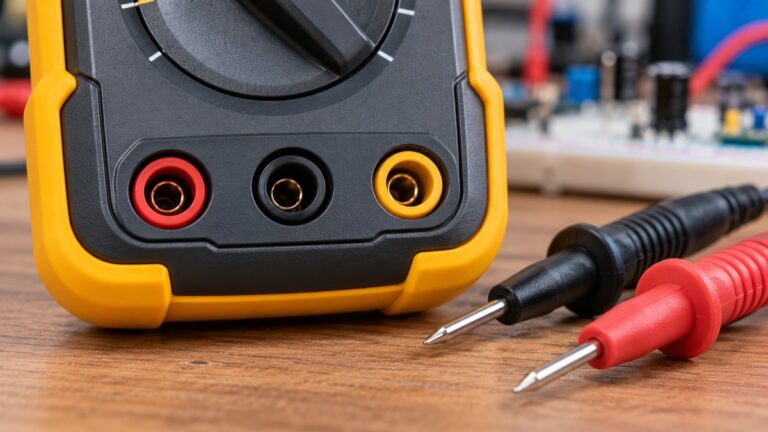
| Probes and leads | Fluke says to insert the red lead in V/Ω and the black lead in COM. | Lead type and jack labels. The sources do not give lead ratings. |
Preparation before any reading
For a broader look at simple battery meters, see our guide to battery voltage testers. Inspect the battery first. The Canadian Boating guide describes a visual test that looks for “any bulging or any deformity” and “corrosion, discolouration or build-up at the terminals.” Fluke says to “always inspect battery terminals for corrosion or looseness before testing.”
Wear eye protection and gloves. The Canadian Boating guide says that “Once appropriate gloves and goggles are worn,” a lead-acid battery’s caps can be removed to check the fluid. Fluke warns that lead-acid batteries “can emit explosive gas and contain acid.”
Step 1: switch off the loads and let the battery rest
Turn off everything that draws power. Fluke says to “Turn off all accessories before taking a resting voltage measurement.” The Towpath Talk guide says to isolate the battery by turning off the isolator switches before testing. Renogy says to test “after it sits idle for one hour.” Boattest’s Nordhavn article uses a longer rest for an isolated bank: “allowed to rest for at least 4 hours (longer is better).”
The Canadian Boating article says that if you test right after charging or while the engine runs, “you will get inaccurate results.” If the boat was just running, Fluke says to turn on the headlights for about one minute and then switch them off to remove surface charge.
Step 2: read the resting voltage at the battery posts
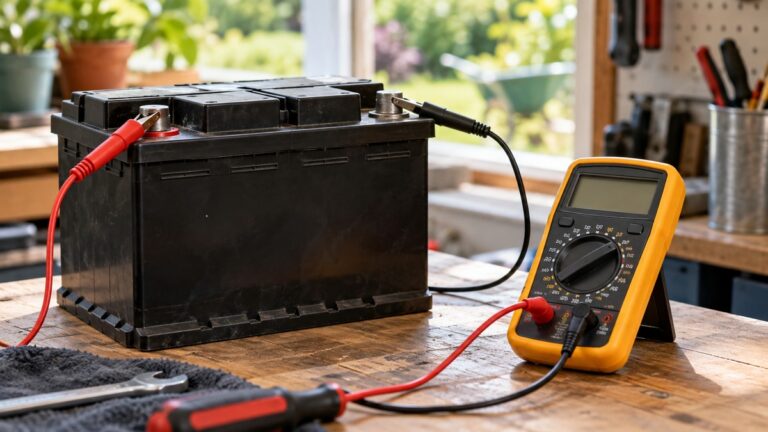
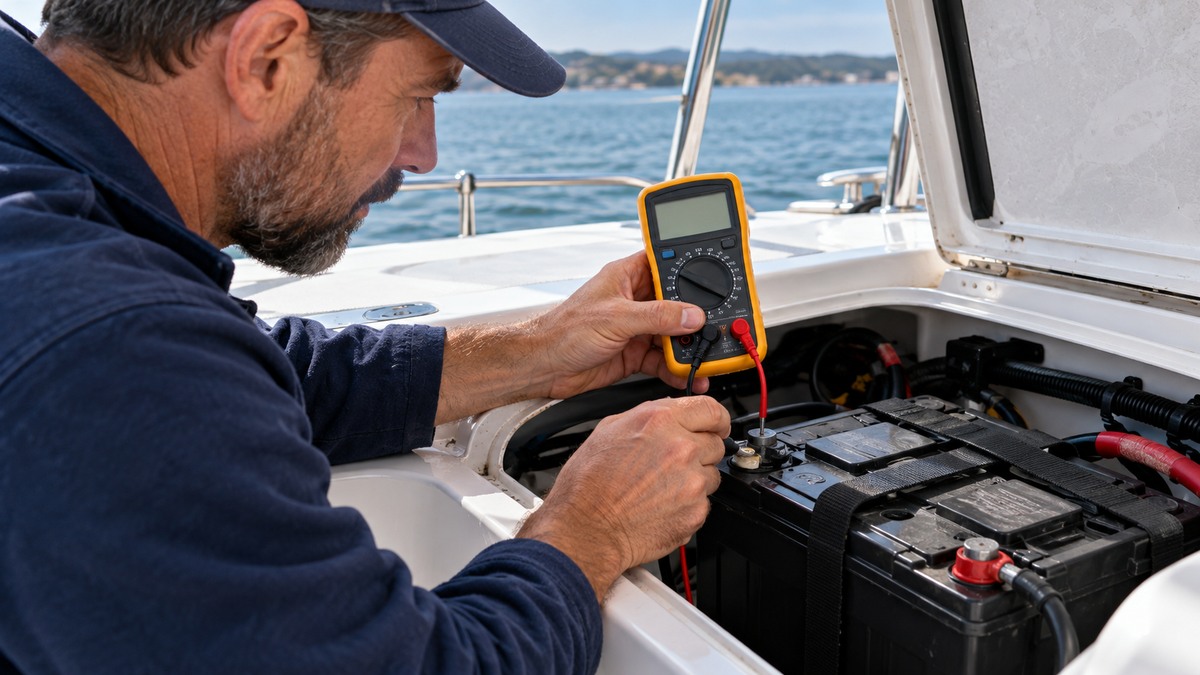
Set the meter to DC volts. Put the red lead on the positive post and the black lead on the negative post. The Canadian Boating guide says that “the test should be done at the source: Don’t rely on the boat’s voltmeter or display.” Record the reading and compare it with the figures above.
Step 3: read the charging voltage
Connect the charger or start the engine, then read the posts again. The Canadian Boating guide says to “test the battery’s voltage again and record the results” while charging, so you can confirm that charging is happening as expected. A reading that stays at the resting value while the charger or engine runs suggests the charging system is not delivering current. The sources do not give the cause, so treat the reading as a prompt to check the charger or alternator, not a diagnosis.
Fluke says to “Use MIN/MAX to catch voltage drops when starting the engine.” Keep the leads on the posts while the engine starts so that you capture the dip.
Step 4: check the battery under load
A resting voltage shows the charge level. It does not show whether the battery can deliver current. The Canadian Boating guide describes a load tester as a simple device: the positive clamp goes on the positive post, the negative clamp on the negative post, and a test button puts the battery under load. The result is shown as “good/weak/bad.” The guide says the test is best run “while the battery is charged, but not under any other load.”
The CHIRP report on a boat battery explosion recommends “Battery load tests to be carried out regularly” and “Voltage monitoring to ensure that overcharging is not occurring.” A load test is therefore a separate check, and the multimeter is still needed before and after it.
Step 5: check the battery bank and the wiring
If the boat has more than one battery, Towpath Talk says that placing the probes on any one positive and any one negative terminal gives a bank reading. Disconnecting each battery gives an individual reading. The Boattest article says the isolated bank should be read “across the battery posts (single battery for a 12-volt system, two batteries in series for a 24-volt system).”
The Canadian Boating electrical article describes checking along the circuit. The battery should read “somewhere between 12 and 14 volts” at the source, and the same voltage should appear at the light when the switches, breakers and fuses allow current to flow. Test the source first, then move down the circuit. Do not isolate a starting battery while the engine is running: Boattest says doing so “can damage the engine starting battery charging alternator.”
Reading the results
In the sources, a resting value near 12.6 volts indicates a fully charged battery. A resting value near 12.4 volts, or below, indicates partial or low charge. A charging value in the range the sources give shows the charger or alternator is working. The sources do not give a single pass or fail number for health. The load test is the check for health.
For a basic check of the wiring between the battery and a load, the continuity tester guide covers the same meter’s continuity setting.
Common mistakes
- Reading the boat’s display instead of the posts. The Canadian Boating guide says to test at the source and not rely on the display.
- Reading straight after charging. Renogy says readings taken right after charging, or while the engine runs, are inaccurate.
- Using a meter with no stated CAT rating. If the listing does not state a CAT rating, the meter should not be used where that rating matters.
- Isolating the starting battery while the engine runs. Boattest says this can damage the charging alternator.
- Treating a voltage reading as a capacity test. The Canadian Boating guide describes the load test as the check for whether a battery can push current.
- Working near sparks or open flame. The HSE booklet lists sparks and flames as ignition sources to keep away from charging batteries.
Why hydrogen and sparks matter
The HSE booklet says that “Hydrogen and oxygen are usually produced inside a battery when it is being charged.” Yachting Monthly, citing marine electrical expert Nigel Calder, says that a pocket of gas can ignite if a spark reaches it, and that hydrogen disperses when there is “even minimal venting from the top of a battery box.” CHIRP says that “Insufficient ventilation can lead to danger.”
The HSE booklet also says to empty pockets of metal objects that could bridge a battery’s terminals, and to keep sources of ignition away from batteries that are being charged. Use insulated tools. These steps apply whenever you take a reading while a battery is charging.
FAQ
What voltage should a boat battery read at rest?
The Canadian Boating guide says a fully charged battery should read 12.6 volts at rest. Renogy gives 12.6 to 12.7 volts for a healthy battery, and Towpath Talk gives 12.6 to 12.8 volts for fully charged. The sources do not agree exactly, so use the battery maker’s figure where one is available.
Why should I wait before reading the battery?
Renogy says to test after the battery has sat idle for one hour. The Canadian Boating guide says readings taken right after charging or while the engine runs are inaccurate. Boattest uses at least four hours for an isolated bank.
Can a multimeter tell me whether a boat battery is healthy?
A multimeter reads voltage, and a resting voltage is an estimate of state of charge. The Canadian Boating guide says the load test answers whether the battery can push current. The sources do not describe a multimeter-only health test.
What should I look for on the listing?
Check for a DC volts setting, a range that covers 12 volts, and a CAT rating on the listing or manual. If the listing does not state a CAT rating, the listing does not state a CAT rating, and the sources do not say whether the meter suits a particular boat circuit.
Bottom line
Choose a multimeter with a DC volts setting, a range that covers 12 volts, and a CAT rating stated on its listing or manual. Read resting voltage after a rest, check charging while the charger or engine runs, and use a load test to check health.
What we could not verify
The sources we opened do not name a meter or give the CAT rating of any model, and no model listing was used here. They do not give a marine battery’s capacity in amp-hours, and they do not give a voltage table for AGM and lithium batteries that matches each other. The Fluke voltage figures are for automotive batteries. The BoatUS 2018 article on marine battery maintenance did not render its article text when we opened it, so its figures are not used. The Canadian Boating and Boattest electrical articles are the same article, so they count as one source here.
Sources
- https://canadianboating.ca/how-to-diy/ask-andrew/ask-andrew-battery-tests-part-1/
- https://canadianboating.ca/?p=41588
- https://boattest.com/article/ask-andrew-electrical-testing-onboard
- https://www.renogy.com/blogs/buyers-guide/how-to-check-the-charge-of-your-marine-battery
- https://www.towpathtalk.co.uk/how-to-test-your-batteries-and-use-a-multi-meter-2
- https://www.fluke.com/en-us/learn/blog/digital-multimeters/how-to-test-a-battery-with-a-multimeter
- https://boattest.com/article/tech-talk-batteries
- https://www.fluke.com/en-us/learn/blog/safety/multimeter-guide
- https://www.fluke.com/en-us/learn/blog/safety/safe-test-tools-real-world-use
- https://www.hse.gov.uk/PUBNS/indg139.pdf
- https://www.yachtingmonthly.com/archive/how-batteries-can-explode-and-how-to-avoid-it-3930
- https://chirp.co.uk/report/m2301/
- https://www.gambica.org.uk/static/d96bb734-348d-478e-b0cba3b50fc35940/Guide-to-Overvoltage-Categories-and-Measurement-Categories.pdf
As an Amazon Associate we earn from qualifying purchases.