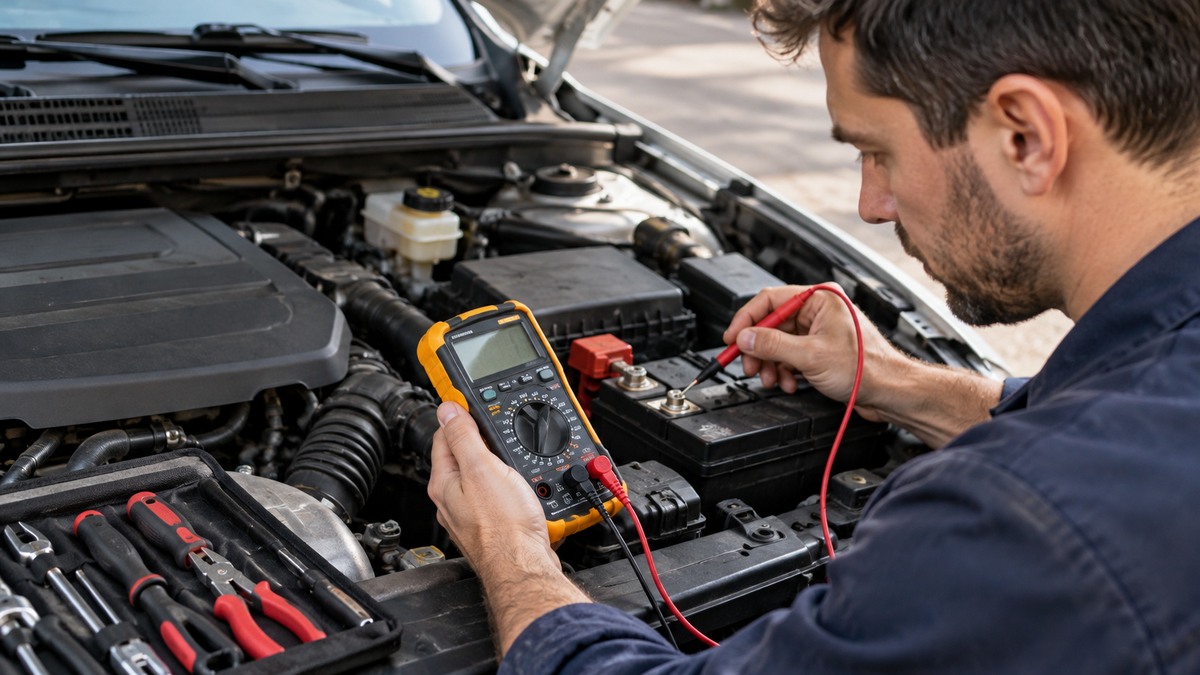
How to Choose a Multimeter for Automotive Work
As an Amazon Associate we earn from qualifying purchases.
How to choose a multimeter for automotive work depends on three jobs: reading battery voltage with the engine off, checking the charging system with the engine running, and measuring small voltage drops in starting and charging circuits. Each job needs a DC volts range, and the charging checks also need an AC range for alternator ripple. Current readings need a separate input with a stated limit. The sources we opened give reference values for these jobs, but many listings do not state the ratings you need, so this guide marks those gaps as it goes.
Electrical safety first
Work on mains circuits can kill. Before you measure anything, check that the meter’s CAT rating suits the circuit you are testing, and read the rating from the listing or the manufacturer’s manual. Panel and service work belongs to a licensed electrician. This guide covers low-voltage and bench work only: batteries, DC starting and charging circuits, cables, and switches.
CAT describes the overvoltage category a meter is built for. Fluke advises choosing “a tool rated for the highest category you could potentially use it in,” and warns about “transient overvoltage” spikes. Fluke’s safety article also says that shock occurs when the human body becomes part of an electrical circuit.
The OSHA booklet text, as reproduced on electrical-contractor.net, notes that less than 100 milliamperes separates a current that is barely perceptible from one that can kill. For that reason, every method in this guide stays at low voltage.
Battery work has its own hazards. Ohio State University Extension advises: “Always make the negative/ground connection first, then the live connection.” The same sheet says to keep sparks and flames away from the battery, that ventilation is important in the battery area, and that splash-protection eye protection should be worn when inspecting or cleaning a battery.
This guide does not cover airbag circuits or the high-voltage systems of hybrid and electric vehicles. The sources we opened do not cover those systems.
Quick answer
- Check that the listing or manual states a CAT rating that suits the work. One listing we opened, for an Extech MN35, states “CATII – 600V” for that model.
- Choose a meter with a DC volts range for battery and charging readings.
- Choose a meter with an AC range if you plan to check alternator ripple.
- Read the DC current input limit and the fuse rating on the listing before you measure current.
How we chose
The criteria come from the jobs the sources describe: battery voltage with the engine off, charging voltage with the engine running, alternator ripple, and voltage drop in starting and charging circuits. A page counted as a source only when we opened it with curl, found each quoted sentence in the fetched text, and the page supported the claim it was used for. We opened 16 pages that returned readable text and used 12 of them. Seven pages returned HTTP 403 and were not counted, and two more gave no usable text. Four opened pages were dropped because their text did not contain the quoted lines or the claim was not needed. The 12 pages used are listed in the list at the end of this guide.
What the job needs from a meter
DC volts for battery and charging
Battery checks start on a DC volts range. Fluke’s battery article sets the meter to DC volts (VDC) and then reads the voltage across the battery terminals. Charging readings also use DC volts, because the charging system’s output is a DC value with a small AC component on top.
AC range for alternator ripple
Fluke describes alternator ripple voltage as the small AC component that sits on top of the charging system’s 14-volt DC output. A ripple check therefore needs an AC volts range, and the listing should state that range. The sources we opened do not say which AC range a particular listing offers, so check the specification table before you buy.
Current input and fuse
Current readings use a separate input, and that input has a stated limit. The Extech MN35 listing states DC current to 10A for that model. Klein’s replacement fuse listing for a 6×32, 10 A, 600 V fuse (part 69032) says it is for use with its MM300, MM325, MM400, MM420 and MM450 meters. A second Klein fuse, part 69033 (5×20, 500 mA, 600 V), is listed for the MM400, MM420 and MM450. Use the fuse type that your own meter’s manual names.
Counts and other specifications
The listings we opened do not state counts for the meters they describe. The sources also do not explain what counts mean for resolution, so this guide does not rank meters by count. When a listing does not state a CAT rating, treat the missing rating as a gap and check the manual before use.
Preparation
- Read the CAT rating, the voltage rating and the current input limit on the listing or in the manual. Not every listing states a CAT rating.
- For voltage checks, put the black lead in COM and the red lead in the V/Ω jack.
- Take battery readings with the vehicle off first. If the car was recently running, Fluke suggests turning the headlights on for about 1 minute and then off to remove surface charge.
- Keep the battery area ventilated, keep sparks and flames away, and wear eye protection when you inspect or clean the battery.
Step 1: battery voltage with the engine off
- Turn the dial to DC volts (VDC).
- Optional: turn on the headlights for about 1 minute, then turn them off, so that the surface charge does not affect the reading.
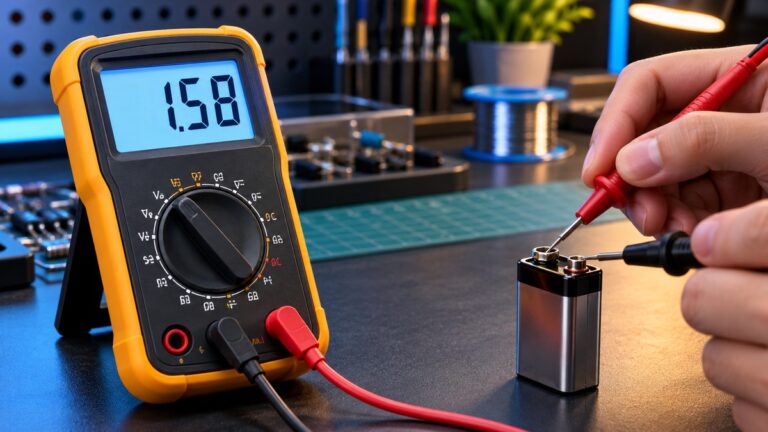
- Touch the red lead to the positive (+) terminal and the black lead to the negative (−) terminal. Read the display.
Fluke gives these reference values for a battery with the engine off: about 12.6 V when fully charged, about 12.4 V at about 75 percent, and about 12.2 V at about 50 percent. It says a reading below 12.0 V is “likely discharged or weak.” Fluke also says to “Always check voltage before load testing a battery.” The sources we opened do not give a load test procedure, so this guide stops at the voltage reading.
Step 2: charging voltage with the engine running
Start the engine and repeat the reading at the battery terminals. Fluke says a good alternator should produce 13.7–14.7 V under normal conditions, and that a reading above 13.0 V with the engine running indicates charging voltage. Ratwell gives a narrower figure of 13.8–14.2 V with the lights on. The two sources do not agree, so this guide shows both figures instead of picking one.
Step 3: alternator ripple with an AC range
Switch to an AC volts range while the engine is running. Fluke’s common automotive testing article says that “a healthy alternator usually shows less than 0.5 V AC.” A second Fluke article places a caution zone at 0.05 to 0.10 V AC and a fault range at 0.30 to 0.50 V AC or more, which it says usually indicates at least one bad diode. The two Fluke articles give different thresholds, and neither cites a standard. The sources we opened do not give a full ripple measurement procedure, so the reference values here apply only once you have an AC reading.
Step 4: voltage drop in starting and charging circuits
Fluke’s starter circuit article gives an acceptable total drop of 0.2 to 0.5 V, with about 0.3 V on the positive side and 0.2 V or less on the ground side. It advises using MIN/MAX to capture the reading during a crank of 4 to 5 seconds. Fluke says that a drop above that range “suggests corrosion, loose terminals, or damaged cables.” It also notes that “slow cranking or intermittent starting often points to excessive resistance in a vehicle’s starter circuit.”
For the charge wire, MSD’s rule of thumb is no more than a 0.50 V drop, with a 0.25 V drop as ideal.
Reading the results
The table compares the reference values from each source. Where two sources differ, both are shown.
| Check | Source reading | Other source reading |
|---|---|---|
| Battery, engine off, about 12.0 V | Fluke: below 12.0 V is likely discharged or weak | Ratwell: 12.0 V is about 25 percent charged |
| Battery, engine off, about 12.35 V | Fluke: about 12.2 V is about 50 percent charged | Ratwell: 12.35 V is about 50 percent charged |
| Charging voltage, engine running | Fluke: 13.7–14.7 V | Ratwell: 13.8–14.2 V with the lights on |
| Alternator ripple (AC) | Fluke common automotive article: less than 0.5 V AC for a healthy alternator | Fluke ripple article: fault range of 0.30 to 0.50 V AC or more |
| Starter circuit total drop | Fluke: 0.2 to 0.5 V acceptable | No other source opened gives this figure |
| Charge wire drop | MSD: no more than 0.50 V, 0.25 V ideal | No other source opened gives this figure |
A reading outside these values is a reason to check further, not a diagnosis. Fluke says to “Combine this test with ripple voltage and voltage drop tests for a complete system diagnosis.”
Common mistakes
- Load testing before the voltage check. Fluke says to “Always check voltage before load testing a battery.”
- Reading ripple without an AC range. Ripple is the AC part of the charging output, so an AC range is needed for that reading.
- Measuring current without checking the input limit. The Extech MN35 listing states 10A DC for that model, and the limit on your meter is what matters.
- Making battery connections in the wrong order. Ohio State says to make the negative/ground connection first.
- Stopping at one high drop. Fluke links a high drop to corrosion, loose terminals or damaged cables, so those points should be checked next.
Buying checklist
- A CAT rating, stated on the listing or in the manual, that suits the highest category you may need.
- A DC volts range and an AC volts range.
- A DC current input with a stated limit, plus the fuse type named in the manual.
- A replacement fuse part number that you can confirm on the manufacturer or retailer listing.
- Whether the listing mentions a backlight or auto-ranging. The sources do not say whether those features help in an engine bay, so treat them as preferences.
FAQ
Do I need a true RMS meter for car work?
The sources we opened do not say that every car check needs a true RMS meter. They do show that ripple is an AC value, so an AC range is required for that check.
What voltage should a healthy car battery show?
Fluke gives about 12.6 V for a fully charged battery with the engine off. Ratwell places 12.35 V at about 50 percent charge, while Fluke places about 50 percent near 12.2 V, so the two pages do not match at that point.
What should the charging voltage be with the engine running?
Fluke says 13.7–14.7 V under normal conditions. Ratwell gives 13.8–14.2 V with the lights on. Both figures are shown because the sources disagree.
Is a 10 A current input enough for every car circuit?
The sources do not say. The Extech MN35 listing states DC current to 10A for that model, and Klein lists a 10 A replacement fuse for several of its meters. Check the stated limit on your own meter before you measure current in any circuit.
Which CAT rating do I need for a car?
The sources we opened do not name a CAT rating for automotive work. Fluke advises choosing the highest category you could potentially use the meter in. For low-voltage battery and bench work, use the rating stated on the listing or in the manual.
Can I use a multimeter on household outlets?
No. This guide covers low-voltage automotive work only. Outlet and panel checks fall outside its scope, and a licensed electrician should handle them.
What we could not verify
The sources we opened do not cover every point this guide might need, so the following items are gaps, not facts:
- The Klein fuse listings do not state a meter’s CAT rating, and we did not open a full specification table for any meter used as an example.
- No source we opened gives a full ripple measurement procedure, and the two Fluke ripple thresholds differ.
- Battery and charging reference values differ between Fluke and Ratwell, and the sources we opened do not cite a standard for these values.
- The sources do not say what counts mean for resolution, or whether auto-ranging or a backlight helps in an engine bay.
- The sources we opened do not cover airbag circuits or hybrid and electric vehicle high-voltage systems.
- Two Fluke PDF manuals we opened did not contain the quoted lines in readable text, so they are not cited.
Bottom line
Choose a meter whose listing states a CAT rating, DC and AC ranges, and a current input limit that suit the job. Then use the reference values in this guide as a starting point for further checks.
For a general buying guide, see our multimeter roundup. For a meter aimed at battery checks, see the battery voltage tester comparison. For car wiring, see the automotive wire tracer guide.
Sources
- Fluke, multimeter safety guide: https://www.fluke.com/en-us/learn/blog/safety/multimeter-guide
- Fluke, how to test a battery with a multimeter: https://www.fluke.com/en-us/learn/blog/digital-multimeters/how-to-test-a-battery-with-a-multimeter
- Fluke, how to test alternator ripple voltage: https://www.fluke.com/en-us/learn/blog/digital-multimeters/how-to-test-alternator-ripple-voltage-with-a-multimeter
- Fluke, common automotive testing with a multimeter: https://www.fluke.com/en-us/learn/blog/digital-multimeters/common-automotive-testing-with-a-multimeter
- Fluke, starter circuit voltage drop: https://www.fluke.com/en-in/learn/blog/digital-multimeters/how-to-check-starter-circuit-voltage-drop-with-a-multimeter
- Ohio State University Extension, AEX-892.2.02: https://ohioline.osu.edu/factsheet/aex-892202
- Extech, MN35 product listing: https://www.extech.com/products/mn35/
- Klein Tools, replacement fuse 69032 listing: https://www.kleintools.com/catalog/test-measurement-accessories/fuse-6×32-10a-600v-mm300400
- Klein Tools, replacement fuse 69033 listing: https://www.kleintools.com/catalog/test-measurement-accessories/fuse-5×20-500ma-600v-mm400
- MSD Ignition, how to test an alternator and wiring: https://www.msdignition.com/blog/post/how_to_test_an_alternator_and_wiring_check_your_charging_system/
- Ratwell, charging system tests: https://ratwell.com/technical/ChargingSystem.html
- electrical-contractor.net, OSHA publication 3075 text: https://www.electrical-contractor.net/ESF/Controlling_Elec_Hazards_1.htm