Voltage Tester for Home Use: How to Choose
As an Amazon Associate we earn from qualifying purchases. Details
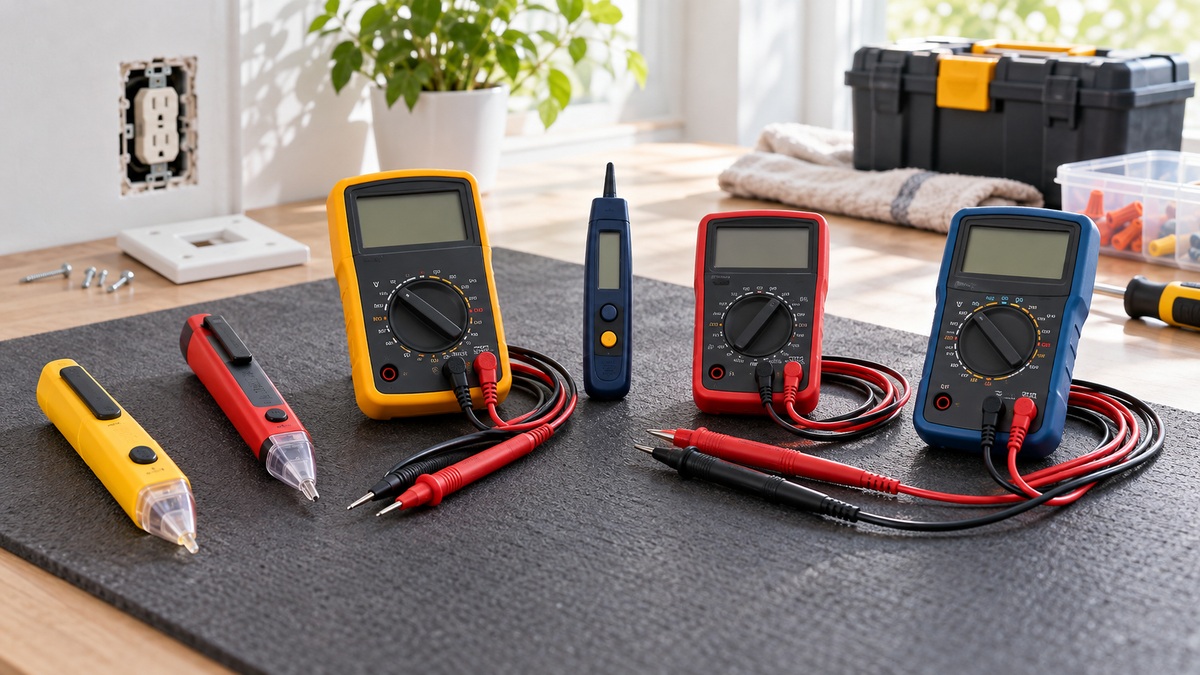
A home voltage tester should be sorted by measurement function before display features or accessories enter the choice. A pen detector, a non-contact checker, and a multimeter each answer a different question, so start by deciding whether you need a yes-or-no check or a numeric reading on outlets, cords, or appliances.
Keep every specification with the product that states it. A voltage range from one tester should not be assumed for another, and an included lead says nothing about the rating of the instrument. If a required range, probe arrangement, or operating detail is missing, confirm it before buying. Mains electricity can kill, so leave panel or service work to a licensed electrician.
Quick answer
For a voltage tester for home use, first decide whether the job needs contact measurement, non-contact detection, a clamp, or a powered circuit probe. Keep only instruments whose titles and listed functions match that method. Next compare the exact range, measurement type, power source, display, and included components stated for each surviving listing. Do not treat a detector as a measuring meter or assume that an automotive probe suits household wiring. If the required category or operating range is not stated, remove that listing until the current product page confirms it. The best choice is the one that documents the needed function while leaving the fewest job-critical questions unanswered.
Set the electrical task before comparing instruments
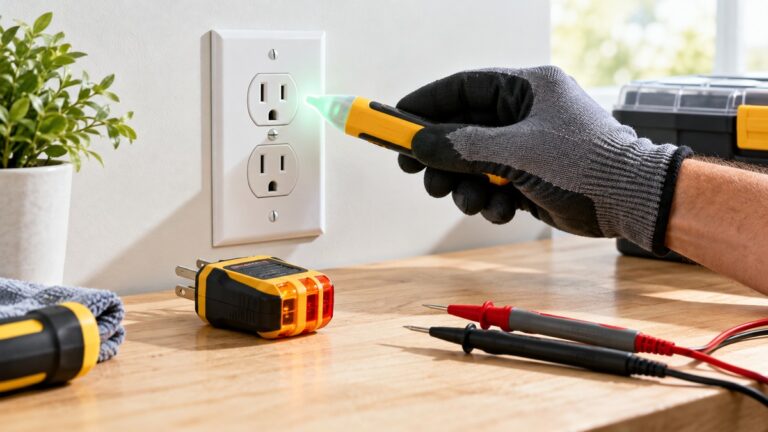
The phrase voltage tester for home use can hide several different jobs. Detection answers whether an electric field is present. Measurement returns a value. A clamp reads current without placing ordinary test leads in series, while a circuit probe may be designed around vehicle wiring. Write the required action in one sentence before considering extras. That sentence becomes the first exclusion test.
Range is the next filter. Compare a stated range with the intended circuit only after confirming that the units and measurement mode match. Never infer a category or maximum from a similar-looking model.
Finally, review power source, display, and supplied parts only after the primary measurement requirement passes. A backlight does not expand range, and included batteries do not establish circuit suitability.
Product choices that match the stated task
1. AstroAI Digital Multimeter Tester 2000 Counts with DC AC Voltmeter and Ohm Volt Amp Meter; Measures (Multimeter, 2000 counts)
Specs from the listing (checked 2026-10-11):
- Power Source: Battery Powered
- Style: compact
- Color: Blue
Pros
- The AstroAI listing states Power Source as Battery Powered.
- The AstroAI listing identifies Style as compact for this exact selection.
Cons
- For AstroAI, any required mode beyond its stated Power Source must be confirmed.
Best for: Readers who want a 2000-count multimeter for DC AC voltage and ohms
Skip if: Skip it when the intended job needs a mode or range not stated for this AstroAI product.
View on Amazon (affiliate link)
2. Klein Tools NCVT1P Voltage Tester, NCVT Pen, 50 to 1000V AC (Non-contact pen, 50-1000V AC)
Specs from the listing (checked 2026-10-11):
- Power Source: Battery Powered
- Style: NCVT
- Color: Orange/Black
Pros
- The KLEIN TOOLS listing states Power Source as Battery Powered.
- The KLEIN TOOLS listing identifies Style as NCVT for this exact selection.
Cons
- For KLEIN TOOLS, any required mode beyond its stated Power Source must be confirmed.
Best for: Readers who want a non-contact voltage pen covering 50 to 1000V AC
Skip if: Skip it when the intended job needs a mode or range not stated for this KLEIN TOOLS product.
View on Amazon (affiliate link)
3. Digital Multimeter Voltmeter Battery Voltage Multi Tester Continuity Ohm Volt Amp DC AC Current (Multimeter with leads, 2000 counts)
Specs from the listing (checked 2026-10-11):
- Power Source: Battery Powered
- Style: modern
- Color: Orange&Black
Pros
- The LJPXHHU listing states Power Source as Battery Powered.
- The LJPXHHU listing identifies Style as modern for this exact selection.
Cons
- For LJPXHHU, any required mode beyond its stated Power Source must be confirmed.
Best for: Readers who want a 2000-count multimeter with leads
Skip if: Skip it when the intended job needs a mode or range not stated for this LJPXHHU product.
View on Amazon (affiliate link)
4. Fluke 1AC II VoltAlert Non-Contact Voltage Tester, Pocket-Sized, 90-1000V AC, Audible Beeper, CAT (Pocket tester, 90-1000V AC)
Specs from the listing (checked 2026-10-11):
- Power Source: Alkaline
- Style: ACV DETECTOR 90-1000V
- Color: Red
Pros
- The Fluke listing states Power Source as Alkaline.
- The Fluke listing identifies Style as ACV DETECTOR 90-1000V for this exact selection.
Cons
- For Fluke, any required mode beyond its stated Power Source must be confirmed.
Best for: Readers who want a pocket-sized non-contact tester with an audible beeper
Skip if: Skip it when the intended job needs a mode or range not stated for this Fluke product.
View on Amazon (affiliate link)
5. Neoteck Non Contact Voltage Detector 12-1000V AC Voltage Tester (Non-contact detector, 12-1000V AC)
Specs from the listing (checked 2026-10-11):
- Power Source: Battery Powered
- Style: AC 12-1000V
- Color: Orange
Pros
- The Neoteck listing states Power Source as Battery Powered.
- The Neoteck listing identifies Style as AC 12-1000V for this exact selection.
Cons
- For Neoteck, any required mode beyond its stated Power Source must be confirmed.
Best for: Readers who want a non-contact detector covering 12-1000V AC
Skip if: Skip it when the intended job needs a mode or range not stated for this Neoteck product.
View on Amazon (affiliate link)
6. MXCOIRTP Voltage Tester, Non-Contact Voltage Detector, Electrical Tester, 3 Ranges AC (Non-contact detector, 3 AC ranges)
Specs from the listing (checked 2026-10-11):
- Power Source: Battery Powered
- Style: Compact
- Color: Orange
Pros
- The MXCOIRTP listing states Power Source as Battery Powered.
- The MXCOIRTP listing identifies Style as Compact for this exact selection.
Cons
- For MXCOIRTP, any required mode beyond its stated Power Source must be confirmed.
Best for: Readers who want a non-contact detector with 3 AC ranges
Skip if: Skip it when the intended job needs a mode or range not stated for this MXCOIRTP product.
View on Amazon (affiliate link)
7. TM-510 Digital Multimeter, 4000 Counts, Smart Measurement, Auto-Ranging Voltmeter; Voltage Tester (Auto-ranging, 4000 counts)
Specs from the listing (checked 2026-10-11):
- Power Source: Battery Powered
- Style: TM-510 Smart Digital Multimeter
- Color: Green
Pros
- The TESMEN listing states Power Source as Battery Powered.
- The TESMEN listing identifies Style as TM-510 Smart Digital Multimeter for this exact selection.
Cons
- For TESMEN, any required mode beyond its stated Power Source must be confirmed.
Best for: Readers who want an auto-ranging multimeter with 4000 counts
Skip if: Skip it when the intended job needs a mode or range not stated for this TESMEN product.
View on Amazon (affiliate link)
AstroAI: listing details
For a voltage tester for home use, the AstroAI is identified in its title as “AstroAI Digital Multimeter Tester 2000 Counts with DC AC Voltmeter and Ohm Volt Amp Meter; Measures Voltage, Current, Resistance, Continuity and Diode, Blue.” Its comparison fields are Power Source: Battery Powered; Style: compact; Color: Blue; Item Weight: 0.15 kg; Environmental Conditions: CAT II 600 V; CAT Ill 300 V. These entries establish only the functions and characteristics explicitly named for the AstroAI; unstated capabilities remain unknown.
Other recorded fields for the AstroAI are Pollution Level: 2; Temperature and Humidity: 32-104 ° F (0-40 °C);(<80% RH, <10 °C RH); Range Selection: Manual. For the AstroAI, a display description cannot substitute for a range. Keep the AstroAI when its named functions match the job; remove the AstroAI when a required mode is absent.
Before choosing the AstroAI, check the same variant and its included components. The AstroAI must stand on its own voltage, current, count, dimensions, and accessories. For the AstroAI, every unanswered mandatory field remains a practical limitation.
KLEIN TOOLS: listing details
For a voltage tester for home use, the KLEIN TOOLS is identified in its title as “Klein Tools NCVT1P Voltage Tester, NCVT Pen, 50 to 1000V AC.” Its comparison fields are Power Source: Battery Powered; Style: NCVT; Color: Orange/Black; Item Weight: 22.68 g; Measurement Type: Voltmeter. These entries establish only the functions and characteristics explicitly named for the KLEIN TOOLS; unstated capabilities remain unknown.
Other recorded fields for the KLEIN TOOLS are Style Name: NCVT; Item Dimensions: 5.5 x 0.72 x 1 inches; Specification Met: Cat Iv 1000v. For the KLEIN TOOLS, a display description cannot substitute for a range. Keep the KLEIN TOOLS when its named functions match the job; remove the KLEIN TOOLS when a required mode is absent.
Before choosing the KLEIN TOOLS, check the same variant and its included components. The KLEIN TOOLS must stand on its own voltage, current, count, dimensions, and accessories. For the KLEIN TOOLS, every unanswered mandatory field remains a practical limitation.
LJPXHHU: listing details
For a voltage tester for home use, the LJPXHHU is identified in its title as “Digital Multimeter Voltmeter Battery Voltage Multi Tester Continuity Ohm Volt Amp DC AC Current Resistance Diodes 2000 Counts Electrical Test Meter with Leads B.” Its comparison fields are Power Source: Battery Powered; Style: modern; Color: Orange&Black; Item Weight: 166 g; Measurement Type: Multimeter. These entries establish only the functions and characteristics explicitly named for the LJPXHHU; unstated capabilities remain unknown.
Other recorded fields for the LJPXHHU are Style Name: modern; Item Dimensions: 5.51 x 2.56 x 1.18 inches; Specification Met: Safety Standards Met. For the LJPXHHU, a display description cannot substitute for a range. Keep the LJPXHHU when its named functions match the job; remove the LJPXHHU when a required mode is absent.
Before choosing the LJPXHHU, check the same variant and its included components. The LJPXHHU must stand on its own voltage, current, count, dimensions, and accessories. For the LJPXHHU, every unanswered mandatory field remains a practical limitation.
Fluke: listing details
For a voltage tester for home use, the Fluke is identified in its title as “Fluke 1AC II VoltAlert Non-Contact Voltage Tester, Pocket-Sized, 90-1000V AC, Audible Beeper, CAT IV Rating.” Its comparison fields are Power Source: Alkaline; Style: ACV DETECTOR 90-1000V; Color: Red; Item Weight: 59 g; Voltage sensing ranges: Nominally, 90 V AC to 1000 V AC. These entries establish only the functions and characteristics explicitly named for the Fluke; unstated capabilities remain unknown.
Other recorded fields for the Fluke are Detector tip style: Flat-tip; Light source: One high intensity red LED; Batteries: 2 AAA alkaline batteries included; Typical battery life of greater than 1-year. For the Fluke, a display description cannot substitute for a range. Keep the Fluke when its named functions match the job; remove the Fluke when a required mode is absent.
Before choosing the Fluke, check the same variant and its included components. The Fluke must stand on its own voltage, current, count, dimensions, and accessories. For the Fluke, every unanswered mandatory field remains a practical limitation.
Neoteck: listing details
For a voltage tester for home use, the Neoteck is identified in its title as “Neoteck Non Contact Voltage Detector 12-1000V AC Voltage Tester.” Its comparison fields are Power Source: Battery Powered; Style: AC 12-1000V; Color: Orange; Item Weight: 65 g; Measurement Type: AC Voltage. These entries establish only the functions and characteristics explicitly named for the Neoteck; unstated capabilities remain unknown.
Other recorded fields for the Neoteck are Style Name: AC 12-1000V; Item Dimensions: 6.3 x 0.79 x 0.79 inches; Specification Met: CE. For the Neoteck, a display description cannot substitute for a range. Keep the Neoteck when its named functions match the job; remove the Neoteck when a required mode is absent.
Before choosing the Neoteck, check the same variant and its included components. The Neoteck must stand on its own voltage, current, count, dimensions, and accessories. For the Neoteck, every unanswered mandatory field remains a practical limitation.
MXCOIRTP: listing details
For a voltage tester for home use, the MXCOIRTP is identified in its title as “MXCOIRTP Voltage Tester, Non-Contact Voltage Detector, Electrical Tester, 3 Ranges AC 12V/48V/70V-1000V, Live/Null Wire Tester with Buzzer Alarm and Flashlight,.” Its comparison fields are Power Source: Battery Powered; Style: Compact; Color: Orange; Measurement Type: Voltmeter; Style Name: Compact. These entries establish only the functions and characteristics explicitly named for the MXCOIRTP; unstated capabilities remain unknown.
Other recorded fields for the MXCOIRTP are Warranty Description: 1 year warranty; Included Components: Voltage Tester. For the MXCOIRTP, a display description cannot substitute for a range. Keep the MXCOIRTP when its named functions match the job; remove the MXCOIRTP when a required mode is absent.
Before choosing the MXCOIRTP, check the same variant and its included components. The MXCOIRTP must stand on its own voltage, current, count, dimensions, and accessories. For the MXCOIRTP, every unanswered mandatory field remains a practical limitation.
TESMEN: listing details
For a voltage tester for home use, the TESMEN is identified in its title as “TM-510 Digital Multimeter, 4000 Counts, Smart Measurement, Auto-Ranging Voltmeter; Voltage Tester with Non-Contact Voltage Function, Measures AC/DC Voltage, Res.” Its comparison fields are Power Source: Battery Powered; Style: TM-510 Smart Digital Multimeter; Color: Green; Item Weight: 0.1 kg; Certification: CE, UKCA, RoHS. These entries establish only the functions and characteristics explicitly named for the TESMEN; unstated capabilities remain unknown.
Other recorded fields for the TESMEN are Altitude: < 2000 m; Working Environment: 0 ~ 40 ℃; Storage Environment: -10 ~ 60 ℃. For the TESMEN, a display description cannot substitute for a range. Keep the TESMEN when its named functions match the job; remove the TESMEN when a required mode is absent.
Before choosing the TESMEN, check the same variant and its included components. The TESMEN must stand on its own voltage, current, count, dimensions, and accessories. For the TESMEN, every unanswered mandatory field remains a practical limitation.
Compare voltage tester for home use fields without crossing categories
Build a worksheet with one row for each surviving product and one column for every mandatory requirement. Enter the seller’s wording, not a shortened interpretation. A row should fail when the title and fields do not confirm the core product type. This approach is stricter than ranking every listed item, but it avoids awarding points to an instrument that performs the wrong electrical task.
Keep measured values in their original units. If two products use different units or describe different modes, do not place the numbers in a single ranking. The larger figure may represent a different measurement altogether. Similarly, counts describe display resolution rather than an operating range, and physical dimensions describe the case rather than electrical capability.
Separate included equipment from supported functions. Test leads, clips, batteries, cases, and probes belong in a setup column. Measurement modes, ranges, and categories belong in capability columns. A generous accessory set cannot establish an unstated measurement mode. Conversely, a capable instrument may require a separate accessory; check the exact included-components field before ordering.
Unknown information deserves its own mark. Write “confirm” rather than yes or no when a necessary field is absent. If the unknown concerns the central electrical task, postpone that choice. If it concerns a convenience feature, compare the remaining verified fields and decide whether the uncertainty changes the result.
Three scenarios for voltage tester for home use
A reader who needs a stated measurement value
This reader should eliminate products described only as detectors. The shortlist must state the measurement type and a relevant range. The display then becomes useful because it presents the value, but screen style remains secondary to the supported electrical function. Any missing range should be checked on the exact product page rather than borrowed from another model.
best-voltage-tester-for-home-use-specific: ### A reader who needs a preliminary presence check
This reader may prefer a detector whose title and fields identify non-contact operation. That device answers a different question from a meter. It should not be presented as proof that a circuit is safe to touch or work on. best-voltage-tester-for-home-use-specific: Follow the manufacturer’s manual and qualified electrical guidance for the actual procedure, because the product listing alone cannot define a complete safety process.
Screening a voltage tester for home use shortlist
Multiplying 7 products by 3 positions gives 21 checks. Reversing the factors confirms the total: 3 positions multiplied by 7 products also gives 21 checks.
Assume 2 products fail the product-type position. Subtracting 2 from 7 leaves 5 products. Check the subtraction by adding the groups: 5 survivors plus 2 rejected products returns 7 products. Suppose 1 more listing lacks the required measurement mode. The remaining count is 5 minus 1, or 4. Verify it in reverse: 4 survivors plus 1 mode rejection equals 5 products from the previous step.
Now score documentation only. Give each survivor 4 points for a confirmed range and 2 points for confirmed included components. The maximum is 6 points per survivor because 4 plus 2 equals 6. Across 4 survivors, 4 multiplied by 6 equals 24 possible points. The reverse check produces the same result: 6 multiplied by 4 equals 24. This estimate does not decide electrical suitability; it simply favors the listing that answers the documented buying questions after incorrect product types have already been removed.
Mistakes that distort a voltage tester for home use comparison
Treating detection and measurement as synonyms
A detector may signal presence without reporting a measured value. A meter may report values through leads or a clamp. Choose the action first, then require the title and fields to support that action.
best-voltage-tester-for-home-use-specific: ### Moving a range from one product to another
Each voltage or current figure belongs only to its own listing and variant. best-voltage-tester-for-home-use-specific: Similar controls, colors, or housings do not make specifications interchangeable. Recheck the exact selection when a range decides the purchase.
best-voltage-tester-for-home-use-specific: ### Counting accessories as capabilities
An included lead, clip, case, or battery describes the package. It does not add an unstated measurement mode or category. Record accessories after the core function passes.
best-voltage-tester-for-home-use-specific: ### Reading counts as an electrical limit
Display counts and electrical ranges answer different questions. Keep them in separate columns and never rank them as though they shared a unit.
best-voltage-tester-for-home-use-specific: ### Ignoring the circuit context
Automotive tools, household detectors, clamp meters, and general multimeters are not automatic substitutes. Match the described environment and method to the planned task. When that match is not explicit, confirm it before selecting the instrument.
best-voltage-tester-for-home-use-specific: ## Related measurement guides
Review Best Klein Tool Voltage Tester How to Use when that neighboring tool type better matches the task. best-voltage-tester-for-home-use-specific: Review Best Fluke Non Contact Voltage Tester when that neighboring tool type better matches the task. best-voltage-tester-for-home-use-specific: Review Best Commercial Electric Voltage Tester How to Use when that neighboring tool type better matches the task.
FAQ
Does a non-contact detector replace a voltage tester for home use that reports values?
No. A detector and a measuring instrument answer different questions. Keep a detector when the job is a preliminary presence check and its stated voltage mode fits. Keep a meter when the job requires a numerical reading. Do not infer a measured value from an audible or visual detection signal, and verify the current listing when the exact mode is unclear.
Which stated range should control the choice?
Use the range attached to the required measurement mode on the exact product. An AC voltage range does not establish DC current capability, and a vehicle-oriented range should not be carried into a household task. When several ranges appear, preserve their labels. If the planned circuit falls outside a clearly stated range, remove that product from consideration.
Are included test leads enough to prove compatibility?
No. Included leads show what arrives with the package, not every circuit or task the instrument supports. First confirm product type, measurement mode, and range. Then verify that the listed leads or probes suit the intended connection. If connector type, probe rating, or compatibility is absent, check the exact product page and the manufacturer’s manual.
Is a higher display count always better for a voltage tester for home use?
No. Counts describe how the display resolves readings; they do not replace a suitable mode or range. A product with a larger count can still be wrong for the planned electrical job. Compare counts only after every product supports the required measurement and after the relevant range has been confirmed for the selected variant.
Can an automotive circuit probe be used as a household voltage tester?
Do not assume that substitution. Automotive probes in this comparison state vehicle-oriented functions or ranges, while household testers may describe different voltage modes and methods. Keep the two applications separate unless the exact product explicitly covers the intended environment. Follow the maker’s instructions and seek a qualified electrician when the procedure exceeds your training.
What should I do when two fields contradict each other?
Do not choose the more convenient value. Mark the range, dimension, component, or mode as unresolved and confirm the exact variant before buying. A contradiction is especially important when it affects the central measurement task. Other verified fields can remain in the comparison, but the disputed figure should not support the choice.
When should an electrician handle the task?
Use a qualified electrician whenever the job involves procedures or hazards beyond your competence. A product description can help compare stated functions, ranges, displays, and included parts, but it cannot establish a complete safe-work method. The manufacturer’s manual governs the device, and professional judgment governs work that should not be attempted by an unqualified user.
Bottom line
Choose a voltage tester for home use only after the exact product type, required measurement mode, and relevant range are all stated for the same selection. Use display features and included parts as tie-breakers, not as substitutes for electrical capability. Choose the listing that answers the job-critical questions directly, and set aside any product whose suitability depends on transferring a specification from another instrument.
Sources
- Electrical reference: supports the general direction to use qualified electrical guidance and follow safe procedures.