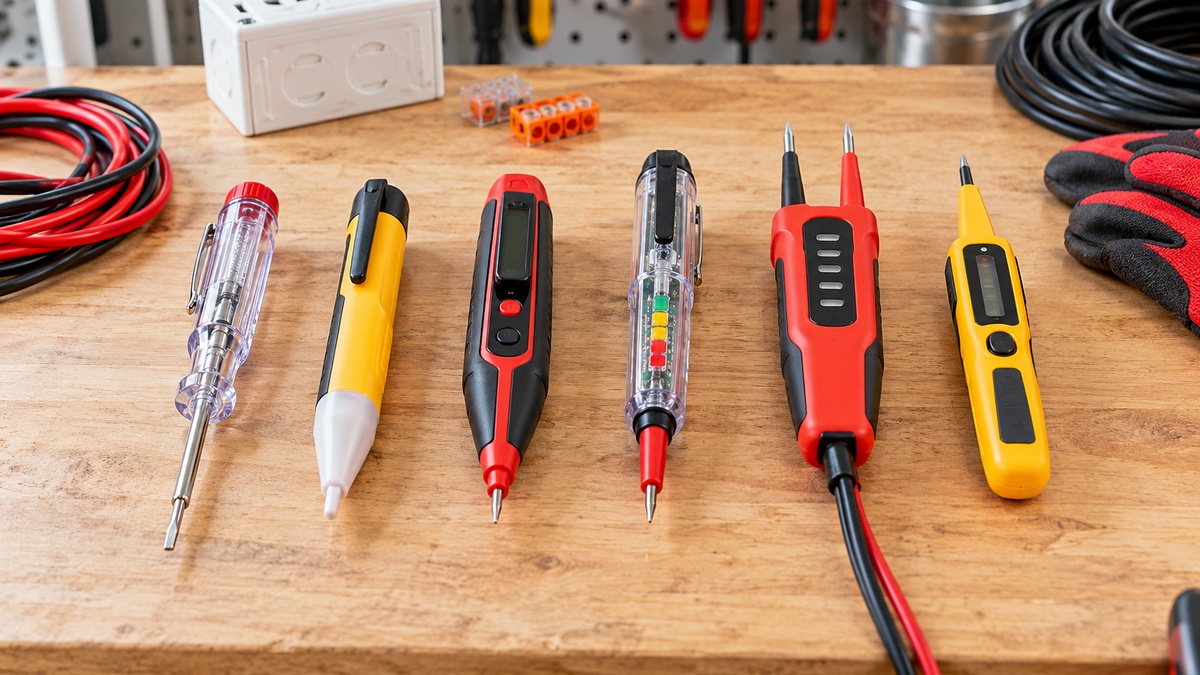
Best Voltage Indicator: How to Pick One
As an Amazon Associate we earn from qualifying purchases. Details
A voltage indicator in this group is one of two things: a non-contact pen that signals when AC voltage is near a wire or outlet, or a small panel meter or battery gauge that shows a DC voltage on a display. The two kinds answer different questions, so the first choice is which one you need. This page covers ten listings from one search, grouped by kind, and it shows the voltage ranges, sensitivity settings and included items that each listing states. Listing figures were checked on 11 October 2026.
Quick answer
For a pen that detects AC voltage without contact, the Klein NCVT1P gives 50 to 1000 volts AC, the Fluke 1AC II gives 90 to 1000 volts AC, and the Neoteck gives 12 to 1000 volts AC. For a display that shows a DC voltage, the Diymore and the bayite listings give 2.5 to 30 volts and 0 to 30 volts. For a 12 to 72 volt battery gauge, the JDIAG and the Exqutoo listings both name 48 volts among their stated settings. The Safpovel panel meter reads 5 to 36 volts DC and is for a panel mount.
Comparison table
| Listing (ASIN) | Type as listed | Voltage range stated | Alert or display stated | Included as listed |
|---|---|---|---|---|
| Klein NCVT1P (B099SJ6469) | Non-contact AC pen | 50 to 1000 V AC | Green LED on; red flash and beep | Instructions and 2 AAA |
| Neoteck PM8908C (B01JYCVU2Q) | Non-contact AC pen | 12 to 1000 V AC | Alarm tone and LED levels | 2 AAA |
| Fluke 1AC II VoltAlert (B000EJ332O) | Non-contact AC pen | 90 to 1000 V AC nominal | Red tip glow and beeper | Meter and 2 AAA alkaline |
| VENLAB VD-200 (B09ZXY4HVK) | Non-contact AC tester | 12 to 1000 V; 48 to 1000 V on low | Alarm and flashlight; LCD | Tester and 2 AAA |
| MXCOIRTP MT01 (B0D7LWBYVW) | Non-contact AC tester | 12, 48 and 70 to 1000 V AC | Buzzer alarm; three sensitivity modes | Voltage tester |
| Diymore mini voltmeter (B08RYPRZFF) | Two-wire DC display, 8 pack | 2.5 to 30 V DC | LED readout in four colors | Voltmeters |
| bayite three-wire voltmeter (B00YALV0NG) | Three-wire DC display, 5 pack | 0 to 30 V DC | Blue LED; calibration screw | Voltmeters |
| Safpovel panel voltmeter (B0DYSNXFYJ) | Round panel gauge, DC | 5 to 36 V DC | LED with three colors | Panel, wires with 10A fuse, terminals, screws |
| JDIAG battery meter (B0CBR5CWVR) | Battery level gauge | 12, 24, 36, 48, 60 or 72 V systems | Waterproof LED capacity indicator | Battery meter |
| Exqutoo battery meter, 2 pack (B0CQC1PP7K) | Battery level and voltage monitor | 12, 24, 36, 48 or 60 V systems | 8-segment level plus digital voltage | Two units |
How we chose these listings
The search returned ten products, and each is presented once. They fall into three groups. Non-contact pens and testers detect voltage near a wire or outlet without touching it. Display voltmeters show a DC voltage on a screen, either as a bare meter, a panel gauge or a battery gauge. Two of the listings, the Diymore and the bayite, are sold in packs of eight and five. The page keeps each pack as one line in the table, and it gives the number of units where the listing states it. No figure has been filled in from another listing.
Pens and testers: non-contact AC detection
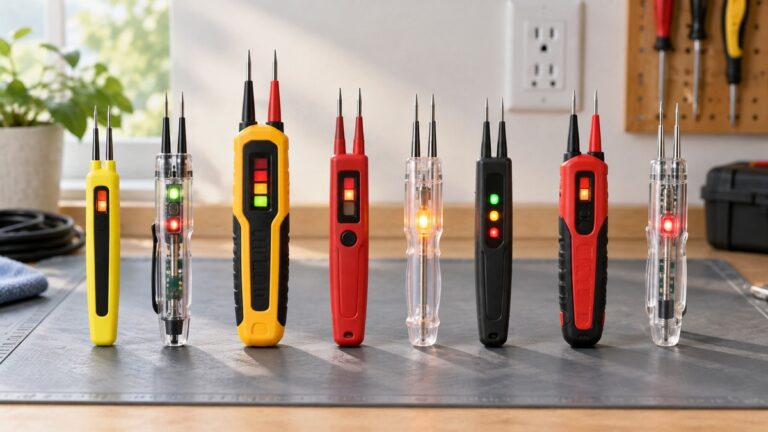
Non-contact pens are the closest thing in this group to a voltage indicator in the everyday sense. They tell you whether AC voltage is present in a cable, a breaker, a switch or an outlet, and they do not give a number. The listings state how they signal: a light, an alarm tone or both. Their ranges start at different voltages. The Klein NCVT1P starts at 50 volts, while the Neoteck, the VENLAB and the MXCOIRTP start at 12 volts. The Fluke 1AC II starts at 90 volts nominal. The starting figure matters for a low-voltage circuit, because a pen that starts at 50 volts will not respond to a 12 volt source.
1. Klein Tools NCVT1P Non-Contact Voltage Tester (B099SJ6469)
The Klein NCVT1P is a pen that detects AC voltage without contact in cables, cords, circuit breakers, lighting fixtures, switches, non-tamper-resistant outlets and wires. The bullets say a bright LED glows green to show the tester is working, and it flashes red and beeps when voltage is detected. The title gives 50 to 1000 volts AC. The included items are the instructions and two AAA batteries. The item weighs 22.68 grams and measures 5.5 by 0.72 by 1 inch. The warranty is listed as see the manufacturer website.
View the Klein NCVT1P listing on Amazon
2. Neoteck Non Contact Voltage Detector, PM8908C (B01JYCVU2Q)
The Neoteck pen has a title range of 12 to 1000 volts AC. Its bullets say you can tell the live wire from the null wire by a change in alarm sound and LED level. The listing includes a note that it is not suitable for testing Christmas lights, which is a useful limit to know before you buy. The bullets say the detection works without contact, so the tester does not need to touch the conductor. The included items are two 1.5V AAA batteries. The item weighs 65 grams and measures 6.3 by 0.79 by 0.79 inches. The listing gives an 18-month warranty.
View the Neoteck PM8908C listing on Amazon
3. Fluke 1AC II VoltAlert Non-Contact Voltage Tester (B000EJ332O)
The Fluke 1AC II gives a nominal voltage sensing range of 90 to 1000 volts AC. Its bullets say the tip glows red and a beeper sounds when voltage is detected, and that a continuous self-test lets you know the tester is working. The safety wording includes a CAT IV 1000 volt rating and a warning to be aware that voltage can be easy to miss. The specification field gives a typical battery life of more than one year, and the included items are the tester with two AAA alkaline batteries. The listing gives a 2-year warranty and an operating temperature figure in the bullets read. The item weighs 59 grams.
View the Fluke 1AC II listing on Amazon
4. VENLAB Voltage Tester, VD-200 (B09ZXY4HVK)
The VENLAB tester has two sensitivity settings. The title gives 12 to 1000 volts and 48 to 1000 volts, and the bullets say the high setting covers 12 to 1000 volts and the low setting covers 48 to 1000 volts. Switching between them is a choice made for the work you are doing. The tester has an alarm, a flashlight and an LCD display. The included items are the voltage tester and two AAA batteries. The item weighs 0.05 kilograms. The bullets describe it as the easiest way to check for current in a wire, outlet, switch or lamp that has stopped working.
View the VENLAB VD-200 listing on Amazon
5. MXCOIRTP Voltage Tester, MT01 (B0D7LWBYVW)
The MXCOIRTP tester has three ranges, 12 volts, 48 volts and 70 to 1000 volts AC, and its title also names a live and null wire tester, a buzzer alarm and a flashlight. The bullets describe three sensitivity modes. The tester starts in low sensitivity by default, with one buzz, and a press of the S button moves to medium, which gives two buzzes, and then to high. The listing names a wire breakpoint finder function in the title. The included items are the voltage tester alone, and the listing gives a 1-year warranty.
View the MXCOIRTP MT01 listing on Amazon
6. Diymore Mini Digital Voltmeter, 8 Pieces (B08RYPRZFF)
The Diymore listing is a pack of eight two-wire DC voltage displays. The bullets say the two-wire connection has reverse polarity protection, and they give DC measurement ranges by colour: 2.5 to 30 volts for the red unit, 2.6 to 30 volts for the yellow and green units, and 3.2 to 30 volts for the blue unit. Those figures differ, so the unit colour matters for a low voltage reading. The listing describes these as ideal for DIY voltage readouts. The specification fields give a count of 8 and a corded electric power source, which is not the usual power source for a two-wire display, so check the wiring on the product page.
View the Diymore listing on Amazon
7. bayite Three-Wire Digital Voltmeter, 5 Pieces (B00YALV0NG)
The bayite listing is a pack of five three-wire DC voltmeters with a blue LED. The bullets say the three-wire connection extends the measurement range to 0.00 to 30 volts, and that a two-wire meter cannot measure below about 3 volts. The stated accuracy is 0.01 volt for readings from 0.01 to 9.99 volts, and 0.1 volt for readings from 10.0 to 30.0 volts. The meter has a calibration screw on the back. The item weighs 4.54 grams and measures 0.9 by 0.55 by 0.39 inches. The model is listed as CECOMINOD000239.
View the bayite listing on Amazon
8. Safpovel Round Panel Voltmeter Gauge, DC 12V (B0DYSNXFYJ)
The Safpovel is a round digital voltmeter gauge for a panel. The bullets give a DC range of 5 to 36 volts, with an LED display and a stated accuracy of plus or minus 0.1 volt. Three color indicators show the voltage level, and the listing describes it for the battery of a vehicle, a boat or an RV. The panel mounting hole is listed as 29 millimetres in diameter. The included items are the voltmeter gauge, a panel, two wires with a 10A fuse, two insulated terminals and two screws. The material is ABS plastic with an LED display, and the model is SP-01-P.
View the Safpovel listing on Amazon
9. JDIAG Battery Level Meter, 12V to 72V (B0CBR5CWVR)
The JDIAG meter is a battery level gauge for systems from 12 to 72 volts, and the title says the voltage is freely selectable across 12, 24, 36, 48, 60 and 72 volts. The bullets say it measures the remaining charge of a battery-powered device, and they list uses that include golf carts, club cars, electric vehicles, boats, scooters and tour buses. The housing is described as waterproof, with an LED capacity indicator. The specification field lists the power source as battery powered and gives the included item as the battery meter itself. The meter is for the battery’s charge level rather than an exact voltage reading.
View the JDIAG listing on Amazon
10. Exqutoo Battery Indicator Voltage Meter, 2 Pack (B0CQC1PP7K)
The Exqutoo listing is two units that combine a battery level indicator with a voltage readout. The bullets say the battery level uses an eight-segment display, with two red and six green segments, and that a digital voltage is shown in the lower part. The title gives 12, 24, 36, 48 and 60 volt systems, and the listing describes it as a two-in-one monitor for a vehicle battery. The units are red, and the specification field lists the count as two.
View the Exqutoo listing on Amazon
Worked example: which gauge covers a 48 volt battery
Take a 48 volt golf cart pack. Check each DC display against that voltage. The Safpovel range is 5 to 36 volts, so 48 volts is above it. The Diymore range is 2.5 to 30 volts, and the bayite range is 0 to 30 volts, so both fall short. The JDIAG title lists 48 volts as a selectable system, and the Exqutoo title lists 48 volts among its systems. Those two are the only DC display or gauge listings in this group that name a 48 volt system.
The pens do not answer this question. They detect AC voltage without contact, so they do not read the DC voltage of a battery. The MXCOIRTP and VENLAB listings do state 48 volt settings, but those are AC detection ranges for live wires and outlets, not battery readings. Choose a display gauge for a battery and a pen for an AC wire.
What we could not verify
The listings do not give the same kind of figure. The pens give ranges and alarm types, the display meters give ranges and accuracy, and the battery gauges give system voltages without an accuracy figure. The Fluke and Klein safety categories are only partly stated, and the Diymore power source conflicts with its type. The JDIAG and Exqutoo listings do not say how the level segments map to a voltage. The Safpovel bullet gives a panel hole of 29 millimetres, and the body size in the specification field should be checked on the product page. The claims about waterproof housing and easy detection are seller statements, and this page does not confirm them.
Frequently asked questions
What is the difference between a voltage pen and a voltmeter display?
A pen detects AC voltage near a conductor without contact and signals presence with a light, a tone or both. A display voltmeter connects to a DC source and shows a voltage number. The listings in this group separate the two by their titles, and the page follows that split.
Which pens start at the lowest voltage?
The Neoteck, VENLAB and MXCOIRTP listings state a range starting at 12 volts. The Klein NCVT1P starts at 50 volts, and the Fluke 1AC II starts at 90 volts nominal.
Do any of the DC meters read below 3 volts?
The bayite three-wire meter does, because its bullets say the three-wire connection extends the range down to 0.00 volts. The bullets say a two-wire meter cannot measure below about 3 volts. The Diymore two-wire displays start at 2.5 volts for the red unit.
Which of these include a battery as part of the package?
The Klein NCVT1P, Neoteck, Fluke 1AC II and VENLAB include AAA batteries with the tester. The Diymore and bayite listings are the voltmeters themselves, and the Safpovel includes wires, terminals and screws rather than a battery. The battery gauges do not name a separate battery in the included items.
Can these tell me the exact state of charge of a battery?
The JDIAG and Exqutoo listings give a battery level, shown as segments or a capacity indicator, along with a voltage for the Exqutoo. The listings do not give an accuracy figure for the level, so treat the segments as a guide and check the battery’s own rating.
Conclusion
For a pen that signals AC voltage without touching the conductor, the Klein NCVT1P, Neoteck, Fluke 1AC II, VENLAB and MXCOIRTP each give a stated range, with the Fluke and Klein starting higher than the rest. For a DC voltage reading, the bayite and Diymore listings cover low voltages, while the Safpovel is a panel gauge. For a 48 volt battery, the JDIAG and Exqutoo listings name the system voltage directly. Check the range and the included items on each product page before you buy. For related pages on this site, see best battery voltage tester, best DC volt meter and best 12V tester light.
Listings on Amazon: Klein NCVT1P, Neoteck PM8908C, Fluke 1AC II, VENLAB VD-200, MXCOIRTP MT01, Diymore, bayite, Safpovel, JDIAG, Exqutoo.