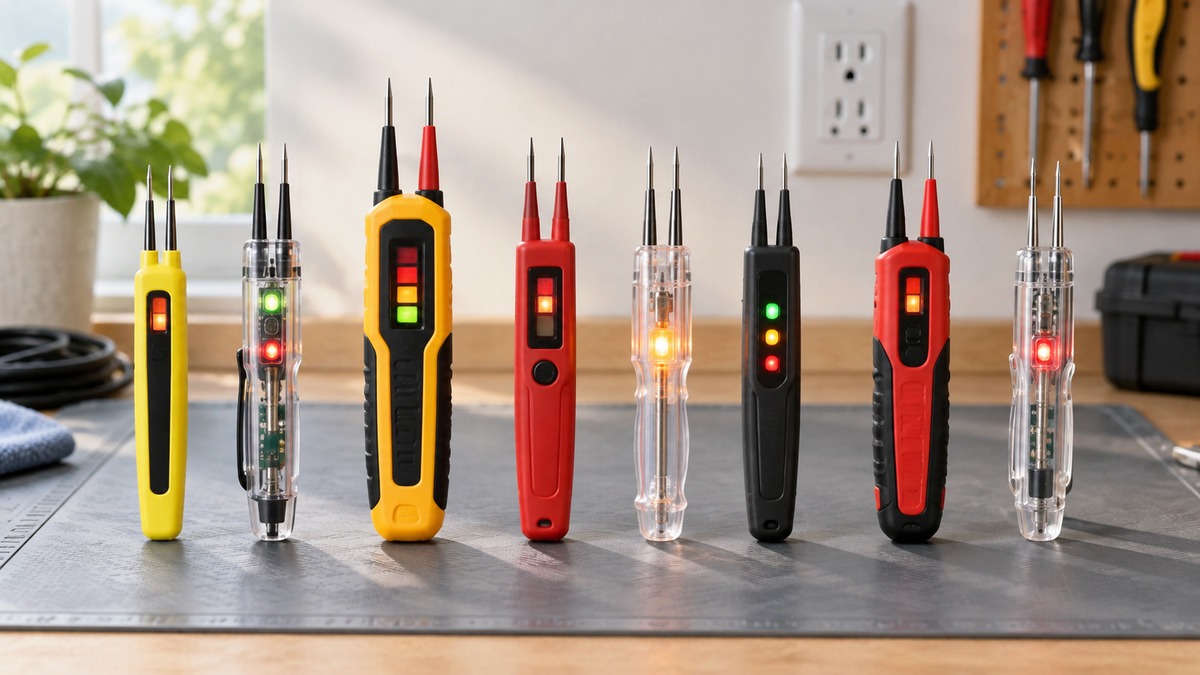
Voltage Testers Compared: 12 Listings
As an Amazon Associate we earn from qualifying purchases. Details
A two prong voltage tester is a handheld meter or pen that shows whether voltage is present between two points. The right choice depends on what each listing states: the voltage range and type, the safety rating, the power source, and the parts in the box. This guide compares 12 listed options, from two-pole and two-lead testers to non-contact pens and multimeters, and shows which stated detail can rule a product out before you buy.
Quick answer
- For a two-point check, start with the testers whose stated design is two-pole or two-lead: the C-Logic 350 and the two Klein AC/DC testers.
- Confirm that the stated range covers the voltage you need. The Klein ET60 lists 12 V to 600 V, and the Klein ET45 bullets list 24 V to 240 V AC.
- Non-contact pens in this guide are listed as detectors. Their records describe lights and alarms, not a numeric reading.
- Hold off on any record where the title and bullets disagree. The Klein ET45 and the Fluke 1AC II both need that check.
What a two prong voltage tester measures
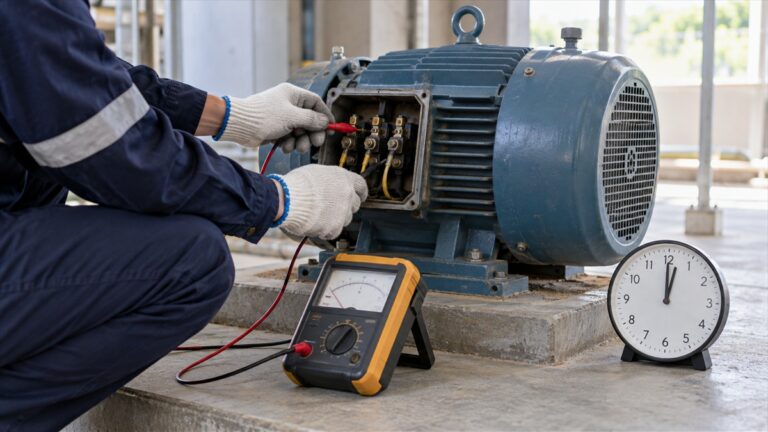
Voltage is a difference between two points. The Purdue Extension meter basics sheet describes it that way, using the positive and negative ends of a battery as the example, and it says the same measuring principles apply to a DC battery and to AC house wiring. That is why the records here name AC, DC or both, and why an AC-only listing should not be used for a DC battery check.
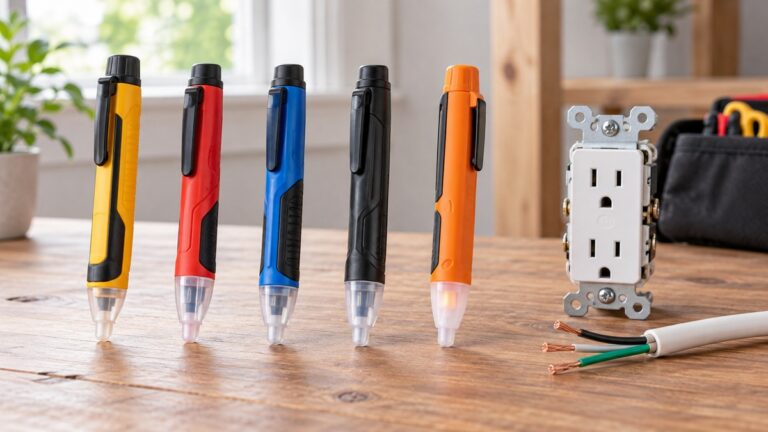
Two-pole and two-lead testers take their reading or indication between two contact points. A non-contact pen works differently. Its listing describes detecting AC voltage without a contact connection, and its bullets describe lights and alarms rather than a number. A multimeter sits in a third group: it shows values for several functions, and its record lists those functions and ranges.
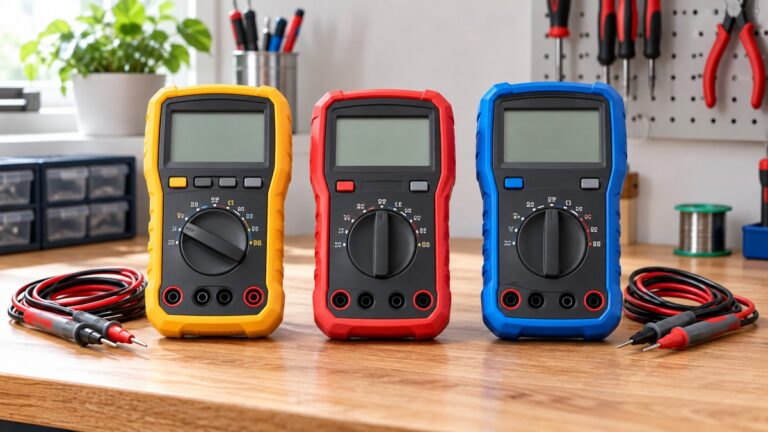
Multimeters need a check at setup. One AstroAI bullet warns that a meter may show no result if the test leads are not fully seated in the correct sockets or the rotary switch is in the wrong position. Check both before you read a value.
Sort each tester into one of these three groups first. A pen, a two-pole tester and a multimeter answer different questions, so a comparison across groups is not a like-for-like comparison.
Read the listing fields in this order
Work through the stated fields in a fixed order, and stop at the first conflict you cannot resolve.
- Type and kind of voltage. Confirm whether the record says AC, DC or both. The C-Logic 350 bullets describe AC detection, so check its kind before you buy.
- Voltage range. Use the numeric figures in the bullets or the specification table. When the title and bullets differ, use the bullets and flag the difference, as this guide does for the Klein ET45.
- Safety rating. Read the category and voltage the record states, such as CAT IV 600 V on the Klein ET60 or CAT III 1000 V on the FS899L. This guide does not define what each category means, and the sources it opened do not cover that.
- Power source. Battery, alkaline, hand-powered and voltage-powered testers work differently, and the difference affects what you need before the first use.
- Parts supplied. Check whether leads, batteries and a manual are listed as included. The records do not always agree: the AstroAI record lists a 9V battery in one field and 2 AAA batteries in its power field.
Stated ranges in one table
The table gives the voltage figures and types each record states. Where a record gives no numeric range, the table says so. These are record statements, not measured results.
| Listing | Stated type | Stated voltage figures | Power (as stated) |
|---|---|---|---|
| AstroAI multimeter | Multimeter | AC ranges 200 V and 600 V; DC ranges from 200 mV to 600 V | Battery powered |
| Klein NCVT1P | Non-contact pen | 50 V to 1000 V AC | Battery powered |
| LJPXHHU XL830L | Multimeter | No numeric range stated | Battery powered |
| Fluke 1AC II | Non-contact pen | 90 V to 1000 V AC; bullets also give 200 V to 1000 V AC | Alkaline |
| WINAMOO | Automotive voltage pen | 3 V to 48 V systems | Corded electric (as stated) |
| ZMIWNIED FS899L | True RMS multimeter | CAT III 1000 V and CAT IV 600 V ratings; no numeric AC range stated | Battery powered; USB-C rechargeable per bullets |
| Neoteck PM8908C | Non-contact pen | 12 V to 1000 V AC | Battery powered |
| C-Logic 350 | Two-pole tester | AC levels 12 V, 24 V, 50 V, 120 V, 230 V and 400 V | Shown as Ac, DC; bullets say battery-free |
| Klein ET60 | AC/DC voltage tester | 12 V to 600 V in nine levels | Hand powered (battery-free) |
| Klein ET45 | AC/DC voltage tester | AC 24 V to 240 V and DC 32 V to 330 V in bullets; title gives 12 V to 240 V AC | Voltage powered (battery-free) |
| Sperry ET6204 | Four-range voltage tester | 80 V to 480 V AC or DC | Battery powered |
| Ideal 61-025 | Non-contact pen | 40 V to 1000 V AC | Battery powered |
The AstroAI record also states figures that the table does not show: an item weight of 0.15 kg; CAT II 600 V and CAT III 300 V in its environmental conditions; an operating temperature of 0 to 40 °C (32 to 104 °F), with a humidity limit stated as below 80% RH; fuse protection of 250 mA/250 V and 10 A/250 V; a 2000-count display; and DC ranges of 200 mV, 2 V, 20 V, 200 V and 600 V. Its record also states a power supply of 2 x 1.5 V AAA batteries.
Three rows need a second look. The Klein ET45 title and bullets disagree on the AC floor, the Fluke 1AC II bullets give two AC floors, and the WINAMOO power entry reads corded electric while its bullets describe a voltage pen. The section on what we could not verify covers each one.
Calculations from the stated figures
These sums use only the table. They show how far apart the records are. They do not show accuracy, and a wider range is not a better tester by itself.
- Lowest AC floors. The Klein ET60 and the C-Logic 350 both state a floor of 12 V, and the Sperry ET6204 states 80 V. The Sperry floor is 68 V above the Klein floor (80 minus 12 equals 68), so the Sperry cannot cover the lower checks that the Klein range includes.
- Conflict size on the Klein ET45. The title floor is 12 V and the bullet floor is 24 V, a gap of 12 V (24 minus 12 equals 12). This guide uses the bullet figure and treats the title figure as unconfirmed.
- Headroom at a limit. The Klein ET45 AC range stops at 240 V, so a 240 V reading sits exactly at its stated limit (240 minus 240 equals 0). Anything above that is outside the stated range.
- Spacing of the top levels. The last two C-Logic levels are 230 V and 400 V, which are 170 V apart (400 minus 230 equals 170). Its listing describes levels rather than a continuous value, so a reading between two levels is not described.
- Width of a range. The Klein ET60 range spans 588 V (600 minus 12 equals 588), the Fluke 1AC II main range from 90 V to 1000 V spans 910 V (1000 minus 90 equals 910), and the Ideal 61-025 spans 960 V (1000 minus 40 equals 960). A wide range helps only when the job needs the top of it.
- Display counts. The FS899L lists 6000 counts and the AstroAI lists 2000 counts, so the FS899L shows three times as many counts (6000 divided by 2000 is 3). A higher count does not replace the accuracy figure in each record.
Where each type fits
Two-point checks. The C-Logic 350 is a two-pole design listed for AC from 12 V to 400 V, with CAT III 400 V in its record and no batteries. The Klein ET60 and Klein ET45 are AC/DC testers, and their bullets describe lead holders on the back spaced for tamper-resistant US-style outlets. The Sperry ET6204 has four ranges from 80 V to 480 V AC or DC, and its bullets describe snap-in leads spaced to fit a standard outlet. For other Klein detectors, see Best Klein Tools Voltage Detector.
Presence checks. The Klein NCVT1P, Fluke 1AC II, Neoteck and Ideal 61-025 are non-contact pens. Their stated floors run from 12 V on the Neoteck to 90 V on the Fluke, and their records describe light and sound alerts. The Neoteck adds a flashlight for dim outlets and switches, and its listing says it is not suitable for Christmas light testing. For more non-contact models, see Best Fluke Non Contact Voltage Tester.
Readings. The AstroAI multimeter, the LJPXHHU XL830L and the ZMIWNIED FS899L show values rather than alerts. The FS899L is the only one of these whose title states true RMS and whose bullets describe a color screen, and it lists CAT III 1000 V and CAT IV 600 V ratings.
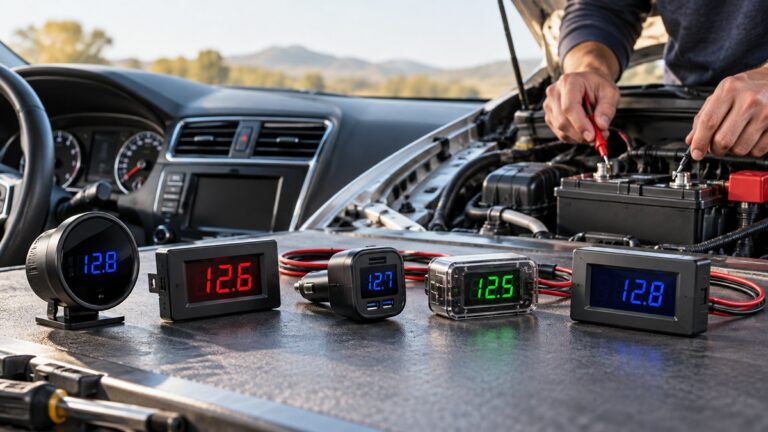
Low-voltage automotive checks. The WINAMOO pen lists a 3 V to 48 V range for car, truck, SUV and boat systems, and it has a polarity light. Its bullets are written for automotive circuits, so a household outlet check is outside what the record describes.
For a different question, how much voltage is lost along a wire run, see Best Voltage Drop Tester.
Safety basics before you probe
Read these points before any check, including one that a listing describes as simple.
- OSHA’s electrical work rule for equipment that must be de-energized says a qualified person must use test equipment to test circuit elements and electrical parts and verify that they are de-energized. The same rule says the test must also check for energized conditions caused by inadvertently induced voltage.
- OSHA’s general electrical requirement says listed or labeled equipment must be installed and used in line with the instructions included in its listing or labeling. For a tester, read the manual and follow its limits before you use it.
- OSHA’s electrical overview says the electrical standards protect workers from electric shock, electrocution, fires and explosions.
- The Purdue sheet warns that working with live circuits can be very hazardous without proper tools and safeguards, and it advises moving cautiously while probing circuits.
These sources describe work practices and equipment use. None of them gives a step-by-step method for a household outlet, and this guide does not give one. If the check involves a service panel, a wiring fault or an unexpected reading, leave the task to a licensed electrician.
Common mistakes
- Reading a non-contact pen as a numeric meter. Its records describe alerts and lights.
- Choosing by the highest stated number. A 1000 V ceiling does not help a 12 V check when the floor is 50 V, as on the Klein NCVT1P.
- Mixing title and bullet figures. Compare the same field in each place, and flag any mismatch.
- Assuming a battery or lead is included because a bullet mentions it. The records do not always agree, so check the included components field too.
- Treating a stated rating as the end of the safety check. A rating describes the tester only, and the listing’s instructions still apply.
How we chose
Each of the 12 picks comes from a listing record with a title, brand, product link, bullet points and a specification table. Those records were checked between 2026-10-11 and 2026-10-16. They cover the C-Logic 350, the Klein ET60, the Klein ET45, the Sperry ET6204 and the Ideal 61-025, along with seven other tools.
Each record was kept under three rules:
- The listing names a voltage tester, voltage detector or multimeter that reads AC voltage.
- The bullets or the specification table state at least one figure for voltage range, safety rating, power source or included parts.
- Every figure in this guide comes from that record. No figure comes from outside it.
Products are grouped by type rather than ranked. Non-contact pens and multimeters stay in the list with their type labelled, because choosing between a pen and a two-point tester is part of the decision. A pen is not a two-point tester, and the table and the cards say so.
What we could not verify
The sources we opened and the listings do not settle the following points. Each one is a reason to check the current listing or the manufacturer’s manual before you buy.
- Whether a stated range fits a specific outlet, panel or circuit. Ranges are listing figures, not in-use results.
- The Klein ET45 floor. The title says 12 V to 240 V AC and the bullets say 24 V to 240 V AC. This guide uses the bullets, and the 12 V figure stays unconfirmed.
- The Fluke 1AC II setting. Its bullets give 90 V to 1000 V AC and 200 V to 1000 V AC, and the record does not say which applies to which use.
- The WINAMOO power source. The record says corded electric, while its bullets describe a voltage pen with battery load testing features.
- The C-Logic 350 power field. It reads Ac, DC, while the bullets describe AC detection and no batteries.
- The AstroAI battery type, which the power field and the included components field state differently.
- A numeric voltage range for the LJPXHHU XL830L and a numeric AC range for the ZMIWNIED FS899L. Neither record gives one.
- What each CAT category means. This guide repeats the ratings the records state, but it does not define the categories, and the sources opened do not do so.
- Warranty terms, certification marks and durability statements. These are the listing’s own claims, and this guide does not check them.
The picks and who each one fits
Each card below gives the specification fields the record states, then the pros and cons taken from its bullets, and the case where that pick does not fit.
1. C-Logic 350 Two-Pole Voltage Tester 12-400V, CAT III 400V (Two-pole AC tester, battery-free)
Specs from the listing (checked 2026-10-16):
- Power Source: Ac, DC
- Included Components: Voltage Tester, User Manual
- Model: CLOGIC350
Pros
- Two-pole design takes its reading across two contact points.
- Battery-free operation, so nothing needs replacing before use.
- Stated levels run from 12 V to 400 V, including 120 V and 230 V.
Cons
- Bullets describe AC detection only, so DC checks are outside the record.
- The power field reads Ac, DC, which does not match the battery-free bullets.
Best for: Buyers who want a battery-free two-point AC check with LED indication.
Skip if: Skip it when you need a numeric DC reading, because the record describes AC detection with LED indication.
View on Amazon (affiliate link)
2. Klein Tools NCVT1P Voltage Tester, NCVT Pen, 50 to 1000V AC (Non-contact AC pen, 50 V to 1000 V)
Specs from the listing (checked 2026-10-11):
- Power Source: Battery Powered
- Specification Met: Cat Iv 1000v
- Included Components: Instructions and 2 x AAA 1.5 Volt Batteries
Pros
- Stated AC detection range runs from 50 V to 1000 V.
- The specification field lists CAT IV 1000 V.
- Auto power-off is listed to conserve batteries.
Cons
- Its stated range starts at 50 V, so lower voltages fall outside it.
- It signals with light and sound, not with a numeric reading.
Best for: Buyers who want a pocket non-contact check of AC voltage above 50 V.
Skip if: Skip it for 12 V or 24 V circuits, because the stated floor is 50 V.
View on Amazon (affiliate link)
3. Digital Multimeter Voltmeter Battery Voltage Multi Tester Continuity Ohm Volt Amp DC AC Current (Backlit multimeter with leads and stand)
Specs from the listing (checked 2026-10-11):
- Power Source: Battery Powered
- Specification Met: Safety Standards Met
- Included Components: multimter
Pros
- Bullets state AC and DC voltage, current, resistance, continuity and diode checks.
- A backlit 2.7-inch display helps in dim light.
- Bullets say a 2-year guarantee and a 9V battery are included.
Cons
- The record gives no numeric AC range, so it cannot be compared line by line.
- The included components field reads only multimter, while the bullets list leads and a manual.
Best for: Buyers who want a general multimeter with a stand, not a two-point tester.
Skip if: Skip it when you need a stated AC range for a two-point check.
View on Amazon (affiliate link)
4. Fluke 1AC II VoltAlert Non-Contact Voltage Tester, Pocket-Sized, 90-1000V AC, Audible Beeper, CAT (Pocket non-contact AC detector, 90 V to 1000 V)
Specs from the listing (checked 2026-10-11):
- Power Source: Alkaline
- Warranty Description: 2 years
- Included Components: Fluke-1AC-A1-II ACV Detector 90-1000V with 2 AAA Alkaline batteries
Pros
- The title and bullets state a 90 V to 1000 V AC range.
- The tip glows and a beeper sounds when voltage is detected.
- Audible and silent modes are both listed.
Cons
- Bullets also give a 200 V to 1000 V AC setting without saying which applies.
- The listing gives no battery life figure for its alkaline cells.
Best for: Buyers who want a pocket-sized non-contact AC check from 90 V upward.
Skip if: Skip it when the target is a 12 V or 24 V circuit, because the stated floor is 90 V or 200 V.
View on Amazon (affiliate link)
5. WINAMOO Automotive Test Light with 3-48V LED Digital Voltage Display, Auto Circuit Tester (Automotive voltage pen, 3 V to 48 V systems)
Specs from the listing (checked 2026-10-11):
- Power Source: Corded Electric
- Specification Met: CE, UL
- Included Components: Automotive Test Light
Pros
- Bullets state a 3 V to 48 V range for automotive systems.
- The digital display reads to 0.1 V resolution.
- Red and green lights show polarity, and the probe is stainless steel.
Cons
- The power source field reads corded electric, which the record does not explain.
- The bullets are written for car, truck, SUV and boat circuits.
Best for: Car, truck, SUV and boat owners who check battery and charging circuits.
Skip if: Skip it for household outlet checks, since the bullets describe automotive uses.
View on Amazon (affiliate link)
6. 2026 Upgraded FS899L Digital Multimeter, 6000 Counts True RMS Auto-Ranging AC/DC Voltage Tester (True RMS multimeter, CAT III 1000 V and CAT IV 600 V)
Specs from the listing (checked 2026-10-11):
- Power Source: Battery Powered
- Specification Met: Cat.iii 1000v, Cat.iv 600v
- Compatible Devices: Appliances, Electronics, Vehicles, etc.
Pros
- The specification field lists CAT III 1000 V and CAT IV 600 V.
- The title describes a 6000-count True RMS display.
- The bullets describe a USB-C rechargeable design.
Cons
- The record gives ratings but no numeric AC or DC range to compare.
- The bullets focus on measurement and a color screen, not a simple two-point indicator.
Best for: Buyers who want a rated multimeter with numeric readings for panels and vehicles.
Skip if: Skip it when you need a simple pen-style indicator rather than a numeric meter.
View on Amazon (affiliate link)
7. Neoteck Non Contact Voltage Detector 12-1000V AC Voltage Tester (Non-contact AC pen, 12 V to 1000 V, with flashlight)
Specs from the listing (checked 2026-10-11):
- Power Source: Battery Powered
- Style: AC 12-1000V
- Included Components: 2×1.5V AAA batteries
Pros
- The stated AC range starts at 12 V and runs to 1000 V.
- A built-in flashlight helps light outlets, switches and breakers.
- The bullets list CE, CAT III 600 V and RoHS marks.
Cons
- The listing says it is not suitable for Christmas light testing.
- The bullets describe sound and LED alerts, not a numeric reading.
Best for: Buyers who want a non-contact AC check from 12 V upward with a flashlight.
Skip if: Skip it for Christmas light testing, which the listing excludes, or when you need a number.
View on Amazon (affiliate link)
8. Klein Tools ET60 Voltage Tester, Tests AC/DC and Low Voltage (AC/DC two-lead tester, 12 V to 600 V, battery-free)
Specs from the listing (checked 2026-10-13):
- Power Source: Hand Powered
- Color: Orange/Black
- Included Components: Test Leads
Pros
- The stated range covers 12 V to 600 V across nine levels.
- Lead holders on the back are spaced for tamper-resistant US-style outlets.
- Battery-free, with power drawn from the circuit under test.
Cons
- The record lists only test leads as included, so check the kit.
- Readings come in nine stated levels rather than a precise value.
Best for: Buyers who need AC and DC checks from 12 V to 600 V without batteries.
Skip if: Skip it when you need a precise numeric value, since the listing describes nine levels.
View on Amazon (affiliate link)
9. Klein Tools ET45 Digital AC/DC Voltage Tester, 12-240V AC, 32-330V DC (AC/DC tester with a conflicting AC floor)
Specs from the listing (checked 2026-10-13):
- Power Source: Voltage-powered
- Item Dimensions: 4.45 x 1.19 x 1.05 inches
- Specification Met: CE
Pros
- The bullets state AC from 24 V to 240 V and DC from 32 V to 330 V.
- Rated IP44, with 9.8-foot (3 m) drop protection, per the bullets.
- Built-in lead holders suit tamper-resistant US-style outlets.
Cons
- The title says 12 V to 240 V AC, while the bullets say 24 V to 240 V AC.
- The safety rating appears in the bullets, not in the specification table.
Best for: Users who want a rugged, battery-free AC/DC check with outlet-spaced leads.
Skip if: Skip it if the 12 V title figure is the number you need, until the listing resolves the conflict.
View on Amazon (affiliate link)
10. Sperry Instruments ET6204 4 Range Voltage Tester, Yellow, 80-480V AC/DC (Four-range AC/DC tester, 80 V to 480 V)
Specs from the listing (checked 2026-10-13):
- Power Source: Battery Powered
- Specification Met: UL
- Item Dimensions: 7.25 x 3.63 x 1.25 inches
Pros
- Four ranges cover 80 V to 480 V AC or DC.
- Snap-in leads fit a standard outlet for one-hand testing.
- The specification field lists UL.
Cons
- The 80 V floor leaves lower-voltage checks outside its stated range.
- Its listed size, 7.25 by 3.63 by 1.25 inches, is larger than the pen-style picks.
Best for: Buyers who want a battery-powered, UL-listed AC or DC check at 80 V and up.
Skip if: Skip it for circuits below 80 V, which the stated ranges do not include.
View on Amazon (affiliate link)
11. IDEAL INDUSTRIES INC. 61-025 Volt Aware Non-Contact Voltage Tester, Clear and Compact Voltage (Non-contact pen, 40 V to 1000 V AC)
Specs from the listing (checked 2026-10-11):
- Power Source: Battery Powered
- Specification Met: CE, UL
- Warranty Description: 2 year manufacturer
Pros
- Stated detection runs from 40 V to 1000 V AC.
- Two AAA batteries are included, according to the bullets.
- Shuts off after 15 minutes without detected voltage.
Cons
- The audible alert can be turned off in sensitive settings.
- Bullets describe indication of voltage presence, not a numeric reading.
Best for: Buyers who want a compact non-contact AC check with batteries included.
Skip if: Skip it when you need a check below 40 V, since the stated floor is 40 V.
View on Amazon (affiliate link)
12. AstroAI Digital Multimeter Tester 2000 Counts with DC AC Voltmeter and Ohm Volt Amp Meter; Measures (Compact multimeter, AC 200 V and 600 V ranges)
Specs from the listing (checked 2026-10-11):
- Power: 2 x 1.5 V AAA Batteries
- AC Voltage: 200V/600V ±(0.8%+5)
- Specification Met: Iec 61010
Pros
- AC voltage ranges of 200 V and 600 V are stated.
- DC ranges run from 200 mV to 600 V.
- The specification field lists IEC 61010, and the environmental conditions field lists CAT II 600 V and CAT III 300 V.
Cons
- The bullets say the meter cannot test all AC current or AC voltage below 100 mV.
- Battery type differs between fields: AAA in the power field, a 9V battery in included components.
Best for: Buyers who want a general multimeter with a 600 V AC range.
Skip if: Skip it for two-point detection, because the record describes a multimeter with ranges rather than a pen or a two-pole tester.
View on Amazon (affiliate link)
Notes on five more testers
The five paragraphs below summarize the C-Logic 350, Klein ET60, Klein ET45, Sperry ET6204 and Ideal 61-025. Each paragraph uses only the record’s own bullets and specification fields.
The C-Logic 350 is a two-pole tester whose bullets list AC detection from 12 V to 400 V, with levels that include 120 V and 230 V. The bullets describe a battery-free design, a rubber-coated housing and CAT III 400 V.
The Klein ET60 covers AC and DC from 12 V to 600 V at nine levels, according to its bullets. It is battery-free, it carries a CAT IV 600 V rating, and its lead holders are spaced for tamper-resistant US-style outlets.
The Klein ET45 lists AC from 24 V to 240 V and DC from 32 V to 330 V in its bullets. Its title gives 12 V to 240 V AC instead, and this guide follows the bullets. The bullets also state IP44 protection, a 9.8-foot (3 m) drop rating and CAT III 350 V with double insulation.
The Sperry ET6204 has four ranges covering 80 V to 480 V AC or DC, and its bullets say it is UL listed. Its snap-in leads are spaced to fit a standard outlet for one-hand testing, and the record is battery-powered.
The Ideal 61-025 is a non-contact pen for 40 V to 1000 V AC. Its bullets say two AAA batteries are included, and the tester shuts off after 15 minutes without detected voltage. The audible alert can be turned off, which matters in sensitive environments.
FAQ
Can a two prong voltage tester show whether an outlet has power?
Yes, if the record states AC detection and a range that includes the voltage you expect. The two-pole and two-lead testers here indicate voltage between the points they touch, and the non-contact pens indicate that voltage is present. Follow the manual, and treat any result as one input rather than the whole safety check.
Is a non-contact pen enough for an outlet check?
It can show that voltage is present, but its records describe alerts and lights rather than a number. If you need a value, look at a multimeter-type record such as the AstroAI, and confirm its stated range and rating before you rely on it.
Does a higher maximum voltage make a tester better?
No. A wider range helps only when your job needs the top of it. The Klein ET60 spans 588 V but starts at 12 V, and the Fluke 1AC II starts at 90 V. The better choice clears both the floor and the rating your job needs, without adding a new mismatch.
What should I do when the title and bullets disagree?
Compare the same field in both places, and do not choose the figure you like best. This guide uses the Klein ET45 bullets (24 V to 240 V AC) and treats the 12 V title figure as unconfirmed. Check the current listing or the manufacturer’s manual, and skip the record if neither settles the question.
Do two prong voltage testers need batteries?
It depends on the record. The C-Logic 350, Klein ET60 and Klein ET45 are described as battery-free, and the Klein ET60 and ET45 bullets say they are powered by the circuit under test. Most of the other records list batteries, so check the battery type and whether it is included before you buy.
Bottom line
Choose the tester whose stated type, voltage range and safety rating all match the job, and skip any record where one of those fields is missing or conflicts with another. A two-point check needs a two-pole or two-lead design, a presence check fits a non-contact pen, and a numeric reading needs a multimeter with a stated range.
Sources
- 29 CFR 1910.333, Selection and use of work practices (OSHA): covers testing circuit parts and verifying they are de-energized.
- 29 CFR 1910.303, General requirements for electrical equipment (OSHA): covers using listed equipment according to the instructions in its listing.
- Electrical (OSHA overview): overview of the electrical standards and the hazards they address.
- Voltage Meter Basics (Purdue University Cooperative Extension, PDF): voltage as a difference between two points, and hazards of live circuits.