How to Use a Clampmeter
As an Amazon Associate we earn from qualifying purchases. Details
A clamp meter measures current by closing its jaw around a conductor, so you read amps without disconnecting anything. Most wrong readings come from the same few mistakes: the wrong function, more than one conductor in the jaw, a range that is too low, or a meter type that cannot read DC. This guide walks through a reading step by step, explains why each mistake changes the number, and works one example. The method comes from Fluke’s clamp meter guides, which we opened, and the safety statements come from OSHA.
Quick answer
Set the meter to the right current function, open the jaw with the trigger, close it around one conductor, and read the display. Fluke’s guide says to clamp only one phase conductor at a time, because “clamping around two or more conductors will cause the magnetic fields to cancel each other.” Never go past the meter’s rated range.
Step by step: reading current with a clamp meter
Step 1: Pick the right type of meter
Fluke’s guide says current transformer clamp meters measure only AC, Hall effect clamp meters measure both AC and DC, and flexible clamp meters use a Rogowski coil and measure AC only. Before you start, check which kind you have. If you need DC current, a meter that lists only AC current cannot give it to you.
Step 2: Set the function and range
Set the dial to AC or DC current. Fluke’s guide says never to exceed the rated measurement range. Typical ranges, from the same guide, start at 100 amps for many models and go up to 600, 999 or 1400 amps, and a flexible accessory can reach 2500 amps.
Step 3: Zero the meter on DC
On a Hall effect meter, Fluke says the Zero button removes DC offset from DC current measurements, and also compensates for external magnetic influences. Do this before you clamp the conductor.
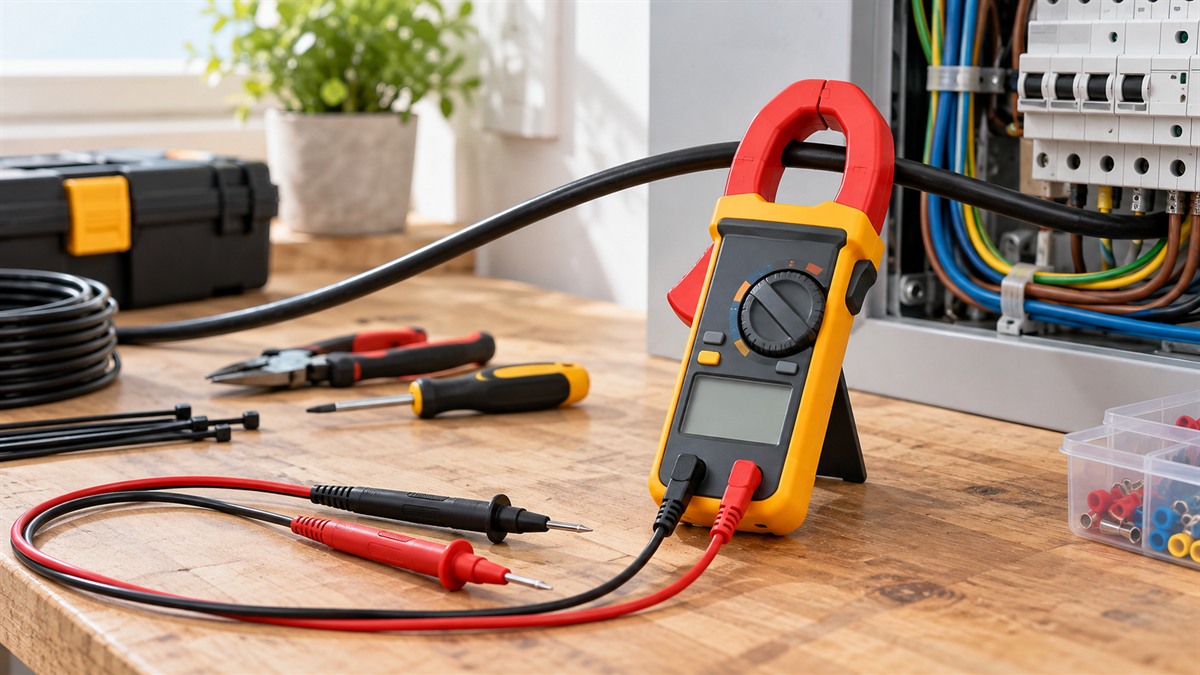
Step 4: Open the jaw and enclose one conductor
Press the trigger and put the jaw around one conductor without touching it. Fluke says conductor alignment is required to meet accuracy specifications, so use the alignment marks on the jaw.
Step 5: Read the display
The display shows the current in that one conductor. If the number is near zero on a load you know is running, suspect the next section: you may have two conductors in the jaw.
Why readings go wrong
More than one conductor. Fluke’s readings guide says the magnetic fields cancel when two or more conductors are clamped. A line cord carries current out on one wire and back on the other, so clamping the whole cord reads close to zero.
Starting current above the range. The same guide gives an example: a 460 volt, 250 hp motor should draw no more than 302 amps at full load, but its starting current can reach 1,500 to 2,000 amps. It adds that most clamp meters top out at 400 amps, some fixed-jaw models reach 1000 amps, and the iFlex flexible probe reaches 2500 amps. Use the min, max and inrush features to capture a start.
Non-linear loads. For loads such as variable frequency drives, uninterruptible power supplies, electronic ballasts and computers, Fluke says to use a true-RMS meter with a low-pass filter.
Conductors that are hard to isolate. Fluke suggests a flexible clamp such as the iFlex, which wraps around a conductor without pulling live conductors apart.
A worked example
For example, say a heater cord feeds a load of 10 amps. Clamp the whole cord and the meter reads about zero, because 10 amps goes out and 10 amps comes back, and the fields cancel. Clamp only the hot conductor and the meter reads about 10 amps. That is the whole difference between a wrong reading and a right one. Now take the motor from the previous section: a meter with a 400 amp range will overload on a 1,500 amp start even though the full-load current of no more than 302 amps is well inside the range. In that case you need a higher-range clamp or a flexible probe.
Safety
A clamp is often used on energized conductors, and OSHA’s electrical work practices standard, 29 CFR 1910.333, says only qualified persons may work on electric circuit parts or equipment that have not been de-energized. The same standard says live parts that an employee may be exposed to shall be de-energized before the employee works on or near them, unless the employer can show that de-energizing creates added hazards or is infeasible. If you are not a qualified person, do not work near exposed live parts; have a qualified person take the reading. Fluke notes that its clamps have a tactile barrier that protects fingers from shock.
Clamp meters in our research
These three listings were checked on 2026-10-17 for our milliamp clamp guide, and they show the range of what a clamp can do.
UNI-T UT210D: best for small DC and AC currents with a multimeter built in
Specs (from the listing): AC/DC current; DC current from 0.1mA to 100 amps (title); 18mm jaw; peak hold and data hold; true RMS; non-contact voltage; CAT III 600V.
Best for: small DC currents on electronics. Skip if: you need a jaw wider than 18mm.
View on Amazon (affiliate link)
VIVANTECH Low Current Clamp Meter: best for car battery draw
Specs (from the listing): AC and DC current from 1mA up to 60 amps; 1mA resolution; 16mm x 18mm jaw; one-button zero adjustment; data hold; auto shut-off after 5 minutes.
Best for: automotive diagnosis. Skip if: you need to read below 1mA.
View on Amazon (affiliate link)
TEMPO CMA-360B: best for AC leakage current
Specs (from the listing): true RMS; AC ranges from 6.000 mA to 60.00 amps; 0.001 mA resolution; wideband response to 100 kHz with a selectable low-pass filter; peak hold. The listing describes AC current ranges.
Best for: leakage checks. Skip if: you need DC current.
View on Amazon (affiliate link)
Sources
The method comes from Fluke’s guides: What is a clamp meter? and Clamp meter readings: problems and solutions. The safety statements come from OSHA: 29 CFR 1910.333, selection and use of work practices. Fluke is a clamp meter manufacturer, so its pages are manufacturer guidance.
Related guides
- How does a current clamp work covers the principle behind the jaw.
- Amp clamp covers clamp meters for current readings.
- True RMS digital clamp meter covers clamp meters with true-RMS readings.
FAQ
Can I clamp both wires of a cord?
Not for a load reading. Fluke says the magnetic fields cancel when two or more conductors are clamped, so the reading is near zero.
Does a clamp meter need the circuit turned off?
No. Fluke’s guide says a clamp measures current without disconnecting or de-energizing the circuit. OSHA’s standard still limits who may work on energized parts, so follow your employer’s procedure.
Can every clamp meter read DC?
No. Fluke says current transformer and Rogowski (flexible) types measure AC only, and Hall effect types measure AC and DC.
Why does my reading drift or look low?
Check that only one conductor is inside the jaw, that the conductor is aligned with the jaw’s marks, and that the load is not above the range. Fluke also recommends a true-RMS meter for non-linear loads.
Conclusion
Use the right meter type, set the function and range, zero a DC reading, and clamp one conductor, aligned with the jaw’s marks. Check starting current against the range, and use a true-RMS meter on drives and electronics. Follow OSHA’s rule that live parts be de-energized unless that is infeasible or adds hazards, and leave energized work to qualified persons.