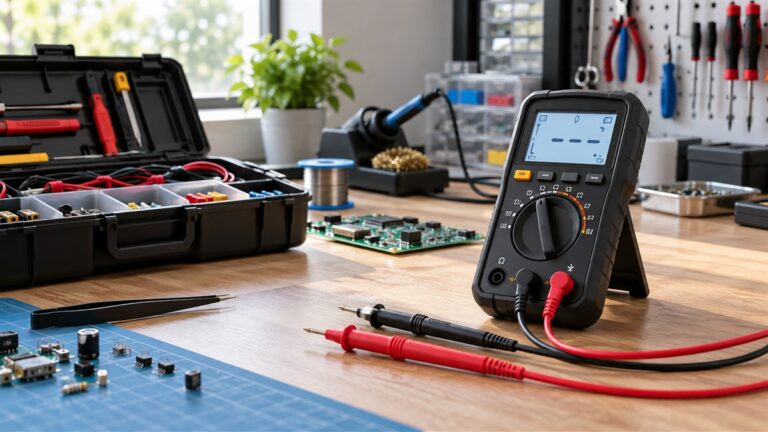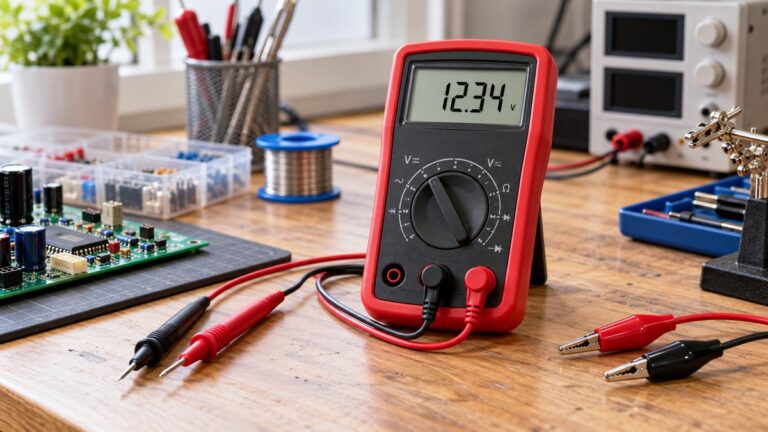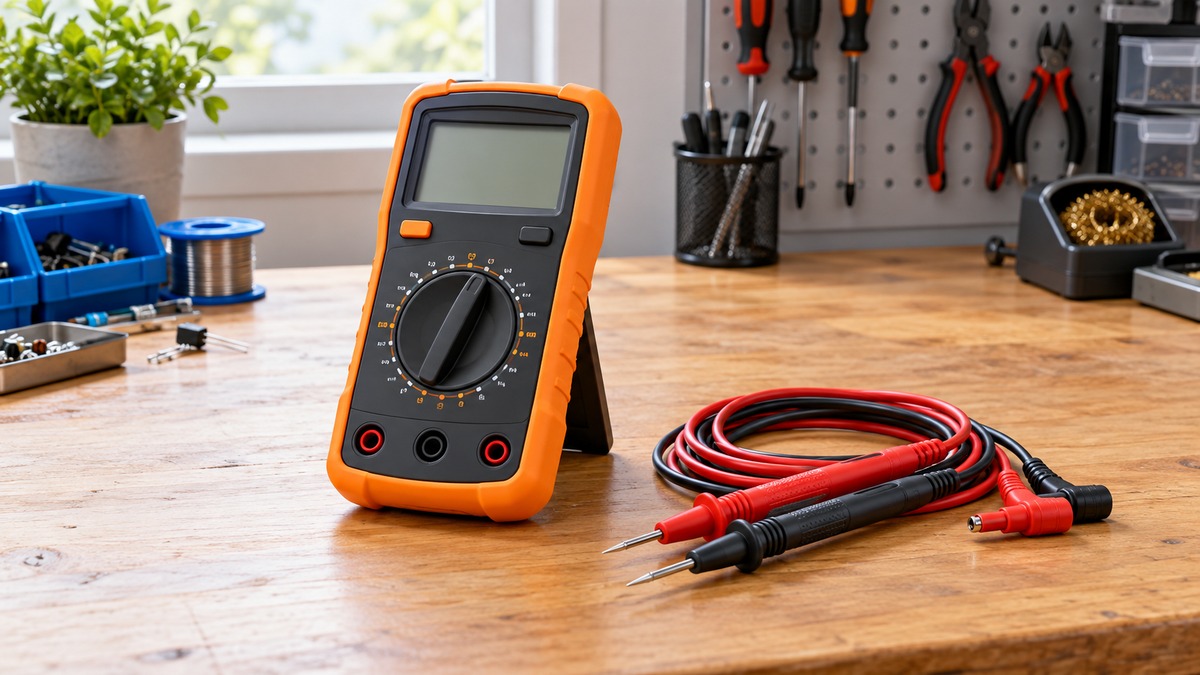
Tankool Digital Multimeter Auto-ranging Multimeter With Ac Dc Review
As an Amazon Associate we earn from qualifying purchases. Details
If you are reading a tankool digital multimeter auto-ranging multimeter with ac dc review, you probably want to know whether this meter covers the common jobs at home and in a car, and what its listing leaves out. This review sets out the stated specifications, including the accuracy figures, and the limits you must respect before you use it on any circuit. It is based on the listing and its specifications, and it does not replace the manual that comes with the meter.
Quick answer
The Tankool TK15 is an auto-ranging digital multimeter for basic AC and DC voltage, current, resistance, continuity and frequency checks. Its specifications list voltage up to 600V, current up to 4A and resistance up to 40MΩ, with accuracy figures for each range. It adds a continuity buzzer, a live wire indication and a backlit display. The specification table does not give a CAT rating and does not say true RMS. Use it for general readings within those limits, and skip it for work that needs a stated CAT rating.
Best for and avoid if
Best for
- Homeowners and DIY users who want one meter for voltage, resistance and continuity checks.
- Car owners who need a basic voltage or continuity reading on a low-voltage circuit.
- Users who want the accuracy figures printed for each range, rather than a general claim.
- Anyone who needs a backlit display or a flashlight for a dim workspace, which the listing describes.
Avoid if
- You need a CAT-rated meter for building wiring or panel work. The specification table does not give a CAT rating, so the rating must be confirmed before you use the meter on those circuits.
- You need true RMS readings on signals that are not a clean sine wave. The listing does not say the meter reads true RMS.
- You need current above 4A, because the listed current range stops there.
- You need a meter for high-energy industrial circuits, where a stated CAT rating and insulation class matter.
Verified specifications
The listing states the following, and this review quotes them as written:
- DC voltage: 4V, 40V and 400V ranges at ±(0.8%rdg+2dgt); 600V at ±(1.0%rdg+2dgt).
- AC voltage (40Hz-1KHz): 4V, 40V and 400V at ±(1.0%rdg+3dgt); 600V at ±(1.2%rdg+3dgt).
- Resistance: 4KΩ, 40KΩ and 400KΩ at ±(1.2%rdg+3dgt); 4MΩ and 40MΩ at ±(2.0%rdg+5dgt).
- Frequency: up to 40KHz at ±(1.0%dg+5dgt).
- DC current: 4A at ±(2.5%rdg+5dgt).
- AC current (40Hz-1KHz): 4A at ±(3.5%rdg+5dgt).
- Continuity: a buzzer sounds when the tested resistance is less than 50Ω.
- Auto-shutdown: after 15 minutes without signal input.
- Power: battery powered, with two 1.5V AAA batteries included.
- Weight: 215 g.
In these figures, rdg means reading and dgt means digit. The percentage applies to the value shown, and the digit term adds a fixed number of counts on top. The listing gives these figures for each range, so you can check the expected error at the value you read.
1. Digital Multimeter, Auto-Ranging Multimeter with AC/DC Voltage, AC/DC Current, Resistance (Best for general home and car checks with printed accuracy)
Specs from the listing (checked 2026-10-13):
- DC Voltage: 4V 40V 400V ±(0.8%rdg+2dgt); 600V ±(1.0%rdg+2dgt)
- AC Voltage (40Hz-1KHz): 4V 40V 400V ±(1.0%rdg+3dgt); 600V ±(1.2%rdg+3dgt)
- Resistance: 4KΩ 40KΩ 400KΩ ±(1.2%rdg+3dgt); 4MΩ 40MΩ ±(2.0%rdg+5dgt)
- Continuity: When the tested resistance is less than 50Ω, the built-in buzzer will make a sound
- Included Components: 1*Multimeter; 2*Test Leads; 2*AAA Batteries; 1*User Manual
Pros
- The listing gives an accuracy figure for each voltage, current and resistance range.
- The listing includes a continuity buzzer, a LIVE indication and a backlit display with a flashlight.
- The listing includes two AAA batteries, two test leads and a user manual.
Cons
- The specification table does not give a CAT rating.
- True RMS is not stated in the listing.
- The listed current range stops at 4A.
Best for: Homeowners and car owners who want one auto-ranging meter for basic voltage, resistance and continuity checks.
Skip if: Skip it if you need a stated CAT rating for building wiring, true RMS on distorted signals or current above 4A.
View on Amazon (affiliate link)
The card above repeats the listing’s pros, cons and key specs. This review adds the context for how to read them.
Strengths and limitations
The main strength is the accuracy table. Most listings state a general claim, but this one gives a percentage and a digit term for each range. For DC voltage, the 4V to 400V ranges are rated at 0.8% of reading plus two digits, and the 600V range at 1.0% plus two digits. That level of detail lets you judge whether a reading is fit for your job before you rely on it.
The second strength is the range of functions in one body. The listing names voltage, current, resistance, capacitance, frequency, diode, continuity and non-contact voltage detection, and it describes a LIVE indication for a live wire. A single meter that covers those jobs saves a second tool for basic checks.
The main limitation is the safety information. The specification table does not give a CAT rating. The bullets say the meter can test power cords, household outlets, fuses, batteries, live wires and automotive circuits, and they say it complies with GB/T 13978-2008 (IEC 61010-1:2001) Safety Requirements. A standards reference is not a CAT rating, so do not treat the outlet claim as a rated use. Check the manual for the category and the conditions before you test any outlet.
The second limitation is the current range. At 4A and a current accuracy of 2.5% of reading plus five digits on DC, the meter suits small current checks, not heavy loads. The listing describes automotive circuit use, but it does not say what current the circuits you test will carry.
The third limitation is the absence of true RMS. The listing does not state true RMS, so the AC readings may not be right on distorted waveforms. A true RMS converter gives a more correct value than averaging meters, which use a correction factor valid only when the input is sinusoidal. If your signals are not clean sine waves, that difference matters.
How it compares with a basic multimeter
A multimeter is a measuring instrument that can measure voltage, resistance and current, and digital multimeters have numeric displays and are more precise than analog meters with a moving pointer. The TK15 fits that description. Its extras, such as the buzzer, the LIVE indication and the flashlight, make it easier to use than a bare-bones meter, but they do not change its measurement category or its true RMS status.
Multimeters also offer some intrinsic safety features to protect the operator if connected to voltages above their measuring capability. The listing mentions overload and fuse protection, which fits that idea. A protective feature is not a substitute for a stated rating, so match the meter to the circuit before you connect it.
Alternatives
If you want a different auto-ranging meter to compare, see the astroai DM130B multimeter review and the best auto ranging digital multimeter guide. For a meter aimed at home use, see the best digital multimeter for home use guide. If your main job is a breaker check, the best test circuit breaker with multimeter guide covers that job in more detail.
Worked example: the DC voltage ranges
The listing gives DC voltage ranges of 4V, 40V, 400V and 600V. Moving from the 400V range up to the 600V range adds 200 volts of range. Current is different: the listed current range stops at 4A, so the voltage arithmetic does not change the current limit.
FAQ
Is this meter safe for household outlets?
The listing says it can test household outlets, but the specification table does not give a CAT rating. Confirm the rating and the conditions in the manual before you test any outlet. Panel and service work belongs to a licensed electrician.
Does the meter read true RMS?
The listing does not state true RMS. Assume it is not true RMS unless the manual says otherwise.
What does the continuity buzzer check?
The listing says the buzzer sounds when the tested resistance is less than 50Ω. It checks for a low-resistance path, not for voltage.
How long before the meter turns off?
The listing says the meter shuts off automatically after 15 minutes without signal input. Turn it off manually when you finish, so the battery lasts longer.
Are the batteries included?
Yes. The listing includes two 1.5V AAA batteries, along with two test leads and a user manual.
What does the accuracy figure mean for a small reading?
The figure combines a percentage of the reading with a fixed number of digits. On a small value, the digit term can be a large share of the error. Use the range that gives the most digits for the value you expect.
Can I use it on a car battery?
The listing describes automotive circuit use. Handle car batteries with care, and follow the vehicle manual for the order of steps. This review does not cover airbag systems or high-voltage hybrid and electric vehicle systems.
Is the 600V range enough for my circuit?
Compare your circuit’s highest voltage with the 600V range, and remember that the range does not state a CAT rating. If the circuit is building wiring, the rating must be confirmed before use.
Bottom line
The Tankool TK15 suits general home and car checks where you want printed accuracy figures, a buzzer and a backlit display in one meter. It does not give a CAT rating in its specifications and does not state true RMS, so it is not the right choice for building wiring or for non-sinusoidal signals. Before you buy, confirm the CAT rating in the manual, and decide whether the 4A current limit suits your work.
Sources
- Multimeter: what a multimeter measures and how digital displays differ from analog meters.
- True RMS converter: why true RMS readings differ from averaging meters on non-sine signals.
- Measurement category: how IEC categories classify live circuits by energy and impulse voltage.