Best Tool to Test Voltage: Six Picks by Task
As an Amazon Associate we earn from qualifying purchases. Details
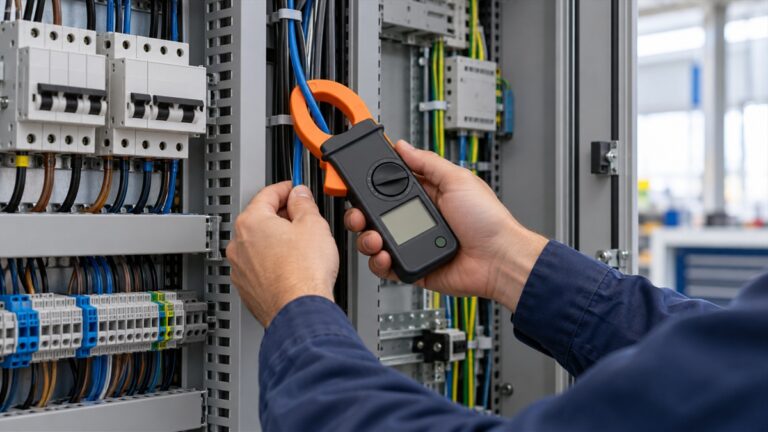
The right tool to test voltage depends on the question you need answered. A non-contact pen tells you whether AC voltage is present near an insulated wire. A multimeter gives values you can compare with a manual, and a clamp meter reads current without breaking the circuit. A multimeter is a measuring instrument that can measure voltage, resistance and current, and some models add temperature or capacitance. This guide compares six picks by range, CAT rating and readout style. Work on mains circuits can kill, so check the CAT rating against the circuit you will touch, and leave panel or service work to a licensed electrician.
Quick answer
Choose a non-contact pen when you need a fast check that AC voltage is present. Choose a multimeter when you need values, and a clamp meter when you need AC current without opening the circuit. Check the CAT rating before you touch mains. The picks here range from a pen listed with a Cat Iv 1000v specification to meters listed as CAT III 600 V and CAT II 600V. The Klein NCVT1P is the quickest for AC presence checks. The UNI-T UT133A covers the widest set of functions in its listing.
What matters when you test voltage
Four features decide which tool fits your task. Compare them in this order.
Non-contact or contact
A non-contact pen answers one question: is voltage present near this conductor? Non-contact test lights can detect voltage on insulated conductors, which is why they suit a quick check of cords, switches and outlets. A multimeter needs leads on the circuit, and it returns a value. Pick the tool by the question. If you only need presence, a pen is faster. If you need a number, use a meter.
CAT rating and circuit category
Measurement category describes where a meter may be used. Measurement category II is for measurements on circuits directly connected to the low-voltage installation. Measurement category IV is for measurements at the source of the high-voltage installation. The picks state different ratings: the pen lists Cat Iv 1000v, the clamp meter lists CAT.III 600V, the multimeter lists CAT III 600 V, and the ZIBOO 101 bullets state CAT II 600V. Match the rating to the circuit. If a listing shows no CAT field at all, do not use that meter on household mains.
Ranges and counts
Ranges set what the meter can read. The clamp meter’s voltage specs list 2V, 20V, 200V and 600V ranges, and the multimeter lists a 600 V limit. Counts describe the display. A simple way to read the figure is that a 2000-count or 6000-count display shows finer steps within a range. That is a simplification, because accuracy is a separate specification, and the specs give it as a percentage plus a digit figure.
True RMS
True RMS matters when the waveform is not a clean sine wave. A true RMS converter gives a more correct value than averaging meters, which use a correction factor valid only when the input is sinusoidal. Distortion or offsets lead averaging meters to errors. Look for true RMS in the title or bullets when you test electronic loads or variable signals.
How to choose
Use these rules, then compare the picks below.
- Choose the Klein NCVT1P for a quick AC presence check near cables, cords, fixtures, switches and outlets.
- Choose the second listing if you want a backlit multimeter with a warranty and a stand, and you do not need a CAT label.
- Choose the AstroAI clamp for AC current readings with clamp jaws, and skip it if you need DC current.
- Choose the UNI-T UT133A for the widest function set, including AC and DC voltage, current, resistance, capacitance, frequency and temperature.
- Choose the AIOMEST for a pocket meter with a protective case and a continuity buzzer.
- Choose the ZIBOO 101 for true RMS readings in a small body with a live wire check.
1. Klein Tools NCVT1P Voltage Tester, NCVT Pen, 50 to 1000V AC (Best pen for quick AC checks)
Specs from the listing (checked 2026-10-11):
- Specification Met: Cat Iv 1000v
- Included Components: Instructions and 2 x AAA 1.5 Volt Batteries
- Item Weight: 22.68 g
- Measurement Type: Voltmeter
Pros
- Its bullets describe non-contact detection of AC voltage in cables, cords, circuit breakers, lighting fixtures, switches and outlets.
- Its Specification Met field lists Cat Iv 1000v.
- Its bullets give 6.6-Foot (2 m) drop protection.
Cons
- It detects AC voltage only, since the title and bullets give a 50 to 1000V AC range.
- Its item weight is 22.68 g, and it runs on two AAA batteries that need replacing over time.
Best for: Anyone who wants a pocket pen to check for live AC before working on a fixture.
Skip if: Skip it if you need a number, since a non-contact pen indicates presence rather than a value.
View on Amazon (affiliate link)
2. Digital Multimeter Voltmeter Battery Voltage Multi Tester Continuity Ohm Volt Amp DC AC Current (Best backlit multimeter with warranty)
Specs from the listing (checked 2026-10-11):
- Specification Met: Safety Standards Met
- Item Weight: 166 g
- Measurement Type: Multimeter
- Included Components: multimter
Pros
- Its bullets describe a 2.7″ large backlit LCD for dimly lit areas.
- Its bullets list AC and DC voltage, DC current, resistance, continuity, diode and battery tests.
- The package includes a 9V battery, test leads and a user manual, according to its bullets.
Cons
- Its specification field says Safety Standards Met but gives no CAT rating.
- Its bullets state a 2 YEARS guarantee and a 24 months claim window, so the terms matter.
Best for: Owners who want a backlit meter with a warranty and a stand.
Skip if: Skip it if you need a CAT label on the meter, since the specs do not show one.
View on Amazon (affiliate link)
3. AstroAI Digital Clamp Meter Multimeter 2000 Counts Amp Voltage Tester Auto-ranging with AC/DC (Best clamp for AC current)
Specs from the listing (checked 2026-10-13):
- Safety/Compliances: CAT.III 600V; Pollution Level: 2; Altitude <2000m
- DC Voltage: 2V/20V/200V/600V ±(0.5%+5)
- AC Voltage: 2V/20V/200V/600V ±(1.0%+5)
- Included Components: 2000 Counts Clamp Meter, Test Leads (Pair), User Manual, Storage Bag
Pros
- Its Safety/Compliances field lists CAT.III 600V and pollution level 2.
- Its DC voltage specs list 2V, 20V, 200V and 600V ranges.
- Its bullets describe a non-contact voltage test with sound and light alarms.
Cons
- Its bullets say it cannot test DC current.
- Its item weight is 415 g, which is heavy for a pocket tool.
Best for: Electricians and DIYers who need AC current readings without breaking the circuit.
Skip if: Skip it if you need DC current, since the bullets say it cannot test DC current.
View on Amazon (affiliate link)
4. UNI-T Digital Multimeter Tester UT133A, AC DC Voltage Current Dmm Multimeter 6000 Counts Auto (Best all-round multimeter)
Specs from the listing (checked 2026-10-13):
- Specification Met: Iec
- Number of Items: 6
- Included Components: 1 x UT133A multimeter,1 x test leads,1 x K-type thermocouple ,1 x paper manual
- Item Weight: 16 ounces
Pros
- Its bullets describe auto ranging with 6000 counts.
- Its bullets state IEC safety rated CAT III 600 V, with an overload alarm.
- Its bullets list AC current up to 10A and temperature measurement.
Cons
- Its Number of Items field reads 6, while its Included Components field lists four entries, so check the box.
- Its specs list an Iec mark but no separate CAT field, so rely on the bullets for the CAT III 600 V rating.
Best for: Owners who want one meter for AC and DC voltage, current, resistance and temperature.
Skip if: Skip it if you need a pocket pen, since this is a multimeter with a 16 ounces weight.
View on Amazon (affiliate link)
5. AIOMEST Digital Multimeter,Pocket Voltmeter Ohmmeter Measuring AC&DC Voltage Resistance Continuity (Best pocket meter)
Specs from the listing (checked 2026-10-13):
- Power Source: Battery Powered
- Measurement Type: Multimeter, Ohmmeter, Voltmeter
- Item Weight: 3.84 ounces
- Specification Met: Beep
Pros
- Its bullets say it measures DC and AC voltage from 1mV to 450V.
- Its bullets describe a function switch that rotates smoothly for choosing each function.
- Its bullets give a 15 minutes auto shut-off and a 12 months product quality warranty.
Cons
- Its specs name no CAT or IEC category, so do not assume a mains rating.
- Its bullets describe 4000 counts on the LCD, and its title gives no range detail beyond auto ranging.
Best for: Hobbyists and homeowners who want a pocket meter with a protective case.
Skip if: Skip it if you need current measurement or a clamp, since neither is described.
View on Amazon (affiliate link)
6. ZIBOO 101 Mini Digital Multimeter, TRMS 4000 Counts Auto-Ranging Pocket Voltmeter, Multi Tester (Best true RMS pocket meter)
Specs from the listing (checked 2026-10-13):
- Specification Met: CE, EMC, RoHS
- Model: ZIBOO 101
- Item Weight: 0.05 kg
- Power Source: Battery Powered
Pros
- Its bullets describe a true RMS, 4000-count, auto-ranging design.
- Its bullets rate it CAT II 600V with overload input protection.
- Its bullets list a live wire testing function and an NCV sensor.
Cons
- Its specs list CE, EMC and RoHS marks but no separate CAT field.
- Its bullets list AC and DC current only up to 400mA, which is small for many jobs.
Best for: Owners who want a pocket meter with true RMS readings and a live wire check.
Skip if: Skip it if you need current above 400mA, since the bullets list 400mA as the top current.
View on Amazon (affiliate link)
The six picks, one at a time
The Klein NCVT1P is a non-contact voltage pen. Its bullets describe detection of AC voltage in cables, cords, circuit breakers, lighting fixtures, switches and outlets. Its Specification Met field lists Cat Iv 1000v, and its title gives a 50 to 1000V AC detection range. The bullets say it shows a green light when on, flashes red and beeps when voltage is detected, and turns itself off to save batteries. It uses two AAA batteries, and the item weighs 22.68 g. It detects AC voltage only, so do not use it as a DC tester. Skip it if you need a number, since a pen indicates presence.
The second listing is a backlit digital multimeter with a 2.7″ LCD. The listed functions are AC and DC voltage, DC current, resistance, continuity, diode and battery tests. The kit includes a 9V battery, test leads and a user manual. The bullets mention overload protection on all ranges and a low battery indication. Its specs show Safety Standards Met but no CAT rating, so check the manual before using it on mains. The bullets state a 2 YEARS quality guarantee and a 24 months claim window, so read the terms. Skip it if a printed CAT label matters to you.
The AstroAI is a clamp meter with a 2000-count display and AC current ranges listed as 2A, 20A, 200A and 400A. Its Safety/Compliances field lists CAT.III 600V and pollution level 2. Its bullets describe non-contact voltage testing, with a green light for weak AC and a red light for strong AC, plus a flashlight. The bullets say it cannot test DC current, and the jaw is used only for current. A clamp measures current without breaking the circuit, so this one is for AC current. Skip it if you need DC current.
The UNI-T UT133A is a 6000-count auto-ranging multimeter. Its bullets describe AC voltage up to 600 V, DC voltage up to 600 V, AC current up to 10A, resistance, capacitance, frequency and temperature measurement. It lists IEC safety rated CAT III 600 V, along with an overload alarm, a low battery indicator and an NCV function. Its Number of Items field reads 6, while its Included Components field lists four entries, so check the box before you order. Skip it if you need a pocket-size tool.
The AIOMEST is a pocket multimeter with an orange body. Its bullets say it measures DC and AC voltage from 1mV to 450V and resistance from 100mΩ to 40MΩ. The bullets describe a function switch that rotates smoothly to choose each function, plus a continuity buzzer and a diode test. The auto shut-off turns it off after 15 minutes without use. The bullets describe a leather protective case and a 12 months product quality warranty. Its specs name no CAT or IEC category, so do not treat it as a mains tester. Skip it if you need a clamp or a current reading.
The ZIBOO 101 is a true RMS pocket meter with 4000 counts and auto ranging. Its bullets list AC and DC voltage up to 600V, AC and DC current up to 400mA, resistance up to 40MΩ, capacitance up to 4000uF and frequency. It includes a non-contact voltage sensor and a live wire test. The bullets rate it CAT II 600V with overload input protection. Its specs list CE, EMC and RoHS marks, but no separate CAT field, so rely on the bullets for that rating. Skip it if you need current above 400mA.
When the meter is the wrong tool
A pen answers whether voltage is present. It does not give a value, and it cannot tell you why a circuit is dead. A multimeter gives values you can compare with a manual, which makes it the better tool for diagnosis. A test light is simpler than a measuring instrument and often answers whether a conductor is live. Use the simplest tool that answers your question, and move up when the simple answer is not enough. If a pen is the tool you are weighing, the pen voltage detector guide goes deeper on that category.
Safety rules still apply. Follow the instrument manual and local electrical rules at every step. OSHA says listed or labeled equipment should be installed and used in accordance with the instructions included in the listing or labeling. Read the manual before the first test, not after the first surprise.
Reading a value without guessing
Set the function you need and check the range the meter supports before you touch the leads. If the expected range is unknown, read the manual before you test. Compare each reading with the value your manual or the equipment label gives, rather than with a number from memory. If a reading does not match, stop and check the setup, the leads and the circuit before you try again.
Using the pen first on shop outlets
A better approach uses the pen first. Check each outlet with the pen, and if it flags one outlet, meter only that outlet. This saves meter time without skipping any outlet.
Mistakes to avoid
Using a pen to measure a value. A non-contact pen indicates presence, and it does not measure. Pair it with a meter when you need a number.
Ignoring the CAT rating. Measurement category IV is for measurements at the source of the high-voltage installation, and category II is for circuits directly connected to the low-voltage installation. Match the meter to the circuit.
Assuming a pen reads DC. The Klein NCVT1P title and bullets describe AC detection only.
Treating the count figure as accuracy. The count describes the display, while accuracy comes from the specs. Read both.
Using a clamp for DC current. The AstroAI clamp cannot test DC current, so choose a tool whose listing includes DC current when you need it.
FAQ
Is a non-contact voltage pen enough to test a wall outlet?
It shows that AC voltage is present near the outlet. It does not give a value or show wiring faults. Use a receptacle tester or a meter when you need more detail.
What does a CAT III 600V rating mean?
It is the measurement category and voltage rating that the listing gives. Match it to the circuit you will test, and check the manual for the full meaning before you use the meter on mains.
Do I need true RMS?
Not always. True RMS gives a more correct value than averaging meters when the signal is not a clean sine wave. For a simple presence check, a pen or basic meter is often enough.
Can a multimeter test DC voltage?
Yes, for the picks whose listings include DC ranges. The second, fourth, fifth and sixth picks all list DC voltage.
What do the counts mean?
A count figure describes the display’s maximum value and resolution, such as 2000 or 6000 counts. Accuracy is a separate specification, so compare both before you buy.
Can I use the clamp meter for DC current?
No. The third pick’s bullets say it cannot test DC current. Choose a meter whose listing includes DC current if you need that reading.
Which pick suits a homeowner who checks a few outlets?
Start with the first pick for quick presence checks. Add the fifth pick if you want a pocket meter that gives values for the rest of your checks.
Bottom line
Use a non-contact pen for presence checks, a multimeter for values, and a clamp meter for AC current. Choose the UNI-T UT133A for the widest function set, the AstroAI for AC current, and the ZIBOO 101 for true RMS in a pocket size. Match every CAT rating to the circuit, and leave mains panel work to a licensed electrician. For related checks, see the best voltage tester for home use guide and the best digital voltage meter for car guide.
Sources
- Multimeter, Wikipedia: a multimeter measures voltage, resistance and current, and some models add temperature or capacitance.
- Measurement category, Wikipedia: category II and category IV describe where a measurement may be taken.
- Test light, Wikipedia: non-contact test lights can detect voltage on insulated conductors.
- True RMS converter, Wikipedia: true RMS gives a more correct value than averaging meters for non-sinusoidal signals.
- Current clamp, Wikipedia: a clamp measures current without breaking the circuit.
- OSHA 29 CFR 1910.303: listed equipment should be installed and used in accordance with the listing instructions.