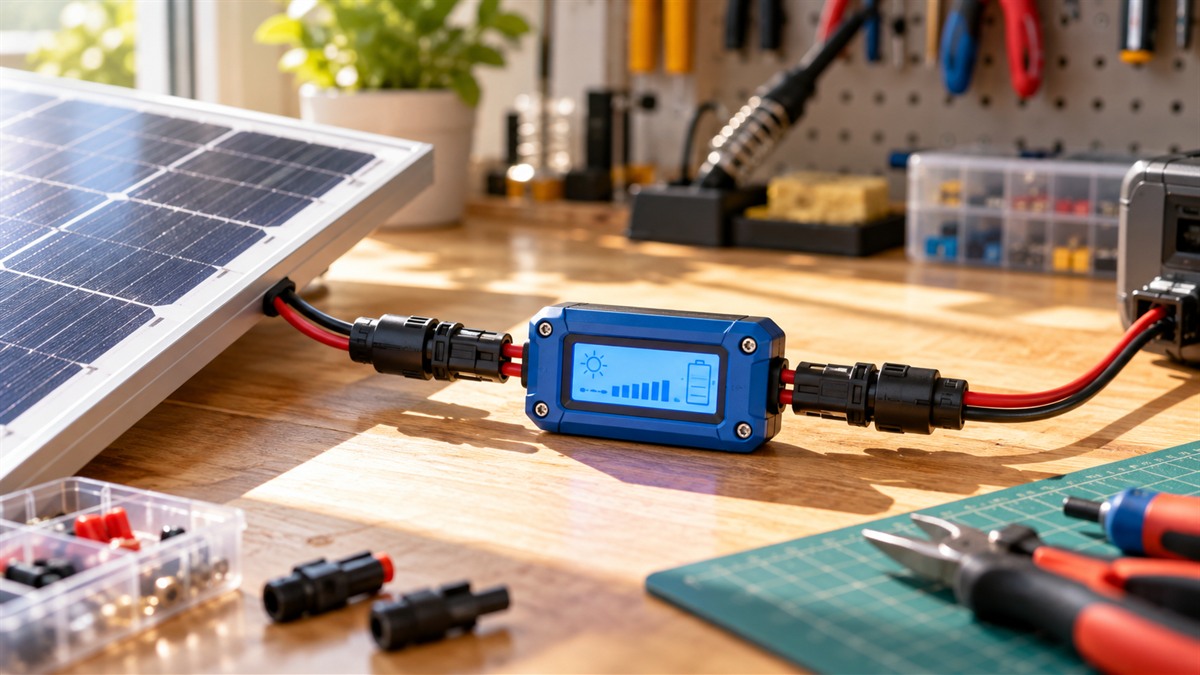
Whcusmm 150a Digital Watt Meter Solar Panel Power Review
As an Amazon Associate we earn from qualifying purchases. Details
If you are reading a whcusmm 150a digital watt meter solar panel power review, you probably want one answer: does this compact meter show the voltage, current and power in a small solar or battery setup, and where does it stop? This review sets out what the listing states, where the listing is unclear, and the limits that matter before you connect the meter to any system. This review is based on the listing and its specifications, and it does not replace the maker’s manual.
Quick answer
The whcusmm meter is a compact, low-voltage DC monitor for solar panels, batteries and similar systems. Its listing states voltage up to 100V, current up to 200A, power up to 6554W and capacity up to 65Ah, with stated resolutions. It also states a 2 years warranty. It is not presented as a mains tool: the listing says it is designed for systems below 100V, and it does not state a CAT rating. Buy it for low-voltage monitoring, and skip it for any mains reading.
Best for and avoid if
Best for
- Owners of small solar panel or battery setups who want voltage, current and power in one display.
- Hobbyists with RC or drone energy systems, which the listing names as a use.
- Users who want a backlit display for outdoor or low-light checks, as the listing describes.
- Readers who need a capacity reading in amp-hours, because the listing gives a 65Ah range with a 0.001Ah resolution.
Avoid if
- You plan to measure mains voltage or any circuit connected to building wiring. The listing does not state a CAT rating, and it says the meter is designed for systems below 100V.
- You need a meter for AC work. The listing does not say whether it measures AC at all.
- You need a probe or a clamp for current on a conductor you cannot reach. The listing describes a meter with connectors, not a clamp.
- You need a warranty longer than the listed 2 years.
Verified specifications
The listing gives these specifications, and this review quotes them as written:
- Voltage: 0-100V, with a 0.01V resolution.
- Current: 0-200A, with ±0.01A accuracy.
- Power: 0-6554W, with a 0.01W resolution.
- Capacity: 0-65Ah, with a 0.001Ah resolution.
- Dimensions: 4.72 x 1.97 x 1.18 inches.
- Weight: 100 g.
- Warranty: 2 years.
- Included: one 150A unit, described in the listing as an aircraft model power meter analyzer.
The listing also states a backlit LCD screen and compatibility with solar, wind, EV, battery and RC systems. It asks the buyer to check connector specifications on a measurement chart before purchase, which is good advice for any connector-based meter.
1. 150A Digital Watt Meter Solar Panel Power Analyzer Voltage Current Tester (Best for low-voltage DC solar and battery monitoring)
Specs from the listing (checked 2026-10-14):
- Item Highlight: 4.8-100V high precision power monitor,backlit LCD screen,works for solar wind turbine,RC drone energy system testing
- Compatible Devices: solar panels, wind turbines, RC systems, EV, battery systems, aircraft
- Warranty Description: 2 years
- Item Dimensions: 4.72 x 1.97 x 1.18 inches
- Included Components: 1*150A Aircraft model power meter analyzer
Pros
- The listing gives voltage 0-100V and current 0-200A, with stated resolutions.
- The listing gives a 2 years warranty and a backlit LCD screen.
- The listing gives dimensions of 4.72 x 1.97 x 1.18 inches and a weight of 100 g.
Cons
- The listing says it is designed for systems below 100V, so it is not for mains work.
- The listing does not state a CAT rating.
- The listing gives two voltage floors, 4.8V and 12V, and does not reconcile them.
Best for: Owners of small solar, battery, RC or EV systems who want a low-voltage DC power readout.
Skip if: Skip it if you measure mains or need a CAT-rated tool, or if you need a meter that states AC capability.
View on Amazon (affiliate link)
The card above repeats the listing’s pros, cons and key specs. This review adds the context for how to read them.
Read the resolutions as display steps, not as accuracy claims. A 0.01V resolution means the display can show changes of that size, but the listing gives an accuracy figure only for current, as ±0.01A. The listing does not give a voltage accuracy percentage, so a voltage reading should be checked against a reference you trust before you size a system around it.
Strengths and limitations
The main strength is the scope of the readout. The listing says the meter shows voltage, current, power, discharge capacity and time, which covers what most small solar or battery checks need. The stated resolutions are fine-grained: 0.01V for voltage, 0.01A for current and 0.001Ah for capacity. A fine resolution helps you see small changes over time, although it does not prove the reading is correct.
The main limitation is the voltage floor, and the listing is not consistent on it. The highlight says 4.8-100V. A bullet says the meter operates at 12V-100V when an optional auxiliary battery is fitted, and it says the meter is designed for systems below 100V. The listing does not reconcile these figures, so rely on neither until the manufacturer clarifies. If your system runs below 12V, ask before you buy.
A second limitation is the included unit’s description. The listing calls the 150A unit an aircraft model power meter analyzer, while the title and bullets describe a solar and battery monitor. The listing does not say what that naming means for your use. Treat the product as a low-voltage DC monitor, and confirm the intended use with the seller.
The third limitation is the missing safety information. The listing does not state a CAT rating, a measurement category or an insulation class. That is normal for a low-voltage monitor, but it is a reason to keep the meter away from mains. The listing’s own note about systems below 100V is the line to respect.
The listing also states power up to 6554W, the highest figure in its specifications. It does not give the voltage and current pairs that produce that figure, so read it as a maximum on the display, not as a typical reading for your system. The same caution applies to the 65Ah capacity figure: the listing gives the range and the resolution, but not the method or the conditions under which the reading is taken. The manual is the place to check both.
How it compares with a multimeter
A multimeter is a measuring instrument that can measure voltage, resistance and current, and digital multimeters have numeric displays. This meter is narrower. Its listing focuses on solar, battery and similar systems, and it adds power and capacity readouts that a basic multimeter does not usually show. That makes it a monitor for a system, not a general-purpose tool for every electrical job.
The difference matters for accuracy and for AC work. A true RMS converter gives a more correct value than averaging meters when the signal is not a clean sine wave, and the listing does not say whether this meter reads true RMS. Because the listing also does not say whether the meter reads AC, do not use it for a job where the waveform matters. A multimeter with a stated CAT rating is the better choice for building wiring, and the CAT section below explains why.
Alternatives
If you need a meter for car circuits, see the best digital voltage meter for car guide. If you need a probe to find a short or check a power point, see the best power probe short finder guide. For a general handheld meter with a stated range, see the best hand held digital multimeter guide. Each alternative answers a different question, so pick by the question you need answered.
Worked example: the voltage headroom
The listing gives voltage up to 100V and says the meter is designed for systems below 100V. A 12-volt battery sits 88 volts below that limit, so a battery system is well inside the stated range. The meter is still not presented as a mains tool.
FAQ
Can I use this meter on household mains?
No. The listing says the meter is designed for systems below 100V, and it does not state a CAT rating. Household mains and panel work belong to a licensed electrician, and the listing does not support mains use.
Does the meter measure AC?
The listing does not say. It describes solar, wind, EV, battery and RC systems, which are usually DC, but it does not state AC capability. Check the manual before you rely on it for any AC reading.
What does the 2 years warranty cover?
The listing states a 2 years warranty without a detailed description. Ask the seller what the warranty covers, including the cable and connectors, before you buy.
Why does the listing give two voltage floors?
The highlight says 4.8-100V and a bullet says 12V-100V with an auxiliary battery. The listing does not explain the difference, so ask the manufacturer which floor applies to your setup.
Is the meter accurate?
The listing gives ±0.01A accuracy for current, and it gives resolutions for voltage, power and capacity. It does not give a voltage accuracy percentage in the parts of the listing reviewed here. Treat the stated figures as the manufacturer’s claims, not as a verified result.
Does it fit my connectors?
The listing asks the buyer to verify connector specifications on a measurement chart before purchase. Check the connector type on your panel or battery against the chart, because the listing does not describe the connectors in detail.
What does the capacity reading mean?
The listing describes a discharge capacity reading in amp-hours, with a range of 0-65Ah and a 0.001Ah resolution. Read it as the manufacturer’s measure, and check the manual for how the figure is calculated and what conditions it assumes.
Is the 150A rating the right size for my system?
The listing gives a current range of 0-200A and a unit named 150A. Compare your system’s expected current with the listed range, and leave some margin. The listing does not describe a safe continuous current, so ask the manufacturer for that figure.
Bottom line
The whcusmm meter suits low-voltage solar, battery and RC monitoring, where you want voltage, current, power and capacity in one backlit display. It is not for mains work, and the listing does not support AC use. Before you buy, clarify the voltage floor, the intended use and the connector fit, and confirm the warranty terms. If those answers fit your system, the meter’s stated specifications are the main reason to consider it.
Sources
- Measurement category: how IEC categories classify live circuits by energy and impulse voltage.